

TB-500's parent protein healed 6 of 10 stubborn eye wounds
Evidence check, October 13, 2026. Updated October 30, 2026.
The claim: "Thymosin beta-4, the protein TB-500 is cut from, heals wounds that will not close."
Our grade: Weak. One small trial of eye drops looked very good and a larger repeat missed its goal, with a third due in November. All of that is the full protein. TB-500, the short fragment injected for injuries, has never been tested in people.
You hurt your shoulder in March. It is October and it still aches, and a friend at the gym says TB-500 fixed his.
Is there anything behind it?
There is, and it is in an odd place. TB-500 is a chain of 7 amino acids copied from the middle of thymosin beta-4, a natural protein that is 43 amino acids long [9]. The best human result for that protein is not in a shoulder. It is in the eye.
Where the claim came from
Thymosin beta-4 earned its name in animals. In a 1999 study, rats with skin wounds that got the protein had 42% more new skin over the wound after 4 days, and up to 61% more after 7 days [14]. A company, RegeneRx, turned the full protein into a drug candidate and tested it in people as eye drops, a skin gel and an infusion.
TB-500 took a different road. Drug testers worked out in 2012 that a product sold under that name held a 7-amino-acid piece of the protein, positions 17 to 23 [9]. It now sells online and through clinics as an injection for tendons, muscles, ligaments, hair and the heart [2]. Paired with BPC-157 it is marketed as the "Wolverine stack," as a 2026 episode of the Mind & Matter podcast put it [1].
So the claim has two parts. Does the full protein heal wounds in people? And does the fragment do the same?
The eye trial
Start with the best result.
Neurotrophic keratopathy is a rare disease in which the clear front of the eye loses its feeling. Small wounds there stop healing and can stay open for months. A trial called SEER-1 gave 18 people with such wounds either thymosin beta-4 drops or placebo drops (the same liquid without the protein), five times a day for four weeks. It was randomized and double-masked: neither patients nor doctors knew who got which [3].
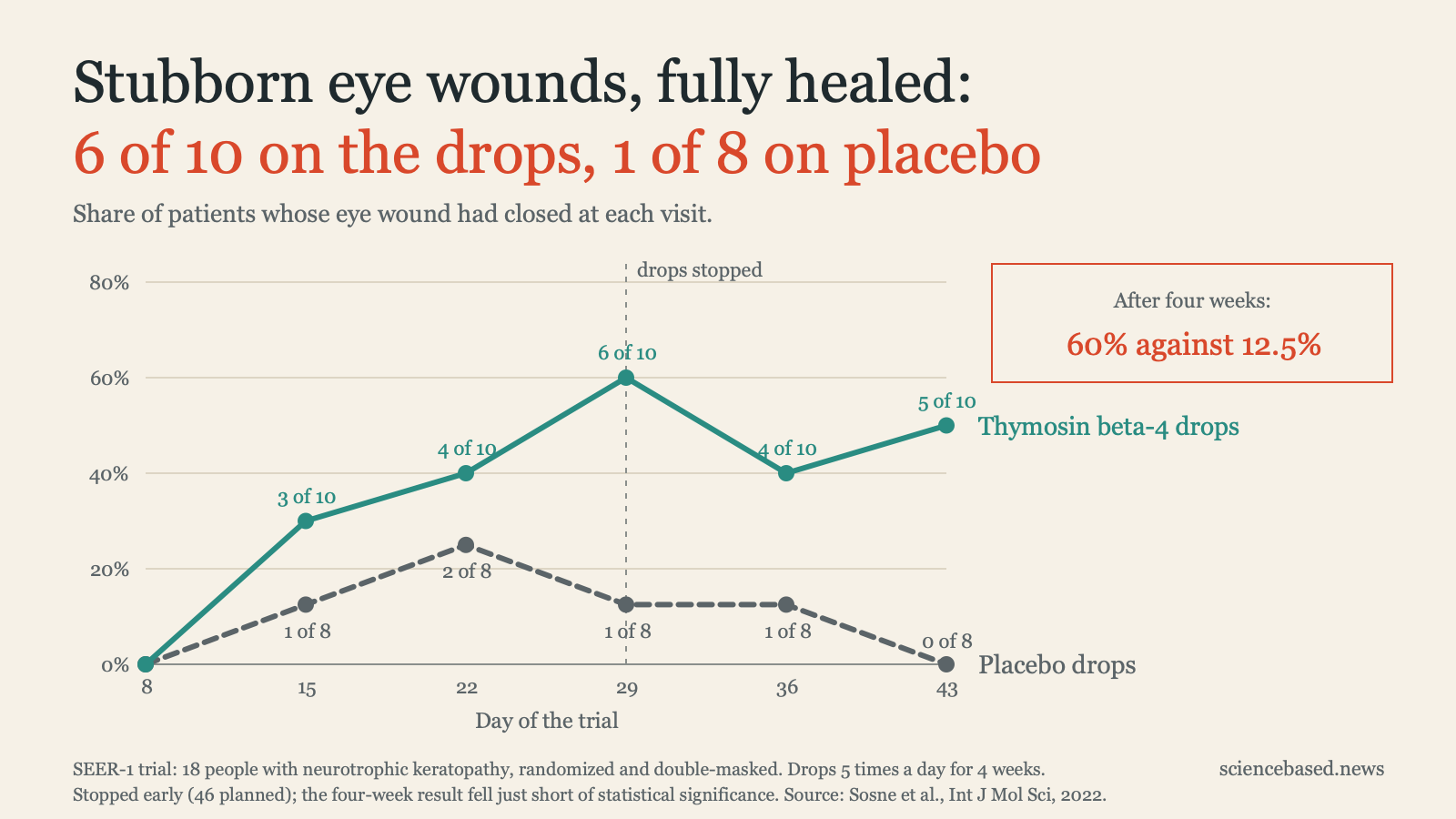
After four weeks, 6 of the 10 people on the drops were fully healed. On placebo it was 1 of 8.
Then the drops stopped, and the gap held. Two weeks later, 5 of 10 were still healed. On placebo it was 0 of 8: the one person who had healed was open again [3].
For people whose eyes had not healed in months, that is a striking result. It is also a small one.
What happened when it was repeated
SEER-1 was planned for 46 people and stopped at 18 because patients were slow to find. With so few, the main comparison at four weeks fell just short of the usual bar for ruling out chance (p = 0.0656). The two-week follow-up cleared it (p = 0.0359). The placebo group was also older and started with larger wounds, and the company developing the drops designed the trial, and three of the six authors work for it or its parent company [3].
The same drops had already been tried for ordinary dry eye in three large trials of 317, 601 and 700 people. In the largest, eye-surface damage improved by 0.41 points on the drops and 0.46 on placebo, and discomfort improved by the same amount in both groups [6].
As a skin gel, the protein was tested on leg ulcers and bedsores. The posted results show no gap: 12 of 55 leg ulcers healed on the gel against 4 of 17 on placebo, and 8 of 54 bedsores against 3 of 18 [7]. Given into a vein after a heart attack, in 96 patients, it did not shrink the damaged area overall [8].
A result in 18 people needs a repeat. The company ran two, each planned for about 70 people. The European one, SEER-3, reported in June 2025: no significant difference in healing at four weeks. The company said more people healed on placebo than it expected [4]. The American one, SEER-2, saw its last patient in August 2026, and results are due in November [5].
Outside that one rare eye disease, the full protein has not beaten placebo in people: not for dry eye, leg ulcers, bedsores or heart attacks [6, 7, 8].
TB-500 is a different molecule
Everything above is the 43-amino-acid protein. The vial sold for injuries holds 7 of those 43.
Whether the short piece does the same job has not been tested in people. The FDA reviewed TB-500 this summer and wrote that it "did not find any information in the medical literature where TB-500 was administered to patients to treat any disease or condition." It also wrote that "thymosin beta-4 and TB-500 are not the same substance" [2].
The lab record is thin too. A 2024 paper put it plainly: "The biological effects of TB-500, however, have not been documented." In its own cell tests, wound-healing activity showed up in a breakdown product of TB-500, not in TB-500 itself [10].
Rats give some hope. In a 2026 study of 32 rats with a cut and repaired Achilles tendon, the tendons of those given TB-500 held more load than untreated ones. The paper describes what it used as "synthetic thymosin beta-4," so which molecule the rats got is not clear [12]. An older study put the full protein straight into a cut knee ligament in rats and found stronger tissue at four weeks [13].
So back to the shoulder. The protein's one good human result came from drops of the full protein on the surface of an eye. The shot offered for a shoulder is a fragment, given a different way, for a different tissue, and no one has measured what it does in a person.
Our grade
| Claim | Evidence | Grade |
|---|---|---|
| Full protein speeds wound healing in rats | Several animal studies | Solid (in animals) |
| Eye drops heal stubborn eye wounds | Placebo trial of 18: 6 of 10 against 1 of 8. Repeat of about 70 missed its goal. Third trial due November 2026 | Weak |
| Eye drops help dry eye | Largest placebo trial, 700 people: no difference | Debunked |
| Skin gel heals leg ulcers and bedsores | Two placebo trials: about the same healed in each group | Weak |
| Infusion limits heart attack damage | Placebo trial of 96: no overall difference | Weak |
| TB-500 injections heal tendons, muscles or joints | No human study of the fragment | Unproven |
| Overall: thymosin beta-4 heals wounds that will not close | One small trial for, one larger against, one pending | Weak |
The case for the other side: the eye result is not nothing. A wound that has been open for months does not often close by luck, and the benefit lasted after the drops stopped. In the failed repeat, the company's account is that the placebo group healed more than expected, and that can hide a real effect [4]. If SEER-2 is clearly positive in November, the eye row moves up to Promising.
The full protein also looked safe in the short run. Healthy volunteers who got it by vein every day for 14 days had no serious side effects [15]. That study did not use the fragment.
On July 23, 2026, an FDA advisory committee voted 8 to 6, with one abstention, to recommend letting pharmacies compound TB-500 [17]. FDA staff had proposed the opposite [2]. The vote does not bind the agency, and it was about access, not about whether it works.
A placebo trial of the fragment itself for a tendon or muscle injury would change the bottom rows. None has been run.
What this means for you
- For a tendon, muscle or joint injury that is not healing, see a doctor or a physical therapist. A 2026 review in a sports medicine journal found that most peptide research is in animals and that the benefits are not yet backed by human trials [19]. For a sore shoulder, 12 weeks of loaded exercise has a 10-year trial behind it: see rotator cuff exercises.
- If you have an eye wound that will not close, an eye doctor can prescribe cenegermin (Oxervate), the one approved drop for neurotrophic keratopathy [4]. Thymosin beta-4 drops are not on sale. Watch for the SEER-2 result.
- If you take TB-500 anyway, tell your doctor. The injected fragment has no human safety study. The FDA's concern is that injected peptides can clump or carry impurities that set off an immune reaction [16].
- Know what is in the vial. French testers who analyzed products sold as TB-500 found the contents did not reliably match the label [11], and the FDA says it has seen different molecules sold under the name [2].
- One open question is cancer. Thymosin beta-4 helps cells move, and colon cancer cells made to produce more of it invaded more in the lab [20]. No one knows whether injecting it matters. If you have had cancer, raise it with your doctor first.
- If you compete in a tested sport, thymosin beta-4 and TB-500 are banned at all times [18].
In the 18-person eye trial, how many wounds healed after four weeks?
Six of 10 healed on thymosin beta-4 drops against 1 of 8 on placebo. Two weeks after stopping it was 5 of 10 against 0 of 8.
How is TB-500 related to thymosin beta-4?
TB-500 copies positions 17 to 23. The FDA says the two are not the same substance.
What did the FDA find when it looked for human studies of TB-500?
The FDA found no report of TB-500 being given to patients for any disease or condition.
What happened when the eye trial was repeated in about 70 people in Europe?
SEER-3 missed its goal in 2025. A third trial, SEER-2, is due to report in November 2026.
What's next
SEER-2, the American trial of the eye drops, finished in August 2026 and its results are due in November [5]. We will update this article and the grade when they come. The FDA has not yet said whether it will follow its committee's vote on TB-500.
This is the seventh of our one-by-one checks on the peptides in our guide to the best peptides, after AOD-9604, MK-677 and the growth hormone family. TB-500 is usually sold with BPC-157; our peptides article goes through BPC-157's studies.
Was this helpful?
Sources
Show all sources (20)
- Jikomes N, McGuire F. Peptides for Tissue Repair: BPC-157, TB-500 & the "Wolverine Stack". Mind & Matter podcast, March 22, 2026. https://mindandmatter.substack.com/p/peptides-for-tissue-repair-bpc-157
- US Food and Drug Administration. Briefing document: TB-500-related bulk drug substances, Pharmacy Compounding Advisory Committee, July 23-24, 2026. Reviewed for wound healing; no human study of the fragment found. https://www.fda.gov/media/193349/download
- Sosne G, Kleinman HK, Springs C, Gross RH, Sung J, Kang S. 0.1% RGN-259 (thymosin ß4) ophthalmic solution promotes healing and improves comfort in neurotrophic keratopathy patients in a randomized, placebo-controlled, double-masked phase III clinical trial. International Journal of Molecular Sciences, 2022. 18 patients, randomized, double-masked, 4 weeks of drops plus 2 weeks of follow-up; stopped early (46 planned); designed and funded by the developer, ReGenTree. doi:10.3390/ijms24010554
- Harp MD. HLB Therapeutics misses primary end point in phase 3 SEER-3 trial of RGN-259. Ophthalmology Times, July 1, 2025. Company announcement of topline results; no published paper yet. https://www.ophthalmologytimes.com/view/hlb-therapeutics-misses-primary-endpoint-in-phase-3-seer-3-trial-of-rgn-259
- Ji YJ. HLB Therapeutics completes global Phase 3 trial of NK eye drop candidate RGN-259, with topline results expected in November. The Bio News, August 26, 2026. Company announcement on SEER-2 (ClinicalTrials.gov NCT05555589, about 70 patients). https://www.thebionews.net/news/articleViewAmp.html?idxno=27535
- ReGenTree LLC. ARISE-3: RGN-259 ophthalmic solution for dry eye syndrome. ClinicalTrials.gov NCT03937882, posted results. 700 people, randomized, double-masked, placebo-controlled; company-run. Earlier trials: ARISE-1 (NCT02597803, 317 people) and ARISE-2 (NCT02974907, 601 people). https://clinicaltrials.gov/study/NCT03937882
- Guarnera G, DeRosa A, Camerini R. The effect of thymosin treatment of venous ulcers. Annals of the New York Academy of Sciences, 2010. 73 patients, randomized, double-blind, placebo-controlled, 3 months; company-run. doi:10.1111/j.1749-6632.2010.05490.x. Healing counts from the posted results: venous ulcers, https://clinicaltrials.gov/study/NCT00832091; pressure ulcers, https://clinicaltrials.gov/study/NCT00382174
- Zhang Y, Dong Q, Bian X, et al. Recombinant human thymosin beta 4 improves ischemic cardiac dysfunction in mice and patients with acute ST-segment elevation myocardial infarction after reperfusion. Cardiovascular Research, 2025. Mice, plus 96 heart attack patients, randomized, double-blind, placebo-controlled; three authors work for the maker. doi:10.1093/cvr/cvaf223
- Esposito S, Deventer K, Goeman J, Van der Eycken J, Van Eenoo P. Synthesis and characterization of the N-terminal acetylated 17-23 fragment of thymosin beta 4 identified in TB-500, a product suspected to possess doping potential. Drug Testing and Analysis, 2012. Lab analysis. doi:10.1002/dta.1402
- Rahaman KA, Muresan AR, Min H, et al. Simultaneous quantification of TB-500 and its metabolites in in-vitro experiments and rats by UHPLC-Q-Exactive orbitrap MS/MS and their screening by wound healing activities in-vitro. Journal of Chromatography B, 2024. Cells and rats. doi:10.1016/j.jchromb.2024.124033
- Delcourt V, Garcia P, Chabot B, et al. TB500/TB1000 and SGF1000: A scientific approach for a better understanding of misbranded and adulterated drugs. Drug Testing and Analysis, 2023. Lab analysis of products sold online. doi:10.1002/dta.3421
- Biçer O, Adanir O, Güleryüz Y, et al. Effects of BPC-157 and TB-500 on Achilles tendon healing in rats: A histopathological and biomechanical study. Joint Diseases and Related Surgery, 2026. 32 rats. doi:10.52312/jdrs.2026.2951
- Xu B, Yang M, Li Z, et al. Thymosin β4 enhances the healing of medial collateral ligament injury in rat. Regulatory Peptides, 2013. Rats, full protein placed in the wound. doi:10.1016/j.regpep.2013.03.026
- Malinda KM, Kleinman HK, Sidhu GS, et al. Thymosin β4 accelerates wound healing. Journal of Investigative Dermatology, 1999. Rats. doi:10.1046/j.1523-1747.1999.00708.x
- Ruff D, Crockford D, Girardi G, Zhang Y. A randomized, placebo-controlled, single and multiple dose study of intravenous thymosin beta4 in healthy volunteers. Annals of the New York Academy of Sciences, 2010. 40 healthy volunteers, up to 14 days; safety only; company-run. doi:10.1111/j.1749-6632.2010.05474.x
- US Food and Drug Administration. Certain Bulk Drug Substances for Use in Compounding that May Present Significant Safety Risks (Thymosin Beta-4, Fragment). https://www.fda.gov/drugs/human-drug-compounding/certain-bulk-drug-substances-use-compounding-may-present-significant-safety-risks
- McDermott Will & Schulte. Bulk-list bound? PCAC backs majority of peptides in two-day public meeting. July 28, 2026. https://www.mcdermottlaw.com/insights/bulk-list-bound-pcac-backs-majority-of-peptides-in-two-day-public-meeting
- World Anti-Doping Agency. 2026 Prohibited List, section S2: "Thymosin-ß4 and its derivatives e.g. TB-500", prohibited at all times. https://www.wada-ama.org/sites/default/files/2025-09/2026list_en_final_clean_september_2025.pdf
- Tewari K, Liu TP, Im C, et al. Peptide Supplements and Their Therapeutic Applications in Sports Medicine. The American Journal of Sports Medicine, 2026. Review; 67% of the publications were animal studies. doi:10.1177/03635465261464420
- Wang WS, Chen PM, Hsiao HL, Wang HS, Liang WY, Su Y. Overexpression of the thymosin beta-4 gene is associated with increased invasion of SW480 colon carcinoma cells and the distant metastasis of human colorectal carcinoma. Oncogene, 2004. Cancer cells in the lab and tumor samples. doi:10.1038/sj.onc.1207888
Discussion