

MOTS-c peptide doubled how far old mice could run
Evidence check, October 25, 2026. Updated October 30, 2026.
The claim: "MOTS-c, a peptide your muscles make when you exercise, can restore an aging body's running ability."
Our grade: Unproven. In mice the result is real and large: old mice given MOTS-c for 2 weeks ran more than twice as far. No published trial has given MOTS-c itself to a person, so for you it is unproven.
The hill you used to jog up now feels steep, and your feed is selling "exercise in a vial": MOTS-c, a peptide sold as a powder to inject. The odd part is that your own muscles already make it.
So why would you need the vial?
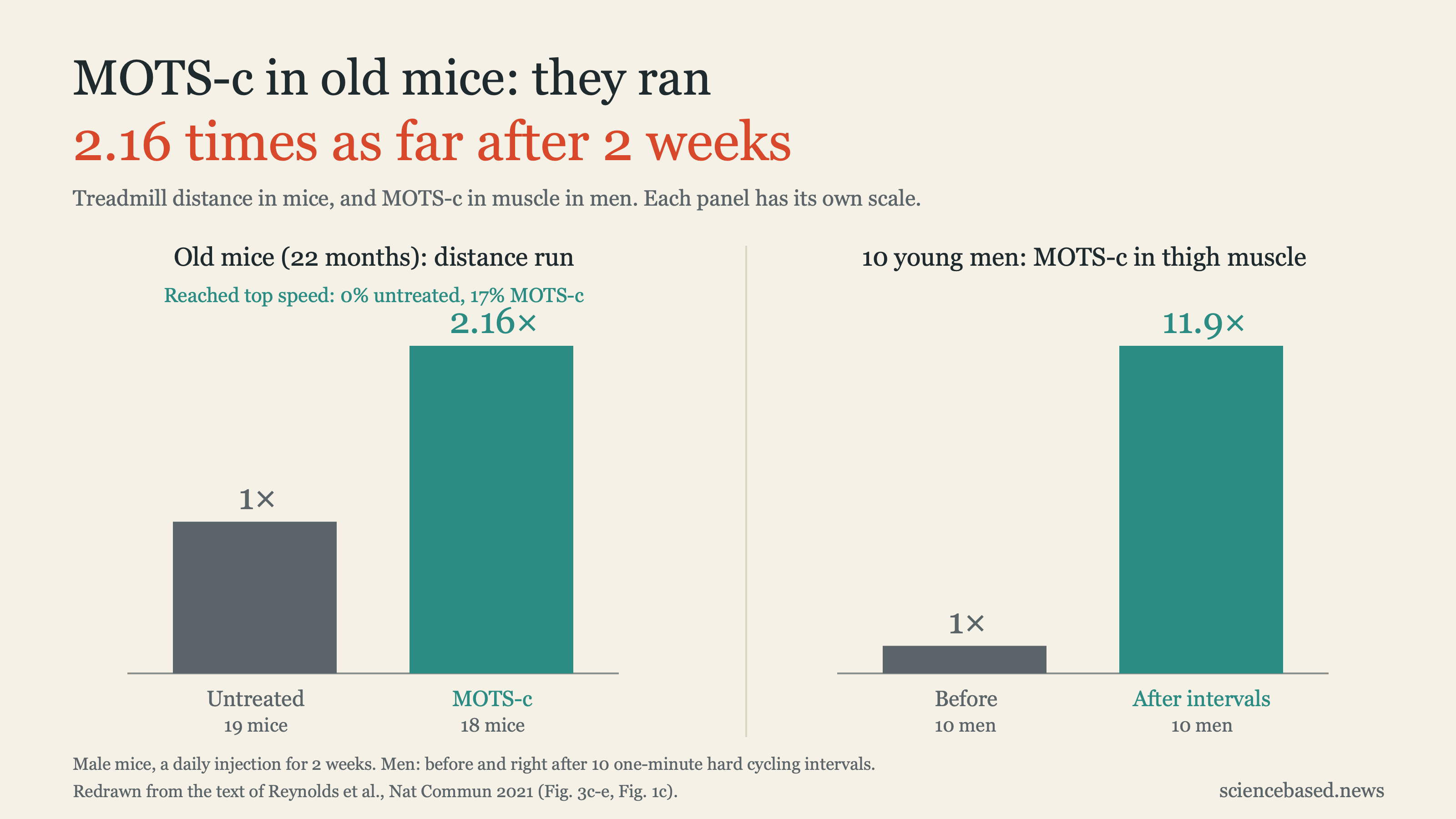
Start with what the vial did in mice. In a 2021 study at the University of Southern California, 22-month-old mice, old age for a mouse, got a daily MOTS-c injection for 2 weeks [1]. On a treadmill they ran 2.16 times as far as untreated mice of the same age, and they beat untreated mice half their age.
Where the claim came from
MOTS-c is a string of 16 amino acids, the building blocks of protein. Its recipe sits in the DNA of mitochondria, the small parts of each cell that turn food into energy, not in the main DNA in the nucleus. A team led by Changhan Lee and Pinchas Cohen found it in 2015 and showed it kept mice on a fatty diet from getting fat and losing their response to insulin [3].
The running study came out in January 2021. USC's press release was titled "'Exercise protein' doubles running capacity, restores function and extends healthy lifespans in older mice" [2]. Peptide sellers took the phrase further, to "exercise in a vial", and MOTS-c is now one of the most searched peptides for longevity.
In 2026 it reached the FDA. A pharmacy group had asked for MOTS-c to be made by compounding pharmacies for "insulin resistance, obesity, osteoporosis, vascular calcification, muscle/fat metabolism, longevity", as shots under the skin [7]. On July 23, 2026, the FDA's compounding advisers voted 8 to 6, with 1 abstaining, to allow it, against the advice of FDA staff [8-11]. The vote does not make it legal yet; the FDA has to write a rule first.
We searched what Peter Attia, Andrew Huberman and Jeff Nippard said in their recent peptide episodes and found nothing on MOTS-c, so the claim here is the study's own and its press release's.
What MOTS-c did in old mice
The mice in the star study were male lab mice, bred by the US National Institute on Aging [1]. At 22 months, 19 got no treatment and 18 got a daily injection of MOTS-c into the belly for 2 weeks. Then each ran on a treadmill that sped up in stages until the mouse stopped.
Treated old mice ran twice as long and 2.16 times as far. That gap was far too big to be chance (P=0.000002). Seventeen percent of them reached the top speed stage; none of the untreated old mice did. They also stayed longer on a turning rod, a test of balance and coordination. Memory, tested in a maze, did not change.
The team then treated a second group for life. Starting at about 23.5 months, mice got MOTS-c three times a week [1]. At over 30 months, very old for a mouse, the treated ones gripped harder (P=0.000078), took longer strides (P=0.0038), and more of them could walk on a slow treadmill for 60 seconds (P=0.043). They had less fat, ate less, kept their blood sugar lower, and lost a little less muscle.
So a peptide the body already makes turned old mice into better runners. That leaves the question the vial skips: how much do your own muscles make, and can you make more?
Younger mice told a similar story. In young mice on a fatty diet, 10 days of MOTS-c let every treated mouse reach the sprint stage, against 16.6% of untreated ones [1]. Seven days did nothing, and grip strength did not change.
The 2015 study found the first clue [3]. Mice on a fatty diet given MOTS-c gained less weight while eating the same amount of food, and their muscles took up sugar better. In 12-month-old mice, a week of MOTS-c brought muscle response to insulin back to the level of young mice. On a normal diet it did not change weight.
Here is the clue that ties it to you. In the same 2021 paper, 10 healthy young men who did not exercise rode a stationary bike: 10 hard one-minute efforts, each followed by 75 seconds of easy pedaling [1]. Small samples of thigh muscle were taken before and after. Right after the last effort, MOTS-c in their muscle was 11.9 times higher, and still raised 4 hours later. In the blood it rose 1.6-fold and was back to normal 4 hours later.
A gene study in people points the same way [4]. Some people in East Asia carry a version of MOTS-c with one building block swapped, which works less well in mice. In 27,527 Japanese adults, men who carried it had more type 2 diabetes. In one group tracked with step counters, the least active men with the variant had type 2 diabetes 65% more often (18.5% against 11.2%). The most active men with it had no extra risk, as if exercise made up for a weaker MOTS-c. That is an observational link, not proof.
That is the answer to the opening question. The peptide in the vial is one your own muscles make, and hard exercise makes nearly 12 times more of it. The mice got it from a needle. On the hill, you can get it from intervals.
What is not known
The limit is simple: every result above for MOTS-c as a treatment is in mice, and only in male mice.
No person has been given MOTS-c itself in a published study. The FDA looked and wrote that it found no published studies of MOTS-c products in people, no human exposure data by any route, and so the "potential safety risks associated with the use of MOTS-c-related BDSs in humans are unknown" [7]. There are no animal toxicity, cancer or pregnancy studies either. The FDA's own database of drug harms had no reports on it through March 2025.
The FDA raised two other doubts [7]. MOTS-c is broken down quickly in human blood in a lab test, so an injection may not reach active levels. And peptides injected under the skin can make the body form antibodies against them, which in the worst case could block the body's own MOTS-c too.
The closest human trial tested a different molecule. CohBar, a company founded on this research, made CB4211, a changed version of MOTS-c built to last longer [5, 6]. In 20 obese adults with fatty liver, 4 weeks of daily CB4211 shots cut ALT, a blood marker of liver damage, by 21% while it rose 4% on a dummy shot. But liver fat fell by the same amount in both groups (5.0 and 4.9 points). Injection-site reactions were the only common side effect. CohBar ran the study and did not take the drug further [15].
The lifespan result is a trend, not a finding [1]. Mice treated late in life had a 6.4% longer median lifespan, but over the whole survival curve the gap could be chance (P=0.23), and the authors write that "larger cohorts will be needed".
The people behind the work also own a stake in it. Lee and Cohen, authors of both mouse studies, are consultants for and shareholders of CohBar [1, 3]. That does not make the results wrong, but it is why a second lab repeating them matters.
And an earlier claim did not hold. A 2015 study of 96 Japanese centenarians suggested the MOTS-c variant helped people reach 100. When the same team checked 736 centenarians, it was no more common in them than in other people (7.7% against 7.5%) [4].
Last, the product. Vials sold online are not tested for what is inside, and MOTS-c is banned in sport at all times as a metabolic modulator [14].
Our grade
The question for the grade is how much of the mouse result carries over to you. The mouse results are strong; the human evidence for MOTS-c as a treatment does not exist yet.
| Claim | Evidence | Grade |
|---|---|---|
| In mice: MOTS-c makes old mice run farther | 1 study, 37 old male mice, 2 weeks; ran 2.16 times as far [1] | Promising |
| In mice: MOTS-c keeps very old mice stronger and lets them live longer | Same lab, about 20 mice; stronger grip and stride; lifespan +6.4%, not significant [1] | Weak |
| Exercise raises your own MOTS-c | 1 study, 10 young men, before and after one session; 11.9-fold in muscle [1] | Promising |
| A weaker MOTS-c is linked to diabetes in inactive men | 3 Japanese groups, 27,527 people, observational [4] | Weak |
| A MOTS-c-like drug helps people | CB4211, 20 adults, 4 weeks: liver marker fell, liver fat did not [5] | Weak |
| Overall: MOTS-c restores an aging body's running ability | No published trial in people; all treatment results in mice [7] | Unproven |
The case for the other side: MOTS-c is not a foreign drug. Your body already makes it, more of it after exercise, and less of it with age [1]. A treatment that tops up something the body makes is more likely to be safe than a new molecule.
Two separate lines of evidence agree. The mice ran better, and in people a weaker natural version is tied to more diabetes in men who don't exercise [4]. That is the kind of match that makes researchers take a mouse result seriously.
The trial that could settle it is under way. A company-run trial is giving MOTS-c or a dummy shot to 120 adults with prediabetes for 12 weeks [13].
What would change the grade: a published randomized trial of MOTS-c in people, with a real outcome such as insulin response, walking speed or strength, and its side effects. A positive one would move it to Promising.
What this means for you
The proven way to make more MOTS-c is the way the 10 men did it: hard intervals. They rode 10 one-minute efforts at their top pace, with 75 seconds of easy pedaling after each [1]. That is about 25 minutes with a warm-up. You don't have to start there. Our sprint intervals article shows that two 20-second all-out sprints, three times a week, raised fitness about 8% in 2 to 12 weeks.
If you have prediabetes or are carrying extra weight, the things that raise insulin response in people are tested: regular exercise, weight loss, and the approved drugs a doctor can prescribe. The MOTS-c trial is testing whether the peptide adds to that, not whether it replaces it.
If you have used MOTS-c, tell your doctor, and mention it before any blood test, because it may change your blood sugar.
The hopeful part is real. Your muscles make an energy-boosting signal of their own, and a single session of hard intervals multiplies it. The mice needed a needle. You need a bike, a hill, and 25 minutes.
What did MOTS-c do for old mice in the 2021 study?
Treated old mice ran 2.16 times as far; memory did not change, and the lifespan gain of 6.4% was not significant.
How much MOTS-c has been tested in people in a published trial?
The FDA found no published human use of MOTS-c itself; a trial in 120 people is under way.
What raised MOTS-c in the muscle of young men nearly 12-fold?
Muscle MOTS-c was 11.9 times higher right after the intervals and still raised 4 hours later.
Which people with a weaker natural MOTS-c had more type 2 diabetes?
The least active men with the variant had 65% more diabetes; active men with it had no extra risk.
What's next
The first answer for people is due soon. The MOTS-MET trial, run by Hudson Biotech, gives 120 adults with prediabetes and overweight a daily MOTS-c shot or a dummy for 12 weeks and measures their response to insulin [13]. Its main results are expected in February 2027. It will be the first time anyone can say whether MOTS-c does in people what it did in mice. We will update this article then.
The FDA has not yet decided whether pharmacies may make it; a draft policy on access to peptides went to the White House on October 14, 2026 [12].
This is one of our checks on the peptides in our guide to the best peptides, after GHK-Cu, melanotan II and collagen. For other ways people try to help their mitochondria, see NAD boosters and urolithin A. Our peptides article covers BPC-157.
Was this helpful?
Sources
Show all sources (15)
- Reynolds JC, Lai RW, Woodhead JST, et al. MOTS-c is an exercise-induced mitochondrial-encoded regulator of age-dependent physical decline and muscle homeostasis. Nature Communications, 2021. Male mice (young, 12 and 22 months; 19 untreated and 18 treated old mice in the running test), 10 days to life-long treatment; human part 10 young men, one exercise session. Funded by the NIH and foundations; two authors are consultants and shareholders of CohBar. https://doi.org/10.1038/s41467-020-20790-0
- University of Southern California, Leonard Davis School of Gerontology. "Exercise protein" doubles running capacity, restores function and extends healthy lifespans in older mice. Press release, January 20, 2021. https://gero.usc.edu/2021/01/20/exercise-protein-running-capacity-mice-mots-c
- Lee C, Zeng J, Drew BG, et al. The mitochondrial-derived peptide MOTS-c promotes metabolic homeostasis and reduces obesity and insulin resistance. Cell Metabolism, 2015. Mice and cells. Two authors consult for CohBar. https://doi.org/10.1016/j.cmet.2015.02.009
- Zempo H, Kim SJ, Fuku N, et al. A pro-diabetogenic mtDNA polymorphism in the mitochondrial-derived peptide, MOTS-c. Aging, 2021. 27,527 Japanese adults in 3 cohorts, observational, plus 736 centenarians and mice. Funded by JSPS and the NIH. https://doi.org/10.18632/aging.202529
- Loomba R, Hompesch M, Salazar H, et al. CB4211, a novel MOTS-c analog, in obese subjects with NAFLD: phase 1a/1b study. Poster LB5, AASLD The Liver Meeting, 2021. Phase 1a 65 healthy adults; phase 1b 20 analyzed, randomized, double-blind, placebo-controlled, 4 weeks. Funded by CohBar. https://d1io3yog0oux5.cloudfront.net/_708cf04ac3f5c70482e09ec7c4a65256/cohbar/db/391/2909/pdf/AASLD+2021+Poster+LB5+Final+for+Submission+25Oct2021.pdf
- CohBar. CohBar announces positive topline results from the phase 1a/1b study of CB4211 under development for NASH and obesity. Press release, August 10, 2021. https://www.globenewswire.com/news-release/2021/8/10/2278324/0/en/cohbar-announces-positive-topline-results-from-the-phase-1a-1b-study-of-cb4211-under-development-for-nash-and-obesity.html
- US Food and Drug Administration. FDA evaluation of MOTS-c-related bulk drug substances. Briefing document, Pharmacy Compounding Advisory Committee, July 23-24, 2026. https://www.fda.gov/media/193347/download
- US Food and Drug Administration. July 23-24, 2026: Meeting of the Pharmacy Compounding Advisory Committee. https://www.fda.gov/advisory-committees/advisory-committee-calendar/july-23-24-2026-meeting-pharmacy-compounding-advisory-committee-07232026
- DLA Piper. Compounding at the crossroads: FDA adcomm recommends adding six peptides to bulk list. July 31, 2026. https://www.dlapiper.com/en-fr/insights/publications/2026/07/fda-adcomm-recommends-adding-six-peptides-to-bulk-list
- McDermott Will & Schulte. Bulk-list bound? PCAC backs majority of peptides in two-day public meeting. July 28, 2026. https://www.mcdermottlaw.com/insights/bulk-list-bound-pcac-backs-majority-of-peptides-in-two-day-public-meeting
- Liang L. Peptides: US advisory committee recommends six for FDA "compounding list". BMJ, 2026;394:e100422. https://www.bmj.com/content/394/bmj-2026-100422
- Holland & Knight. Peptides at a crossroads: what wellness providers need to know about HHS and FDA actions. October 2026. https://www.hklaw.com/en/insights/publications/2026/10/peptides-at-a-crossroads-what-wellness-providers-need-to-know
- ClinicalTrials.gov. NCT07505745: MOTS-c in adults with prediabetes and overweight or obesity (MOTS-MET). 120 adults, randomized, quadruple-blind, placebo-controlled, 12 weeks; sponsor Hudson Biotech. https://clinicaltrials.gov/study/NCT07505745
- US Anti-Doping Agency. What is MOTS-c peptide? https://www.usada.org/spirit-of-sport/what-is-mots-c-peptide
- Alzheimer's Drug Discovery Foundation. MOTS-c. Cognitive Vitality report. https://www.alzdiscovery.org/uploads/cognitive_vitality_media/MOTS-c.pdf
Discussion