

Ipamorelin sets off one short burst of growth hormone, but no human trial has tested it for sleep, muscle or fat
Evidence check, October 5, 2026
The claim: "Ipamorelin raises your own growth hormone for deeper sleep, more muscle and less fat, without the cortisol or hunger of older peptides."
Our grade: Unproven. It does raise growth hormone, for a few hours, in one small study of healthy men. No trial has measured sleep, muscle or fat, and the shot clinics sell has never been studied in people.

Nora is 51. Most nights she wakes around 3 a.m. and lies there until the alarm. A clinic's website offers a small shot before bed, ipamorelin: "deeper sleep, lean muscle, and none of the cortisol or hunger of older peptides."
Has anyone checked what it does to sleep?
The answer is in two human studies, a pig study from 1998 and an FDA review from 2024.
Where the claim came from
Ipamorelin is a chain of five amino acids made by Novo Nordisk in the 1990s. It copies ghrelin, the hormone your stomach makes when you are hungry. Ghrelin also tells the pituitary, a gland under the brain, to release growth hormone.
Older drugs of this kind had a flaw. They also raised cortisol, the stress hormone. In 1998 Novo Nordisk's scientists reported that ipamorelin did not, and called it "the first selective" drug of its type [1]. That one word, selective, is the root of today's sales pitch.
Andrew Huberman covered it in an April 2024 episode on peptides and called it the most talked-about peptide in its class. He said it "tends to really improve sleep." He also said it will raise hunger, which is the opposite of what most clinics say [2].
Clinics usually sell it mixed with CJC-1295, which pushes growth hormone through a different switch.
It does raise growth hormone, in one burst
The human proof is one study from 1999. Healthy men got ipamorelin through a 15-minute drip into a vein, at five doses, eight men per dose [3].
Growth hormone rose in a single burst. It peaked at about 40 minutes and then fell away. By six hours it was back to very low levels at every dose [3, 4]. The drug itself was half gone from the blood in about two hours.
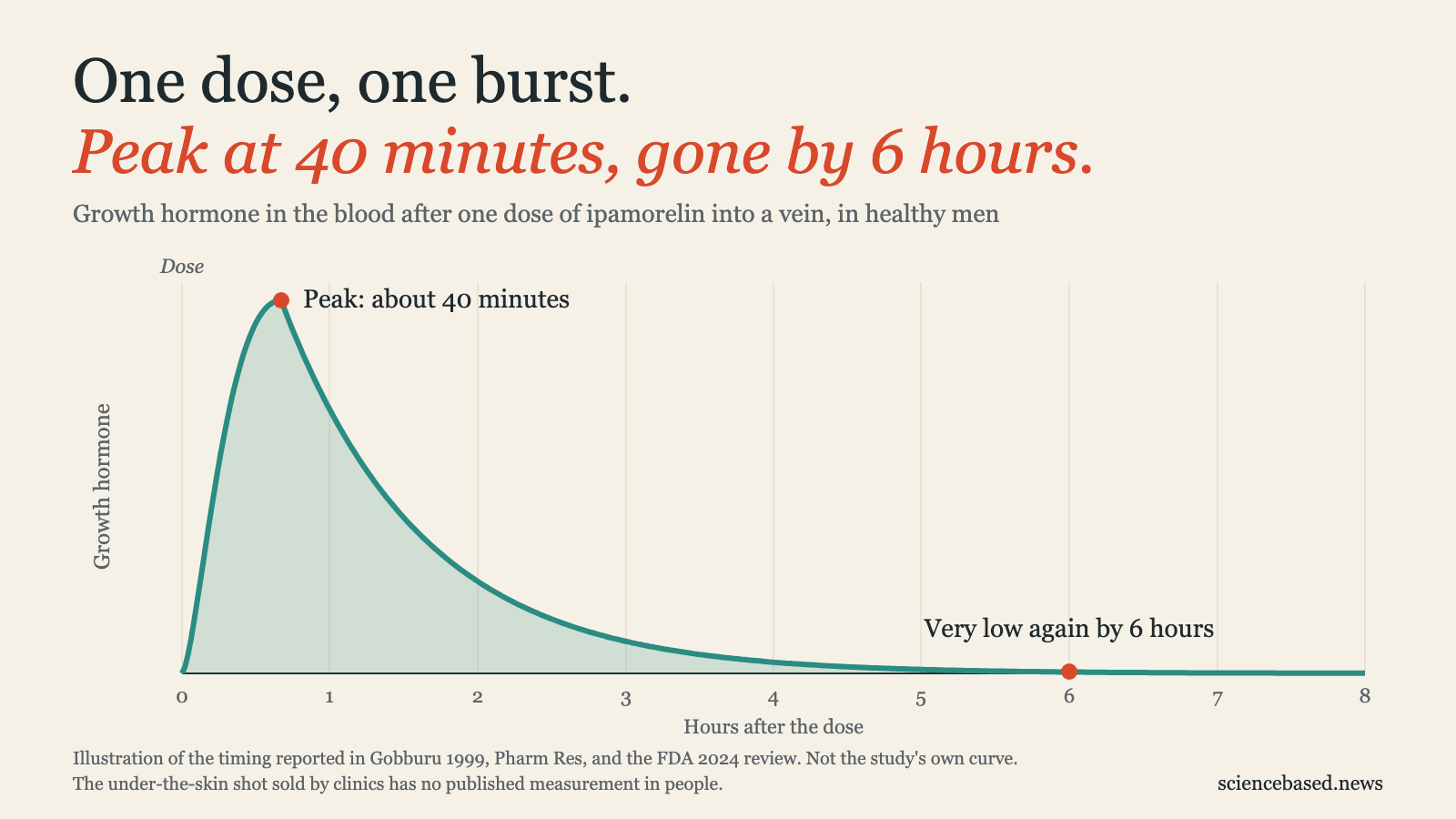
So one dose is one pulse. Compare that with CJC-1295, where one shot kept growth hormone raised for about a week.
There is a catch. Those men got the drug into a vein. Clinics sell a shot under the skin. When FDA reviewers searched in 2024, they found no published data on what the under-the-skin shot does to growth hormone in people [4]. Nor has anyone published a human study of the blend with CJC-1295.
"No cortisol" comes from pigs
Where does the clean reputation come from?
In the 1998 study, pigs got ipamorelin or one of two older peptides. The older ones pushed up cortisol. Ipamorelin did not, even at more than 200 times the dose needed to release growth hormone [1].
That is a real and useful finding. It is also a finding in pigs. The published summary of the human study reports growth hormone and nothing else [3]. A 2026 review says no other hormones moved in that study [5], but we could not find the numbers.
"No hunger" has no human test, and mice got fatter
Ipamorelin copies the hunger hormone. So does it make you hungry?
In mice, yes. In a 2001 University of Cambridge study, mice given ipamorelin twice a day ate more. Their body weight rose about 15% in two weeks and their share of body fat went up. Mice given growth hormone itself did not gain fat [6]. Rats given repeated doses after surgery also ate more and gained weight [7].
Nobody has measured appetite or body fat in people taking it. A drug sold for fat loss added fat in the only animals tested.
Its only patient trials were for the gut, and they fell short
Because ghrelin also gets the gut moving, a company called Helsinn tested ipamorelin on patients whose bowels had shut down after surgery.
The trial enrolled 117 people having bowel surgery. They were randomized to ipamorelin or placebo, into a vein, twice a day for up to a week. Neither patients nor doctors knew who got which [8].
The ipamorelin group could eat a solid meal after 25.3 hours and the placebo group after 32.6. That gap was small enough to be chance (p = 0.15), and no other measure of recovery differed [8].
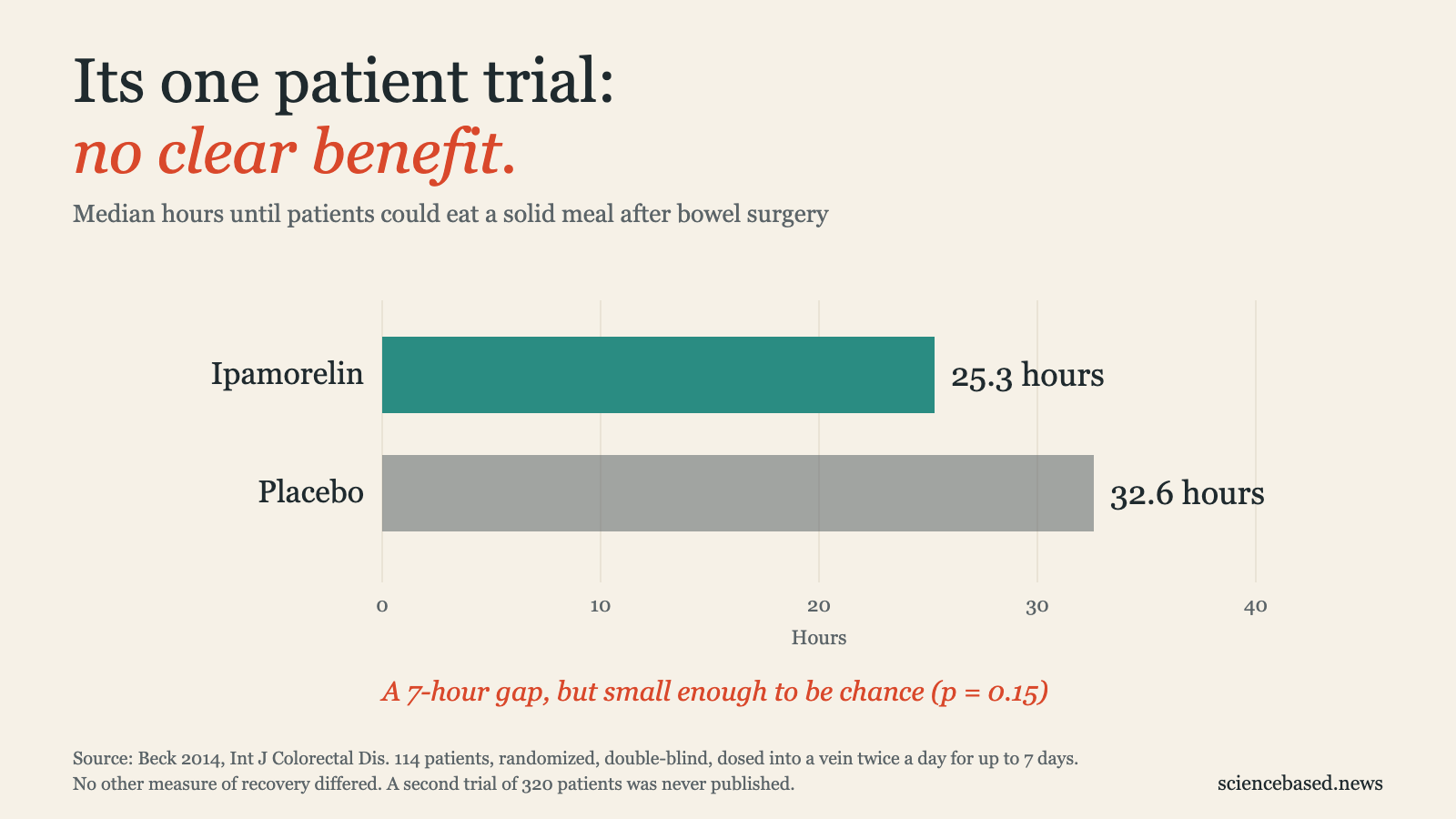
A second, larger trial of 320 patients finished in 2014. Its results were never posted or published [9]. Development was dropped [4].
So what about sleep?
No study has measured sleep on ipamorelin. Not deep sleep, not total sleep, not how people felt in the morning.
The only sleep number that exists is a side effect count from the surgery trial. Insomnia was reported by 6 of 56 patients on ipamorelin and 3 of 58 on placebo [4]. That is far too few people to prove anything, and they were in hospital beds after surgery.
But it is the only human data there is, and it does not point toward better sleep.
So back to Nora at 3 a.m. Nobody can tell her this shot would help. The honest answer is that no one has looked.
What the FDA found on safety
In October 2024 an FDA expert panel voted on whether pharmacies should be allowed to make ipamorelin. Nobody voted yes. Twelve voted no and one abstained [10].
The reviewers' main point was how little is known. For the under-the-skin shot they found no safety studies at all [4].
In the surgery trial, high blood sugar at discharge was more common on ipamorelin (14.3% versus 8.6%), and so was low potassium (12.5% versus 3.4%). Two patients on ipamorelin died. Both had colon cancer and a leak at the surgical join, and the FDA said it is unclear whether the drug played a part [4].
Raising growth hormone has known risks of its own: higher blood sugar, fluid retention, and a growth signal that may matter if you have had cancer [4].
Our grade
| Claim | Evidence | Grade |
|---|---|---|
| Ipamorelin raises growth hormone for a few hours | One study, about 40 healthy men, given into a vein | Promising |
| It doesn't raise cortisol | Shown in pigs; no published human numbers | Unproven |
| It doesn't cause hunger or fat gain | Mice ate more and gained fat; no human test | Unproven |
| It improves sleep, builds muscle or burns fat | No human trial has measured any of these | Unproven |
| The under-the-skin shot, or the blend with CJC-1295, works in people | No published human study | Unproven |
| It speeds gut recovery after surgery | One randomized trial of 117, no clear benefit; a second never published | Weak |
The case for the other side: the idea is not silly. Growth hormone does rise during deep sleep, and tesamorelin, which raises growth hormone through the other switch, shrank deep belly fat about 15% in trials of 806 people with HIV. In rats, ipamorelin protected muscle strength and bone from steroid damage [11]. And in the surgery trial, side effects of any kind were reported by 87.5% of patients on ipamorelin and 94.8% on placebo [8].
One randomized trial that measured sleep, muscle or fat would change this grade. None is registered [9].
What this means for you
Unproven does not mean it can't work. It means you would be the test.
- If you wake at 3 a.m. like Nora, start with what has trials behind it. Talk therapy for insomnia (CBT-I) is the first treatment doctors' guidelines recommend [13]. Around menopause, ask about hormone therapy, which treats the night sweats that break sleep.
- If the goal is deep belly fat, the tested drug in this family is tesamorelin. The GLP-1 drugs have far bigger trials: see the pills.
- If the goal is muscle, lifting and enough protein have the evidence. See how much protein you need.
- If you still want to try it, know that the dose, the route and the blend have not been studied. Tell your doctor first if you have diabetes, prediabetes or a history of cancer, and have your blood sugar checked.
- If you compete in a tested sport, it is banned [12].
What did the one human study of ipamorelin's hormone effect show?
Growth hormone peaked about 40 minutes after the dose and was back to very low levels within 6 hours.
Where does the "it doesn't raise cortisol" claim come from?
Novo Nordisk's 1998 study found no cortisol rise in pigs. No human numbers have been published.
How many human trials have measured sleep, muscle or fat on ipamorelin?
The only patient trials tested gut recovery after bowel surgery.
What happened when mice got ipamorelin twice a day?
In a 2001 study the mice ate more, and their weight and body fat went up.
What's next
No trial of ipamorelin for sleep, muscle or fat is registered [9]. The FDA has not made a final decision on whether pharmacies may make it.
This is the third of our one-by-one checks on the peptides in the guide, after tesamorelin and CJC-1295. Next is sermorelin, which was once an FDA-approved drug.
Was this helpful?
Sources
- Raun K, Hansen BS, Johansen NL, et al. Ipamorelin, the first selective growth hormone secretagogue. Eur J Endocrinol, 1998. Rat pituitary cells, rats and pigs. Run by Novo Nordisk. doi:10.1530/eje.0.1390552
- Huberman A. Benefits & risks of peptide therapeutics for physical & mental health. Huberman Lab podcast, April 1, 2024. hubermanlab.com
- Gobburu JV, Agersø H, Jusko WJ, Ynddal L. Pharmacokinetic-pharmacodynamic modeling of ipamorelin, a growth hormone releasing peptide, in human volunteers. Pharm Res, 1999. Healthy men, five doses with eight men per dose, one 15-minute infusion into a vein; hormone levels only. Novo Nordisk authors. doi:10.1023/a:1018955126402
- US Food and Drug Administration. Briefing document for the Pharmacy Compounding Advisory Committee meeting, October 29, 2024: evaluation of ipamorelin-related bulk drug substances. fda.gov
- Dominikowski A, Rękoś Z, Olejarz M, et al. The emerging landscape of performance-enhancing peptides modulating GH-IGF1 axis: bridging the gap between clinical evidence and patient self-administration. Front Endocrinol (Lausanne), 2026. Narrative review. doi:10.3389/fendo.2026.1822475
- Lall S, Tung LY, Ohlsson C, Jansson JO, Dickson SL. Growth hormone (GH)-independent stimulation of adiposity by GH secretagogues. Biochem Biophys Res Commun, 2001. Mice, 2 to 9 weeks. doi:10.1006/bbrc.2000.4065
- Venkova K, Mann W, Nelson R, Greenwood-Van Meerveld B. Efficacy of ipamorelin, a novel ghrelin mimetic, in a rodent model of postoperative ileus. J Pharmacol Exp Ther, 2009. Rats, 48 hours. doi:10.1124/jpet.108.149211
- Beck DE, Sweeney WB, McCarter MD; Ipamorelin 201 Study Group. Prospective, randomized, controlled, proof-of-concept study of the ghrelin mimetic ipamorelin for the management of postoperative ileus in bowel resection patients. Int J Colorectal Dis, 2014. 117 patients enrolled (114 analyzed), randomized, double-blind, placebo-controlled, up to 7 days. Funded by Helsinn. doi:10.1007/s00384-014-2030-8
- ClinicalTrials.gov. Safety and efficacy of ipamorelin compared to placebo for the recovery of gastrointestinal function. Phase 2, Helsinn, 320 patients, completed 2014, no results posted. One of three ipamorelin trials in the registry (searched October 5, 2026); none tests sleep, muscle or fat. NCT01280344
- US Food and Drug Administration. Summary minutes of the Pharmacy Compounding Advisory Committee meeting, October 29, 2024. fda.gov
- Andersen NB, Malmlöf K, Johansen PB, et al. The growth hormone secretagogue ipamorelin counteracts glucocorticoid-induced decrease in bone formation of adult rats. Growth Horm IGF Res, 2001. Rats, 3 months. doi:10.1054/ghir.2001.0239
- Semenistaya E, Zvereva I, Thomas A, et al. Determination of growth hormone releasing peptides metabolites in human urine after nasal administration of GHRP-1, GHRP-2, GHRP-6, Hexarelin, and Ipamorelin. Drug Test Anal, 2015. Anti-doping lab study. doi:10.1002/dta.1787
- Qaseem A, Kansagara D, Forciea MA, et al. Management of chronic insomnia disorder in adults: a clinical practice guideline from the American College of Physicians. Ann Intern Med, 2016. Guideline. doi:10.7326/M15-2175