

Six months of sermorelin left older adults sleeping and lifting the same
Evidence check, October 5, 2026
The claim: "Sermorelin raises your own growth hormone for deeper sleep, more muscle and a younger body."
Our grade: Weak. It does raise growth hormone. But in the one placebo trial, 89 older adults slept no better and got no stronger after 6 months of nightly shots.
Ruth is 66. She falls asleep fine, but her sleep feels thin, and she wakes up tired. A clinic offers a small shot before bed, sermorelin, to bring back the deep sleep and the growth hormone of her 30s.
Did the people who took it in a trial sleep any better?
Unlike most peptides, this one has an answer. Researchers in Seattle ran that trial for six months. They also found something nobody was selling it for.
Where the claim came from
Your brain makes a signal called GHRH that tells the pituitary, a gland under the brain, to release growth hormone. Sermorelin is the first 29 of that signal's 44 building blocks, the part that does the work.
It was a real medicine. The FDA approved it in 1990 as a test of the pituitary, and in 1997 as a treatment for children who were not growing because they made too little growth hormone [1]. In a study of 110 such children, with no placebo group, growth sped up from 4.1 to 7.2 cm a year after 12 months of bedtime shots [2].
The maker stopped selling it in 2008. The FDA later ruled that this was not for reasons of safety or effectiveness [1]. Pharmacies still mix it today, and it is often sold as "FDA-approved." It was approved, for children, and that product no longer exists.
The sleep claim has real roots too. Your biggest burst of growth hormone comes soon after you fall into deep sleep [10]. In a 1992 German study, 7 young men got four small doses of GHRH into a vein during one night. Deep sleep rose from 14% to 20% of the night [4].
Andrew Huberman said in an April 2024 episode that this effect on deep sleep is "pretty well documented." He also said he had mostly stopped taking sermorelin, because his sleep trackers showed less dream sleep on it [3].
It does raise growth hormone
This part holds up. In 10 men of about 68, two shots a day for two weeks lifted growth hormone and IGF-1 (the hormone that carries out growth hormone's effects) to the level of men in their 20s [6].
The Seattle trial showed the same over a longer time. Growth hormone across the day doubled and IGF-1 rose 34%. Neither moved on placebo [8].
So the shot does what the label says to your blood. The question is what that does for you.
The six-month trial
Researchers at the University of Washington enrolled healthy men and women aged 60 to 85, average age 68. They were randomized to sermorelin or a placebo shot, about an hour before bed, every night for six months. Neither they nor the testers knew who got which. In the end 89 people finished: 44 on sermorelin and 45 on placebo [8].
The plan was to test whether the hormone could improve sleep, body and mind in older people.
Sleep did not improve
Each person filled out a standard sleep questionnaire before and after. A higher score means worse sleep.
In an early look at 75 of them, the score on sermorelin went from 4.1 to 5.4. On placebo it went from 4.5 to 4.6 [9].
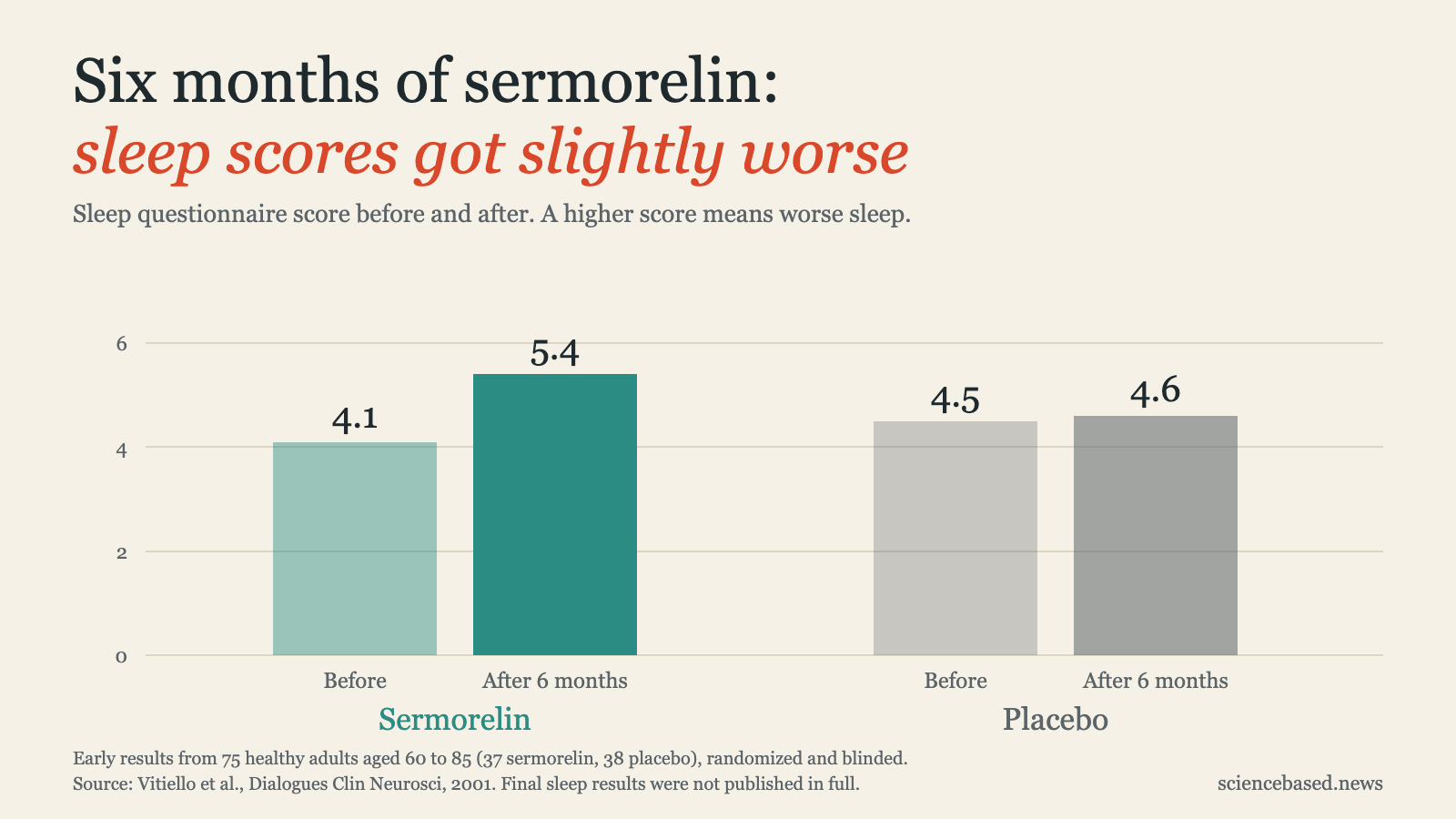
That is a small move in the wrong direction. The researchers called it "counterintuitive" and said no one part of the questionnaire explained it [9]. A later review by two of the same team said the shot "failed to improve and may even have impaired deep sleep" [10].
Why would it fail when the one-night study worked? Three things differ. Those were young men, and when the same German lab tried older people, the effect was "much less" [5]. The doses went into a vein in four pulses, not one shot under the skin. And in Seattle the shot produced one big burst of growth hormone, after which levels late in the night were lower than before [9].
So back to Ruth. The best evidence we have says the shot would not deepen her sleep, and might make it a little worse.
One caution on our own evidence. These sleep numbers come from the researchers' early reports. We could not find a full paper with the final sleep results, and that is a gap.
Fat fell a little, strength did not move
The same early reports said body fat fell about 5% in men, and in women not taking estrogen, with a matching rise in lean mass [9]. Belly fat fell most [10].
But "there was no improvement in strength or aerobic fitness" [10]. An earlier study of 11 men aged 64 to 76 found the same: six weeks of nightly shots at double the dose changed neither muscle nor fat on a scan, and it had no placebo group [7].
More lean tissue on a scan, no more strength. That is the pattern for this whole family of drugs.
The surprise: thinking tests
The one full paper from the Seattle trial is about the mind [8].
On a set of timed puzzle tasks (the "performance" half of a standard IQ test), the sermorelin group's score rose from 114.7 to 119.0. The placebo group's rose from 115.2 to 116.6. Sorting pictures into a story, a speed task and doing two tasks at once also improved more on sermorelin. Word skills did not change [8].
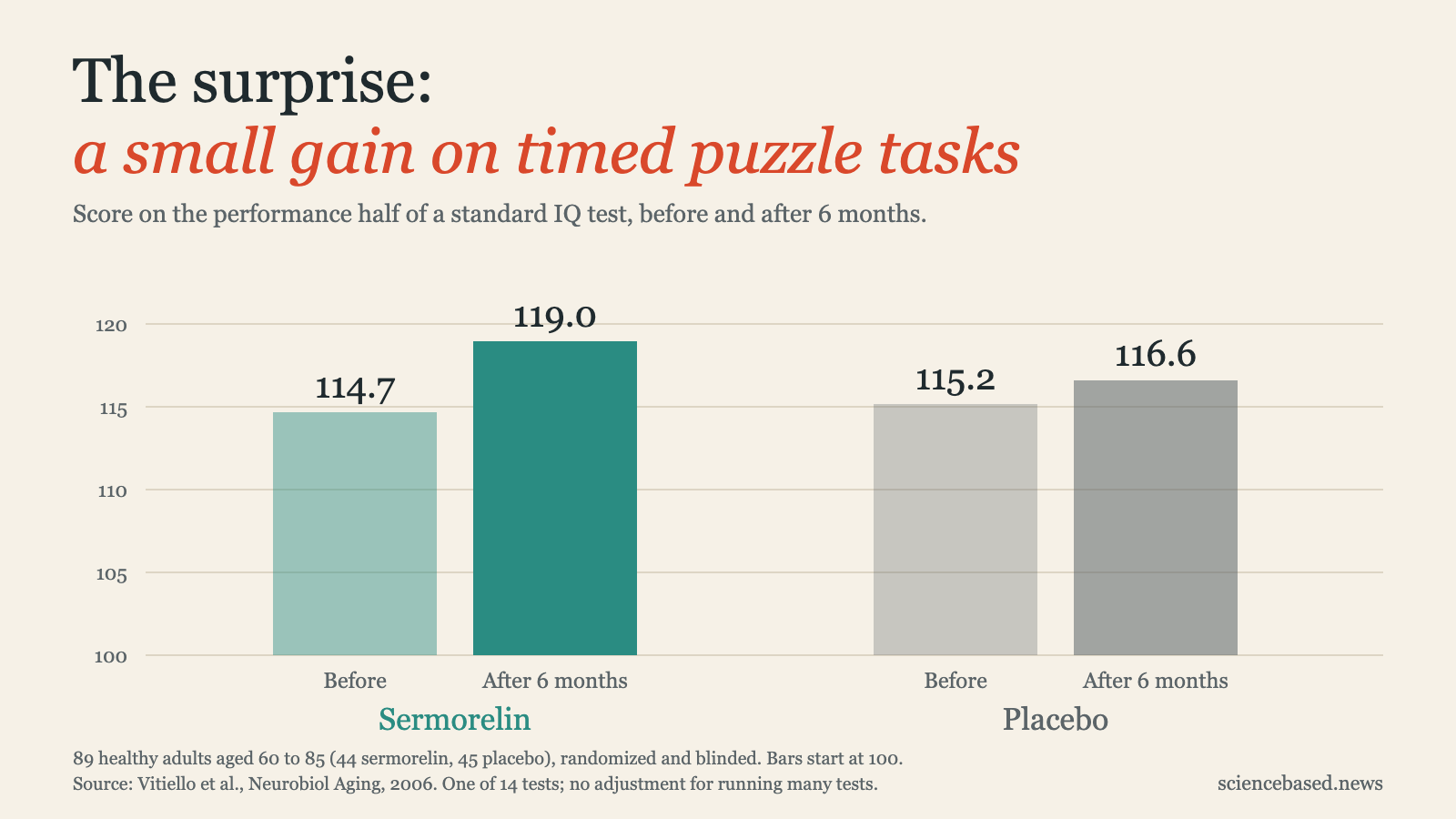
It is a small gain, about three points more than placebo. And there are reasons for care. The team ran 14 tests and did not adjust for that, so one or two could be flukes. Two authors had consulted for the drug's maker [8].
But it was then repeated, with a sister drug. In 152 adults aged 55 to 87, some with early memory problems, 20 weeks of tesamorelin improved planning and focus compared with placebo [11].
Nobody sells sermorelin for this. It is the best result it has.
Our grade
| Claim | Evidence | Grade |
|---|---|---|
| Raises growth hormone and IGF-1 | Several small human studies, including one placebo trial of 89 | Solid |
| Helps children with low growth hormone grow | The former approved use; 110 children, no placebo group | Promising |
| Sharper thinking in older adults | One placebo trial of 89; repeated with tesamorelin in 152 | Promising |
| Less body fat | Early reports from the same trial; about 5% | Weak |
| More strength or fitness | No change in the placebo trial | Not supported |
| Deeper or better sleep | Slightly worse scores in the placebo trial; early report only | Not supported |
| Overall anti-aging shot | One real trial, most hoped-for benefits missing | Weak |
The case for the other side: people on sermorelin held their score on a test of everyday physical tasks while the placebo group declined, and the reviewers called that "tantalizing" [10]. Side effects were mild. About 2% had redness or swelling where the needle went in [8], and children mostly had brief flushing of the face [12]. And the thinking result has now shown up in two trials.
A trial that measured deep sleep with brain-wave recordings, at the dose clinics use, would change the sleep grade either way. None is registered [15].
What this means for you
- If you want it for sleep, the evidence points the other way. For trouble sleeping, talk therapy for insomnia (CBT-I) is the first treatment doctors' guidelines recommend [14].
- If you want it for strength, it did not add any. Lifting and enough protein do. See how much protein you need.
- If the thinking result interests you, know that it is one trial plus one with a different drug, in people over 55. It is a reason for more research, not yet a reason to inject.
- Clinic doses are smaller than the trial's. Huberman gave the usual dose as 200 to 400 micrograms [3]. The Seattle trial used 1,000. Nobody has tested whether the lower dose does anything beyond the blood test.
- What you would get today is mixed by a pharmacy, not the product the FDA once approved. Tell your doctor, and have your blood sugar checked if you have diabetes or prediabetes, since growth hormone can raise it [10].
- If you compete in a tested sport, it is banned [13].
In the 6-month placebo trial, what happened to sleep scores on sermorelin?
The score went from 4.1 to 5.4, where higher means worse sleep. On placebo it barely moved.
What happened to strength?
Body fat fell a little, but strength and fitness did not improve.
What was the surprise finding?
Scores on timed puzzle tasks rose about three points more than on placebo.
How does the usual clinic dose compare with the trial's?
Clinics typically use 200 to 400 micrograms. The trial used 1,000.
What's next
No trial of sermorelin in healthy adults is registered today. Two small trials of GHRH in older people were stopped early, with 5 and 13 people [15]. The research has moved to tesamorelin, which lasts longer in the body.
This is the fourth of our one-by-one checks on the peptides in the guide, after tesamorelin, CJC-1295 and ipamorelin. Next is MK-677, a pill that raises growth hormone and has a one-year trial.
Was this helpful?
Sources
- US Food and Drug Administration. Determination that Geref (sermorelin acetate) injection, 0.5 milligrams base/vial and 1.0 milligrams base/vial, and Geref (sermorelin acetate) injection, 0.05 milligrams base/ampule, were not withdrawn from sale for reasons of safety or effectiveness. Federal Register, March 4, 2013. federalregister.gov
- Thorner M, Rochiccioli P, Colle M, et al; Geref International Study Group. Once daily subcutaneous growth hormone-releasing hormone therapy accelerates growth in growth hormone-deficient children during the first year of therapy. J Clin Endocrinol Metab, 1996. 110 children (86 analyzed), no placebo group, 12 months. doi:10.1210/jcem.81.3.8772599
- Huberman A. Benefits & risks of peptide therapeutics for physical & mental health. Huberman Lab podcast, April 1, 2024. hubermanlab.com
- Steiger A, Guldner J, Hemmeter U, et al. Effects of growth hormone-releasing hormone and somatostatin on sleep EEG and nocturnal hormone secretion in male controls. Neuroendocrinology, 1992. 7 healthy young men, GHRH into a vein, one night each with placebo comparison. doi:10.1159/000126275
- Guldner J, Schier T, Friess E, et al. Reduced efficacy of growth hormone-releasing hormone in modulating sleep endocrine activity in the elderly. Neurobiol Aging, 1997. 13 healthy seniors, average age 69, GHRH into a vein, placebo comparison. doi:10.1016/s0197-4580(97)00106-1
- Corpas E, Harman SM, Piñeyro MA, et al. Growth hormone (GH)-releasing hormone-(1-29) twice daily reverses the decreased GH and insulin-like growth factor-I levels in old men. J Clin Endocrinol Metab, 1992. 10 older and 9 young men, 14 days per dose; hormone levels only. doi:10.1210/jcem.75.2.1379256
- Vittone J, Blackman MR, Busby-Whitehead J, et al. Effects of single nightly injections of growth hormone-releasing hormone (GHRH 1-29) in healthy elderly men. Metabolism, 1997. 11 men, 6 weeks, no placebo group. doi:10.1016/s0026-0495(97)90174-8
- Vitiello MV, Moe KE, Merriam GR, et al. Growth hormone releasing hormone improves the cognition of healthy older adults. Neurobiol Aging, 2006. 89 adults aged 60 to 85, randomized, double-blind, placebo-controlled, 6 months. Funded by the US National Institutes of Health and Department of Veterans Affairs; drug supplied by Serono, for which two authors had consulted. doi:10.1016/j.neurobiolaging.2005.01.010
- Vitiello MV, Schwartz RS, Moe KE, et al. Treating age-related changes in somatotrophic hormones, sleep, and cognition. Dialogues Clin Neurosci, 2001. Review by the trial's researchers with early results from 75 participants. doi:10.31887/DCNS.2001.3.3/mvvitiello
- Hersch EC, Merriam GR. Growth hormone (GH)-releasing hormone and GH secretagogues in normal aging: Fountain of Youth or Pool of Tantalus? Clin Interv Aging, 2008. Review. PMC2544358
- Baker LD, Barsness SM, Borson S, et al. Effects of growth hormone-releasing hormone on cognitive function in adults with mild cognitive impairment and healthy older adults: results of a controlled trial. Arch Neurol, 2012. 152 adults (137 finished), randomized, double-blind, placebo-controlled, 20 weeks of tesamorelin. doi:10.1001/archneurol.2012.1970
- Prakash A, Goa KL. Sermorelin: a review of its use in the diagnosis and treatment of children with idiopathic growth hormone deficiency. BioDrugs, 1999. Review. doi:10.2165/00063030-199912020-00007
- World Anti-Doping Agency. The Prohibited List, 2026. Sermorelin is named under S2, peptide hormones and releasing factors. wada-ama.org
- Qaseem A, Kansagara D, Forciea MA, et al. Management of chronic insomnia disorder in adults: a clinical practice guideline from the American College of Physicians. Ann Intern Med, 2016. Guideline. doi:10.7326/M15-2175
- ClinicalTrials.gov. Search for sermorelin and GHRH trials in healthy older adults, October 5, 2026. Two were terminated early: NCT00807365 (5 people) and NCT01410799 (13 people).