

CJC-1295 raised growth hormone up to 10 times in healthy adults, but no trial has shown it builds muscle, burns fat or improves sleep
Evidence check, October 5, 2026
The claim: "CJC-1295 boosts your own growth hormone to build muscle, burn fat and deepen sleep."
Our grade: Unproven. It does raise growth hormone on blood tests, in short studies of healthy adults. No trial has measured muscle, fat or sleep, and the only trial in patients was stopped in 2006.

Maya is 38. She lifts three mornings a week before work, and lately she wakes up sore and tired. A clinic near her gym sells a blend, CJC-1295 with ipamorelin: "deeper sleep, faster recovery, lean muscle."
Has anyone tested that?
It matters because this blend is one of the most popular items on the peptide menu, and it costs real money every month. Here is what the studies say, and what they never looked at.
Where the claim came from
Your brain releases a signal called GHRH that tells the body to make growth hormone. The natural signal lasts only minutes in the blood. In 2005 a Montreal company, ConjuChem, built a copy with a chemical hook on the end. The hook, called DAC, latches onto albumin, a common blood protein, and the copy rides along with it for days. In rats it was still in the blood after 72 hours and released four times more growth hormone than the plain version [1].
The company dropped the drug a year later. It never went away. Bodybuilding forums took it up for fat loss, muscle, skin, sleep and healing injuries [10]. Andrew Huberman covered it in an April 2024 episode on peptides, in a section on drugs that raise growth hormone [12]. Today clinics sell it, usually mixed with ipamorelin, another peptide that raises growth hormone.
It does raise growth hormone
This part of the claim is true. In two placebo-controlled studies in healthy adults aged 21 to 61, a single shot raised growth hormone in the blood 2 to 10 times for six days or more. IGF-1, the hormone that carries out most of growth hormone's effects, rose 1.5 to 3 times for 9 to 11 days [2]. The drug's half-life was about a week. The company ran both studies.
A second team looked closer. In 12 healthy men aged 20 to 40, one shot raised average growth hormone 46% and IGF-1 45% a week later, and the body kept releasing the hormone in its normal bursts [3]. In mice born unable to make GHRH, a daily shot brought their growth back to normal [4].
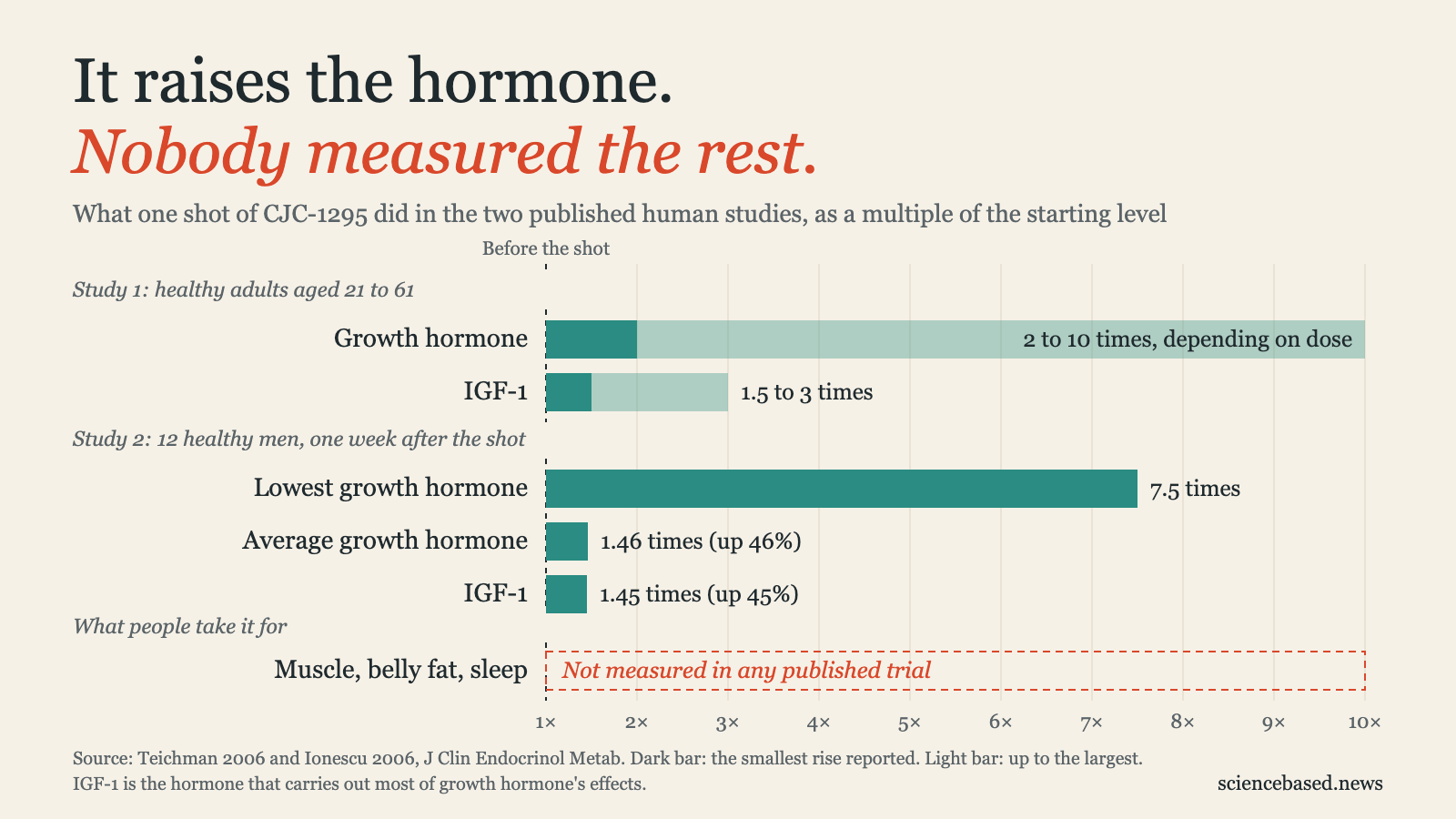
So the drug does what it was built to do. But a hormone level is a blood test. It is not muscle, and it is not sleep.
The one trial in patients was stopped
In 2006 the company began the trial that would have shown more. It enrolled 192 people with HIV and deep belly fat, and gave them a weekly shot or a placebo for 12 weeks [5, 6].
In July 2006 a man in the trial had a heart attack about two hours after his 11th shot, and died. His doctor thought the most likely cause was heart disease he already had. Nobody could show the drug caused it. The company stopped the trial anyway, and the results were never published [6, 7].
That left a hole. A rival drug built on the same idea, tesamorelin, finished its trials in the same kind of patients and was approved. We know what it does to belly fat. For CJC-1295, nobody ever found out. See our check on tesamorelin.
What the short studies showed about side effects
FDA staff reviewed everything published on CJC-1295 for an advisory panel in December 2024 [7]. In the first company study, about 70% of people who got the drug had a reaction where the needle went in. In the second, everyone did. People also reported flushing, headache, nausea, dizziness and drops in blood pressure, and the 12-man study saw faster heart rates.
Nobody in the published studies got more than three doses. The FDA reviewers said long-term safety in people is unknown. They also noted lab tests in which the drug damaged DNA in pituitary cells, and that no cancer studies in animals had been done [7].
The panel voted 13 to 0 against letting pharmacies make it [8]. The FDA still lists it among substances that may pose serious safety risks when mixed to order [9].
The vial may not be the drug that was tested
Here is the part most menus leave out. There are two things sold as CJC-1295.
One has the DAC hook. That is the drug in every study above. The other has no hook, and it clears from the blood far faster. A 2026 review of these peptides lists both among the ones doctors now see patients using [11]. The first black-market CJC-1295 vial described in a journal, seized in Norway, held the no-hook kind [13].
What do we know about the no-hook version in people? The FDA's reviewers put it this way: it is "unknown" whether those forms are active as drugs at all [7]. We found no published human study of it, and none of the blend with ipamorelin.
So back to Maya. The promise on that menu rests on hormone tests, done twenty years ago, in healthy adults who got one to three shots of a drug that may not be the one in her vial. No one has tested whether any version helps a person sleep, recover or build muscle.
Our grade
| Claim | Evidence | Grade |
|---|---|---|
| Raises growth hormone and IGF-1 (the version with DAC) | Two placebo-controlled dose studies and a 12-man study, one to three shots | Promising |
| Builds muscle or burns fat | No human trial has measured either; the one patient trial was stopped | Unproven |
| Improves sleep or recovery | No human trial | Unproven |
| The version without DAC, or the blend with ipamorelin, works in people | No published human study | Unproven |
| Safe to take for months | Longest published dosing was three shots | Unproven |
The case for the other side: the idea is sound. Tesamorelin works the same way and shrank deep belly fat about 15% in trials of 806 people. A compounding advocate told the FDA panel that pharmacies had filled more than 450,000 prescriptions for CJC-1295 with almost no harm reports [7]. But no reports is not the same as no harm when nobody is counting, and it says nothing about benefit. A 2026 review in a surgery journal called CJC-1295 "investigational" [14]. One randomized trial that measured body fat, muscle or sleep would change this grade. None is registered [5].
What this means for you
Unproven does not mean it can't work. It means you would be the experiment. Here is what has better odds.
- If the goal is deep belly fat, the tested drug in this family is tesamorelin, and it has limits of its own. The GLP-1 drugs have far bigger trials: see the pills and retatrutide.
- If the goal is muscle and recovery, lifting and enough protein have the evidence. See how much protein you need.
- If you still want to try it, ask the clinic which version is in the vial, with DAC or without, and where it was made. Tell your doctor first if you have heart disease, diabetes or a history of cancer, because raised IGF-1 is a growth signal and the long-term effect is unknown.
- If you compete in a tested sport, it is banned under world anti-doping rules [13].
What did the human studies of CJC-1295 measure?
The published studies measured growth hormone and IGF-1. None measured muscle, fat or sleep.
What happened to the one trial in patients, in 2006?
The company stopped the trial after a participant died of a heart attack. Nobody showed the drug caused it, but the results never came out.
What is known about the version without DAC, which many clinics sell?
Every published study used the version with DAC. FDA reviewers said it is unknown whether the other forms are active at all.
What was the longest anyone took CJC-1295 in a published study?
People got one to three shots. Long-term safety in people is unknown.
What's next
No trial of CJC-1295 is registered as running or planned [5], so this grade is unlikely to change soon. The FDA has not made a final decision on whether pharmacies may make it.
This is the second of our one-by-one checks on the peptides in the guide. The first was tesamorelin. Next is ipamorelin, the other half of the blend. Related: peptides: GLP-1s, BPC-157 and epitalon.
Was this helpful?
Sources
- Jetté L, Léger R, Thibaudeau K, et al. Human growth hormone-releasing factor (hGRF)1-29-albumin bioconjugates activate the GRF receptor on the anterior pituitary in rats: identification of CJC-1295 as a long-lasting GRF analog. Endocrinology, 2005. Rats and rat pituitary cells. Run by ConjuChem. doi:10.1210/en.2004-1286
- Teichman SL, Neale A, Lawrence B, et al. Prolonged stimulation of growth hormone (GH) and insulin-like growth factor I secretion by CJC-1295, a long-acting analog of GH-releasing hormone, in healthy adults. J Clin Endocrinol Metab, 2006. Healthy adults aged 21 to 61, two randomized, placebo-controlled, double-blind dose studies, 28 and 49 days, one to three shots; hormone levels only (the abstract does not give the number of people). Run by ConjuChem. doi:10.1210/jc.2005-1536
- Ionescu M, Frohman LA. Pulsatile secretion of growth hormone (GH) persists during continuous stimulation by CJC-1295, a long-acting GH-releasing hormone analog. J Clin Endocrinol Metab, 2006. 12 healthy men aged 20 to 40, one shot, measured before and one week after, no placebo group. Part NIH funded. doi:10.1210/jc.2006-1702
- Alba M, Fintini D, Sagazio A, et al. Once-daily administration of CJC-1295, a long-acting growth hormone-releasing hormone (GHRH) analog, normalizes growth in the GHRH knockout mouse. Am J Physiol Endocrinol Metab, 2006. Mice, 5 weeks. doi:10.1152/ajpendo.00201.2006
- ClinicalTrials.gov. A study to evaluate CJC 1295 in HIV patients with visceral obesity. Phase 2, ConjuChem, started December 2005, terminated; the only CJC-1295 trial in the registry (searched October 5, 2026). NCT00267527
- Bernard EJ. Lipodystrophy study halted after patient death. aidsmap, July 2006. aidsmap.com
- US Food and Drug Administration. Transcript of the Pharmacy Compounding Advisory Committee meeting, December 4, 2024, topic 1 (CJC-1295). fda.gov
- US Food and Drug Administration. Summary minutes of the Pharmacy Compounding Advisory Committee meeting, December 4, 2024. fda.gov
- US Food and Drug Administration. Certain bulk drug substances for use in compounding that may present significant safety risks. Page current as of April 22, 2026. fda.gov
- Van Hout MC, Hearne E. Netnography of female use of the synthetic growth hormone CJC-1295: pulses and potions. Subst Use Misuse, 2016. Analysis of 23 online forum threads. doi:10.3109/10826084.2015.1082595
- Dominikowski A, Rękoś Z, Olejarz M, et al. The emerging landscape of performance-enhancing peptides modulating GH-IGF1 axis: bridging the gap between clinical evidence and patient self-administration. Front Endocrinol (Lausanne), 2026. Narrative review. doi:10.3389/fendo.2026.1822475
- Huberman A. Benefits & risks of peptide therapeutics for physical & mental health. Huberman Lab podcast, April 1, 2024. hubermanlab.com
- Henninge J, Pepaj M, Hullstein I, Hemmersbach P. Identification of CJC-1295, a growth-hormone-releasing peptide, in an unknown pharmaceutical preparation. Drug Test Anal, 2010. Lab analysis of one seized vial. doi:10.1002/dta.233
- Villegas Meza AD, Nocek M, Mitchell BC, et al. Injectable peptides in sports medicine: a structured narrative review of evidence, safety, and antidoping implications. JBJS Rev, 2026. Narrative review of studies from 2020 to 2025. doi:10.2106/JBJS.RVW.26.00027