

KPV peptide: its close cousin doubled early colitis remission
Evidence check, October 30, 2026
The claim: "KPV, a three-amino-acid piece of a natural anti-inflammatory hormone, calms inflammation in the gut."
Our grade: Unproven. A near-twin of KPV, called KdPT, about doubled remission at 2 and 4 weeks in a randomized trial of 168 people with ulcerative colitis, and KPV itself calmed colitis in mice. Caveat: no published study has given KPV itself to a person, and the twin's trial missed its planned main test.
KPV is the smallest peptide on the menu at peptide clinics: three amino acids, sold as capsules, creams and shots to calm the gut and the skin. Searches for it nearly tripled in a year. Does a peptide that small do anything in a person?
The best answer comes from its near-twin. In a German-led trial, 168 adults with mild to moderate ulcerative colitis, an inflammation of the large bowel, took KdPT or a dummy by mouth for 8 weeks, on top of their usual drugs [1, 2]. KdPT differs from KPV in one amino acid. At 2 and 4 weeks, about twice as many people on KdPT were in remission as on the dummy [3].
That raises a puzzle. Most peptides are digested like any other protein before they can do anything. So how could three amino acids in a drink calm an inflamed colon?
Where the claim came from
KPV is the last three amino acids, lysine, proline and valine, of alpha-MSH, a hormone the body makes in the brain, the skin and the gut. Alpha-MSH does two things: it darkens the skin, and it calms inflammation. In the 1990s and 2000s, labs found that the last three amino acids keep the calming part without the tanning [4, 5]. That made KPV a candidate drug for inflamed bowels.
In 2008 two teams showed it worked in mice [4, 5]. Peptide clinics picked it up later and now promote it for gut health, skin, wound healing, mast cell and histamine problems, Lyme disease and recovery from COVID, the FDA found [8]. It is often sold together with BPC-157 as a "gut stack".
In 2026 it reached the FDA. KPV was put forward for pharmacies to make as a 0.1% cream for wounds and inflammation; the group that nominated it withdrew, and the FDA reviewed it anyway [8]. FDA staff advised against it. On July 23, 2026, the FDA's compounding advisers voted 8 to 6, with 1 abstaining, to allow it anyway [9-11]. The vote does not make it legal yet; the FDA has to write a rule first.
What the near-twin did in people
The star study is a phase 2 trial run at 33 hospitals in Germany, Italy, Poland, Hungary, the Czech Republic and Slovakia from 2012 to 2013 [1, 2]. Every patient had active ulcerative colitis, mild to moderate, confirmed by a camera exam. They kept taking their usual drugs (mesalamine, steroids or azathioprine) and added a drink of KdPT, 20, 50 or 100 mg twice a day, or a matching dummy. Neither they nor their doctors knew which.
KdPT is KPV's closest relative: the last amino acid is threonine instead of valine, and the middle one is the mirror-image form, which makes it harder to break down. A German company, Dr. August Wolff, developed it and paid for the trial.
Of the 168 people who started, 162 were analyzed. Remission meant a symptom score of 3 or less out of a possible 29, adding up stools, blood, pain and how the person felt. At 2 weeks and again at 4 weeks, remission was "approximately twice as high" in the three KdPT groups together as on the dummy [3]. The gaps were unlikely to be chance (P=0.035 at 2 weeks, P=0.028 at 4 weeks) [1]. The lowest dose, 20 mg, worked earliest. At 8 weeks, more people on KdPT had their symptoms at least halved (P=0.043) [1].
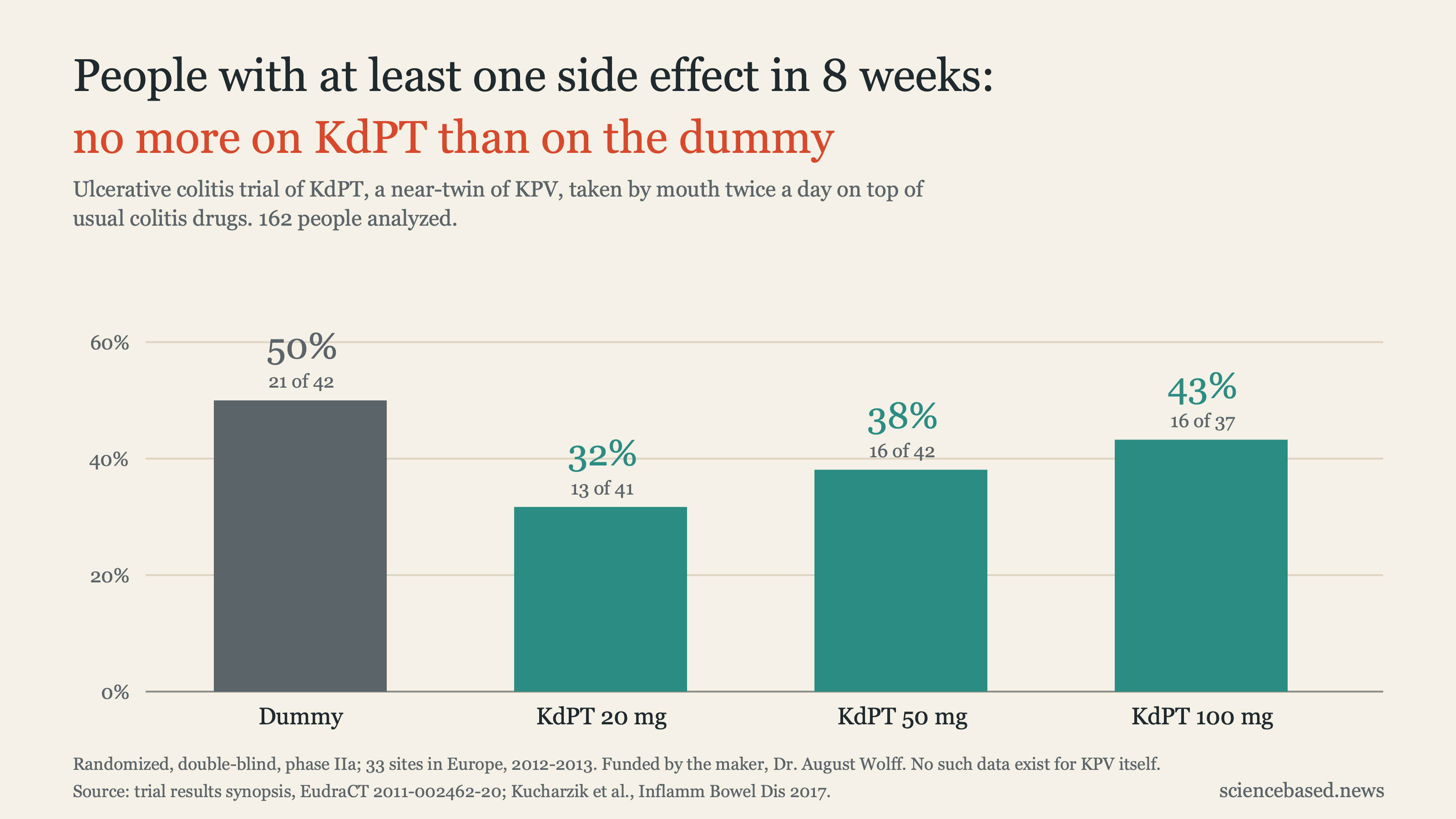
Side effects were no more common than on the dummy. In 8 weeks, 50% of people on the dummy reported at least one, against 32%, 38% and 43% in the three KdPT groups [2]. Only 4 of all the events were severe, spread across the groups.
Mice answer the puzzle, and they point the same way for KPV itself. In mice given a chemical that inflames the colon, KPV in the drinking water cut weight loss and lowered a marker of immune cells in the colon by about 30% [4]. The answer to the puzzle is a pump. KPV went into gut cells through PepT1, a pump that normally carries the small bits of digested protein, and inflamed colons make more of it. So the tiny peptide gets in where the inflammation is. In a second team's mice, KPV sped recovery in two kinds of colitis, and in a strain that lacks one alpha-MSH receptor, every treated mouse survived a colitis that killed untreated ones [5]. KdPT did the same in two mouse models and helped keep the gut wall sealed, without darkening skin [6]. A later study packed KPV into tiny particles coated to stick to inflamed colon; they calmed colitis in mice better than uncoated ones [7].
What is not known
The limits are big. Start with the trial. Its planned main test, how fast people improved by half and stayed there, missed: on the dummy, people kept getting better after week 4, and the gap closed [2]. The team then used two tests made for curves like that: one came out just short of the usual bar (P=0.053), the other just under it (P=0.037), which the authors count as meeting it [2, 3]. The remission results are side results, not the trial's main question. The exact remission percentages were never published in the summary or abstracts we could read; the full paper is behind a paywall.
The trial was run and paid for by the company that makes KdPT, and one author worked for it [1]. The company said a larger phase 2 trial would follow [2]. We found none registered in the 13 years since.
KdPT is not KPV. One amino acid is different, and the mirror-image middle one changes how long it lasts in the body. A result for one does not transfer to the other by default.
For KPV itself, there is nothing in people. The FDA searched the medical literature, its own reports of drug harms and its food and supplement complaints through December 2025 and found no study, no case report and no human exposure data by any route [8]. It wrote that the "potential safety risks associated with the use of KPV in humans are unknown." There are no animal toxicity, cancer or pregnancy studies either. The FDA also raised doubts about what is in the vials: peptides can clump, and clumps can make the body form antibodies against them [8].
Skin is a separate problem. In a lab test, KPV did not pass through human skin; it got through only when the skin was broken by tiny needles or an electric current [8]. A plain KPV cream may stay on the surface.
And the uses on clinic websites, from Lyme disease to histamine problems, have no study behind them at all [8].
Our grade
The question for the grade is whether KPV calms gut inflammation in people. The mouse results are consistent and the near-twin's trial is encouraging; the human evidence for KPV itself is zero.
| Claim | Evidence | Grade |
|---|---|---|
| In mice: KPV calms colitis | 3 studies by 2 teams, 5-10 mice per group; less weight loss and inflammation [4, 5, 7] | Promising |
| A near-twin, KdPT, speeds remission in ulcerative colitis | 1 trial, 162 people analyzed, 8 weeks; remission about doubled at 2 and 4 weeks, main test missed; company-funded [1-3] | Weak |
| KdPT is safe for 8 weeks | Same trial; side effects 32-43% against 50% on the dummy [2] | Promising |
| KPV cream calms skin | No human study; KPV did not pass through human skin in a lab test [8] | Unproven |
| Overall: KPV calms inflammation in the gut | No published study in people [8] | Unproven |
The case for the other side: KPV is not a foreign molecule. It is a piece of a hormone the body already makes, and it is so small that it can be taken by mouth, which most peptides cannot. Its pump, PepT1, is busiest in an inflamed colon. And the one trial of its nearest relative points in the right direction, with no more side effects than a dummy.
What would change the grade: a published randomized trial of KPV itself in people, with a real outcome such as remission in colitis or healing of a skin condition, and its side effects. A positive one would move it to Promising. A second, larger KdPT trial would also lift the near-twin's row.
What this means for you
If you are healthy and want a calmer gut, KPV has no evidence for that at all. The trial was in people with active colitis, on top of their usual drugs. What helps a healthy gut in people is tested and cheap: more fiber, fewer ultra-processed foods, and regular exercise.
If you have colitis or Crohn's disease, the approved drugs your gastroenterologist can prescribe have trials in thousands of people. The KdPT trial tested the twin as an add-on, not a swap. Do not stop a prescribed drug for KPV. If you are curious, take the trial (sources 1 and 2) to your doctor.
If you use KPV now, tell your doctor what you take and where it comes from. Vials sold "for research" are not checked for what is inside.
The hopeful part is real. A three-amino-acid fragment of your own hormone calmed colitis in mice, and its near-twin, swallowed as a drink, doubled early remission in people without more side effects. That is more than most peptides on the clinic menu can show.
What is KPV?
KPV is lysine, proline and valine, the end of alpha-MSH; it keeps the calming part without the tanning.
How many published studies have given KPV itself to a person?
The FDA found no study, case report or human exposure data for KPV by any route.
What did KdPT, KPV's near-twin, do in the colitis trial?
Remission was about twice as high at 2 and 4 weeks; the trial's planned main test was missed.
What happened to KPV in a lab test on human skin?
KPV got through only when the skin was broken by tiny needles or an electric current.
What's next
The next step for KPV is a rule, not a trial. After the July 2026 vote, the FDA still has to decide whether pharmacies may make it, and a draft policy on access to peptides went to the White House on October 14, 2026 [12]. Even if allowed, it would be made to order, not approved: no one would have tested it in a trial.
For evidence, the step that matters is the larger KdPT trial the company planned in 2013, or any trial of KPV itself. We found neither registered. We will update this article when one is.
This is one of our checks on the peptides in our guide to the best peptides, after MOTS-c, GHK-Cu and semax and selank. Our peptides article covers BPC-157, KPV's partner in the "gut stack".
A peptide small enough to swallow, from a hormone you already make, has done well in mice and in one trial of its twin. That is a real start, and it is worth watching.
Was this helpful?
Sources
Show all sources (12)
- Kucharzik T, Lemmnitz G, Abels C, Maaser C. Tripeptide K(D)PT is well tolerated in mild-to-moderate ulcerative colitis: results from a randomized multicenter study. Inflammatory Bowel Diseases, 2017;23(2):261-271. 168 adults with ulcerative colitis, randomized, double-blind, placebo-controlled, 8 weeks; read from the abstract (full text paywalled). Funded by Dr. August Wolff GmbH; one author is a company employee. https://doi.org/10.1097/MIB.0000000000001000
- Dr. August Wolff GmbH & Co. KG Arzneimittel. Clinical trial synopsis, KPT4-01/2011: K(D)PT in patients with mild to moderate ulcerative colitis. EU Clinical Trials Register, EudraCT 2011-002462-20, report dated December 12, 2013. https://www.clinicaltrialsregister.eu/ctr-search/trial/2011-002462-20/results
- Kucharzik T, Lemmnitz G, Abels C, Maaser C. Tripeptide KDPT accelerates disease remission in patients with mild to moderate active ulcerative colitis. Gastroenterology, 2014;146(5 Suppl 1):S-588, abstract Mo1216. Conference abstract of the same trial. https://doi.org/10.1016/S0016-5085(14)62131-4
- Dalmasso G, Charrier-Hisamuddin L, Nguyen HT, et al. PepT1-mediated tripeptide KPV uptake reduces intestinal inflammation. Gastroenterology, 2008;134(1):166-178. Human cells and mice (5-10 per group), two colitis models. https://doi.org/10.1053/j.gastro.2007.10.026
- Kannengiesser K, Maaser C, Heidemann J, et al. Melanocortin-derived tripeptide KPV has anti-inflammatory potential in murine models of inflammatory bowel disease. Inflammatory Bowel Diseases, 2008;14(3):324-331. Mice, two colitis models. https://doi.org/10.1002/ibd.20334
- Bettenworth D, Buyse M, Böhm M, et al. The tripeptide KdPT protects from intestinal inflammation and maintains intestinal barrier function. American Journal of Pathology, 2011;179(3):1230-1242. Mice and cells. https://doi.org/10.1016/j.ajpath.2011.05.013
- Xiao B, Xu Z, Viennois E, et al. Orally targeted delivery of tripeptide KPV via hyaluronic acid-functionalized nanoparticles efficiently alleviates ulcerative colitis. Molecular Therapy, 2017;25(7):1628-1640. Mice. https://doi.org/10.1016/j.ymthe.2016.11.020
- US Food and Drug Administration. FDA evaluation of KPV (free base) and KPV acetate. Briefing document, Pharmacy Compounding Advisory Committee, July 23-24, 2026. https://www.fda.gov/media/193346/download
- US Food and Drug Administration. July 23-24, 2026: Meeting of the Pharmacy Compounding Advisory Committee. https://www.fda.gov/advisory-committees/advisory-committee-calendar/july-23-24-2026-meeting-pharmacy-compounding-advisory-committee-07232026
- DLA Piper. Compounding at the crossroads: FDA adcomm recommends adding six peptides to bulk list. July 31, 2026. https://www.dlapiper.com/en-fr/insights/publications/2026/07/fda-adcomm-recommends-adding-six-peptides-to-bulk-list
- Liang L. Peptides: US advisory committee recommends six for FDA "compounding list". BMJ, 2026;394:e100422. https://www.bmj.com/content/394/bmj-2026-100422
- Holland & Knight. Peptides at a crossroads: what wellness providers need to know about HHS and FDA actions. October 2026. https://www.hklaw.com/en/insights/publications/2026/10/peptides-at-a-crossroads-what-wellness-providers-need-to-know
Discussion