

Selank and semax: the calm spray outlasted a benzodiazepine
Evidence check, October 29, 2026. Updated October 30, 2026.
The claim: "Selank, a Russian nasal-spray peptide, calms anxiety without sedation, and its sister peptide semax sharpens focus."
Our grade: Weak. In a randomized Russian trial of 60 people, selank eased anxiety less than a benzodiazepine during treatment, but a week after the last dose 17 of 30 selank users were still much better, against 9 of 30. Caveat: no trial has compared either peptide with a placebo, and semax has never been tested for focus in healthy people.
Two little nasal sprays keep turning up in your feed, sold as a pair. One is "for calm" and the other "for focus". They are Russian peptides called selank and semax.
Can a spray calm you down without the fog of an anxiety pill?
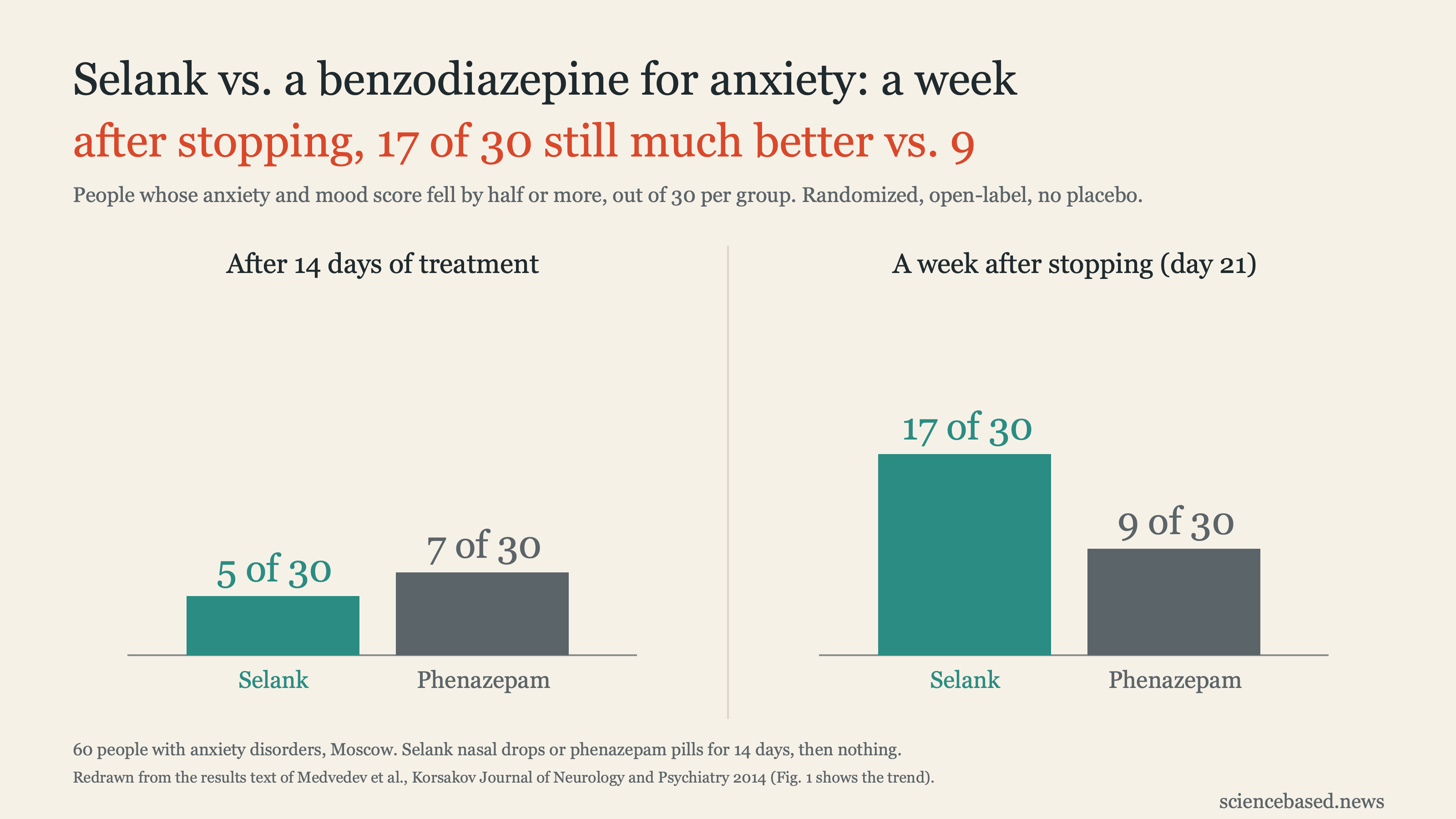
In the best trial we found, it did something interesting. In 2014, doctors in Moscow gave 60 people with anxiety either selank or phenazepam, a benzodiazepine (the drug family of Valium and Xanax), for two weeks [1]. A week after both drugs stopped, selank users were almost twice as likely as phenazepam users to still be much better.
Where the claim came from
Selank and semax were both made at the Institute of Molecular Genetics in Moscow. Each is a short chain of 7 amino acids, the building blocks of protein, copied from a piece of a natural body signal and given a 3-amino-acid tail that makes it last longer. Semax is built on a piece of ACTH, a stress hormone, and selank on tuftsin, a small immune peptide [1, 3].
In Russia, both are registered drugs sold as nasal drops. Semax is used there after strokes and selank for anxiety [1, 3].
In the US neither is approved. Clinics and websites sell them as nasal sprays and shots, alone and as a "50:50" semax and selank mix, the FDA found [3]. Interest jumped in July 2026, when the FDA's compounding advisers voted 8 to 5, with 1 abstaining, to let pharmacies make semax to order, against the advice of FDA staff [3, 7].
We searched the podcast and YouTube feeds we follow, from Huberman Lab to Peter Attia and Bryan Johnson, and found no episode on either peptide. The claim here is the sellers' own, built on the Russian studies.
What selank did against a benzodiazepine
During the two weeks of treatment, the benzodiazepine worked faster and harder. On a standard anxiety rating, scores fell 55% with phenazepam and 26% with selank by day 14 [1]. On the doctors' overall rating, a different measure from the chart below, 14 of 30 phenazepam users were much improved, against 5 of 30 on selank.
Then both drugs stopped, and the picture flipped. The doctors checked everyone again a week later, on day 21. Selank users kept getting better, while anxiety came back in the phenazepam group. By day 21, 17 of 30 selank users had their anxiety and mood score cut at least in half, against 9 of 30 on phenazepam, a difference unlikely to be chance (p = 0.037) [1].
The "no fog" part held up too. Phenazepam users made more mistakes on an attention test and found fewer words on a word test, and they had not recovered a week after stopping [1]. Selank users did not get worse on either test, and found 5% more words by day 14. The main side effect of selank was a dry nose. On phenazepam it was drowsiness, weakness, emotional flatness, sexual problems and dizziness on standing.
On a quality-of-life survey, the mental health score improved 43% on selank and 3% on phenazepam by day 14 [1].
An earlier study found much the same. In 2008, 62 people with generalized anxiety or nervous exhaustion got selank or medazepam, another benzodiazepine, and both groups had a similar drop in anxiety [2]. Selank users also reported more energy.
So back to the "calm" spray in your feed: in the trials, it calmed people more slowly than a benzodiazepine, but without the drowsiness, and the calm outlasted the dose. Why it lasted, and whether it was selank at all, is the question the trials leave open. And what about the "focus" spray?
Semax: strokes, not study sessions
Semax is sold for focus, but it was studied mostly in people recovering from strokes. In a 2018 Russian study of 110 stroke patients, those given two 10-day courses of semax recovered everyday skills, such as dressing and walking, faster than those who did not get it [4]. Their blood levels of BDNF, a growth factor that helps brain cells form new connections, rose and stayed up. There was no placebo, and we could read only the abstract.
In its 2026 review, the FDA did not count the Russian stroke studies, because no English translations were available [3]. It found two small human studies of other uses:
- Migraine: 12 people got one dose with no comparison group. In 4, the headache stopped within 2 hours, and the other 8 had less pain [3].
- Facial nerve pain: in 16 people with trigeminal neuralgia, a nerve pain in the face, nothing changed. The authors wrote that semax "does not exhibit analgesic activity by itself" [3].
For focus in healthy people, the evidence is thin. The FDA lists one 1996 study in 19 healthy men [3]. A 2020 placebo-controlled study of 52 healthy people looked at brain scans after semax or selank, not at memory or attention [5]. No trial has asked healthy people to take semax or a placebo and then measured whether they think better.
Selank and semax side effects
In the trials, selank's main side effect was a dry nose [1]. The FDA found no human study that measured how semax moves through the body, and no study of semax shots at all; every human study used nose drops [3]. Across all the studies it found, about 33 to 47 healthy adults had ever taken semax, and side effects were rarely reported.
The FDA's adverse event database holds one report: a person who bought semax nose drops online in 2024 had eye pain and burning, went to the hospital, and still had not recovered a year later [3]. One report can't show that semax caused it.
The FDA has two broader worries [3, 6]. Semax may slow blood clotting, which matters for anyone on blood thinners. And both peptides, made by a compounding pharmacy or an online seller, can clump or carry impurities that set off an immune reaction.
Are semax and selank legal?
Neither is an FDA-approved drug. The July 2026 vote on semax was advice, not a decision; as of October 2026 the FDA had not added it to the list pharmacies may use, and a draft federal policy on access to peptides went to the White House on October 14 [8]. Selank was put forward for compounding in 2023, then withdrawn, and the FDA lists it among substances that may pose significant safety risks [6].
So when you see them for sale, they are sold as "research chemicals" or by clinics working in a gray area. Nobody checks what is in the bottle.
What is not known
Was the lasting calm really selank? The trials can't say yet, for five reasons, all fixable:
- No placebo. Both selank trials compared it with a benzodiazepine, never with a dummy spray [1, 2]. Anxiety often eases on its own, so without a placebo group we can't tell how much of the 17 of 30 was selank.
- Not blinded. The 2014 trial was open: patients and doctors knew who got what [1]. A doctor who expects the new drug to do well can rate it a little better.
- Funded by the maker. The 2014 trial was paid for partly by Peptogen, the Russian company that makes selank, and one author is from the institute that created it [1].
- Short. Treatment lasted 2 weeks and follow-up 1 more week [1]. Nobody knows what happens after months of use.
- Semax for focus is untested. The healthy-volunteer studies are tiny and measured brain scans, not thinking [3, 5].
Each of these could be settled by one well-run trial: selank against a placebo, double-blind, for 8 weeks, outside Russia.
Our grade
| Claim | Evidence | Grade |
|---|---|---|
| Selank eases anxiety | 2 randomized trials, 60 and 62 people, against benzodiazepines; no placebo; 1 open-label and maker-funded [1, 2] | Weak |
| Selank does not cause drowsiness or slow thinking | 1 trial, 60 people; no drop on attention or word tests, against clear drops on phenazepam [1] | Weak |
| Semax helps recovery after stroke | 1 study of 110 patients, no placebo, abstract only; not counted by the FDA [3, 4] | Weak |
| Semax sharpens focus in healthy people | No trial with a test of thinking against a placebo; brain scans only [3, 5] | Unproven |
| Overall: selank calms anxiety without sedation, and semax sharpens focus | Weak human evidence for selank, none for semax and focus | Weak |
The case for the other side: selank has been a registered drug in Russia for years, and two trials against real anxiety drugs found it worked about as well in the end, without their main side effects [1, 2]. That is more than most peptides sold online can show.
The lasting effect is the kind of result researchers notice. A benzodiazepine's calm tends to fade, or rebound, when it stops. A drug whose effect keeps building for a week after the last dose would be useful, if a placebo trial confirms it.
What would change the grade: a double-blind trial of selank against a placebo, in at least 100 people with anxiety, for 8 weeks or more. A clear win would move selank to Promising. For semax, any placebo-controlled trial that measures memory or attention in healthy people would give it its first real grade for focus.
What this means for you
If anxiety is the reason you are curious, the treatments with the most trials behind them are talk therapy, especially cognitive behavioral therapy, and the medicines a doctor can prescribe. Regular exercise helps too, and it has a long list of other benefits; our sprint intervals check shows how 10 minutes three times a week raised fitness.
If focus is the reason, sleep comes first. Our sleep and brain cleaning article explains what a night of deep sleep does for the brain, and no peptide has been shown to replace it.
If you already use selank or semax, tell your doctor, especially if you take blood thinners or another medicine for anxiety. Products bought online are not tested for what is in them.
The hopeful part is real. A short peptide matched a benzodiazepine for anxiety by the end of a Russian trial, without the fog, and the calm was still growing a week later. It deserves a proper placebo trial. Until then, the "calm" spray is a promising idea, and the proven calm is still therapy, exercise and sleep.
In the 2014 trial, what happened a week after selank and phenazepam were stopped?
On day 21, a week after the last dose, selank users kept improving and phenazepam's effect faded.
During the two weeks of treatment, which drug lowered anxiety scores more?
The benzodiazepine worked faster and harder while people took it; selank caught up after both stopped.
Has semax been tested for focus in healthy people against a placebo?
A 2020 placebo study of 52 healthy people measured brain scans, not memory or attention.
What is the biggest gap in the selank evidence?
Both trials compared selank with a benzodiazepine; without a placebo group, we can't tell how much was the drug.
What's next
The next big answer would come from a placebo-controlled trial of selank, and we would love to see one run outside Russia. For semax, the FDA's decision on whether pharmacies may make it is the next step, and a federal policy on access to peptides is under review [8]. We will update this article when either arrives.
Semax and selank are two of the peptides in our guide to the best peptides. Their closest relatives on the site are epitalon and pinealon, two more short peptides from Russian labs, and for a peptide your own muscles make, see MOTS-c.
A Russian lab may have found a calmer kind of calm, and a good trial could tell us soon.
Was this helpful?
Sources
Show all sources (8)
- Medvedev VE, Tereshchenko ON, Israelian AIu, Chobanu IK, Kost NV, Sokolov OIu, Miasoedov NF. A comparison of the anxiolytic effect and tolerability of selank and phenazepam in the treatment of anxiety disorders. Zhurnal Nevrologii i Psikhiatrii imeni S.S. Korsakova, 2014;114(7):17-22. 60 people with anxiety disorders, randomized, open-label, selank 2.7 mg a day against phenazepam 2 mg a day for 14 days, follow-up to day 21; funded in part by Peptogen, the maker of selank, and a Russian government grant. Read in full in Russian. https://www.mediasphera.ru/issues/zhurnal-nevrologii-i-psikhiatrii-im-s-s-korsakova/2014/7/031997-7298201473
- Zozulia AA, Neznamov GG, Siuniakov TS, et al. Efficacy and possible mechanisms of action of a new peptide anxiolytic selank in the therapy of generalized anxiety disorders and neurasthenia. Zhurnal Nevrologii i Psikhiatrii imeni S.S. Korsakova, 2008. 62 patients, selank against medazepam, no placebo group. Abstract only. https://pubmed.ncbi.nlm.nih.gov/18454096/
- US Food and Drug Administration. FDA evaluation of semax-related bulk drug substances. Briefing document, Pharmacy Compounding Advisory Committee, July 23-24, 2026 (evaluation dated May 11, 2026). https://www.fda.gov/media/193348/download
- Gusev EI, Martynov MY, Kostenko EV, et al. The efficacy of semax in the treatment of patients at different stages of ischemic stroke. Zhurnal Nevrologii i Psikhiatrii imeni S.S. Korsakova, 2018. 110 stroke patients, semax or not, no placebo group. Abstract only. https://doi.org/10.17116/jnevro20181183261-68
- Panikratova YR, Lebedeva IS, Sokolov OY, et al. Functional connectomic approach to studying selank and semax effects. Doklady Biological Sciences, 2020. 52 healthy people, placebo-controlled, brain scans only. Abstract only. https://doi.org/10.1134/S001249662001007X
- US Food and Drug Administration. Certain bulk drug substances for use in compounding that may present significant safety risks. Updated April 2026. https://www.fda.gov/drugs/human-drug-compounding/certain-bulk-drug-substances-use-compounding-may-present-significant-safety-risks
- Reuters. FDA advisory panel recommends peptide Semax be added to pharmacy compounding list. July 24, 2026. https://www.reuters.com/legal/litigation/fda-advisory-panel-recommends-peptide-semax-be-added-pharmacy-compounding-list-2026-07-24
- Holland & Knight. Peptides at a crossroads: what wellness providers need to know about HHS and FDA actions. October 2026. https://www.hklaw.com/en/insights/publications/2026/10/peptides-at-a-crossroads-what-wellness-providers-need-to-know
Discussion