

PT-141 (Vyleesi) raised women's desire in two big trials
Evidence check, October 26, 2026. Updated October 31, 2026.
The claim: "PT-141 (bremelanotide, sold as Vyleesi) raises sexual desire in premenopausal women whose low desire bothers them."
Our grade: Solid. Two randomized trials of 1,267 women agree: desire rose and distress fell more than on placebo, and 58% felt they had benefited, against 36% on placebo. The effect is small, 40% had nausea, and it is only shown in women before menopause.
You love your partner, nothing is wrong between you, and still the wish for sex has gone quiet, and that bothers you. Your feed calls PT-141 "the libido peptide", a shot that works in the brain, not the blood vessels.
How much desire would it bring back, and what would it cost you?
For one group, there is a real answer. In two trials of 1,267 women before menopause, published in 2019, PT-141 raised desire more than a dummy shot over 24 weeks [1]. It is the only peptide sold for libido that is an approved drug.
Where the claim came from
PT-141 is the lab name of bremelanotide, a chain of 7 amino acids, the building blocks of protein. It grew out of melanotan II, a tanning peptide that gave men erections as a side effect. It works on melanocortin receptors in the brain, the same switches that help control hunger and skin color.
In June 2019 the FDA approved it as Vyleesi, an autoinjector pen, for premenopausal women with hypoactive sexual desire disorder: low desire that causes marked distress and is not caused by an illness, a medicine or problems in the relationship [2, 3].
Andrew Huberman covered it in his April 2024 episode on peptides. He said it is "FDA approved for the treatment of women that have suppressed libido", and that "men also will take" it [10]. In October 2024 his guest Craig Koniver, a doctor who prescribes peptides, said it can help men's erections because it is "a neurogenic mechanism", working through nerves rather than blood flow [11]. So the claim people hear is wider than the label.
We graded the part the trials tested: women before menopause.
What the two big trials found
The trials were called RECONNECT [1]. Women aged 19 to 56 who had low desire for at least 6 months, in a stable relationship, first used a dummy shot for 4 weeks. Then they were randomly given bremelanotide 1.75 mg or a dummy shot for 24 weeks, to use about 45 minutes before they expected to have sex, no more than once a day and 12 times a month. Women on antidepressants or with depression were left out.
Desire was scored on a short questionnaire from 1.2 to 6. It started at about 2 [2]. On the drug it rose 0.30 points more than on the dummy in the first trial and 0.42 in the second. Distress about low desire, scored 0 to 4, fell 0.37 and 0.29 points more. Both gaps were well beyond chance, and both showed by week 4 and lasted to week 24.
Those are small numbers on a scale few people know. Here is what they meant for a woman. About 25% of women on the drug had a big rise in desire, at least 1.2 points, against about 17% on the dummy [3]. And when asked whether they had benefited, 58% of women on the drug said yes in each trial, against 36% and 35% on the dummy [1].
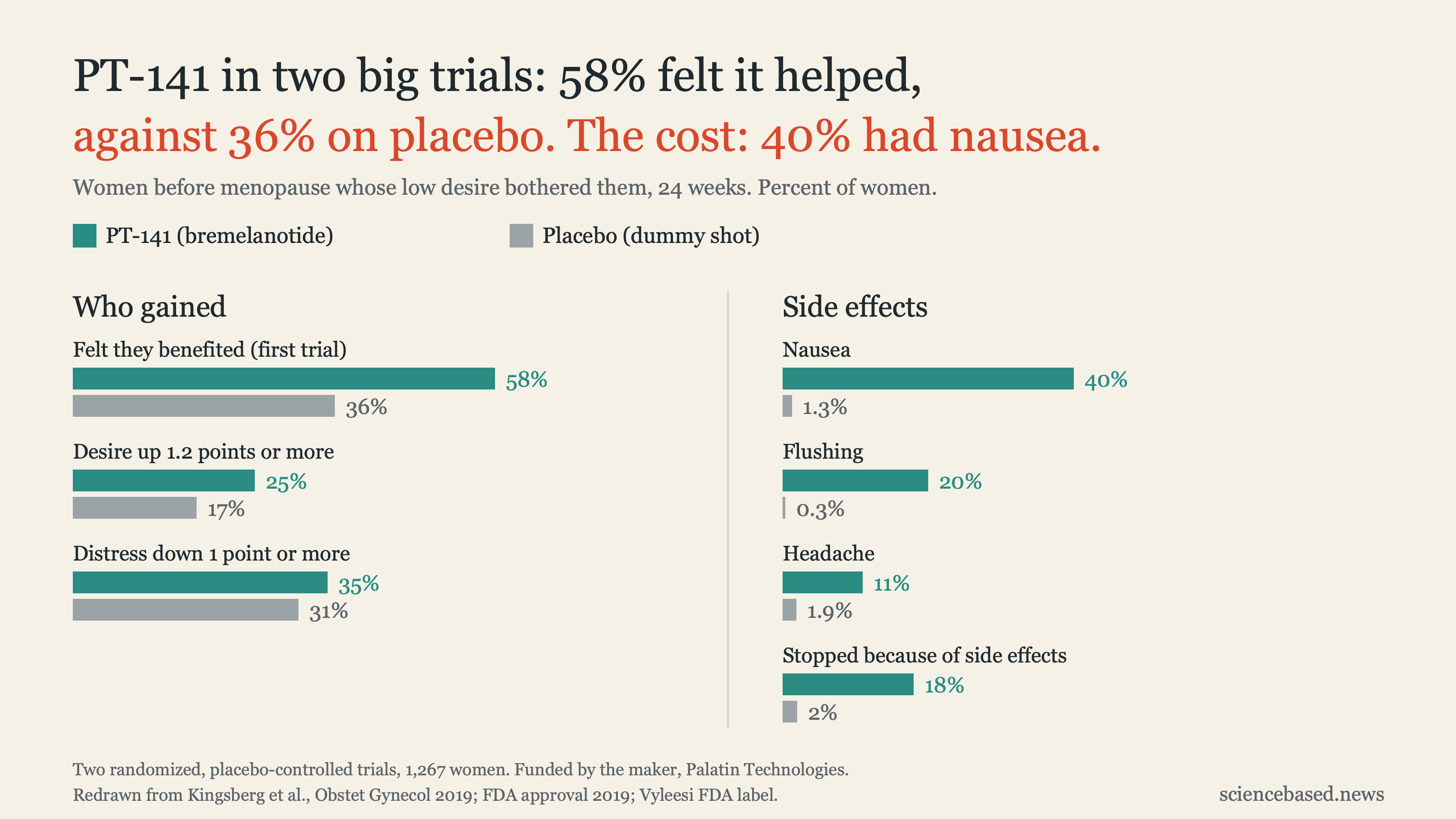
That is the answer to the question from the start. For women like the ones in the trials, PT-141 brings some desire back: about 1 in 4 had a big gain, and 1 in 12 had one because of the drug rather than the dummy. Many more felt a smaller change was worth it. The cost is on the right of the chart, and the biggest part of it is nausea.
A smaller trial came first. In 2016, 397 premenopausal women with low desire or arousal were randomly given one of three doses or a dummy shot for 12 weeks [5]. At 1.75 mg, the dose later approved, desire rose 1.0 point against 0.4 on the dummy. Satisfying sexual events rose by 0.7 a month on the two higher doses, against 0.2 on the dummy.
Then the women could keep going. Of the women who finished RECONNECT, 684 took the drug openly for another 52 weeks [4]. Women who had been on it all along had desire 1.25 to 1.30 points above where they started, and women who switched from the dummy gained 0.70 to 0.77. There was no dummy group in that year, and women who disliked the drug had already left, so it overstates the effect. About 40% finished the extra year.
The company also asked 242 women in exit surveys, and 80 in interviews, what changed [9]. Women on the drug more often described physical signs of arousal and more wish for sex; women on the dummy mostly did not.
What it did not do, and who it was not tested in
Two things are left to check: whether more desire meant better sex, and whether the result reaches anyone beyond these women.
The gain in desire did not turn into more satisfying sex in the big trials. The number of satisfying sexual events a month was a key goal set in advance, and it did not change (0.0 against -0.1 on the dummy) [1]. A later count, chosen after the results were in, found 25% of a woman's encounters were more satisfying on the drug against 10% on the dummy. That is a clue, not proof.
Nausea is the main side effect. 40% had it, against 1.3% on the dummy, and 8% stopped because of it [1]. It came about 30 minutes after a dose and lasted a median 2.4 hours. Most of it came with the first doses: 21% after the first dose and about 3% after later ones; 13% took a medicine for it [2]. Flushing hit 20% and headache 11%. In all, 18% stopped because of side effects, against 2% on the dummy.
More women left the trials early on the drug: 42% against 16% in the first trial, 44% against 28% in the second [1]. A psychologist who reanalyzed the trials counted 1 woman stopping for side effects for every 6 treated, and argued that fewer women chose to stay on the drug than on the dummy [7]: 70% of women on the drug went on to the open extra year, against 87% of women on the dummy [6]. The trial authors replied that his method was wrong [8].
Each dose raises blood pressure by up to 6 points on the top number and 3 on the bottom, and slows the heart by up to 5 beats a minute, for up to 12 hours [2]. So it is not for women with high blood pressure that is not controlled or with heart disease.
About 1% of women in the trials, using it up to 8 times a month, got dark patches on the face, gums or breasts [2]. Used daily for 8 days, 38% did. Not all patches faded, which is why the label says no more than 8 doses a month. It also lowers the level of naltrexone taken by mouth, a drug for alcohol and opioid addiction.
The trials say nothing about other groups. Women after menopause were not in them. Most women were white (86%) and in the US, and the trials were paid for by the companies that sold it [1].
Men are the open question. Small lab studies in the early 2000s found the nasal spray gave men erections within about 30 minutes, with flushing and nausea [12]. One larger trial in 342 men whose erections did not respond to sildenafil (Viagra) reported success in 34% against 9% on placebo [13]. But in 2023 the journal put an expression of concern on that study, one of 14 by the same author, whose study of the drug in women was retracted. In 2008 the company stopped developing the spray, for men and women, after a review of regulatory and business information [14]. It came back only for women, as a shot. No good trial in men has been published since.
Our grade
The question for the grade is how sure we can be that PT-141 raises desire in the women it was tested in. Two large trials and one earlier trial agree, so for them it is Solid, with a small effect.
| Claim | Evidence | Grade |
|---|---|---|
| Raises desire and eases distress in premenopausal women with low desire | 2 randomized trials, 1,267 women, 24 weeks, plus a 397-woman trial [1, 5] | Solid |
| Leads to more satisfying sex | Key goal missed in both big trials; the earlier trial found +0.7 a month [1, 5] | Weak |
| Keeps working past 6 months | 684 women, 52 more weeks, no placebo group [4] | Promising |
| Works for women after menopause | Not tested in these trials | Unproven |
| Helps men's erections or desire | Small lab studies; the one large trial has an expression of concern [12, 13] | Weak |
| Overall: PT-141 raises desire in premenopausal women whose low desire bothers them | 2 large randomized trials agree; effect small; 40% nausea [1-3] | Solid |
The case for the other side: the effect is small. A 0.3 to 0.4 point gain on a 1.2 to 6 scale is less than half the usual spread between women (an effect size of 0.39) [1], and only 1 in 12 got a big gain because of the drug [3]. Critics say that is close to nothing for a shot that makes 4 in 10 women sick to their stomach [7].
The yardstick is also soft. Desire is measured with a short questionnaire. Critics argue it is not clear such a change means a better sex life, and the one hard count, satisfying sex, did not move in the big trials [1, 15].
On the other side, women decide whether it is worth it, dose by dose. It is used only before sex, the nausea mostly fades after the first doses, and the label says to stop at 8 weeks if nothing changes [2]. A small effect that a woman can feel, on a problem with few treatments, is still an effect.
What would change the grade: an independent trial with an active comparison, or one that shows more satisfying sex, would make it stronger. A trial in women after menopause, or in men, would let us grade those claims.
What this means for you
If you are a premenopausal woman and low desire bothers you, bremelanotide is a real option to raise with a doctor. The doctor will first look for causes that have their own fix: depression, the pill, antidepressants, thyroid problems, pain during sex, stress or trouble in the relationship.
How much, and how soon. The trial dose was one 1.75 mg shot under the skin of the belly or thigh, about 45 minutes before sex, at most once a day and 8 times a month by the label [1, 2]. Most women used it 2 or 3 times a month. The gain in desire showed by week 4. If nothing changes after 8 weeks, the label says to stop.
Plan for the nausea. Try the first dose on a quiet evening, and ask about an anti-nausea pill; most nausea came with the first doses [2].
If you are a man, or past menopause, the trials did not test you. Gray-market PT-141 sold as "research peptide" vials is not the checked drug, and its content and dose are unknown.
There are other options with trials too. A 2026 review of 36 studies found that mindfulness-based cognitive behavioral therapy, a talking therapy, improved desire, arousal and orgasm, and that flibanserin (Addyi), a daily pill for the same problem, improved desire [16]. No trial has compared therapy with the drugs head to head, and you can do both.
The hopeful part is real. Low desire that bothers you is a recognized medical problem, not a flaw, and there is now an approved drug that helped more than half the women who tried it feel better about it. For the woman at the start, that is a reason to bring it up at her next visit.
Who was PT-141 (Vyleesi) tested and approved for?
The two big trials enrolled 1,267 premenopausal women with low desire that caused distress.
How many women on the drug felt they had benefited?
58% on the drug said they benefited in each trial, against 36% and 35% on the dummy shot.
What was the most common side effect?
Nausea hit 40% against 1.3% on placebo; 21% after the first dose and about 3% after later ones.
When is it used?
It is used as needed, about 45 minutes before sex; the label says no more than 8 doses a month.
What's next
The next answers to look for are about the people the trials left out. Doctors are asking whether bremelanotide should be tried in men with low desire or arousal [17], and a good trial in men would settle Huberman's "men also will take it". A trial in women after menopause would tell the many women past 50 whether it is for them.
This is one of our checks on the peptides in our guide to the best peptides, after melanotan II, the tanning peptide PT-141 came from, and MOTS-c. Our peptides article covers BPC-157, and for men's hormones see TRT.
Was this helpful?
Sources
Show all sources (17)
- Kingsberg SA, Clayton AH, Portman D, et al. Bremelanotide for the treatment of hypoactive sexual desire disorder: two randomized phase 3 trials. Obstetrics & Gynecology, 2019. 1,267 premenopausal women, 2 randomized, double-blind, placebo-controlled trials, 24 weeks. Funded by Palatin Technologies; writing support paid by AMAG Pharmaceuticals. https://doi.org/10.1097/AOG.0000000000003500
- US Food and Drug Administration. Vyleesi (bremelanotide injection), prescribing information. 2019. https://www.accessdata.fda.gov/drugsatfda_docs/label/2019/210557s000lbl.pdf
- US Food and Drug Administration. FDA approves new treatment for hypoactive sexual desire disorder in premenopausal women. Press release, June 21, 2019. https://web.archive.org/web/20250513082340/https://www.fda.gov/news-events/press-announcements/fda-approves-new-treatment-hypoactive-sexual-desire-disorder-premenopausal-women
- Simon JA, Kingsberg SA, Portman D, et al. Long-term safety and efficacy of bremelanotide for hypoactive sexual desire disorder. Obstetrics & Gynecology, 2019. 684 women, open-label, 52 weeks after the trials, no placebo. Industry funded. https://doi.org/10.1097/AOG.0000000000003514
- Clayton AH, Althof SE, Kingsberg S, et al. Bremelanotide for female sexual dysfunctions in premenopausal women: a randomized, placebo-controlled dose-finding trial. Women's Health, 2016. 397 women randomized, double-blind, 12 weeks. Funded by Palatin Technologies. https://doi.org/10.2217/whe-2016-0018
- Clayton AH, Kingsberg SA, Portman D, et al. Safety profile of bremelanotide across the clinical development program. Journal of Women's Health, 2022. Safety data from 43 studies, about 3,500 people. Industry funded. https://doi.org/10.1089/jwh.2021.0191
- Spielmans GI. Re-analyzing phase III bremelanotide trials for "hypoactive sexual desire disorder" in women. Journal of Sex Research, 2021. Reanalysis of the 2 phase 3 trials. https://doi.org/10.1080/00224499.2021.1885601
- Kingsberg SA, Clayton AH, Portman D, et al. Failure of a meta-analysis: a commentary on Glen Spielmans's "Re-analyzing phase III bremelanotide trials". Journal of Sex Research, 2021. https://doi.org/10.1080/00224499.2021.1902926
- Koochaki P, Revicki D, Wilson H, et al. The patient experience of premenopausal women treated with bremelanotide for hypoactive sexual desire disorder: RECONNECT exit study results. Journal of Women's Health, 2021. 242 surveys and 80 interviews. Industry funded. https://doi.org/10.1089/jwh.2020.8460
- Huberman Lab. Benefits & risks of peptide therapeutics for physical & mental health. Podcast, April 1, 2024 (from 01:12:09). https://www.hubermanlab.com/episode/benefits-risks-of-peptide-therapeutics-for-physical-mental-health
- Huberman Lab. Dr. Craig Koniver: peptide & hormone therapies for health, performance & longevity. Podcast, October 7, 2024 (from 02:07:53). https://www.hubermanlab.com/episode/dr-craig-koniver-peptide-hormone-therapies-for-health-performance-longevity
- Diamond LE, Earle DC, Rosen RC, et al. Double-blind, placebo-controlled evaluation of the safety, pharmacokinetic properties and pharmacodynamic effects of intranasal PT-141, a melanocortin receptor agonist, in healthy males and patients with mild-to-moderate erectile dysfunction. International Journal of Impotence Research, 2004. Healthy men and men with erection problems, randomized, single doses. Industry funded. https://doi.org/10.1038/sj.ijir.3901139
- Safarinejad MR, Hosseini SY. Salvage of sildenafil failures with bremelanotide: a randomized, double-blind, placebo controlled study. Journal of Urology, 2008. 342 men. Under an expression of concern since January 10, 2023: https://doi.org/10.1097/JU.0000000000003117. https://doi.org/10.1016/j.juro.2007.10.063
- Palatin Technologies. Form 8-K, exhibit 99: results and restructuring, May 13, 2008. https://www.sec.gov/Archives/edgar/data/911216/000108802008000021/ex99.htm
- Spielmans GI. Small effects, questionable outcomes: bremelanotide for hypoactive sexual desire disorder. Journal of Sex Research, 2024. https://doi.org/10.1080/00224499.2023.2175192
- Toledo RG, Winkelman WD, Reyes-Gonzalez D, et al. Female sexual desire, arousal, and orgasmic dysfunctions: a systematic review and meta-analysis of treatment options. Journal of Minimally Invasive Gynecology, 2026. 36 studies, 26 of them randomized. https://doi.org/10.1016/j.jmig.2025.06.004
- Pfaus JG, Balon R. Should bremelanotide be considered for the treatment of sexual arousal and desire disorders in men? Journal of Clinical Psychopharmacology, 2026. https://doi.org/10.1097/JCP.0000000000002179
Discussion