

Thymosin alpha-1 halved hepatitis B deaths in 3 trials
Evidence check, October 31, 2026
The claim: "Thymosin alpha-1 retunes a tired immune system, so the body fights infection the way it did when it was young."
Our grade: Weak. In chronic hepatitis B, three randomized trials with 907 people between them found about half as many deaths on thymosin alpha-1, and fewer side effects, not more [1]. Caveat: Cochrane rates that evidence very low certainty, all ten trials it found had design flaws, and the largest modern trial, in 1,089 people with sepsis, found no survival benefit [2].
Someone at the gym tells you about the shot his clinic gives him to "reset" his immune system. He is 70, and he mentions he has not had a cold in two years.
Does the shot do that?
The peptide he is describing is almost certainly thymosin alpha-1, a 28-amino-acid copy of a signal the thymus makes. The thymus is the small gland behind the breastbone that trains your T cells, and it shrinks and fills with fat as you age. Of all the peptides sold by longevity clinics, this one has the most human evidence behind it, by a wide margin: it is a licensed drug in roughly 35 countries, sold as Zadaxin, mostly for chronic hepatitis B and C [3].
Which makes the next two facts hard to square. In the liver disease it is licensed for, it cut deaths by about half. In the largest trial ever run on it, in a thousand people whose immune systems had collapsed, it did nothing at all.
Where the claim came from
The thymus story is what sells it. On June 1, 2026, Andrew Huberman gave the subject nearly three hours with Dr. Abud Bakri, a physician who prescribes peptides; the chapter on the thymus shrinking with age and thymosin alpha-1's effect on immune function starts at 1 hour 29 minutes [4]. Ben Greenfield ran a whole episode with the same guest on the gland and the peptides aimed at it [5]. The pitch on peptide podcasts is careful and worth repeating fairly: the peptide is called a modulator, not a booster. The claim is that it turns a weak immune response up and an overactive one down.
Clinics sell it for colds, long covid, Lyme disease and "immune resilience." Those uses have no trials. The evidence is in two places instead: a liver disease, and a hospital emergency.
Does it work? Start with the disease it is licensed for
The best evidence on thymosin alpha-1 arrived on September 9, 2026, when Cochrane published a review of every randomized trial in chronic hepatitis B [1]. Ten trials, 1,349 adults, from Bangladesh, China, Italy, Korea, Singapore and Taiwan, published between 1991 and 2018. Two compared the peptide with a dummy injection, two with no treatment, and six added it on top of a standard antiviral drug that both groups got.
Across the three trials that counted deaths, 14 of 460 people on thymosin alpha-1 died, against 26 of 447 on the comparison treatment: 3.0% against 5.8%, six months to two years after treatment ended. Serious side effects went the same direction, 10.1% against 13.4%, and minor ones were half as common.
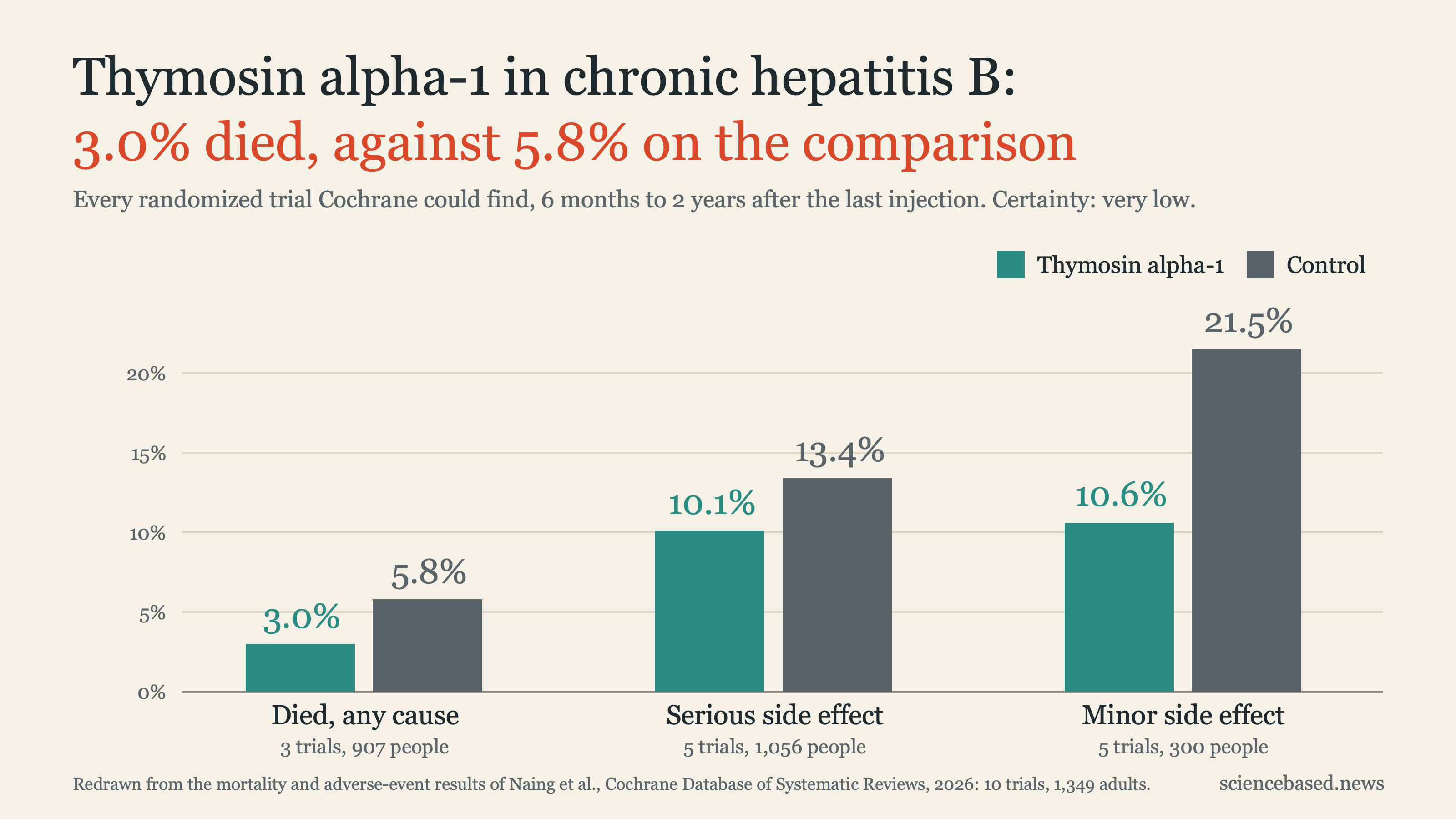
A drug that lowers deaths and side effects at the same time is unusual, and it is the single most impressive number in this peptide's whole file. Hold onto two things about it, though. The confidence interval runs from a 71% drop to a 4% drop, which is to say it only just clears no effect. And Cochrane graded the certainty very low, because all ten trials had problems with how they were designed or reported.
One older finding helps explain why these trials run long. A 2001 meta-analysis of five placebo-controlled trials in 353 people found almost nothing at the end of treatment, a hint six months later, and a clear benefit twelve months after the last injection [6]. The immune response it is meant to retune, if it does, takes a year to show up in the blood.
The big modern test: 1,106 people with sepsis
Then there is the trial the sales pages skip. Sepsis is the body's own catastrophic response to an infection, and it involves exactly the immune collapse thymosin alpha-1 is supposed to fix. Smaller trials had suggested it saved lives there.
Between 2016 and 2020, 22 hospitals across China ran that test properly: 1,106 adults with sepsis, randomly assigned to thymosin alpha-1 or a saline placebo for seven days, with nobody — patients, doctors or statisticians — knowing which was which [2]. Everyone got standard intensive care on top.
| 1,089 people with sepsis | Thymosin alpha-1 | Placebo | Change |
|---|---|---|---|
| Died within 28 days | 23.4% | 24.1% | no clear difference |
| Died within 90 days | 31.0% | 32.4% | no clear difference |
| New infection within 28 days | 25.3% | 26.1% | no clear difference |
| Any side effect | 66.4% | 67.6% | no clear difference |
| Serious side effect | 26.8% | 29.3% | no clear difference |
Flat, on every line. The hazard ratio for death at 28 days was 0.97, with a range from 0.76 to 1.24 — as close to "no effect" as a trial gets. The authors were straight about it, and about the one thing the trial did establish: in a thousand critically ill people, the drug caused no more harm than salt water.
A 2025 meta-analysis of 11 sepsis trials shows what happens when you pool the weaker studies with the strong ones [7]. Overall it found a benefit, with an odds ratio of 0.73. Split by quality, the five better trials (1,568 patients) showed 0.82, with a range crossing no effect, and the six weaker ones (359 patients) showed 0.41. Small, lower-quality trials carried the entire result, and the funnel plot flagged publication bias on top of that.
So back to your friend at the gym. The pattern across both diseases is the same: the peptide looks best where the evidence is thinnest, and it fades as the trials get bigger and better. That is the signature of a drug whose effect is small, or absent, or limited to people nobody has identified yet.
What the trials cannot tell you
No trial has tested it in healthy people for colds, flu or "immune resilience" — the use it is actually sold for. The nearest thing is a 1989 study in 90 men aged 65 to 99 that measured antibodies after a flu shot, not illness [8].
The hepatitis B result rests on old, small and flawed trials. The largest of the ten had 690 people; the smallest had 12. Four were paid for by industry. Cochrane found no trial still running anywhere, so nobody is on course to settle it.
The sepsis trial does leave one thread. Among people aged 60 and over, and among those with diabetes, the drug looked better than it did overall. The investigators themselves call that a hypothesis for a future trial, not a finding — subgroups like these turn out to be noise far more often than not.
Our grade
| Claim | Evidence | Grade |
|---|---|---|
| Lowers deaths in chronic hepatitis B | 3 randomized trials, 907 people: 3.0% vs 5.8%; Cochrane certainty very low | Weak |
| Saves lives in sepsis | 1 trial, 1,089 people: 23.4% vs 24.1%, no difference | Debunked |
| Fewer infections in healthy people | No trial | Unproven |
| Safe at the doses studied | 1,089 people: side effects matched placebo | Promising |
| Overall: retunes a tired immune system to fight infection | A real but very low-certainty death reduction in one liver disease; nothing in the largest modern trial | Weak |
The case for the other side is better than for most peptides on the clinic menu. This is a licensed medicine with decades of use in dozens of countries, a death reduction in the disease it is licensed for, and a safety record built on more than a thousand critically ill people. Dismissing it as hype would be wrong.
What would move the grade up is also clear: one modern, well-run trial in chronic hepatitis B or in older adults, reporting deaths or infections rather than blood markers, with follow-up long enough to catch a delayed effect. None is registered.
In the US, meanwhile, you cannot get it legally. The FDA has never approved it, and in December 2024 the agency's compounding advisers took up whether pharmacies should be allowed to make it. The FDA's own review said no: the substance is not well characterized chemically, it may provoke immune reactions, and approved drugs already exist for the serious diseases in question [9]. The committee agreed. It is not on the 503A list that would make compounding lawful, and the July 2026 advisory meeting that recommended six other peptides did not review it [10].
What this means for you
If you have chronic hepatitis B, the drugs to ask your liver doctor about are tenofovir and entecavir, which have the large trials behind them. In every trial above where thymosin alpha-1 was added to standard treatment, it was added on top, never instead.
If what you actually want is the immune system you had at 40, the proven options are unglamorous and they work: the flu, covid, shingles and pneumonia vaccines, keeping the muscle you have, and sleeping properly. Those lower infections in older adults. No vial on a clinic menu has been shown to do that.
And if you are taking it anyway, tell your doctor. The drug itself looks mild, but a gray-market vial is not checked for purity, and that is a different risk from the molecule.
The hopeful part is real, and it is not about buying anything. The gland behind your breastbone is now a serious target for research, not a throwaway organ — this peptide is the first of several attempts to speak its language, and it already has a death reduction in one disease to its name. Keep the shots that are proven, keep the muscle, and watch this one.
What did the 2026 Cochrane review find in chronic hepatitis B?
14 of 460 people on thymosin alpha-1 died against 26 of 447 on the comparison, but all ten trials had design flaws.
What happened in the biggest sepsis trial, with 1,106 people?
The hazard ratio was 0.97, with a range from 0.76 to 1.24.
What use is thymosin alpha-1 actually licensed for abroad?
It is sold as Zadaxin in roughly 35 countries, mostly for the two chronic liver infections.
Can you get thymosin alpha-1 legally in the US?
The FDA's review in December 2024 found it poorly characterized chemically and possibly immunogenic.
What's next
The study worth waiting for is the one nobody has started. Cochrane searched every trial register in June 2026 and found no ongoing trial of thymosin alpha-1 in hepatitis B, which means the next answer will come from whoever runs the modern trial first. The thymus itself is the livelier field: blood tests that score how much of yours is still working are moving into clinics, and they would make a future trial much easier to aim.
Nearer term, the US rules are in motion. HHS and the FDA sent an interim policy on compounding certain peptides to the White House for review on October 14, 2026 [10]. It does not cover this one, but it is the first sign of a formal path.
More in this series: our peptide guide grades 20 of them in one table, KPV and semax and selank got the same treatment this week, and TB-500 is thymosin alpha-1's unrelated namesake, which people mix up constantly.
Your immune system is not a gadget you upgrade. It is a system you keep in shape — and the dull things that do that are the things with the best evidence of all.
Was this helpful?
Sources
Show all sources (10)
- Naing C, Ni H, Aung HH, Aye SN, Nikolova D, Poovorawan Y, Pavlov C. Thymosin-ɑ1 for people with chronic hepatitis B. Cochrane Database of Systematic Reviews, 2026. 10 randomized trials, 1,349 participants, follow-up 6 months to 5 years after treatment. No dedicated funding. https://doi.org/10.1002/14651858.CD014610.pub2
- Wu J, Pei F, Zhou L, et al. The efficacy and safety of thymosin α1 for sepsis (TESTS): multicentre, double blinded, randomised, placebo controlled, phase 3 trial. The BMJ, 2025. 1,106 adults randomized at 22 centres in China, 7 days of treatment, 90-day follow-up. https://doi.org/10.1136/bmj-2024-082583
- Goldstein AL, Goldstein AL. From lab to bedside: emerging clinical applications of thymosin alpha 1. Expert Opinion on Biological Therapy, 2009. Review; records approval in over 35 countries for hepatitis B and C and as an immune stimulant and adjuvant. https://doi.org/10.1517/14712590902911412
- Huberman A, Bakri A. Peptides: The Science, Uses & Safety. Huberman Lab, episode 283, June 1, 2026. Thymus and thymosin alpha-1 from 1:29:38. https://www.hubermanlab.com/episode/peptides-the-science-uses-and-safety-abud-bakri
- Greenfield B, Bakri A. The Little-Known "Throwaway" Gland That Is Critical For Immunity. Boundless Life. https://bengreenfieldlife.com/thymuspodcast
- Chan HL, Tang JL, Tam W, Sung JJ. The efficacy of thymosin in the treatment of chronic hepatitis B virus infection: a meta-analysis. Alimentary Pharmacology & Therapeutics, 2001. 5 randomized trials, 353 patients. https://doi.org/10.1046/j.1365-2036.2001.01135.x
- Gu B, Zhou Y, Nie Y, et al. Efficacy of thymosin α1 for sepsis: a systematic review and meta-analysis of randomized controlled trials. Frontiers in Cellular and Infection Microbiology, 2025. 11 randomized trials, 1,927 patients. https://doi.org/10.3389/fcimb.2025.1673959
- Gravenstein S, Duthie EH, Miller BA, et al. Augmentation of influenza antibody response in elderly men by thymosin alpha one. Journal of the American Geriatrics Society, 1989. 90 men aged 65-99, randomized. https://pubmed.ncbi.nlm.nih.gov/2642497/
- US Food and Drug Administration. Evaluation of Thymosin Alpha-1 (Ta1)-Related Bulk Drug Substances for Inclusion on the 503A Bulk Drug Substances List. Briefing document, Pharmacy Compounding Advisory Committee, December 4, 2024. https://www.fda.gov/media/183820/download
- Holland & Knight. Peptides at a Crossroads: What Wellness Providers Need to Know About HHS and FDA Actions. October 16, 2026. https://www.hklaw.com/en/insights/publications/2026/10/peptides-at-a-crossroads-what-wellness-providers-need-to-know
Discussion