

MK-677 pill kept growth hormone at young-adult levels for a year
Evidence check, October 7, 2026
The claim: "MK-677 is a daily pill that raises your growth hormone to build muscle and deepen sleep."
Our grade: Weak. It does raise growth hormone, for a full year. But in the one-year trial, 65 older adults gained weight and no strength, and their blood sugar rose.

Sam is 35 and lifts three times a week. A friend at the gym is taking MK-677, a capsule he bought online. No needles, he says, and he is up eight pounds.
If Sam gained that weight too, would it be muscle he could use?
There is a real answer. MK-677 is one of the few products on the peptide shelf with a year-long trial against a placebo, a dummy pill. The trial put the weight on a scanner and the people on strength machines.
Where the claim came from
MK-677, also called ibutamoren, is not a peptide. It is a small molecule you swallow. It copies ghrelin, the hunger hormone your stomach makes, which also tells the pituitary gland under your brain to release growth hormone. Merck developed it in the 1990s. It was never approved as a medicine.
Andrew Huberman covered it in his April 2024 episode on peptides. He called it "simply an oral version" of the injected growth hormone releasers and said that group "can potently increase growth hormone" [1]. His show notes cite two short Merck-era studies in younger adults, which we get to below.
He is right about the hormone. That part is the best-proven thing about this pill.
The hormone rise is real and it lasts
Researchers at the University of Virginia gave 65 healthy adults aged 60 to 81 either 25 mg of MK-677 or a placebo every morning for a year. The trial was randomized and double-blind, so neither the volunteers nor the staff knew who got which. The National Institutes of Health paid for it and Merck supplied the pills [2].
Growth hormone over 24 hours rose 1.8-fold. IGF-1, the blood marker that follows growth hormone, rose 1.5-fold, "to those of healthy young adults" in the authors' words. It stayed there all year [2].
An earlier study of 32 adults aged 64 to 81 found the same thing over four weeks: growth hormone up 97% on 25 mg [5]. So the pill does what the label says. The question is what the extra hormone does for you.
What a year of it did to the body
People on MK-677 gained 2.7 kg (6 lb) over the year. People on placebo gained 0.8 kg (1.8 lb) [2].
Body scans split that weight into parts. Lean mass, which is everything that isn't fat or bone, rose 1.1 kg on the pill and fell 0.5 kg on placebo. Fat rose too: 1.8 kg on the pill against 1.1 kg on placebo, a gap too small to be sure of [2].
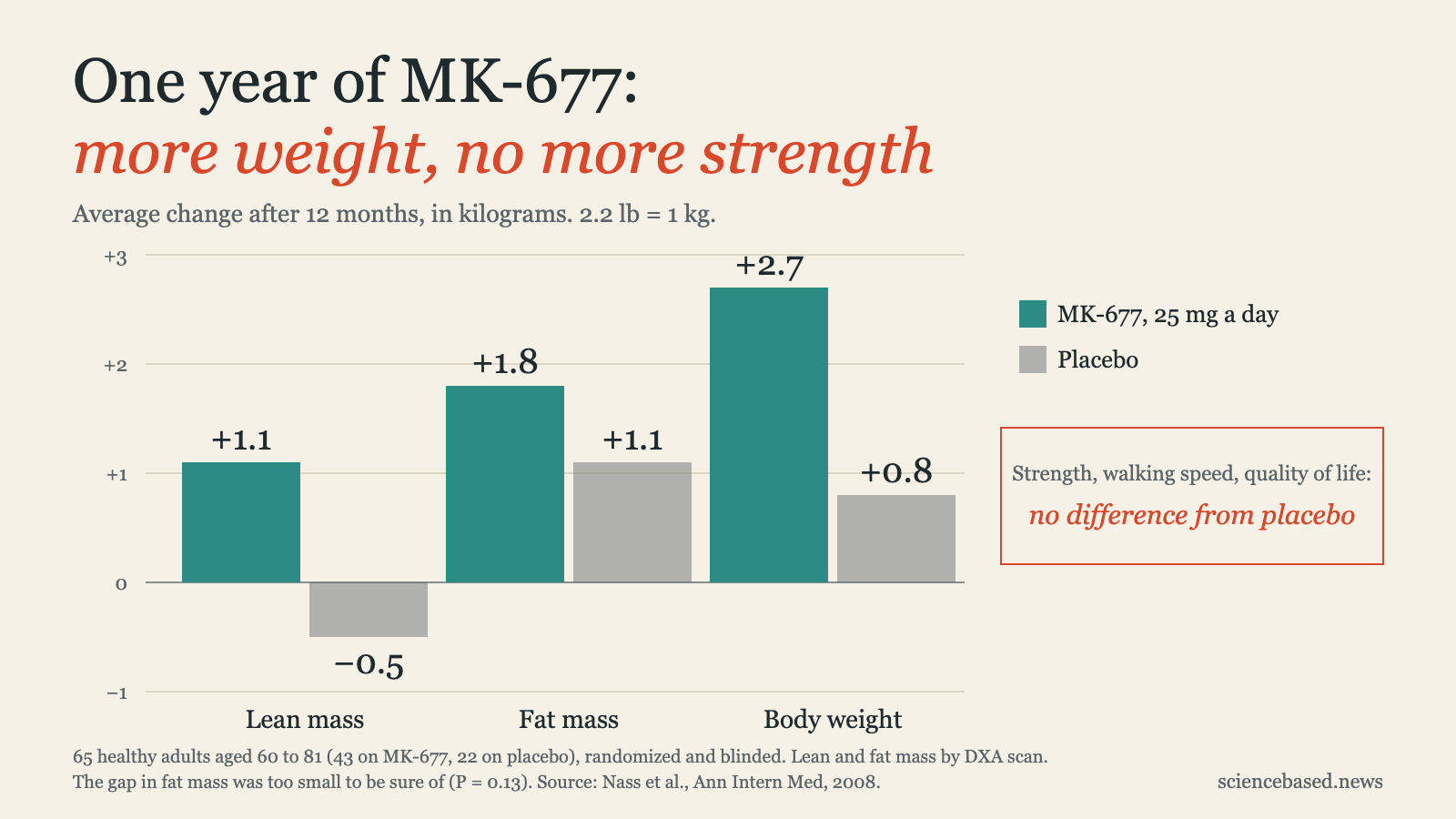
Lean mass is not the same as muscle. It includes water, and growth hormone makes the body hold water. The team also measured the thigh muscle directly with a CT scan. It had not grown [2].
Then they tested strength at the knee and shoulder, plus walking speed and everyday function. None of it differed from placebo. The authors wrote that the added lean mass "did not result in changes in strength or function" [2].
So back to Sam's friend. Going by this trial, his eight pounds are mostly water and fat, and he is no stronger for them.
What it did to blood sugar
Fasting blood sugar rose by 5 mg/dL on the pill and did not move on placebo. Sixteen of the 43 people on MK-677 went from a normal fasting level to 101 to 110, the low end of the prediabetes range. Two of 22 on placebo did [2].
HbA1c, a three-month average of blood sugar, rose 0.2 points on the pill. The body also responded less well to insulin [2]. A shorter trial saw the same pattern: 24 obese men aged 18 to 50 took the pill or a placebo for 8 weeks, and their blood sugar after a sugar drink was worse on the pill [4].
Hunger went up in 67% of people on the pill, against 36% on placebo. For half of them it settled within three months [2].
What about younger people, and sleep?
The studies in people Sam's age are short. Eight volunteers aged 24 to 39 on a strict diet lost less body protein during a week on MK-677 [3]. The 24 obese men gained lean mass in 8 weeks, and their fat did not change [4]. Neither study measured strength, and neither lasted long enough to show muscle.
The sleep claim rests on one study from 1997. Eight men aged 18 to 30 took the pill at bedtime for a week. Their deepest stage of sleep grew by about 50% and dream sleep by over 20% [6]. That is a real finding in eight people. Nobody has run a longer sleep trial since.
Our grade
| Claim | Evidence | Grade |
|---|---|---|
| Raises growth hormone and IGF-1 for a year | Placebo trial of 65, plus earlier trials | Solid |
| Adds lean mass on a scan | Placebo trials of 65 and 24 | Promising |
| Deeper sleep | 8 young men, one week | Weak |
| More muscle strength or better function | No difference in the one-year trial | Not supported |
| Helps recovery after a hip fracture | 123 patients; stopped early over heart failure | Not supported |
| Slows Alzheimer's | Placebo trial of 563, one year | Not supported |
| Overall: build muscle and sleep deeper | Hormone up, strength flat, blood sugar up | Weak |
The case for the other side: the hormone rise is large and lasting, which most products on this shelf cannot show. LDL cholesterol fell a little. And the Virginia team said their trial was too small and short to settle whether function improves over more years [2].
The safety signal matters, though. A Merck trial in 123 people recovering from a broken hip was "terminated early due to a safety signal of congestive heart failure" [7]. Peter Attia's notes put the count at four patients on the drug and one on placebo, and his team wrote that they "cannot recommend" it [9]. The FDA lists the drug among substances pharmacies should not compound, for the same reason [10]. A Merck trial in 563 people with Alzheimer's raised IGF-1 by 73% and slowed nothing [8].
A year-long trial in adults under 50 that tested strength would change this grade either way. None is registered.
What this means for you
- If you want strength, this pill has not added any. Lifting and enough protein do. See how much protein you need.
- Expect the scale to go up. In the trial about 6 pounds came on in a year, and the scans say much of it was fat and water.
- If you take it anyway, get a fasting blood sugar and HbA1c test before you start and again at three months. If you have prediabetes or diabetes, this is the wrong pill.
- If you have heart disease or swelling in your legs, stay away. The hip fracture trial was stopped over heart failure.
- What you can buy is not a pharmacy product. It is sold online as a "research chemical", so the dose on the label is a promise, not a test result.
- If you compete in a tested sport, it is banned by name [11].
- For sleep, one week in eight men is not enough to plan on. Talk therapy for insomnia (CBT-I) has far more behind it.
In the one-year trial, what happened to strength on MK-677?
Knee and shoulder strength, walking speed and everyday function were all the same as on placebo.
What did the pill do to growth hormone?
Growth hormone rose 1.8-fold and IGF-1 rose 1.5-fold, to young-adult levels, and stayed there.
Which blood test should you get if you take it?
Fasting blood sugar rose, and 16 of 43 people on the pill moved into the prediabetes range.
What is the evidence for deeper sleep?
Deep sleep grew by about 50% in that study. No longer sleep trial has been run.
What's next
The same drug, under the name LUM-201, is now in a late-stage trial for children who make too little growth hormone: 150 children, one year, against placebo, with results expected after December 2027 [12]. That could make it a real medicine for them. No trial in healthy adults is registered.
This is the fifth of our one-by-one checks on the peptides in the guide, after tesamorelin, CJC-1295, ipamorelin and sermorelin. Next is AOD-9604, sold as a fat-loss fragment of growth hormone.
Was this helpful?
Sources
- Huberman A. Benefits & Risks of Peptide Therapeutics for Physical & Mental Health. Huberman Lab, April 1, 2024. https://www.hubermanlab.com/episode/benefits-risks-of-peptide-therapeutics-for-physical-mental-health
- Nass R, Pezzoli SS, Oliveri MC, et al. Effects of an oral ghrelin mimetic on body composition and clinical outcomes in healthy older adults: a randomized trial. Annals of Internal Medicine, 2008. 65 healthy adults aged 60 to 81, randomized, double-blind, placebo-controlled, 12 months; funded by the NIH, pills supplied by Merck. doi:10.7326/0003-4819-149-9-200811040-00003
- Murphy MG, Plunkett LM, Gertz BJ, et al. MK-677, an orally active growth hormone secretagogue, reverses diet-induced catabolism. Journal of Clinical Endocrinology & Metabolism, 1998. 8 healthy volunteers aged 24 to 39, randomized crossover, 7 days; run by Merck. doi:10.1210/jcem.83.2.4551
- Svensson J, Lönn L, Jansson JO, et al. Two-month treatment of obese subjects with the oral growth hormone (GH) secretagogue MK-677 increases GH secretion, fat-free mass, and energy expenditure. Journal of Clinical Endocrinology & Metabolism, 1998. 24 obese men aged 18 to 50, randomized, double-blind, placebo-controlled, 8 weeks. doi:10.1210/jcem.83.2.4539
- Chapman IM, Bach MA, Van Cauter E, et al. Stimulation of the growth hormone (GH)-insulin-like growth factor I axis by daily oral administration of a GH secretogogue (MK-677) in healthy elderly subjects. Journal of Clinical Endocrinology & Metabolism, 1996. 32 healthy adults aged 64 to 81, randomized, placebo-controlled, up to 4 weeks. doi:10.1210/jcem.81.12.8954023
- Copinschi G, Leproult R, Van Onderbergen A, et al. Prolonged oral treatment with MK-677, a novel growth hormone secretagogue, improves sleep quality in man. Neuroendocrinology, 1997. 8 young men, 7-day placebo crossover, and 6 older adults with no placebo. doi:10.1159/000127249
- Adunsky A, Chandler J, Heyden N, et al. MK-0677 (ibutamoren mesylate) for the treatment of patients recovering from hip fracture: a multicenter, randomized, placebo-controlled phase IIb study. Archives of Gerontology and Geriatrics, 2011. 123 patients, randomized, placebo-controlled, 24 weeks, stopped early; run by Merck. doi:10.1016/j.archger.2010.10.004
- Sevigny JJ, Ryan JM, van Dyck CH, et al. Growth hormone secretagogue MK-677: no clinical effect on AD progression in a randomized trial. Neurology, 2008. 563 people with mild to moderate Alzheimer's disease, randomized, double-blind, placebo-controlled, 12 months; run by Merck. doi:10.1212/01.wnl.0000335163.88054.e7
- Attia P. #387, AMA #83: Peptides. The Peter Attia Drive, 2026. https://peterattiamd.com/preview-ama83/
- US Food and Drug Administration. Certain Bulk Drug Substances for Use in Compounding that May Present Significant Safety Risks (ibutamoren mesylate). https://www.fda.gov/drugs/human-drug-compounding/certain-bulk-drug-substances-use-compounding-may-present-significant-safety-risks
- World Anti-Doping Agency. Prohibited List 2026, growth hormone secretagogues, "ibutamoren (MK-677)". https://www.wada-ama.org/en/prohibited-list
- ClinicalTrials.gov NCT06948214. LUM-201 in children with growth hormone deficiency, phase 3, 150 children, 12 months, placebo-controlled; sponsor Lumos Pharma. https://clinicaltrials.gov/study/NCT06948214