

Pinealon restored brain-cell connections in mice bred to get Alzheimer's
Evidence check, October 6, 2026
The claim: "Pinealon gives you more REM sleep and protects your brain as you age."
Our grade: Unproven. Mouse and cell studies show real effects on nerve cells. No study in people has measured sleep or memory against a placebo.
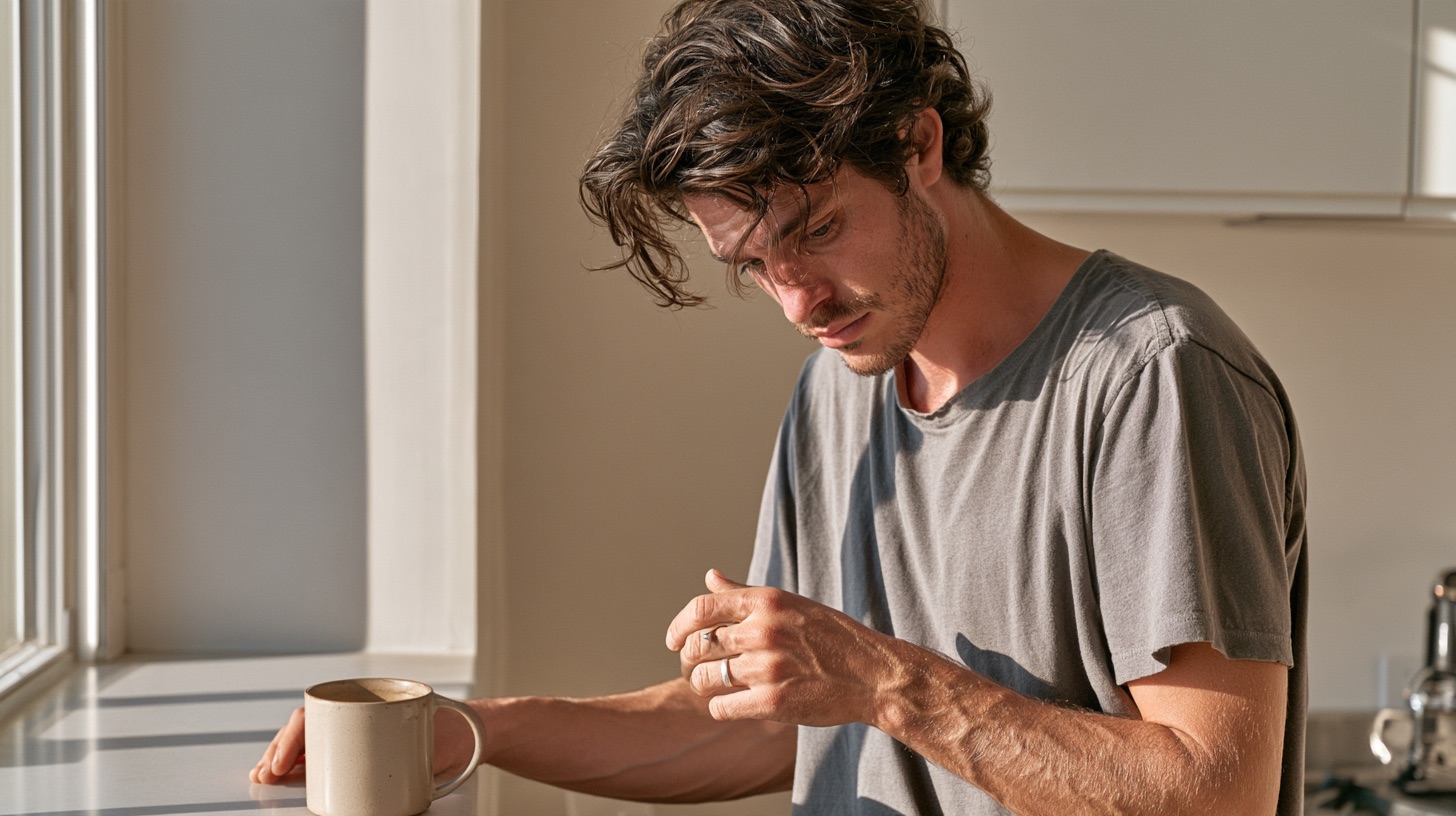
Leo is 26. Every morning he checks his sleep ring before his coffee is done. Deep sleep is fine. Dream sleep, called REM, is stuck at about an hour. Then he hears a famous podcast host say a tiny peptide nearly doubled his.
Has anyone tested that?
REM sleep matters for memory and mood, so a real fix would be worth a lot. We went through every pinealon paper we could find on PubMed, the main index of medical research.
Where the claim came from
Pinealon is three amino acids in a row: glutamate, aspartate and arginine. Researchers write it "EDR". It comes from the St. Petersburg lab of Vladimir Khavinson, which makes very short peptides it says can switch genes on and off [3].
The sleep claim took off in October 2024. On the Huberman Lab podcast, Andrew Huberman told his guest, the physician Craig Koniver, about pinealon in a section on peptides for sleep [1]. He had taken it for four to six months, along with glycine, an amino acid [2]. Men's Health quotes him: "never before have I found something that can improve the amount of rapid eye movement sleep that I get," going "from an hour to two hours or from an hour and thirty to nearly three hours" [2].
That is one person's sleep numbers, and he was taking two things at once. It is a good reason to look at the studies.
Sellers add more: sharper memory, protection from Alzheimer's, slower aging. The usual story is that it acts on the pineal gland, the pea-sized part of the brain that makes the sleep hormone melatonin [2].
The name points to the wrong gland
Here is the first surprise. The lab's own review says pinealon was found in Cortexin, a Russian nerve-protecting medicine made of mixed peptides [3]. Not one paper we found measured melatonin, the pineal gland or sleep after pinealon, in people or in animals.
We searched PubMed for pinealon with "sleep", "REM", "melatonin" and "circadian". One paper came back. It is a 2026 review by American orthopedic surgeons that lists pinealon among "recovery" peptides and says that across these peptides "there is a current lack of clinical trials" [13].
So the sleep claim has no study behind it at all. The brain claim has some.
What it does to nerve cells in a dish
Nerve cells talk to each other through tiny knobs on their branches called dendritic spines. Think of them as connection points. The sturdy ones, shaped like mushrooms, are tied to lasting memories. Alzheimer's strips them away.
In 2017 the lab grew mouse nerve cells in a dish and added amyloid, the sticky protein that builds up in Alzheimer's. Mushroom spines dropped. With pinealon in the dish, they rose 71%, back to normal [5].
In 2024 the team tried human cells. They turned skin cells from elderly donors into nerve cells, which keep the marks of age. Pinealon gave them 28% more main branches. A marker of DNA damage fell 23%, though that result just missed the usual cutoff for being sure it wasn't chance [6].
Earlier cell work found less damage from oxygen stress [7]. In rats, pups whose mothers got pinealon during a harmful pregnancy diet did better on tests of learning and finding their way [8].
The best study: mice bred to get Alzheimer's
A dish is not a brain. So in 2021 the lab moved to living mice that carry human Alzheimer's genes and lose connection points as they grow up [4].
Ten such mice got a pinealon shot in the belly every day for two months. Ten got salt water. Ten healthy mice got salt water too. Then the team counted spines in the hippocampus, the brain's memory center.
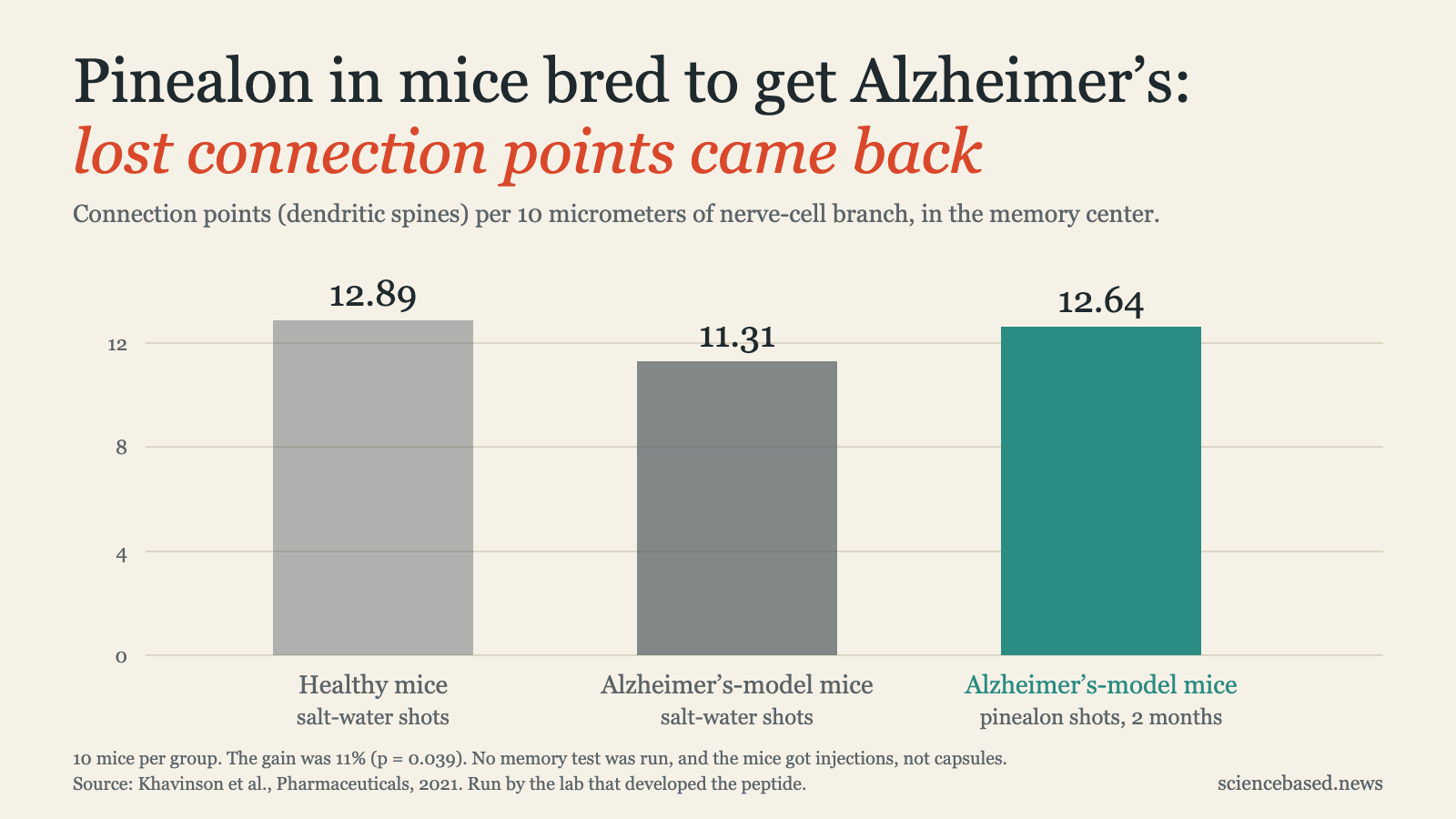
The Alzheimer's mice on salt water had 11.31 spines per stretch of branch. Healthy mice had 12.89. The pinealon mice had 12.64, which is 11% more than their untreated twins and about level with healthy mice [4].
That is the peptide's best result, and it is a real one. Now the limits, which the paper is open about.
The mushroom spines, the memory kind, did not clearly rise in the whole group. They did in males, not in females. The electrical sign of memory forming showed "a positive trend" that did not pass the test for chance. A sister peptide in the same study, called KED, did better. And nobody ran a memory test, so we don't know if these mice remembered anything better [4].
Every one of these studies came from the lab that developed pinealon. Khavinson is named on its patent [3]. No outside group has repeated them.
What about people?
Human reports exist. All are in one Russian journal, and we could read only their English summaries.
In one, 32 people aged 41 to 83 with long-term brain problems took pinealon or a sister peptide, vesugen. The authors reported slower aging on a "biological age" score, and said vesugen did better. They also found fewer blood stem cells afterward, which they called "significant inhibition" of blood-cell production, and signs of more oxygen stress, not less [9].
Train drivers took one capsule of 100 micrograms twice a day for two weeks and improved on "biological age" measures [10]. In a study of 150 truck drivers, the authors said pinealon and vesugen eased nervous strain, most when taken together. The summary doesn't say how many drivers took them [11].
None of these summaries mentions a placebo group or random assignment. Without those you can't tell a drug from hope, or from time passing.
The memory claim traces to one line in the lab's reviews: 72 patients with old head injuries took pinealon on top of usual care, and memory improved in 59.4% of them [3][4][12]. The reviews give no comparison group. We could not find the original report.
So back to Leo and his ring. Nobody has measured what pinealon does to REM sleep, in anyone. For his real question, the answer is that science has not asked it yet.
Our grade
| Claim | Evidence | Grade |
|---|---|---|
| More REM or deeper sleep | No study in people or animals; one person's sleep tracker | Unproven |
| Protects nerve cells | Cell studies and one mouse study of 10 per group, all from the developer's lab | Unproven in people |
| Better memory | 72 patients mentioned in reviews, no comparison group given; no memory test in the mice | Unproven |
| Slows aging | Small Russian reports with no placebo group; one found fewer blood stem cells | Weak |
| Overall | Promising lab signals, no controlled human trial | Unproven |
The case for the other side: the lab results point the same way across mouse cells, human cells and living mice, and that is how real drugs start. The summaries of the human reports mention no serious side effects, though those studies were not built to find them. And Huberman's doubling of REM is large enough that a small trial could confirm or sink it quickly.
That trial would change the grade: 30 or 40 people, pinealon or a placebo, sleep measured with brain-wave recordings. None is registered today [14].
What this means for you
- If you want more REM sleep, pinealon is a guess. No study has measured it.
- A tracker can't settle it for you either if you change two things at once. If you try anything for sleep, change one thing at a time and give it a few weeks.
- For trouble sleeping, the first treatment doctors' guidelines recommend is talk therapy for insomnia, called CBT-I [15]. It has the trials pinealon lacks.
- The doses don't match. The mice got 400 micrograms per kilo of body weight by injection [4]. The capsules in the Russian reports held 100 micrograms, taken twice a day [10]. Weight for weight that is more than 100 times less, and swallowed, not injected.
- Tell your doctor if you take it, and mention the blood stem cell finding [9]. It is one small report, but nobody has followed it up.
- If you worry about Alzheimer's, the mouse result is a reason for scientists to keep going. It is not yet a reason to buy.
How many studies have measured pinealon's effect on sleep?
We found no study that measured sleep, REM or melatonin after pinealon.
What did pinealon do in mice bred to get Alzheimer's?
Spine density rose from 11.31 to 12.64, close to the 12.89 of healthy mice.
What did that mouse study leave out?
The team counted connection points but did not test whether the mice remembered better.
What is missing from the human reports?
None of the summaries mentions a placebo group or random assignment.
What's next
No trial of pinealon is registered on ClinicalTrials.gov [14]. The lab's latest work is still in cells [6]. If a sleep study or an outside lab's mouse study appears, we will update this page.
Pinealon is now in our guide to popular peptides, next to its cousin epitalon. Other one-by-one checks so far: tesamorelin, CJC-1295, ipamorelin and sermorelin, whose sleep claim did get a real trial. Next is MK-677, a pill that raises growth hormone.
Was this helpful?
Sources
- Huberman A, Koniver C. Peptide & hormone therapies for health, performance & longevity. Huberman Lab podcast, October 7, 2024. Pinealon is discussed from 1:24:47. youtube.com
- Solis-Moreira J. Pinealon peptide for sleep: benefits, risks, and research. Men's Health, 2026. Source of the Huberman quotes. menshealth.com
- Khavinson V, Linkova N, Kozhevnikova E, Trofimova S. EDR peptide: possible mechanism of gene expression and protein synthesis regulation involved in the pathogenesis of Alzheimer's disease. Molecules, 2020. Review by the developer's lab. doi:10.3390/molecules26010159
- Khavinson V, Ilina A, Kraskovskaya N, et al. Neuroprotective effects of tripeptides-epigenetic regulators in mouse model of Alzheimer's disease. Pharmaceuticals (Basel), 2021. Mice, 10 per group, daily injections for 2 months; no memory test. No outside funding; developer's lab. doi:10.3390/ph14060515
- Kraskovskaya NA, Kukanova EO, Lin'kova NS, Popugaeva EA, Khavinson VK. Tripeptides restore the number of neuronal spines under conditions of in vitro modeled Alzheimer's disease. Bull Exp Biol Med, 2017. Mouse nerve cells in a dish. doi:10.1007/s10517-017-3847-2
- Kraskovskaya N, Linkova N, Sakhenberg E, et al. Short peptides protect fibroblast-derived induced neurons from age-related changes. Int J Mol Sci, 2024. Human nerve cells made from elderly donors' skin cells, in a dish. doi:10.3390/ijms252111363
- Khavinson V, Ribakova Y, Kulebiakin K, et al. Pinealon increases cell viability by suppression of free radical levels and activating proliferative processes. Rejuvenation Res, 2011. Cells in a dish. doi:10.1089/rej.2011.1172
- Arutjunyan A, Kozina L, Stvolinskiy S, Bulygina Y, Mashkina A, Khavinson V. Pinealon protects the rat offspring from prenatal hyperhomocysteinemia. Int J Clin Exp Med, 2012. Rats. PMC3342713
- Meshchaninov VN, Tkachenko EL, Zharkov SV, Gavrilov IV, Katyreva IuE. Effect of synthetic peptides on aging of patients with chronic polymorbidity and organic brain syndrome of the central nervous system in remission. Adv Gerontol, 2015. 32 people aged 41 to 83, no placebo group mentioned; in Russian, English summary only. PubMed 26390612
- Nazimko VA, Morgul' EV, Petrova OA, et al. Analysis of some parameters of biological age and adaptation possibilities of workers of locomotive brigades. Adv Gerontol, 2012. Train crews, 2 weeks, group size and controls not given in the summary; in Russian. PubMed 22708445
- Bashkireva AS, Artamonova VG. The peptide correction of neurotic disorders among professional truck-drivers. Adv Gerontol, 2012. 150 truck drivers, no placebo group mentioned; in Russian. PubMed 23734521
- Umnov RS, Lin'kova NS, Khavinson VKh. Neuroprotective effects of peptides bioregulators in people of various age. Adv Gerontol, 2013. Review; in Russian. PubMed 24738258
- Rahman OF, Lee SJ, Seeds WA. Therapeutic peptides in orthopaedics: applications, challenges, and future directions. J Am Acad Orthop Surg Glob Res Rev, 2026. Review. doi:10.5435/JAAOSGlobal-D-25-00236
- ClinicalTrials.gov. Search for "pinealon", October 6, 2026: no studies. clinicaltrials.gov
- Qaseem A, Kansagara D, Forciea MA, et al. Management of chronic insomnia disorder in adults: a clinical practice guideline from the American College of Physicians. Ann Intern Med, 2016. Guideline. doi:10.7326/M15-2175