

Collagen for knee arthritis: less pain in 25 trials
Evidence check, October 24, 2026
The claim: "A daily scoop of collagen eases knee arthritis pain."
Our grade: Promising. Across 25 randomized trials with 2,856 people, mostly with knee arthritis, collagen eased pain by about 9 points out of 100 more than a dummy, right at the size people can feel, with no extra side effects. Most trials were short and many were paid for by the makers.
You're 52, your knee aches on the stairs, and a friend swears the scoop of collagen in her morning coffee fixed hers.
Can a protein powder really ease an arthritic knee?
A 2024 review pooled 25 randomized trials with 2,856 people to find out [3]. On average, collagen took about 8.5 more points off a 0 to 100 pain scale than a dummy powder did, right at the 9 points people with arthritis say they can feel. The trials did not agree, though. One found 31 points; the biggest found under 5. Which ones to believe, and who gained most, decides whether that scoop is worth it for you.
Where the claim came from
Collagen is the main protein in cartilage, tendons and skin. Collagen powder is that protein, mostly from cow hide, pig skin or fish skin, cut into short pieces (peptides) so it dissolves in a drink. Knee pain from osteoarthritis, the wear-and-tear kind, is one of the oldest reasons people buy it.
The doubt has always been whether a swallowed protein can reach a joint at all. On FoundMyFitness in August 2024, Rhonda Patrick answered that it can, at least in animals: when the powder was tagged so it could be traced, "it does go to cartilage" [1]. Her guest, the muscle researcher Luc van Loon, was more careful. Any benefit, he said, should show up in collagen-rich tissue such as "tendon, cartilage, bone", but he does not know whether collagen does more there than the same amount of other protein.
In January 2025, Keith Baar, who studies tendons at UC Davis, said of collagen: "One of the places where we have good evidence is in osteoarthritis" [2].
A plausible path is not proof. What matters is whether knees hurt less, and that is what the trials measured.
How much it helped
The 2024 review, from Taiwan, gathered 35 randomized trials of collagen for osteoarthritis [3]. To avoid tiny trials that tend to show big effects, it left out those with fewer than 20 people per group. That left 25 trials and 2,856 people for pain. Most were in knee arthritis. Most gave collagen by mouth; a few injected it into the knee. Most compared it with a dummy, a few with another treatment.
Across those trials:
- Pain: 8.5 points less on a 0 to 100 scale than the comparison group, with the true value likely between 5.4 and 11.7. The reviewers rated the certainty moderate.
- Daily function (walking, stairs, getting up from a chair): better too, and here the certainty was high, from 24 trials with 2,647 people.
- Trials judged at low risk of bias still showed the benefit.
- The type of collagen did not matter: powder, peptides and the capsule form called UC-II worked about the same.
The 9-point mark matters. Doctors use it as the smallest change in pain a patient notices [3]. Collagen's average sits right at it, so many people will feel a modest difference, and some will feel none.
For scale, a Cochrane review of 44 trials with 3,537 people found that exercise eased knee arthritis pain by about 12 points out of 100, about as much as anti-inflammatory painkillers do in their trials [5]. Collagen did a bit less than exercise, in different trials. You can do both.
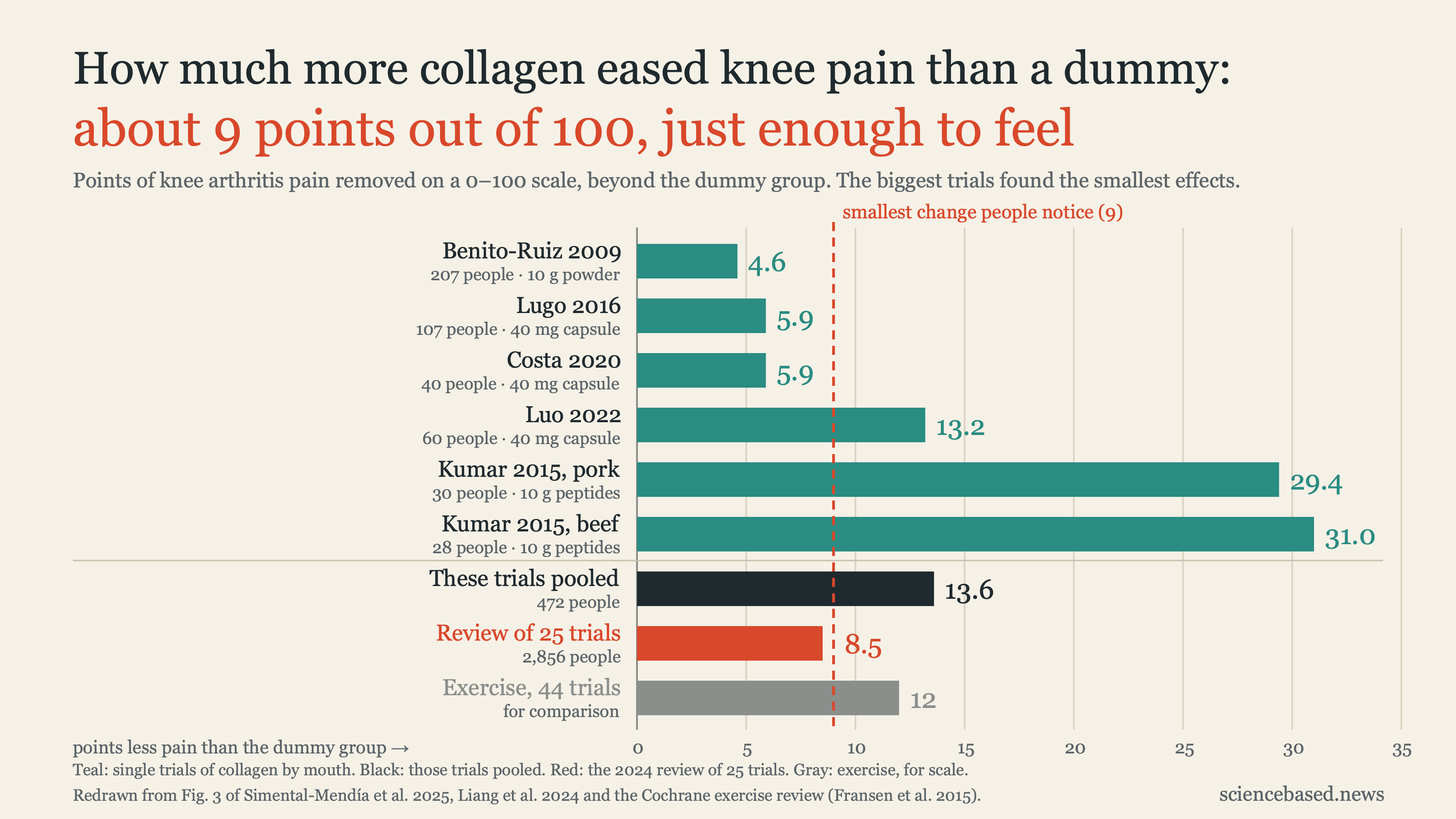
A second review, from Mexico in 2025, looked only at collagen by mouth in knee arthritis: 11 trials with 870 people [4]. Pain fell 13.6 points more than with a dummy, but the trials disagreed with each other a great deal. The chart shows why that number is likely too high. The biggest trial found the smallest effect, and the two tiniest groups found the biggest. That pattern is a sign that small positive trials got published and small negative ones did not, which is why the 25-trial figure of about 9 is the one to trust.
So back to the stairs: a daily scoop is likely to take a small, real edge off the ache, about what you'd notice, not a new knee.
The trials behind it
Who gains most? The biggest single trial, in Spain and Ecuador in 2009, gave 250 people with knee arthritis 10 grams a day of collagen powder or a dummy for 6 months [6]. Overall, pain eased only a little more than with the dummy (4.6 points in the review's pooling [4]). But the people with the most worn joints, and those who ate the least meat, gained the most. We read only the abstract of this trial.
A 2015 trial in India gave 10 grams a day of pork or beef collagen peptides to two groups of 19 and 18 people for 13 weeks, against a dummy group [7]. Pain fell about 30 points more than with the dummy, one of the largest effects in any collagen trial. With groups this small, a result like that is fragile. We read only the abstract.
The capsule form, UC-II, is a different idea: 40 milligrams a day of collagen kept in its natural shape, meant to calm the immune system's attack on cartilage rather than supply building blocks. In the review's pooling, its trials ranged from 5.9 to 13.2 points better than a dummy over 12 to 24 weeks [4].
Younger, active people with knee pain but no arthritis have been tested too. In a German trial that 180 adults aged 18 to 30 finished, 5 grams a day of a specific collagen peptide for 12 weeks cut knee pain during activity from 55 to 33 points, against 57 to 41 on a dummy [8]. A 2017 trial in 139 young athletes found a similar gain [9]. The maker of the peptide, GELITA, helped pay for both.
Not every trial worked. An independent trial in Thailand, paid for by the country's medical council, gave 68 people aged 50 to 80 a daily tablet with a small dose (480 milligrams of collagen powder and 20 milligrams of UC-II) for 12 weeks [10]. Pain fell the same on collagen and dummy (2.2 and 2.3 points on a 0 to 10 scale). The authors say the dose was low and the trial too small to see a modest effect.
Some trials look too good. In a 2025 Turkish trial of 160 people, a 10-gram collagen drink cut a standard arthritis score from 54 to 34 in 8 weeks, while the dummy group did not improve at all [11]. Dummy groups in pain trials almost always improve a little, so a flat one is unusual. In a 2025 Spanish trial of 120 people, pain fell 44% on collagen against 7% on the dummy over 6 months, but 72% of the dummy group were taking painkillers or anti-inflammatory drugs at the start, against 28% of the collagen group [12]. Both trials were paid for by the makers.
A 2025 Korean trial of 3 grams a day of fish collagen peptides in 60 people found less pain on the arthritis questionnaire at 6 months, but not on the simple 0 to 100 pain scale, and no change in the joint space on X-ray [13].
So the outliers both ways have reasons behind them. The steady middle is the 25-trial average: a modest benefit you can feel, and in the biggest trial, the most for the most worn knees.
What is not proven yet
The trials were short. Most lasted under 6 months, so nobody knows whether the benefit grows, holds or fades over years [3].
Many were paid for by collagen makers, and the reviews found signs that small negative trials went unpublished [3, 4]. The 2024 review dealt with this by leaving out the smallest trials, and the benefit held.
The pain result is not settled. The 2024 review's abstract says it had enough people to be sure, but its own test of that showed enough for function and side effects, not yet for pain. One or two large, independent trials could still move the number.
Nobody has shown that collagen rebuilds cartilage. A 30-person MRI study in 2011 saw a hint of change in 2 of 6 knee regions after 24 weeks, with no change in symptoms [14], and the Korean trial saw no change on X-ray [13]. Collagen seems to ease pain; it has not been shown to fix the joint.
The products differ. Trials used hydrolyzed powder at under 1 gram to 10 grams, peptides, and UC-II capsules at 40 milligrams, from cows, pigs, chickens and fish. The review found no difference between types, but few trials compared them head to head.
Our grade
| Claim | Evidence | Grade |
|---|---|---|
| Collagen eases knee arthritis pain more than a dummy | 25 randomized trials, 2,856 people; about 8.5 points out of 100, moderate certainty [3] | Promising |
| Collagen improves daily function in arthritis | 24 randomized trials, 2,647 people; high certainty [3] | Solid |
| Collagen is safe to take for months | 22 trials, 2,381 people; side effects the same as on a dummy [3] | Solid |
| Collagen eases knee pain in young active people | 2 randomized trials, 319 people, one maker's product [8, 9] | Promising |
| Collagen rebuilds cartilage | 1 small MRI pilot, 1 X-ray result with no change [13, 14] | Unproven |
| Overall: a daily scoop of collagen eases knee arthritis pain | A small, real benefit near the level people notice, in short trials, many funded by makers | Promising |
The case for the other side is that 9 points is not much. A person whose knee hurts at 50 out of 100 might move to 41, and the true average might be as low as 5.
The trials may also overstate it. The reviews found signs of missing negative trials, and the biggest single trial found a small effect.
The independent Thai trial found nothing, though at a fraction of the usual dose.
And on the plus side, function was rated with high certainty, the side effects matched the dummy's, and the benefit held in the trials at lowest risk of bias.
What would change the grade: one or two large trials, not paid for by makers, running a year, at 10 grams a day. If they found the same 9 points or more, the grade would rise to Solid. If they found nothing, it would fall to Weak.
What this means for you
If your knees ache from arthritis, collagen is a low-risk thing to try. Take 10 grams a day, about one scoop, the dose used in most powder trials [6, 7, 11, 12]. It dissolves in coffee, tea, soup or a smoothie and has little taste. If your knee is badly worn or you eat little meat, the biggest trial suggests you may gain more than average [6]. The capsule form, UC-II, is a different product taken at 40 milligrams a day.
Give it about 3 months before you judge. Most trials ran 3 to 6 months. Note your pain on the stairs now, on a 0 to 10 scale, and again at 3 months. A drop of about one point is the size the trials found. If you feel nothing by then, stop.
Don't count it as protein for your muscles. Collagen lacks enough of the building blocks muscle needs, and van Loon found it does not build muscle the way whey or other proteins do [1]. Get your protein target from other foods (see how much protein you need).
Keep the exercise. Strength and walking exercise eased knee pain about 12 points in 44 trials [5], and it builds the muscles that take load off the joint. Collagen can sit on top of it.
Safety is reassuring: in 22 trials, side effects on collagen were no more common than on a dummy [3]. Collagen comes from cows, pigs or fish, so check the label if you avoid any of them.
The hopeful part is that the knee on the stairs has two tools with real trials behind them: a scoop in the morning coffee and legs that keep getting stronger. Together they can take a noticeable edge off the ache.
In 25 trials, how much did collagen ease arthritis pain compared with a dummy?
The 2024 review found about 8.5 points less pain on a 0 to 100 scale, near the 9 points people can feel.
What daily dose did most collagen powder trials use?
Most powder trials used 10 grams a day; the capsule form, UC-II, is a different product taken at 40 milligrams.
How long should you try collagen before judging it?
Most trials ran 3 to 6 months, and the benefit built up over weeks.
What has collagen not been shown to do?
An MRI pilot saw only a hint, and an X-ray study saw no change in the joint space.
Which helps knee arthritis pain at least as much as collagen?
In 44 trials, exercise eased knee pain about 12 points out of 100, a bit more than collagen's 9.
What's next
Larger trials are under way. A Spanish university trial of the capsule form UC-II, from chicken or salmon, in 120 people is due in 2027 [15], and a Turkish trial will compare 10 grams of collagen powder with 5 grams of a smaller peptide and a dummy [16]. A Slovenian trial is testing collagen with glucosamine alongside exercise in 93 people with knee arthritis, which will show whether the two add up [17]. A long, independent trial at 10 grams a day is what would settle it, and we will update this grade when one reports.
This is one of our checks on the peptides in our guide to the best peptides, after GHK-Cu and melanotan II. For the protein your muscles do need, see how much protein you need.
Was this helpful?
Sources
Show all sources (17)
- FoundMyFitness. What Collagen Supplements Can and Cannot Do (with Luc van Loon). Video clip, August 12, 2024. https://www.foundmyfitness.com/episodes/hydrolyzed-collagen-muscle
- UC Davis Health. Do collagen, omega-3 and whey supplements help your bones? January 3, 2025. https://health.ucdavis.edu/news/health-wellness/do-collagen-omega-3-and-whey-supplements-help-your-bones/2025/01
- Liang CW, Cheng HY, Lee YH, et al. Efficacy and safety of collagen derivatives for osteoarthritis: a trial sequential meta-analysis. Osteoarthritis and Cartilage, 2024. 35 randomized trials, 3,165 people; main pain analysis 25 trials, 2,856 people; no outside funding. https://doi.org/10.1016/j.joca.2023.12.010
- Simental-Mendía M, Ortega-Mata D, Acosta-Olivo CA, et al. Effect of collagen supplementation on knee osteoarthritis: a systematic review and meta-analysis of randomized controlled trials. Clinical and Experimental Rheumatology, 2025. 11 randomized trials, 870 people, oral collagen only. https://doi.org/10.55563/clinexprheumatol/kflfr5
- Fransen M, McConnell S, Harmer AR, et al. Exercise for osteoarthritis of the knee. Cochrane Database of Systematic Reviews, 2015. 44 randomized trials, 3,537 people for pain. https://doi.org/10.1002/14651858.CD004376.pub3
- Benito-Ruiz P, Camacho-Zambrano MM, Carrillo-Arcentales JN, et al. A randomized controlled trial on the efficacy and safety of a food ingredient, collagen hydrolysate, for improving joint comfort. International Journal of Food Sciences and Nutrition, 2009. 250 people with knee arthritis, randomized, placebo-controlled, 6 months. https://doi.org/10.1080/09637480802498820
- Kumar S, Sugihara F, Suzuki K, et al. A double-blind, placebo-controlled, randomised, clinical study on the effectiveness of collagen peptide on osteoarthritis. Journal of the Science of Food and Agriculture, 2015. Two collagen groups of 19 and 18 people and a placebo group, randomized, 13 weeks. https://doi.org/10.1002/jsfa.6752
- Zdzieblik D, Brame J, Oesser S, et al. The influence of specific bioactive collagen peptides on knee joint discomfort in young physically active adults: a randomized controlled trial. Nutrients, 2021. 218 adults aged 18-30 randomized, 180 finished, placebo-controlled, 12 weeks; partly funded by GELITA, the maker. https://doi.org/10.3390/nu13020523
- Zdzieblik D, Oesser S, Gollhofer A, et al. Improvement of activity-related knee joint discomfort following supplementation of specific collagen peptides. Applied Physiology, Nutrition, and Metabolism, 2017. 139 young athletes finished, randomized, placebo-controlled, 12 weeks; peptides supplied by GELITA. https://doi.org/10.1139/apnm-2016-0390
- Yuenyongviwat V, Anusitviwat C, Tuntarattanapong P, et al. Efficacy of combined undenatured type II collagen and hydrolysed collagen supplementation in knee osteoarthritis: a randomised controlled trial. Scientific Reports, 2025. 68 people aged 50-80, randomized, placebo-controlled, 12 weeks; funded by the Medical Council of Thailand. https://doi.org/10.1038/s41598-025-17505-0
- Demir-Dora D, Tuna S, Kurtoglu ED, et al. Evaluation of the efficacy and safety of CollaSel PRO type I and type III hydrolyzed collagen peptides in the treatment of osteoarthritis: a double-blind, placebo-controlled, randomized clinical trial. Journal of Clinical Medicine, 2025. 160 people, randomized, placebo-controlled, 8 weeks; funded by Sel Sanayi, the maker. https://doi.org/10.3390/jcm14113655
- Carrillo-Norte JA, Gervasini-Rodríguez G, Santiago-Triviño MÁ, et al. Oral administration of hydrolyzed collagen alleviates pain and enhances functionality in knee osteoarthritis: results from a randomized, double-blind, placebo-controlled study. Contemporary Clinical Trials Communications, 2025. 120 people, randomized, placebo-controlled, 6 months; funded by the maker. https://doi.org/10.1016/j.conctc.2024.101424
- Park SY, Lee SH, Kim HT, et al. Efficacy and safety of low-molecular-weight collagen peptides in knee osteoarthritis: a randomized, double-blind, placebo-controlled trial. Frontiers in Nutrition, 2025. 60 people analyzed, randomized, placebo-controlled, 6 months; funded by the maker. https://doi.org/10.3389/fnut.2025.1644899
- McAlindon TE, Nuite M, Krishnan N, et al. Change in knee osteoarthritis cartilage detected by delayed gadolinium enhanced magnetic resonance imaging following treatment with collagen hydrolysate: a pilot randomized controlled trial. Osteoarthritis and Cartilage, 2011. 30 people, randomized, placebo-controlled, 24 weeks (followed to 48). https://doi.org/10.1016/j.joca.2011.01.001
- ClinicalTrials.gov. NCT07870967: Undenatured type II collagen for knee osteoarthritis pain (Universidad Católica San Antonio de Murcia). 120 people, randomized, placebo-controlled, 4 months; results expected 2027. https://clinicaltrials.gov/study/NCT07870967
- ClinicalTrials.gov. NCT07800780: Effects of different collagen formulations on knee osteoarthritis (Izmir). 45 people, randomized, placebo-controlled; results expected 2027. https://clinicaltrials.gov/study/NCT07800780
- ClinicalTrials.gov. NCT06269549: Effectiveness of kinesiological and dietary supplement intervention in individuals with knee osteoarthritis (University of Primorska). 93 people, randomized. https://clinicaltrials.gov/study/NCT06269549
Discussion