

One SS-31 peptide infusion lifted older muscle's energy capacity
Evidence check, November 2, 2026
The claim: "SS-31 recharges your mitochondria and slows aging."
Our grade: Weak. One infusion of the peptide SS-31 lifted older adults' muscle energy capacity by a borderline margin in a 39-person trial, and the FDA has approved it for one rare disease, Barth syndrome. Caveat: in the biggest trial, 218 adults with mitochondrial disease walked no farther on daily shots than on placebo, and no trial has tested it on aging.
"One of the most profound peptides I think of in existence." That is how a guest on Dave Asprey's show described SS-31 in February 2026. The two guests were Josh Felber and Jay Campbell, cofounders of the peptide company BioLongevity Labs [3]. Here is the best result behind the buzz: in a 2021 trial of 39 older adults, one 2-hour infusion raised a hand muscle's maximum energy output 27%, against 12% on placebo, a borderline gap that had faded by day 7 [6].
Weak mitochondria help explain the fatigue and weakness that come with age [6], which is why this result stands out among the peptides people are trying. The FDA approved SS-31 in September 2025 as Forzinity, but only for Barth syndrome, an inherited disease that affects about 1 in 1,000,000 males [1, 2].
Does SS-31 work?
For the things people want from it, not so far. Daily shots have now been tested against placebo in several diseases where mitochondria fail, and the trials missed their main goals.
| Study | Type | People | Result |
|---|---|---|---|
| Older adults, 2021 [6] | Randomized human trial, one infusion | 39 healthy, aged 60 to 85, low mitochondrial function | Maximum muscle energy output +27% vs +12% on placebo, a borderline gap; lead gone by day 7 |
| Mitochondrial muscle disease, 2023 [9] | Randomized human trial, 24 weeks | 218 adults | 6-minute walk +14.1 m vs +17.3 m on placebo; fatigue no different |
| Mitochondrial muscle disease, 2020 [10] | Randomized human trial, 4 weeks, each person had both drug and placebo | 30 adults | Walked 19.8 m more; missed its goal |
| Barth syndrome, 2021 [2] | Randomized human trial, 12 weeks, each person had both drug and placebo | 12 males, aged 12 to 35 | Walk -0.8 m vs placebo; strength +6.7 newtons, no clear difference |
| Barth, no placebo phase, 2021 and 2024 [2, 16] | Human, no placebo, up to 168 weeks | 10 entered, 8 stayed | Walk +96.1 m at 168 weeks |
| Heart failure, 2020 [11] | Randomized human trial, 4 weeks | 71 adults | Volume of the heart's main pumping chamber no different |
| Dry macular degeneration, 2025 [12] | Randomized human trial, 48 weeks | 176 people, average age 76 | Missed both main goals; less loss of light-sensing cells, on a measure not chosen as a main goal |
| Old mice, 2025 [7] | Animal, 8 weeks | Male and female, 24 months old | Less frailty, stronger hearts; no change in aging clocks (lab tests of biological age) |
What is SS-31 peptide?
SS-31 and elamipretide are the same molecule, a lab-made chain of four amino acids. It sticks to cardiolipin, a fat in the inner wall of mitochondria, the parts of a cell that make its energy. Cardiolipin holds the energy machinery in place. Barth syndrome damages it, which is why the drug was tried there [2, 13].
One infusion raised older muscle's energy capacity
The best result comes from the University of Washington, where David Marcinek, a radiology researcher, helped plan and run the trial. The team screened 120 healthy adults aged 60 to 85 and kept those with low mitochondrial function, turning away 47 whose mitochondria were already good. Then 39 people got one 2-hour infusion of SS-31 or placebo, without knowing which, while a scanner tracked how fast a hand muscle could make ATP, the cell's energy molecule [6].
Maximum ATP output, the most energy the muscle could make, rose 27% on SS-31 and 12% on placebo. The gap was borderline: it just cleared the usual test for chance when measured as a percent rise, and just missed it as a raw rise [6]. If it holds up, it is a fast effect. Treatments that build new mitochondria take weeks to months, and this one showed up within hours [6].
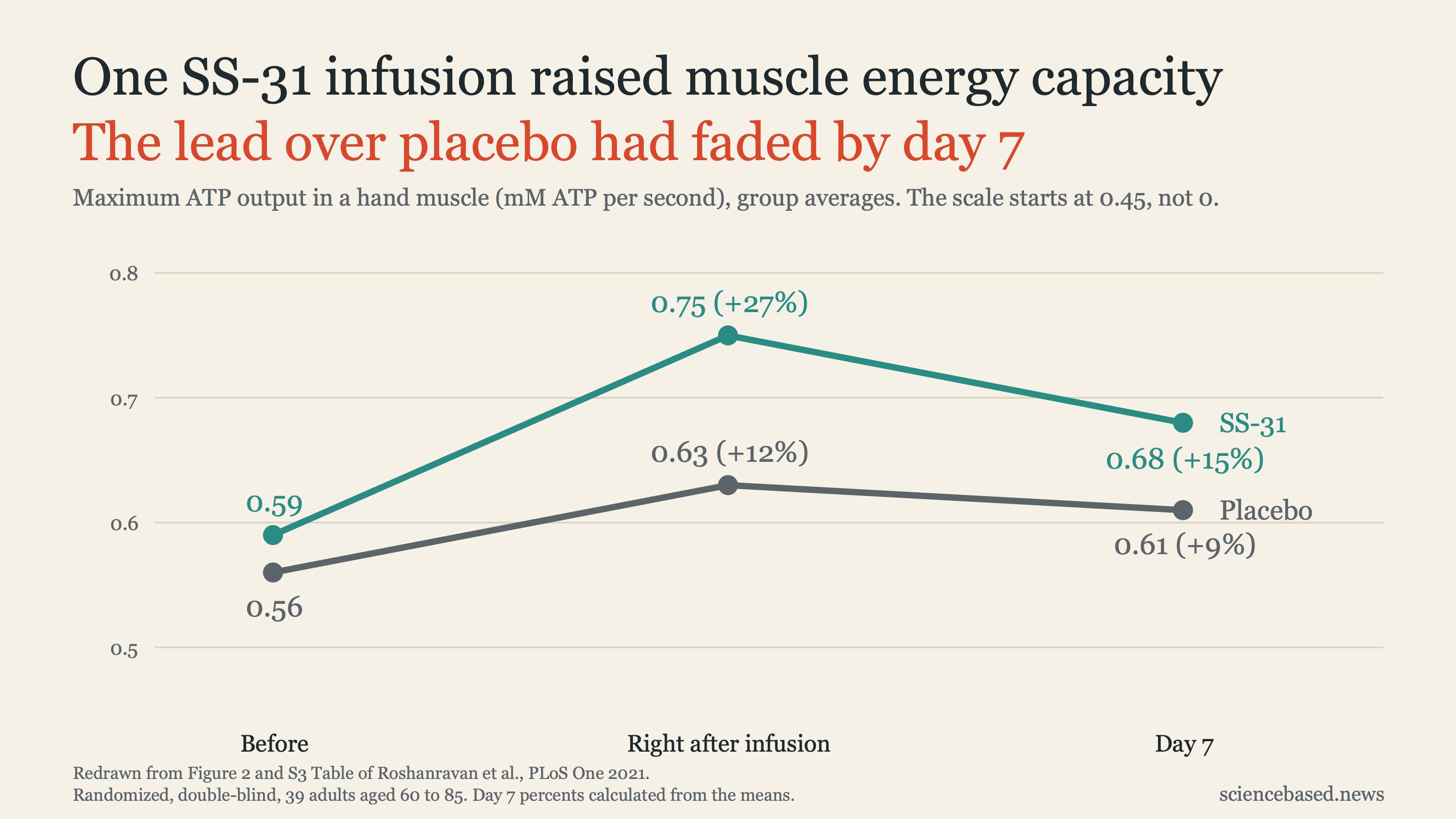
By day 7, the SS-31 group was still above its starting point, but no longer clearly ahead of placebo. The muscle's staying power did not clearly improve on infusion day. Taken across infusion day, day 1 and day 7 together it did, a hint from a study too small to test it well. The trial had no blood-flow measure, so better delivery of fuel can't be ruled out as the cause [6].
So the recharge did show up on a scanner, right after the infusion, by a narrow margin, in people picked for weak mitochondria. Those who already had good mitochondria were never tested.
What the bigger trials found
The biggest test matters most. In 218 adults with mitochondrial muscle disease, the 6-minute walk rose 14.1 m on the drug and 17.3 m on placebo [9]. One smaller group, people whose disease came from faults in their nuclear DNA, did better, but it was picked out after the trial, and a follow-up trial in that group finished in December 2024 with no results posted yet [9, 17].
Barth is the bright spot. In the 12-week phase where no patient knew which shot was which, 12 males did no better on the drug than on placebo. In the open phase, where everyone knew they were on it, typical knee strength climbed 63 newtons from a starting 124 by week 168 [13], and patients and doctors report real gains [15]. Without a control group, a placebo effect can't be ruled out, as the authors say [2].
FDA reviewers doubted the strength gains, and a senior official overruled them [14, 15]. Barth had no other treatment, and a required trial must now confirm the benefit [1].
Aging itself has only mouse data. Old mice treated for 8 weeks gained less frailty and had stronger hearts, yet lab tests of biological age, called aging clocks, read no younger [7]. Neither that study nor a longer one measured lifespan [7, 8].
Where the claim came from
SS-31 went from rare-disease drug to longevity peptide fast, and Asprey's guests were not alone in the excitement [3]. On Huberman Lab in December 2025, the conversation with mitochondria researcher Martin Picard turned to how many people "are injecting this stuff like crazy" [4].
Others push back. Picard said in the same talk that for mitochondrial disease "mostly the trials have been negative" [4]. Peter Attia said in a 2026 peptide episode: "The claims that SS-31 slows aging or boosts energy or enhances performance are completely speculative" [5].
What are the side effects of SS-31?
Skin reactions where the needle goes in are the main price. These numbers come from the Barth trial, so they rest on 12 people [13].
| Side effect | SS-31 | Placebo | Change |
|---|---|---|---|
| Redness | 100% | 25% | +75 points |
| Pain | 75% | 42% | +33 points |
| Hardening | 67% | 17% | +50 points |
| Itching | 67% | 17% | +50 points |
| Hives | 25% | 0% | +25 points |
In the 218-person trial, 7.3% quit for side effects, against 1.8% on placebo; serious events were 4.6% and 2.8%, none tied to the drug [9]. In the eye trial, 60% had injection reactions against 27%, and 24.8% stopped treatment for side effects against 15.2% [12]. The label also warns of serious allergic reactions, and no cancer studies have been done [13].
Is SS-31 FDA approved?
Yes, for one use: Forzinity, for Barth syndrome in people of at least 30 kg [1]. It costs nearly $800,000 a year [15]. Vials sold online as SS-31 are not Forzinity, and the FDA has not checked what is in them. The approval says nothing about energy or aging.
Our grade
| Claim | Evidence | Grade |
|---|---|---|
| One infusion raises energy capacity in older muscle | 1 placebo trial, 39 people; borderline gap, lead gone by day 7 | Promising |
| Daily shots improve Barth syndrome | Blinded phase missed, 12 people; gains without a placebo group; a confirming trial is running | Promising |
| Daily shots improve walking or fatigue in mitochondrial disease | Placebo trials of 218 and 30 people missed; a smaller group, picked out afterward, gained | Weak |
| SS-31 slows aging in people | No human trial; mouse clocks unchanged | Unproven |
| Overall: SS-31 recharges your mitochondria and slows aging | A short, borderline signal, bigger trials that missed, and no aging data | Weak |
The case for the other side: the mechanism is real, and the older-adult result fits it.
The failed trials were in disease, mostly at one dose, and aging muscle may respond differently.
The eye trial's signal, 43% less loss of photoreceptors, the eye's light-sensing cells, on a measure not chosen as the main goal, is big enough to deserve its larger trial.
A blinded trial of daily shots in older adults, with walking or strength as the goal, lasting six months or more, would move this grade up if it hit.
What this means for you
If you have Barth syndrome, this is the one approved treatment, and it is worth a full talk with your cardiologist.
If you don't, no trial shows a benefit for you, and the shots have real costs: daily needles, sore red skin and an unknown vial.
The good news is that more energy from your own mitochondria is something you can build. Hard sprint intervals raise fitness in weeks, and urolithin A has its own trials in older muscle. Mitochondria do matter, and those are two ways to act on that now.
What did one SS-31 infusion do in older adults?
The gap over placebo was borderline, and it had faded by day 7.
What happened in the biggest trial of daily shots, with 218 adults?
The walk rose 14.1 m on the drug and 17.3 m on placebo.
What is SS-31 approved for?
Forzinity is approved only for Barth syndrome, in people of at least 30 kg.
Which side effect is most common?
All 12 people in the Barth trial had skin redness on the drug, against 25% on placebo.
What's next
The first test of daily shots in ordinary older adults is under way at the University of Washington: 30 people aged 65 to 80, for 4 weeks, mainly for safety, with mobility and thinking measured too [19]. It has no placebo, so it can only show whether a bigger trial makes sense.
The larger eye trial, 313 people on daily shots or placebo for 96 weeks, is due to finish in August 2027 [20]. A 72-week placebo trial in Barth, 48 people, is recruiting through 2029 [21]. That one will test the strength gains blind.
Curious about other peptides? Our peptide guide grades them side by side, MOTS-c is the other mitochondria peptide, and NAD boosters chase the same energy idea. We will update this page when the eye trial reports.
Was this helpful?
Sources
Show all sources (21)
- US Food and Drug Administration. FDA grants accelerated approval to first treatment for Barth syndrome. September 19, 2025. https://www.fda.gov/news-events/press-announcements/fda-grants-accelerated-approval-first-treatment-barth-syndrome
- Reid Thompson W, Hornby B, Manuel R, et al. A phase 2/3 randomized clinical trial followed by an open-label extension to evaluate the effectiveness of elamipretide in Barth syndrome. Genetics in Medicine, 2021. 12 males, randomized double-blind crossover, 12 weeks, then open-label. Funded by Stealth BioTherapeutics. https://doi.org/10.1038/s41436-020-01006-8
- The Human Upgrade with Dave Asprey, #1380: The Secret to Staying DANGEROUS After 50, with Josh Felber and Jay Campbell, February 26, 2026. The quoted guest's words are at about 16:30. https://www.youtube.com/watch?v=agcmpf3NkHY
- Huberman Lab, with Martin Picard, December 15, 2025. https://www.youtube.com/watch?v=nMkQUlBtFlk
- Peter Attia, #387 AMA #83: Peptides, evaluating the science, safety, and hype in a rapidly growing field. 2026. https://peterattiamd.com/preview-ama83
- Roshanravan B, Liu SZ, Ali AS, et al. In vivo mitochondrial ATP production is improved in older adult skeletal muscle after a single dose of elamipretide in a randomized trial. PLoS One, 2021. 39 adults aged 60 to 85, randomized double-blind, one 2-hour infusion. Funded by Stealth BioTherapeutics and the NIH; three authors, including David Marcinek, were paid consultants to Stealth in 2014-2016. https://doi.org/10.1371/journal.pone.0253849
- Mitchell W, Pharaoh G, Tyshkovskiy A, et al. The mitochondria-targeted peptide therapeutic elamipretide improves cardiac and skeletal muscle function during aging without detectable changes in tissue epigenetic or transcriptomic age. Aging Cell, 2025. Mice, young and 24 months old, 8 weeks. https://doi.org/10.1111/acel.70026
- Nickel K, Zhu L, Mangalindan R, et al. Long-term treatment with elamipretide enhances healthy aging phenotypes in mice. Aging Pathobiology and Therapeutics, 2022. Mice from 18 months of age, 10 months. https://doi.org/10.31491/apt.2022.09.089
- Karaa A, Bertini E, Carelli V, et al. Efficacy and safety of elamipretide in individuals with primary mitochondrial myopathy: the MMPOWER-3 randomized clinical trial. Neurology, 2023. 218 adults, randomized double-blind, 24 weeks. Funded by Stealth BioTherapeutics. https://doi.org/10.1212/WNL.0000000000207402
- Karaa A, Haas R, Goldstein A, et al. A randomized crossover trial of elamipretide in adults with primary mitochondrial myopathy. Journal of Cachexia, Sarcopenia and Muscle, 2020. 30 adults, randomized double-blind crossover, 4 weeks. Funded by Stealth BioTherapeutics. https://doi.org/10.1002/jcsm.12559
- Butler J, Khan MS, Anker SD, et al. Effects of elamipretide on left ventricular function in patients with heart failure with reduced ejection fraction: the PROGRESS-HF phase 2 trial. Journal of Cardiac Failure, 2020. 71 adults, randomized double-blind, 4 weeks. https://doi.org/10.1016/j.cardfail.2020.02.001
- Ehlers JP, Hu A, Boyer D, et al. ReCLAIM-2: a randomized phase II clinical trial evaluating elamipretide in age-related macular degeneration, geographic atrophy growth, visual function, and ellipsoid zone preservation. Ophthalmology Science, 2025. 176 people, randomized double-masked, 48 weeks. Funded by Stealth BioTherapeutics. https://doi.org/10.1016/j.xops.2024.100628
- Forzinity (elamipretide) prescribing information. US FDA, 2025. https://www.accessdata.fda.gov/drugsatfda_docs/label/2025/215244s000lbl.pdf
- US Food and Drug Administration. Integrated review, NDA 215244, elamipretide. 2025. https://www.accessdata.fda.gov/drugsatfda_docs/nda/2025/215244Orig1s000IntegratedR.pdf
- Reuters. US FDA cleared pricey rare disease drug over reviewer objections. November 5, 2025. https://www.reuters.com/business/healthcare-pharmaceuticals/us-fda-cleared-pricey-rare-disease-drug-over-reviewer-objections-2025-11-05/
- Thompson WR, Manuel R, Abbruscato A, et al. Long-term efficacy and safety of elamipretide in patients with Barth syndrome: 168-week open-label extension results of TAZPOWER. Genetics in Medicine, 2024. 10 entered, 8 at week 168, no placebo group. https://doi.org/10.1016/j.gim.2024.101138
- NuPOWER, NCT05162768. ClinicalTrials.gov. 102 adults, randomized, 48 weeks. Completed December 4, 2024; no results posted as of October 31, 2026. https://clinicaltrials.gov/study/NCT05162768
- US Food and Drug Administration. Cardiovascular and Renal Drugs Advisory Committee, minutes, October 10, 2024. https://www.fda.gov/media/187179/download
- Study of Healthy Aging and Physical Function With Elamipretide, NCT07275424. ClinicalTrials.gov. https://clinicaltrials.gov/study/NCT07275424
- ReNEW, NCT06373731. ClinicalTrials.gov. https://clinicaltrials.gov/study/NCT06373731
- 4TAZPower, NCT07531251. ClinicalTrials.gov. https://clinicaltrials.gov/study/NCT07531251
Discussion