

Epitalon lengthened telomeres in human cells in a dish
Evidence check, October 27, 2026
The claim: "Epitalon, a four-amino-acid peptide, lengthens your telomeres and slows aging."
Our grade: Unproven. In human cells in a dish, the telomere result is real and was repeated by an independent lab in 2025. No study has measured telomeres, aging or lifespan in a person taking epitalon, so for you it is unproven.
You scroll past another "longevity stack", and there it is again: epitalon, a white powder first made in Russia, sold to inject. The promise is that it lengthens your telomeres, the protective caps on the ends of your chromosomes that wear down as you age.
Can a peptide really rebuild them?
In a dish, yes. In 2025 a lab at Brunel University London gave epitalon to normal human cells for 3 weeks [1]. Telomerase, the enzyme that rebuilds telomeres, became 4 times as active in one kind of cell and 26 times as active in another, and their telomeres grew longer.
Where the claim came from
Epitalon is a chain of just four amino acids, the building blocks of protein: alanine, glutamic acid, aspartic acid and glycine (AEDG for short). A research group in St. Petersburg, Russia, led by Vladimir Khavinson, made it from the recipe of epithalamin, an extract of cow pineal glands, the small gland in the brain that makes the sleep hormone melatonin [3].
In 2003 the same group reported that epitalon switched on telomerase and lengthened telomeres in human fetal cells grown in a dish [2]. That paper is where "lengthens telomeres" comes from. Almost everything written about epitalon since then, in mice, monkeys and people, came from that one group and its partners [3].
In 2026 epitalon reached the FDA. A pharmacy group asked for it to be made by compounding pharmacies as a shot under the skin for insomnia [4]. FDA staff advised against it, saying there was not enough evidence. On July 24, 2026, the FDA's compounding advisers voted 7 to 4, with 1 abstaining, to allow it anyway [5, 6, 7]. The vote does not make it legal yet; the FDA has to decide first.
We searched the podcast and YouTube feeds we follow, from Huberman Lab to Peter Attia and Bryan Johnson, and found no episode on epitalon, so the claim here is the sellers' and the Russian group's own.
What epitalon did to human cells
The star study is the first time a lab outside the Russian network tested the telomere claim, 22 years after it was made [1]. Sozan Al-dulaimi and colleagues at Brunel University London got their epitalon from UK peptide sellers (the paper says it was bought in one place and a gift in another), and it names no funder.
They used two kinds of normal human cells: fibroblasts, the cells that make connective tissue, and breast lining cells. Each got a small daily dose of epitalon for 3 weeks, and untreated cells were kept beside them for comparison. Four days did nothing. After 3 weeks, both had longer telomeres than the untreated cells, and the gene for telomerase was switched on.
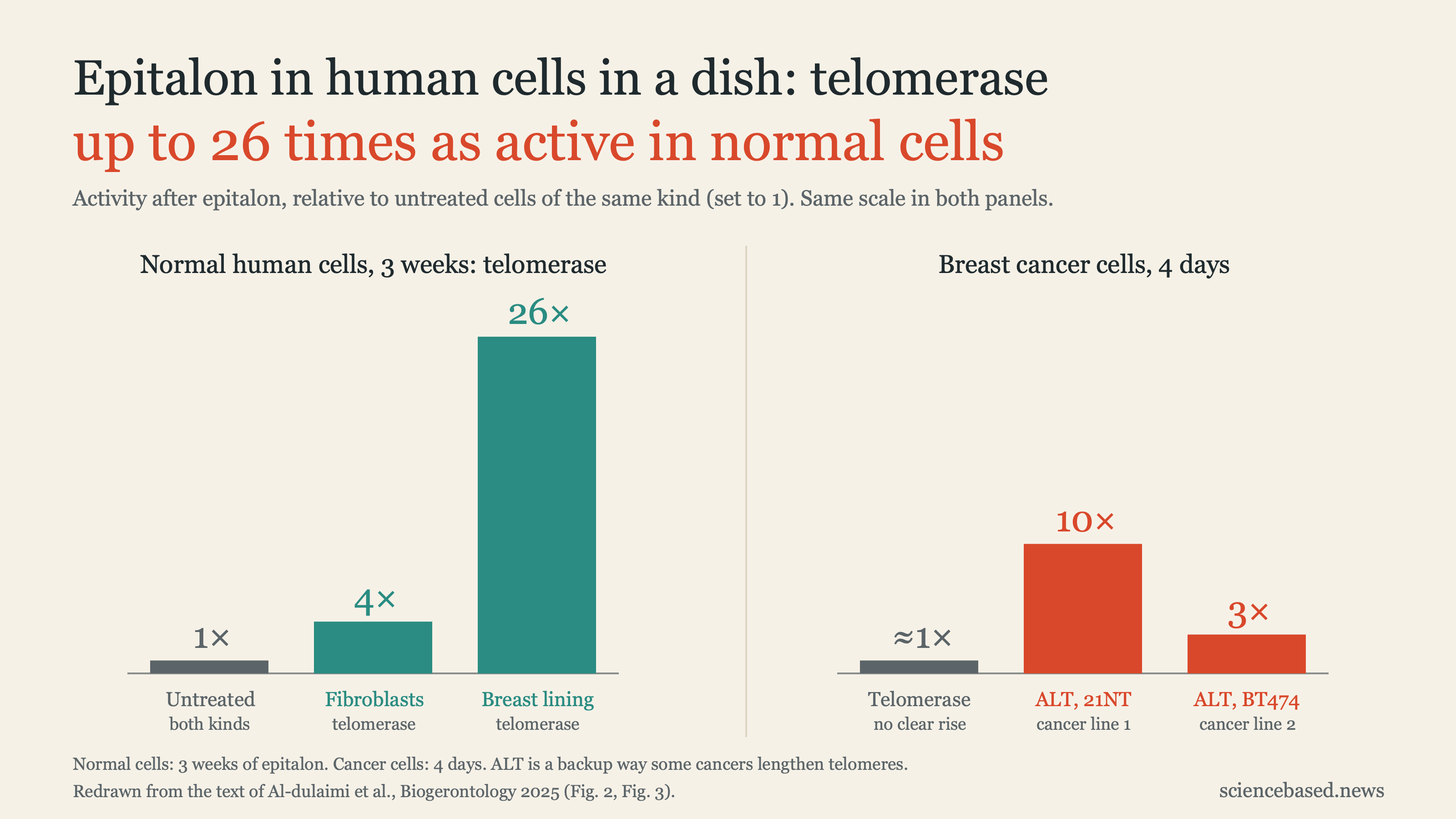
The size of the change is the striking part. Telomerase activity rose 4-fold in the fibroblasts and 26-fold in the breast lining cells [1]. It still stayed below the level in cancer cells, which the authors read as a good sign: the normal cells were not pushed all the way to the endless dividing of a tumor.
So the 2003 claim held up in a second lab. That leaves two questions the vial skips: what happens in a whole body, and what happens to cells you would not want to help?
The first clue in a whole animal came from mice. In 2003 the Russian group gave 54 female mice a small epitalon shot 5 days a month from 3 months of age until they died, and 54 others a salt-water shot [8]. Average lifespan did not change. The longest-lived 10% of treated mice lived 13.3% longer, the oldest mouse lived 12.3% longer, chromosome damage in bone marrow fell 17.1%, and leukemia was 6 times rarer. Total tumors did not change.
Old monkeys came next. In a 2001 study described in the FDA's review, old female rhesus monkeys, 20 to 26 years old, got an epitalon shot daily for 10 days [4]. Their evening melatonin rose more than 4-fold, and their evening cortisol, a stress hormone that should fall at night, dropped about 30%, back to the daily pattern of young monkeys. Young monkeys' melatonin did not change.
Then people. In the only randomized trial of synthetic epitalon, 40 women aged 40 to 50, mostly doctors and nurses on night shifts, whose melatonin was low for their age, got a spray of epitalon or salt water under the tongue for 20 days [9]. In the epitalon group, a melatonin breakdown product in the urine rose 1.7-fold, back to the normal level for their age, and it did not change on placebo [4]. A smaller study in older adults, 15 on epitalon, 15 on epithalamin and 10 on placebo, found night melatonin rose in those whose level started low [10].
That second question has an answer, and it is the twist. The Brunel team also gave epitalon to two kinds of breast cancer cells for 4 days [1]. Their telomeres grew too, in one line from 2.4 to 4 thousand DNA letters. But not through telomerase: it did not rise. Instead epitalon switched on ALT, a backup way some cancers use to lengthen telomeres, 10-fold in one line and 3-fold in the other. Normal cells showed little or none of it.
That is the answer to the opening question. In a dish, epitalon does rebuild telomeres, and a second lab has now seen it. It also lengthened them in cancer cells, by another route. Nobody has yet checked what it does to the telomeres of a person.
What is not known
The main limit is plain. No study has measured telomere length, a marker of biological age, or lifespan in a person taking epitalon [3, 4]. The human studies measured melatonin.
The melatonin trial is small and thin on detail [4, 9]. It had 20 women per group for 20 days. The paper does not say whether the women or the researchers knew who got what. It measured a urine marker, not sleep. The authors also wrote that 83% on epitalon had better "psycho-emotional and general physical condition", against 25% on placebo, but gave no method for measuring it. A second paper from the same team appears to report the same women again, so it is not a second trial [3].
The cancer question is open. Long telomeres are linked to a higher risk of some cancers, and the FDA's reviewers flagged that a drug that switches on telomerase could, in theory, help tumors [4]. The mouse study above found no more tumors and fewer leukemias [8], and in mice with a breast cancer gene, epitalon slowed tumors [3]. But the FDA found no 2-year cancer study, the standard test, and the 2025 cancer-cell result shows epitalon can lengthen telomeres in cancer cells too [1, 4].
There is no safety record in people. The FDA found no clinical safety studies, no data on how the body absorbs and clears epitalon, and no reports of harm in its databases through December 2025, which may only mean no one reported any [4]. The melatonin trial did not report side effects at all.
The famous death results are for a different product. Epithalamin, the cow-gland extract, was given to 70 older heart patients in a randomized study: 12 years later, 28% fewer had died than in the untreated group, and heart deaths were half as common [11]. Another report followed 266 adults over 60 for 6 to 8 years and found about 1.6 to 1.8 times fewer deaths with epithalamin [3]. Both come from the same research network, the extract is a mix of many molecules, and neither was repeated elsewhere.
Last, the product. Epitalon sold online is not an approved drug, and no one checks what is in the vial.
Our grade
The question for the grade is how much of the result in cells carries over to your body. The cell result is solid for a lab finding; the human evidence is about melatonin, not telomeres or aging.
| Claim | Evidence | Grade |
|---|---|---|
| In cells: epitalon lengthens telomeres in normal human cells | 2 labs, 2003 and 2025; telomerase 4 and 26 times as active after 3 weeks [1, 2] | Promising |
| In mice: epitalon makes mice live longer | 1 study, 108 female mice; average lifespan unchanged, longest-lived 10% lived 13.3% longer [8] | Weak |
| Epitalon brings low melatonin back to normal in people | 1 small randomized trial, 40 women, 20 days, blinding not stated; 1.7-fold rise [4, 9] | Weak |
| Epithalamin (the gland extract) means fewer deaths in older people | 1 group, 70 heart patients, 12 years; 28% fewer deaths [11] | Weak |
| Overall: epitalon lengthens your telomeres and slows aging | No study has measured telomeres, aging or lifespan in a person taking it [3, 4] | Unproven |
The case for the other side: the telomere result is no longer one group's word. An independent lab with no stake in the peptide found the same thing in 2025, in two kinds of normal human cells [1].
The results point the same way across species. Cells made more telomerase, old mice had less chromosome damage, and old monkeys and middle-aged women with low melatonin got their melatonin back [1, 4, 8, 9]. A treatment that seems to restore what aging takes away, and not push past it, is the kind researchers take seriously.
The safety signal so far is quiet. Mice treated for life had fewer leukemias, not more cancer [8], and in normal cells telomerase stayed below cancer levels [1].
What would change the grade: a randomized trial in people that measures telomere length, or a hard outcome such as sleep, frailty or deaths, with side effects reported, run outside the Russian network. A positive one would move it to Promising for that outcome.
What this means for you
The things that slow aging in people have human trials behind them, and exercise leads the list. In our sprint intervals check, two 20-second all-out sprints on a bike, three times a week, raised fitness about 8% in 2 to 12 weeks. Hard intervals also raise MOTS-c, a peptide your own muscles make, nearly 12-fold, as our MOTS-c article explains.
If telomeres are why you are interested, know what a test can and can't tell you. Our guide to biological age tests explains why telomere length is one of the weaker aging markers: across 121,749 people, each step shorter meant only about 9% higher risk of death.
If sleep is the reason, the epitalon studies measured melatonin, not sleep. Poor sleep and night-shift work are worth taking to a doctor, who can check for causes and offer treatments that have been tested on sleep itself. Our sleep and brain cleaning article covers what deep sleep does.
If you have used epitalon, tell your doctor, and say so if you have ever had cancer.
The hopeful part is real. A peptide made of four building blocks switched on the body's own repair enzyme for telomeres in human cells, and a second lab has now confirmed it. That is a real lead, and it is worth a proper human trial. Until one is done, the proven tools for living longer are the ones you can start this week.
What did the 2025 independent lab study find in normal human cells?
After 3 weeks of epitalon, telomerase rose 4-fold in fibroblasts and 26-fold in breast lining cells; 4 days did nothing.
Has any study measured telomeres in a person taking epitalon?
The randomized trial in 40 women measured a melatonin marker in the urine, not telomeres or aging.
What did epitalon do to breast cancer cells in the 2025 study?
Telomerase did not rise in the cancer cells, but ALT, a backup way to lengthen telomeres, rose 10-fold and 3-fold.
Which product were the famous studies of fewer deaths about?
Epithalamin is a different product, a mix of many molecules; synthetic epitalon has no study of deaths.
What's next
The next big answer would be a human trial that measures telomeres, and none is registered yet. Now that a lab outside Russia has confirmed the cell result, the next step is clear: a randomized trial in older adults that measures telomere length and sleep, run by a group with no stake in the product. We will update this article when one reports.
The FDA has not yet decided whether pharmacies may make epitalon; a draft policy on access to peptides went to the White House on October 14, 2026 [12].
This is one of our checks on the peptides in our guide to the best peptides. Its closest relative on the site is pinealon, another short peptide from the same Russian group. For other peptides sold for aging, see MOTS-c and GHK-Cu, and for other ways people try to slow aging, see NAD boosters.
Was this helpful?
Sources
Show all sources (12)
- Al-dulaimi S, Thomas R, Matta S, Roberts T. Epitalon increases telomere length in human cell lines through telomerase upregulation or ALT activity. Biogerontology, 2025. Human cells in a dish (2 normal, 2 breast cancer lines), 4 days to 3 weeks; no funding stated; epitalon from UK peptide sellers. Correction published 2025 (https://doi.org/10.1007/s10522-025-10326-8). https://doi.org/10.1007/s10522-025-10315-x
- Khavinson VKh, Bondarev IE, Butyugov AA. Epithalon peptide induces telomerase activity and telomere elongation in human somatic cells. Bulletin of Experimental Biology and Medicine, 2003. Human fetal fibroblasts in a dish. https://doi.org/10.1023/a:1025493705728
- Jain A, Gallacher DM, Issa MA, et al. Epitalon and epithalamin: a narrative review of mechanistic, preclinical, and clinical evidence. International Journal of Molecular Sciences, 2026;27(19):8922. Review. https://doi.org/10.3390/ijms27198922
- US Food and Drug Administration. FDA evaluation of epitalon-related bulk drug substances. Briefing document, Pharmacy Compounding Advisory Committee, July 23-24, 2026. https://www.fda.gov/media/193345/download
- US Food and Drug Administration. July 23-24, 2026: Meeting of the Pharmacy Compounding Advisory Committee. https://www.fda.gov/advisory-committees/advisory-committee-calendar/july-23-24-2026-meeting-pharmacy-compounding-advisory-committee-07232026
- Restore Health Consulting. FDA's PCAC votes in favor of six peptides for 503A bulks list: what compounders need to know. August 17, 2026. https://www.restorehealthconsulting.com/news/fdas-pcac-votes-in-favor-of-six-peptides-for-potential-inclusion-on-the-503a-bulks-list-what-compounders-need-to-know
- Liang L. Peptides: US advisory committee recommends six for FDA "compounding list". BMJ, 2026;394:e100422. https://www.bmj.com/content/394/bmj-2026-100422
- Anisimov VN, Khavinson VKh, Popovich IG, et al. Effect of Epitalon on biomarkers of aging, life span and spontaneous tumor incidence in female Swiss-derived SHR mice. Biogerontology, 2003. 108 female mice, lifelong. https://doi.org/10.1023/a:1025114230714
- Ivko OM, Linkova NS, Ilina AR, Sharova AA, Ryzhak GA. AEDG peptide regulation of the expression of human circadian rhythm genes upon accelerated aging of the pineal gland. Advances in Gerontology, 2021;11(1):53-58. 75 women, 40 randomized to epitalon or placebo, 20 days. https://doi.org/10.1134/S2079057021010380
- Korkushko OV, Lapin BA, Goncharova ND, et al. Normalizing effect of the pineal gland peptides on the daily melatonin rhythm in old monkeys and elderly people. Advances in Gerontology, 2007;20(1):74-85. Old monkeys; 40 older adults (15 epitalon, 15 epithalamin, 10 placebo), 10 days. https://pubmed.ncbi.nlm.nih.gov/17969590
- Korkushko OV, Khavinson VKh, Shatilo VB, Antonyuk-Shcheglova IA. Geroprotective effect of epithalamine (pineal gland peptide preparation) in elderly subjects with accelerated aging. Bulletin of Experimental Biology and Medicine, 2006. 70 older heart patients, randomized, 3 years of treatment, 12-year follow-up. https://doi.org/10.1007/s10517-006-0365-z
- Holland & Knight. Peptides at a crossroads: what wellness providers need to know about HHS and FDA actions. October 2026. https://www.hklaw.com/en/insights/publications/2026/10/peptides-at-a-crossroads-what-wellness-providers-need-to-know
Discussion