

Biological age tests compared: a blood panel rivals $499 kits
Evidence check, October 19, 2026. Updated November 2, 2026.
The claim: A biological age worked out from routine blood tests predicts death about as well as a $499 DNA methylation kit.
Our grade: Promising. In 1,065 American adults followed for 20 years, a clock built from routine checkup results predicted who died better than the best DNA clock, and the free nine-marker PhenoAge has been checked in more than 11,000 people. It is one head-to-head comparison in one country, and no test has been shown to help you live longer.
Nora is 51. She has a $499 DNA aging kit in her online cart, and last month's blood test results sitting in her email.
Does she need the kit to learn her biological age?
Maybe not. In a 2025 study of 1,065 adults, a clock built from ordinary checkup results scored higher than every DNA clock in the test at predicting who would die over 20 years [1].
Where the claim came from
Most biological age tests sold online read methylation: chemical tags on your DNA that shift as you age. A formula, called a clock, turns the pattern into an age. The best ones, GrimAge and DunedinPACE, were built on who died or declined, not on birthdays [4].
Those kits cost about $149 to $499 in the US, and much more abroad [12, 18]. But some of the same scientists also built clocks from blood tests your doctor already orders. Morgan Levine's PhenoAge, from 2018, uses nine of them plus your age [3].
Peter Attia's April 2026 episode on aging clocks ends on that note. His show notes list "why aging clocks are not yet reliable as consumer tools and why traditional health metrics still matter most" [16]. Doctor and longevity writer Hillary Lin took five commercial tests in a year and put a free option at the top of her own list: "You can calculate your PhenoAge for free from standard blood work" [10].
Can a routine blood test really keep up with a DNA lab?
The checkup clock that beat the DNA clocks
A team at the National University of Singapore built LinAge2 from 60 measures a clinic already collects: blood tests, plus things like blood pressure and smoking. They trained it on a US national health survey and tested it on a later wave of that survey [1].
For 1,065 of those people, the survey had also stored blood for DNA testing, so every major DNA clock could be run on the same people. That made it a fair race.
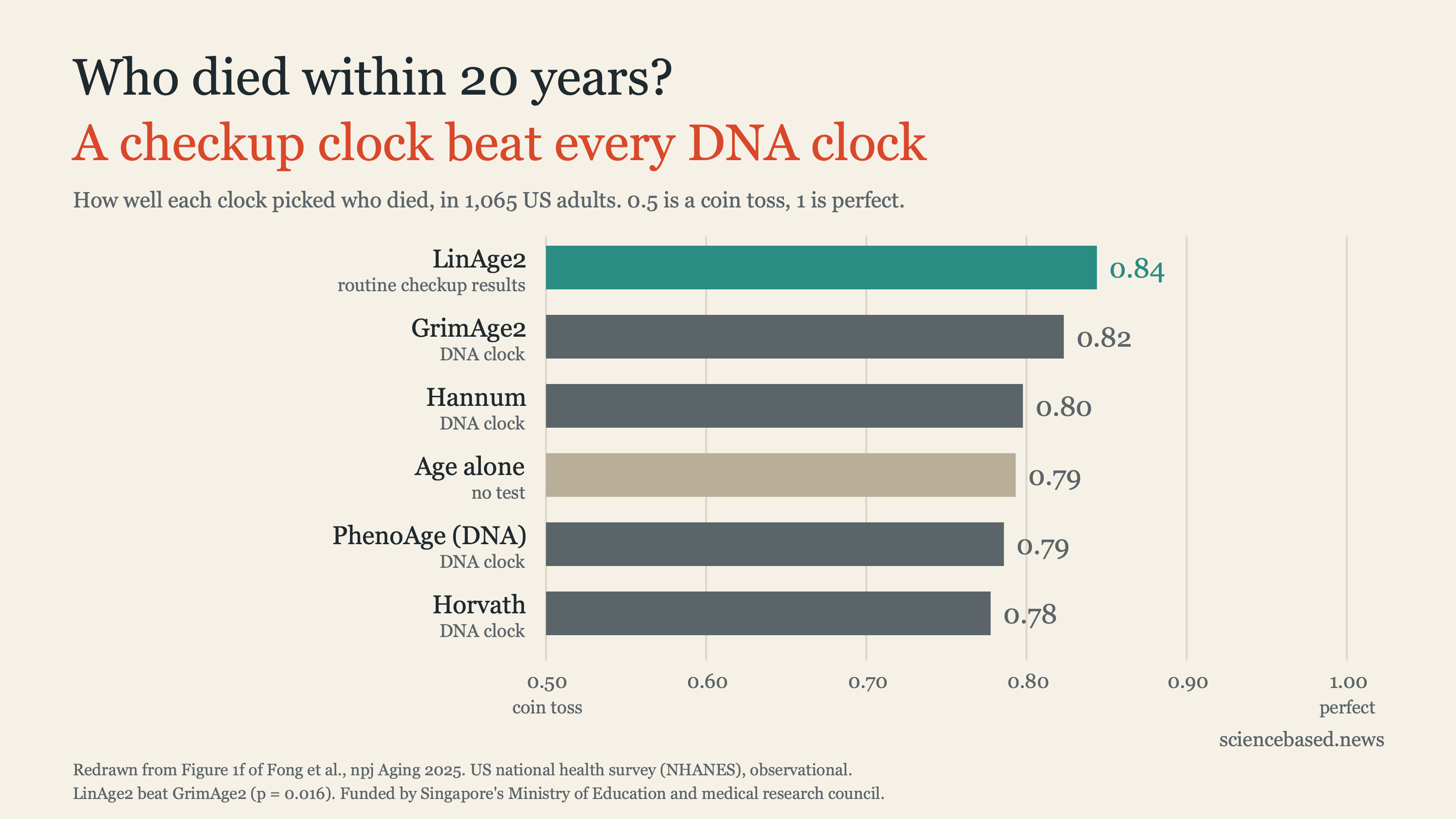
The score shows how often a clock ranks the person who died ahead of the one who lived. A coin toss scores 0.5. Your age alone scored 0.79. LinAge2 scored 0.84, ahead of GrimAge2 at 0.82, the strongest DNA clock in the test. Three older DNA clocks, Horvath, Hannum and the DNA version of PhenoAge, did no better than age alone [1].
The paper's authors were surprised too. "Surprisingly, clinical aging clocks still outperform several prominent ... epigenetic clocks," they wrote [1].
One of their examples shows why. Two men were both 72. One, an obese smoker, read 16 years older than his age and died 5.4 years later. The other read 7.6 years younger and lived to 91 [1].
The free version you can work out yourself
LinAge2 is sold in Singapore, as a S$741 package with a doctor's visit [17]. Do you need that? Its simpler parent, PhenoAge, needs only nine routine markers, and you may already have most of them.
The nine are albumin, creatinine, fasting glucose, CRP (a marker of inflammation), lymphocyte percent, mean cell volume, red cell distribution width, alkaline phosphatase and white cell count [3]. A standard metabolic panel and a full blood count cover eight. CRP usually has to be added.
PhenoAge has been tested on 11,432 American adults followed for up to 12 years. Each year it read above your real age went with a 9% higher risk of death. It held in young and old, and in 1,906 people with no disease and a normal weight [2].
At 65, women in the healthiest fifth of PhenoAge scores were predicted to live to about 87, and those in the least healthy fifth to just over 78. For men the figures were about 85 and just under 76 [2].
LinAge2 study: Fong and colleagues, npj Aging, 2025. Built on the US NHANES survey of 1999-2000 and tested on 2001-2002, observational. In the 1,065 people with DNA data, the 20-year scores were LinAge2 0.844, GrimAge2 0.823, Hannum 0.798, age alone 0.793, DNA PhenoAge 0.786 and Horvath 0.778. LinAge2 beat GrimAge2 (p = 0.016) and DNA PhenoAge (p < 0.001). In a larger group of 2,036, LinAge2 also beat clinical PhenoAge, 0.868 to 0.848, and age alone, 0.829. The study was paid for by Singapore's Ministry of Education and medical research council; the authors declared no competing interests [1].
Where it fell short: among people aged 65 to 74, LinAge2 was no better than GrimAge2 at separating the healthiest and least healthy quarters, and clinical PhenoAge was no better than age alone in that age group [1].
PhenoAge study: Liu and colleagues, PLOS Medicine, 2018. 11,432 adults aged 20 to 84 in NHANES 1999-2010, plus 185 aged 85 and over, observational, 871 deaths. Hazard ratio 1.09 per year (95% CI 1.08 to 1.10), 1.08 in the healthy group. Paid for by the US National Institute on Aging [2]. The formula was built on an earlier survey of 9,926 adults [3].
GrimAge, the best-known DNA clock, carried a hazard ratio of 1.10 per year in its first paper [4]. Its authors warn that hazard ratios from clocks on different scales can't be compared directly, which is why the LinAge2 race on the same people matters [4].
So Nora's email may already hold most of a test that did as well as her $499 kit.
Where the tests fall short
Before Nora trusts any of these numbers, she should know four catches. Each has a fix. First, none of these scores is a medical test: TruDiagnostic, the biggest US seller, says plainly that TruAge "is not a diagnostic test" [11].
Different tests give different ages. Nick Urban, who writes about longevity tests, took seven kits on the same day at age 30.4. They read from 24.9 to 38, a 13-year spread [9]. Pick one test and stick with it.
PhenoAge reads very young in healthy people. Lin's calculated PhenoAge was 20.4 at a real age of 35.5. "A healthy, optimized person will always score well against a population baseline that includes widespread metabolic dysfunction," she wrote [10]. Use it to track yourself, not to boast. A cold or a hard workout can also raise CRP and white cells, so test when you are well.
Some kits use the wrong sample. Clocks built on blood read saliva and cheek samples older, by up to about 30 years on some clocks [6]. Choose a blood kit.
Retests are noisy. Older DNA clocks read the same blood sample up to 9 years apart in the lab [5]. Two years of calorie cutting moved DunedinPACE only 2% to 3%, and PhenoAge and GrimAge not at all [7]. TruDiagnostic recommends testing every three months [11], but it sells the kits. Waiting 4 to 6 months or longer, and reading three results, tells you more.
Your data
Read the privacy terms before you send DNA. TruDiagnostic's privacy policy says "We may share Aggregate Information publicly or with third parties", which it defines as pooled data that doesn't identify anyone [11]. Tally Health's terms let it use your sample information for future research by default [13]. NOVOS says information that doesn't identify you can go to partners and advertisers [14]. A blood panel at your own doctor's lab stays in your medical record.
Prices and where to buy
Prices were taken from sellers' own pages on October 19, 2026 [12, 17, 18].
| Test | What it reads | Price | Our grade |
|---|---|---|---|
| PhenoAge from your own blood test | 9 routine blood markers | Free with recent bloodwork; panels from A$59 (Australia), S$69 (Singapore) | Promising |
| LinAge2 (Raffles BioAge Discovery, Singapore) | 60 checkup measures | S$741 with a doctor's visit | Promising |
| TruDiagnostic TruAge | Blood spot: DunedinPACE, OMICmAge, organ ages | US$499; US-only by post, resold abroad | Promising |
| NOVOS Age (US and Canada) | Blood spot: DunedinPACE | US$349 | Promising |
| neotes bioAge (EU) | Blood spot: says GrimAge | €299 | Promising |
| GlycanAge | Sugar tags on antibodies | US$499, £379 | Weak |
| AgeQ (Singapore) | 7 blood markers | S$99 to S$158 by clinic | Weak |
| Saliva and cheek methylation kits (Tally, Elysium, TruMe, epiAge) | DNA tags in saliva or cheek cells | US$149 to US$299, €199.95 | Weak |
| Telomere length tests | Length of chromosome caps | About US$100 to US$400 | Weak |
| Undisclosed formulas (Generation Lab, InsideTracker InnerAge, Muhdo, DoNotAge) | Not published | US$99 to US$499 | Unproven |
| Hair "epigenetic" scans | Not DNA | Varies | Unproven |
Corrected November 2, 2026: one row in this table went from "Not supported" to Unproven. We keep our lowest grade for good human evidence that points the other way, and the evidence here is too thin for that.
GlycanAge has moved in a hormone trial, but we found no peer-reviewed study linking it to death. AgeQ has no published paper we could find. Telomere length is only weakly tied to death: about 9% higher risk per step shorter, across 121,749 people [8]. Hair scans sold in Mexico, Spain and elsewhere use a bioresonance device that can't read DNA, a Mexican fact-checker found [15].
Country by country:
- United States: TruAge, NOVOS and the saliva kits sell direct. Most PhenoAge markers are on a routine panel.
- United Kingdom: TruAge from about £337 through resellers, GlycanAge at £379. Medichecks' £249 Optimal Health panel covers most PhenoAge markers.
- Germany: neotes at €299 and epiAge at €199.95. Health insurance does not pay.
- India: TruAge resold for ₹45,000 to ₹85,000; Tata 1mg sells MedGenome's test for ₹52,000.
- Australia: PhenoAge panels from A$59; TruAge resold for A$795 to A$895.
- Singapore: AgeQ from S$99, PhenoAge from S$69, LinAge2 at S$741.
- Mexico and Spain: TruAge is not sold direct. Mexican lab service TOMA offers a PhenoAge panel from MXN 1,795 a year.
- Taiwan: one clinic runs GrimAge or PhenoAge for NT$12,000; others sell methylation or telomere tests.
Our grade
| Claim | Evidence | Grade |
|---|---|---|
| A routine checkup clock predicts death as well as the best DNA clock | 1,065 US adults, 20 years, observational: LinAge2 0.844 vs GrimAge2 0.823 [1] | Promising |
| Free PhenoAge from nine blood markers predicts death | 11,432 adults, up to 12 years: 9% higher risk per year older [2] | Promising |
| A blood DNA kit with GrimAge or DunedinPACE predicts death | Large cohorts; 10% higher risk per year on GrimAge [4] | Promising |
| Saliva and cheek kits match blood | Up to about 30 years older on blood-built clocks [6] | Debunked |
| One test tells you your own biological age | Seven kits in one person spread 13 years [9] | Weak |
| Lowering your score helps you live longer | No trial has counted deaths | Unproven |
| Overall: routine blood tests predict death about as well as a $499 DNA kit | One head-to-head study, backed by PhenoAge's large checks | Promising |
What would make us grade lower? The case for the other side starts with numbers. LinAge2 won by 0.02 on a scale where age alone already scores 0.79. That is a real but small edge.
It is also one comparison, in one US survey, run by the team that built LinAge2. No one has yet repeated it in another country.
And neither kind of test has been shown to change what happens to you. A trial where people acted on a score and then got sick or died less often would raise this grade. So would the same race repeated in Asian or European groups.
What this means for you
Start with what you have. If you had blood work this year, check it for the nine PhenoAge markers. Ask your doctor to add CRP next time, and make it a fasting test. Our free PhenoAge calculator turns the numbers into an age in your browser and saves nothing.
Treat the result as a look at your own trend, not a verdict. If it reads high, the markers themselves tell you where to look: blood sugar, kidney function or inflammation. Those are things a doctor can test and treat.
If you want a DNA test as well, choose blood, not saliva. Pick a lab that reports GrimAge or DunedinPACE. Test at the same hour each time, and wait 4 to 6 months or more between tests.
Skip hair scans and any kit that won't say which clock it uses.
Which clock predicted 20-year death best in 1,065 US adults?
LinAge2 scored 0.84, GrimAge2 0.82 and Horvath 0.78, below age alone at 0.79.
What do you need for a free PhenoAge reading?
The nine markers are on routine blood tests; CRP usually has to be added.
Why skip a saliva or cheek kit?
Most clocks were trained on blood, and other samples read older.
How often is it worth retesting a DNA clock?
Scores move slowly, and lab noise can be years, so short gaps show mostly noise.
Ask about this study
Answers by AI from this article only. Not medical advice. Questions and answers are saved (never your IP address): what we keep.
What's next
Our free PhenoAge calculator runs in your browser and saves nothing.
For how the DNA clocks did on disease and death in 18,859 people, read the best biological age clocks. For habits that changed health and not just a score, see five health levers, checked one by one, and for another blood test that tracks healthy people, see continuous glucose monitors.
Was this helpful?
Sources
Show all sources (18)
- Fong S, Denisov KA, Nefedova AA, Kennedy BK, Gruber J. LinAge2: providing actionable insights and benchmarking with epigenetic clocks. npj Aging, 2025. NHANES 1999-2002, observational: 1,065 people with DNA data, 2,036 in the clinical comparison, 20-year follow-up. Funded by Singapore's Ministry of Education and National Medical Research Council. doi:10.1038/s41514-025-00221-4
- Liu Z, Kuo PL, Horvath S, Crimmins E, Ferrucci L, Levine M. A new aging measure captures morbidity and mortality risk across diverse subpopulations from NHANES IV: a cohort study. PLOS Medicine, 2018. 11,432 adults aged 20 to 84 plus 185 aged 85 and over, observational, up to 12.6 years. Funded by the US National Institute on Aging. doi:10.1371/journal.pmed.1002718
- Levine ME, Lu AT, Quach A, et al. An epigenetic biomarker of aging for lifespan and healthspan. Aging, 2018. Clinical PhenoAge built on 9,926 adults in NHANES III, observational. doi:10.18632/aging.101414
- Lu AT, Quach A, Wilson JG, et al. DNA methylation GrimAge strongly predicts lifespan and healthspan. Aging, 2019. Validation in several cohorts, observational. doi:10.18632/aging.101684
- Higgins-Chen AT, Thrush KL, Wang Y, et al. A computational solution for bolstering reliability of epigenetic clocks: implications for clinical trials and longitudinal tracking. Nature Aging, 2022. 36 blood samples each run twice. Two authors have clocks licensed to Elysium Health. doi:10.1038/s43587-022-00248-2
- Apsley AT, Ye Q, Caspi A, et al. Cross-tissue comparison of epigenetic aging clocks in humans. Aging Cell, 2025. 83 people, 284 samples from five tissues, observational. doi:10.1111/acel.14451
- Waziry R, Ryan CP, Corcoran DL, et al. Effect of long-term caloric restriction on DNA methylation measures of biological aging in healthy adults from the CALERIE trial. Nature Aging, 2023. 197 people analyzed, randomized, 2 years. Two authors are inventors of DunedinPACE. doi:10.1038/s43587-022-00357-y
- Wang Q, Zhan Y, Pedersen NL, Fang F, Hägg S. Telomere length and all-cause mortality: a meta-analysis. Ageing Research Reviews, 2018. 121,749 people, 21,763 deaths, meta-analysis of observational studies. Graded from the abstract. PubMed 30254001
- Urban N. 7 biological age tests compared. Outliyr, 2025, updated 2026 (affiliate site). Seven tests on samples taken March 20, 2025. outliyr.com
- Lin H. Your biological age test might be lying to you. Newsletter, March 23, 2026. newsletter.hillarylinmd.com
- TruDiagnostic. About TruAge, About Tests and Privacy Policy, viewed October 31, 2026. trudiagnostic.com/about-truage, trudiagnostic.com/about-tests, trudiagnostic.com/privacy-policy
- TruDiagnostic. TruAge Complete product page and shipping help page, viewed October 19, 2026. shop.trudiagnostic.com
- Tally Health. Terms of service, viewed October 19, 2026. tallyhealth.com
- NOVOS. Privacy policy, viewed October 19, 2026. novoslabs.com
- Verificado. Escaneo de cabello y epigenética: no puede "apagar" genes ni dar dietas personalizadas. April 23, 2026. verificado.com.mx
- Attia P. #386: Aging clocks: what they measure, how they work, and their clinical and real-world relevance. The Peter Attia Drive, April 6, 2026. peterattiamd.com/agingclocks
- Raffles Health. R50 Insights Edition: BioAge Discovery, viewed October 19, 2026. raffleshealth.com
- Seller pages viewed October 19, 2026: NOVOS (novoslabs.com), neotes (neotes.com), GlycanAge (glycanage.com), Tally (tallyhealth.com), Elysium (elysiumhealth.com), TruMe (trumelabs.com), epiAge (epi-age.de), i-screen (i-screen.com.au), Parkway Shenton AgeQ (parkwayshenton.com.sg), Medichecks (medichecks.com), P4Health (p4health.com.au), Tata 1mg (1mg.com), Mapmygenome (mapmygenome.in), MyDiagnostics (mydiagnostics.in), TOMA (toma.mx), Lola Health (lolahealth.com), Generation Lab (generationlab.com), InsideTracker (insidetracker.com), DoNotAge (donotage.org), 豐田之山診所 (fthealthy3.com).
Discussion