Your glucose monitor can't tell you which foods are bad for you
Evidence check, September 26, 2026
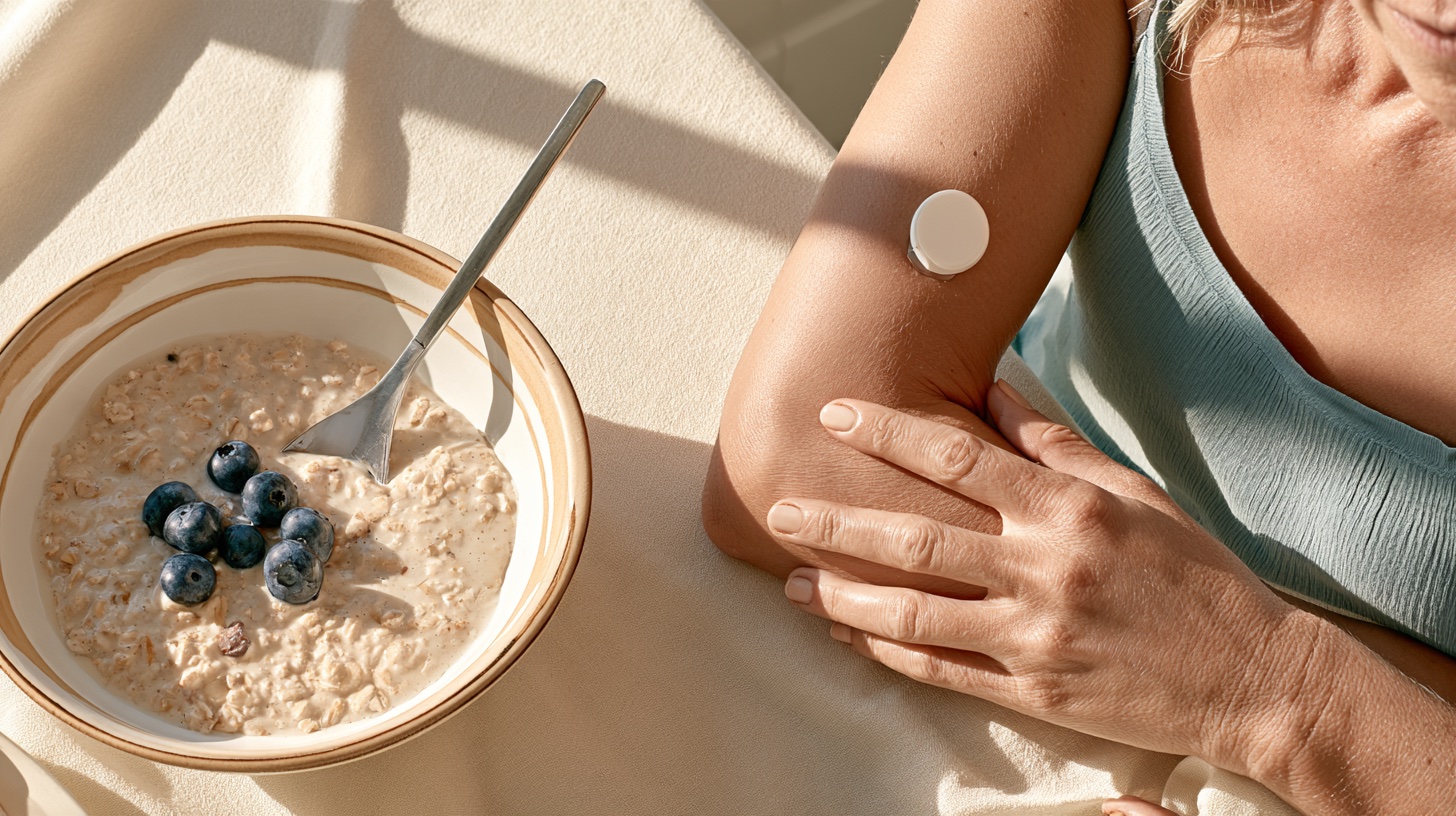
You eat a bowl of oatmeal. Twenty minutes later your phone buzzes. Your blood sugar has "spiked." The app paints the meal red. You decide oatmeal is bad for you.
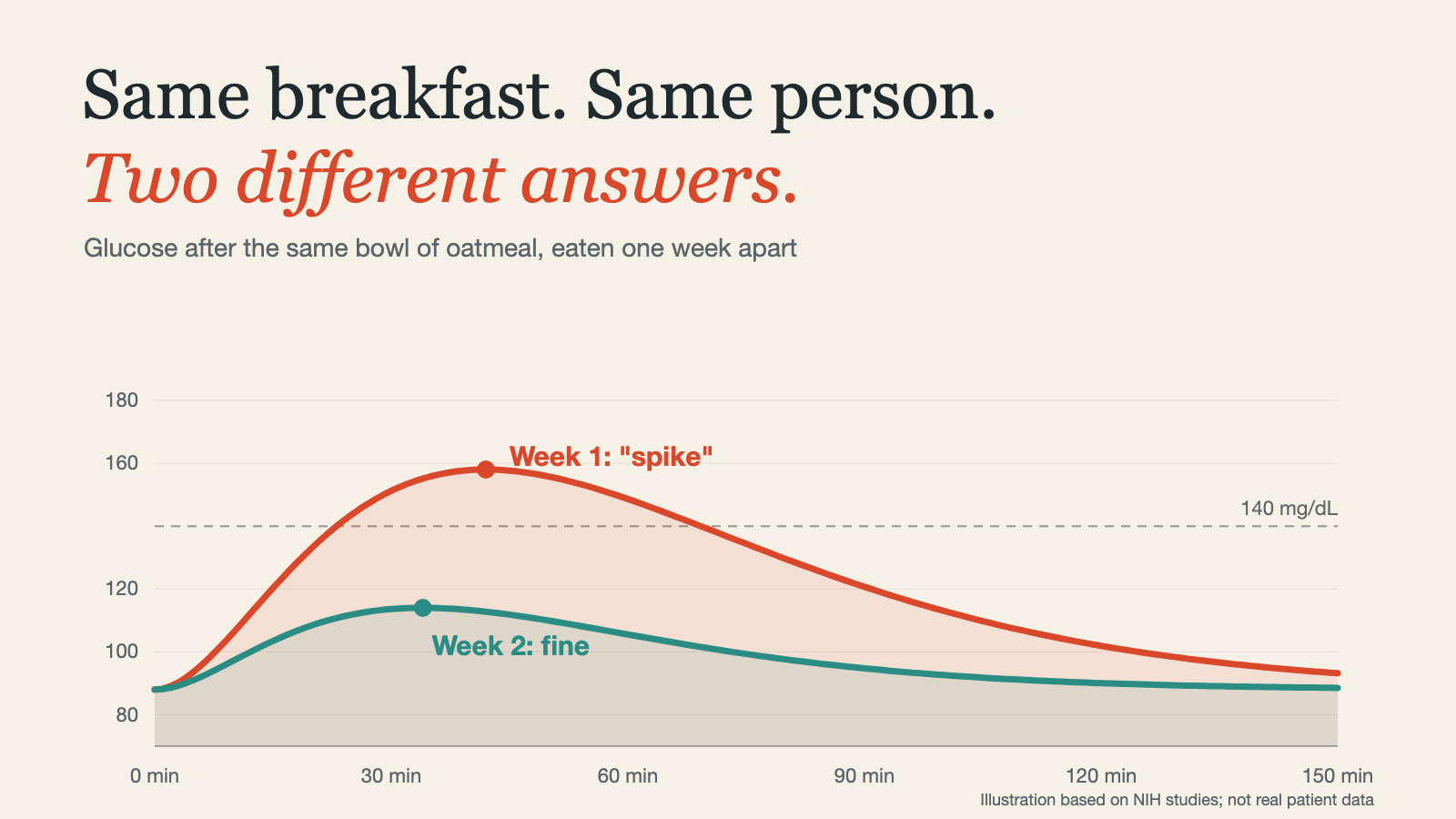
Now imagine you ate the exact same bowl next week, in the exact same way. There's a good chance the app would tell you something different.
That's the problem with the hottest gadget in the longevity world. Since 2024 anyone in the US can buy a continuous glucose monitor (CGM) without a prescription. It's a small sensor on the back of your arm that reads your sugar every few minutes. Podcasts talk about "glucose spikes" as if each one does a little damage. Apps grade your meals. Whole diet programs are built on the readings. More and more healthy people are changing what they eat based on a device that was built for people with diabetes.
This piece checks whether that works. By the end you'll know what a normal curve looks like, how much a single reading can be trusted, what the best trials show when healthy people use these devices to choose their food, and what to do for your blood sugar instead.
Where the idea came from
The case for CGMs in healthy people rests on three real findings.
The first is that people react differently to the same food. A 2015 study from the Weizmann Institute tracked 800 Israelis and found that the same meal could affect people very differently. In one example the researchers gave, one person's blood sugar jumped after a banana but not after cookies, while another person showed the opposite. A larger British study, PREDICT 1 (1,002 people, published in 2020), found the same wide spread.
The second is that "healthy" people spike more than we assumed. A 2018 Stanford study put CGMs on 57 adults. Some people whose standard blood tests were normal still spent up to 15% of their time in the prediabetic range.
The third is older and comes from outside CGM research. Large observational studies, such as the European DECODE project in the 1990s, found that people with high blood sugar two hours after a sugar drink died earlier, even when their fasting sugar looked fine.
Put these together and you get a story. Spikes matter. Everyone's spikes are different. So measure your own and eat to avoid them. It's a tidy story. The question is whether each link holds.
What normal actually looks like
Start with what a healthy body does. In 2019, researchers put blinded CGMs (the wearer couldn't see the numbers) on 153 healthy, non-obese people aged 7 to 80. Their average glucose was about 99 mg/dL. They spent a median of 96% of the day between 70 and 140. They spent about 30 minutes a day above 140.
So brief rises after meals are normal. A healthy body sees one, releases insulin and brings the number back down. A spike on its own is not a sign that something is wrong. An app that colors every bump red doesn't tell you this.
Can one reading be trusted?
This is where the story starts to break.
In 2020, a team at the US National Institutes of Health had 16 healthy adults live in a research ward for four weeks. All their food came from the research kitchen. Each person wore two CGMs at once: one from Dexcom and one from Abbott, the two biggest makers. Across 760 meals, the two devices often ranked the same meals in a different order. When the researchers used one sensor to pick each person's "better" half of meals, the sensor on the other arm said about half of the benefit wasn't there.
In 2025 the same NIH group went further. They looked at 30 healthy adults who ate the same meals twice, about a week apart, under tightly controlled conditions. That gave them 1,189 pairs of repeat meals to compare. The response to the same meal the second time was only loosely related to the first. On a standard reliability score, where 1 means a perfect repeat and 0 means no relationship at all, the devices scored 0.28 (Abbott) and 0.17 (Dexcom).
Then the key finding. For a given person, the difference between two servings of the same meal was about as big as the difference between two completely different meals.
The punchline
If the same meal can look as different from itself as it does from another meal, then a single CGM reading can't tell you which food is better for you. The noise is as large as the signal.
The people in these studies lived in a research ward. Their food and daily routine were tightly controlled. At home, with stress, poor sleep, a walk after lunch or none, the noise is likely to be larger. The authors say this too.
That doesn't make the sensor useless. It means one reading of one meal is a weak guide. You'd need to eat the same meal several times and average the results before trusting the ranking. Almost nobody who buys a CGM does that.
Do healthy people get healthier using one?
This is the question that matters most. There's no large randomized trial showing that healthy people who wear a CGM live longer or get less heart disease or diabetes. That trial hasn't been run.
The closest evidence comes from personalized diet programs that use CGM data. The biggest is ZOE's METHOD trial, published in 2024. It randomized 347 US adults to either ZOE's personalized program or standard government diet advice for 18 weeks. The ZOE group improved its blood fats (triglycerides) more, and lost a bit more weight. That is a real result from a real trial.
But the CGM was only one piece of the package. The ZOE group also got a gut bacteria test, blood fat testing, an app, and a lot of general healthy-eating coaching. The trial can't say which part did the work. Many of the authors worked for ZOE or held shares in it. And ZOE has since dropped the CGM from its program. It now says it can predict your glucose responses without one.
An earlier Israeli trial, from the Weizmann group in 2021, gave a personalized "low-spike" diet to 225 adults with prediabetes and compared it with a Mediterranean diet for six months. The personalized diet did better. Time spent above 140 fell by 1.3 hours a day, against 0.3 hours on the Mediterranean diet. HbA1c, a measure of average blood sugar, fell by 0.16 points against 0.08. Those are real but small changes. Those people had prediabetes, though, so this doesn't tell us much about healthy readers. The NIH group notes that personalized-glucose trials so far show small effects, with average glucose within about 7 mg/dL of standard advice.
Our grade
| Claim | Evidence | Grade |
|---|---|---|
| People differ in their glucose response to the same food | Several studies, 800 to 1,000 people each, observational | Solid |
| Brief spikes after meals are a problem in healthy people | Observational links from sugar-drink tests; no CGM trial | Weak |
| A CGM can tell you which foods are best for you | Two controlled NIH studies (16 and 30 people) say readings are too noisy | Not supported |
| Wearing a CGM makes healthy people healthier | No trial of the device alone; one industry-run trial of a wider program | Unproven |
Discussion
There's a fair case for the other side. Many people say a CGM changed their habits. Seeing a big jump after a soda or a pastry can make a lesson stick in a way a pamphlet never will. For someone with prediabetes, a few weeks with a sensor may be a good use of money, and doctors are starting to study exactly that.
Motivation is not the same thing as accuracy, though. If the lesson you learn is "sugary drinks raise my blood sugar," you didn't need a sensor. If the lesson is "oatmeal is bad for me but rice is fine," the data doesn't support that level of detail. And there's a cost beyond money. Some healthy people start avoiding fruit, beans and whole grains because of a red bar in an app. Those are some of the best-studied foods for long-term health.
The field is also moving. Researchers now suggest repeating meals several times and averaging the results, which could fix much of the noise problem. If a trial someday shows healthy people doing better with a CGM than without one, we'll update this grade.
What this means for your health
Here is how knowing this can change what you do.
You keep the foods that are good for you. A single high reading is not a reason to drop oatmeal, fruit, beans or brown rice. These foods are linked to lower rates of heart disease and diabetes in decades of research. If a sensor talks you out of them, it may leave you worse off than before you bought it.
You spend your effort on what has been proven to work. The strongest evidence for keeping blood sugar healthy doesn't involve a sensor at all. In the Diabetes Prevention Program, a US trial of 3,234 adults with high blood sugar, one group got coaching to lose 7% of their body weight and do 150 minutes a week of activity like brisk walking. Over about three years, that group was 58% less likely to develop diabetes than the placebo group. Losing weight, moving more and eating more fiber all have trial evidence. Ranking your meals by CGM readings does not.
You get the right test. If you're worried about your blood sugar, a standard HbA1c or fasting glucose blood test from your doctor is how prediabetes is usually diagnosed. It costs far less than months of sensors. It also measures your average over weeks, which is the number doctors know how to act on.
You can use a CGM without being misled by it. If you still want one, treat it as a few-week experiment. Look for patterns across many days, not single meals. If one meal looks bad, eat it three or four more times before you believe the number. And pay attention to the big, obvious signals, like a soda or a pastry eaten alone, rather than small differences between healthy meals.
You worry less. A rise to 140 after lunch that comes back down within a couple of hours is what a healthy body does. It doesn't need fixing.
Conclusion
A CGM is a good tool for people with diabetes, where it guides insulin doses and prevents dangerous lows. For healthy people it's an interesting window into their own body, but a poor judge of individual foods. The best controlled study found that the same meal eaten twice varied as much as two different meals. And no trial has shown that tracking your spikes makes you healthier. The things that do protect your blood sugar are the unglamorous ones, and none of them need a sensor.
Next evidence check: "biological age" tests. Several companies will tell you from a blood or spit sample that you're aging faster or slower than your birthday says. We'll look at whether those tests agree with each other, and whether any of them predict how long people actually live.
Sources
- Zeevi D et al. Personalized nutrition by prediction of glycemic responses. Cell, 2015. 800 participants, observational, plus a 26-person follow-up trial. https://doi.org/10.1016/j.cell.2015.11.001
- Berry SE et al. Human postprandial responses to food and potential for precision nutrition (PREDICT 1). Nature Medicine, 2020. 1,002 participants, observational. https://doi.org/10.1038/s41591-020-0934-0
- Hall H et al. Glucotypes reveal new patterns of glucose dysregulation. PLoS Biology, 2018. 57 participants, observational. https://doi.org/10.1371/journal.pbio.2005143
- Shah VN et al. Continuous glucose monitoring profiles in healthy nondiabetic participants. J Clin Endocrinol Metab, 2019. 153 participants, observational. https://doi.org/10.1210/jc.2018-02763
- Howard R, Guo J, Hall KD. Imprecision nutrition? Different simultaneous continuous glucose monitors provide discordant meal rankings. Am J Clin Nutr, 2020. 16 participants, inpatient. https://doi.org/10.1093/ajcn/nqaa198
- Hengist A et al. Imprecision nutrition? Intraindividual variability of glucose responses to duplicate presented meals in adults without diabetes. Am J Clin Nutr, 2025. 30 participants, 1,189 repeat-meal pairs, inpatient. https://doi.org/10.1016/j.ajcnut.2024.10.007
- Bermingham KM et al. Effects of a personalized nutrition program on cardiometabolic health (ZOE METHOD). Nature Medicine, 2024. 347 participants, randomized, 18 weeks, industry-funded. https://www.nature.com/articles/s41591-024-02951-6
- Ben-Yacov O et al. Personalized postprandial glucose response-targeting diet versus Mediterranean diet in prediabetes. Diabetes Care, 2021. 225 participants, randomized, 6 months. https://diabetesjournals.org/care/article/44/9/1980/138839
- DECODE Study Group. Glucose tolerance and mortality. Lancet, 1999. Observational. https://doi.org/10.1016/S0140-6736(98)12131-1
- Diabetes Prevention Program Research Group. Reduction in the incidence of type 2 diabetes with lifestyle intervention or metformin. N Engl J Med, 2002. 3,234 participants, randomized. https://doi.org/10.1056/NEJMoa012512
- US FDA. FDA clears first over-the-counter continuous glucose monitor. March 5, 2024. https://www.fda.gov/news-events/press-announcements/fda-clears-first-over-counter-continuous-glucose-monitor