

In a 410-person Parkinson's trial, placebo beat NAD booster NR
Evidence check, October 12, 2026. Updated October 18, 2026.
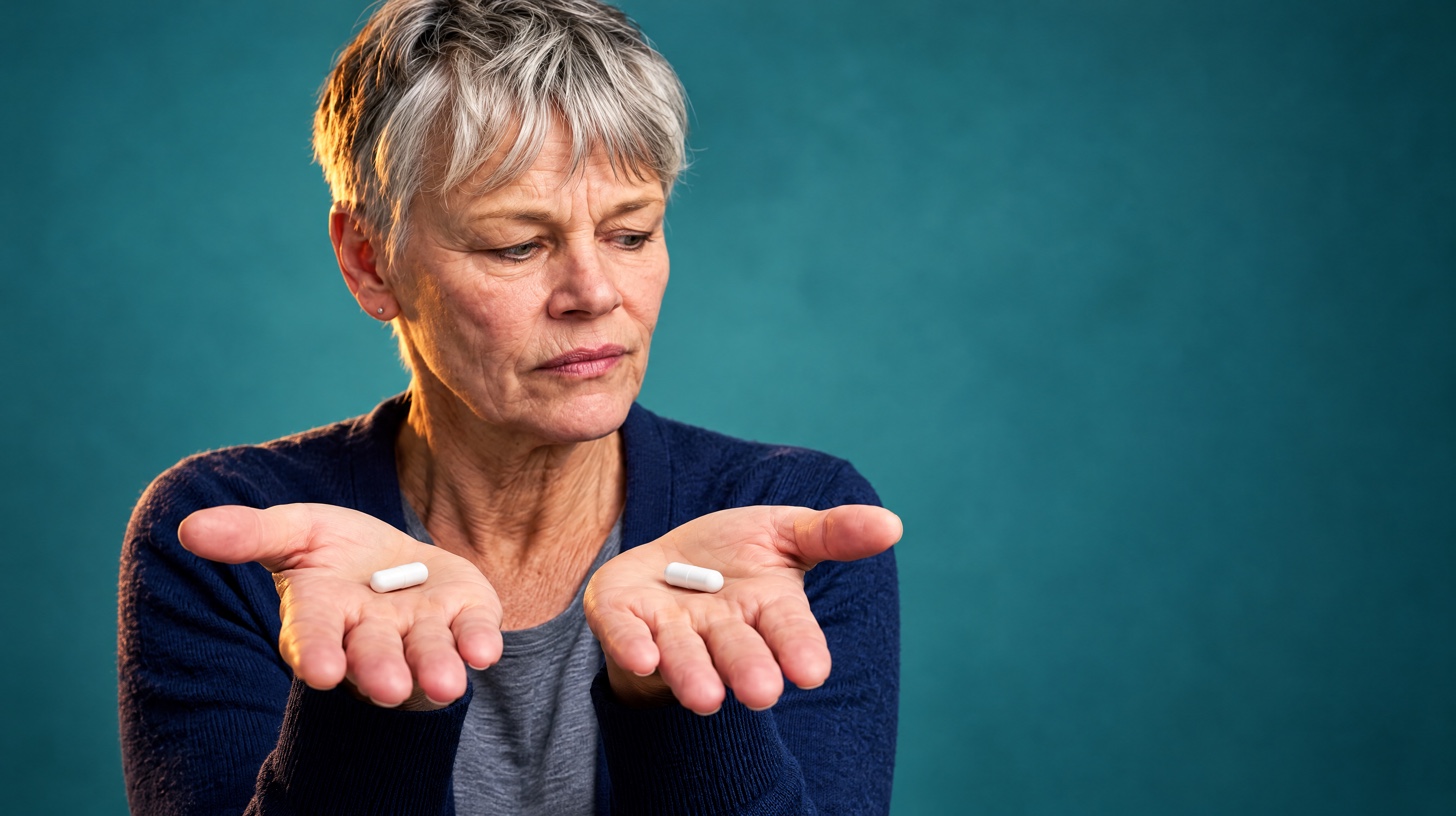
The claim: Raising your NAD+ with NR protects your brain and slows Parkinson's.
Our grade: Debunked. In the largest trial so far, 410 people with early Parkinson's took NR or a placebo for a year. The NR group's blood NAD rose sharply and their symptoms ended slightly worse, not better.
Ruth is 66 and was told last spring that she has Parkinson's. A friend sent her a podcast about NAD boosters, and a bottle of NR is in her online cart.
Should she buy it?
No. On October 8, 2026, JAMA published NOPARK, a one-year trial in 410 people very much like Ruth: average age 66, diagnosed within the past two years [1]. But the way it failed is strange. The capsules raised NAD in the blood, as promised, and the people who took them ended the year slightly worse off than the people on dummy pills.
How does a supplement do its job and still fail?
Why it should have worked
NAD+ is a small molecule every cell uses to turn food into energy and to repair itself. Levels fall with age. NR (nicotinamide riboside) and NMN are vitamin B3 relatives the body turns into NAD+.
The idea reached most people through Harvard's David Sinclair. On the Huberman Lab podcast in December 2021 he said: "I take a precursor to NAD called NMN," and that after about two weeks "you'll double, on average double your NAD levels in the blood" [3]. He was open that what he does may not work for others.
The Parkinson's version had real science behind it. Nerve cells that die in Parkinson's show signs of failing energy supply. A team in Bergen, Norway, gave 30 newly diagnosed patients 1,000 mg of NR or a placebo for 30 days. Brain scans showed NAD rising, and the people whose brain NAD rose improved a little [4]. A second trial found that 3,000 mg a day for four weeks was safe in 20 patients [5].
Those were good reasons to hope. They were also short and small, so the same team ran the big one.
After a year, the placebo group was ahead
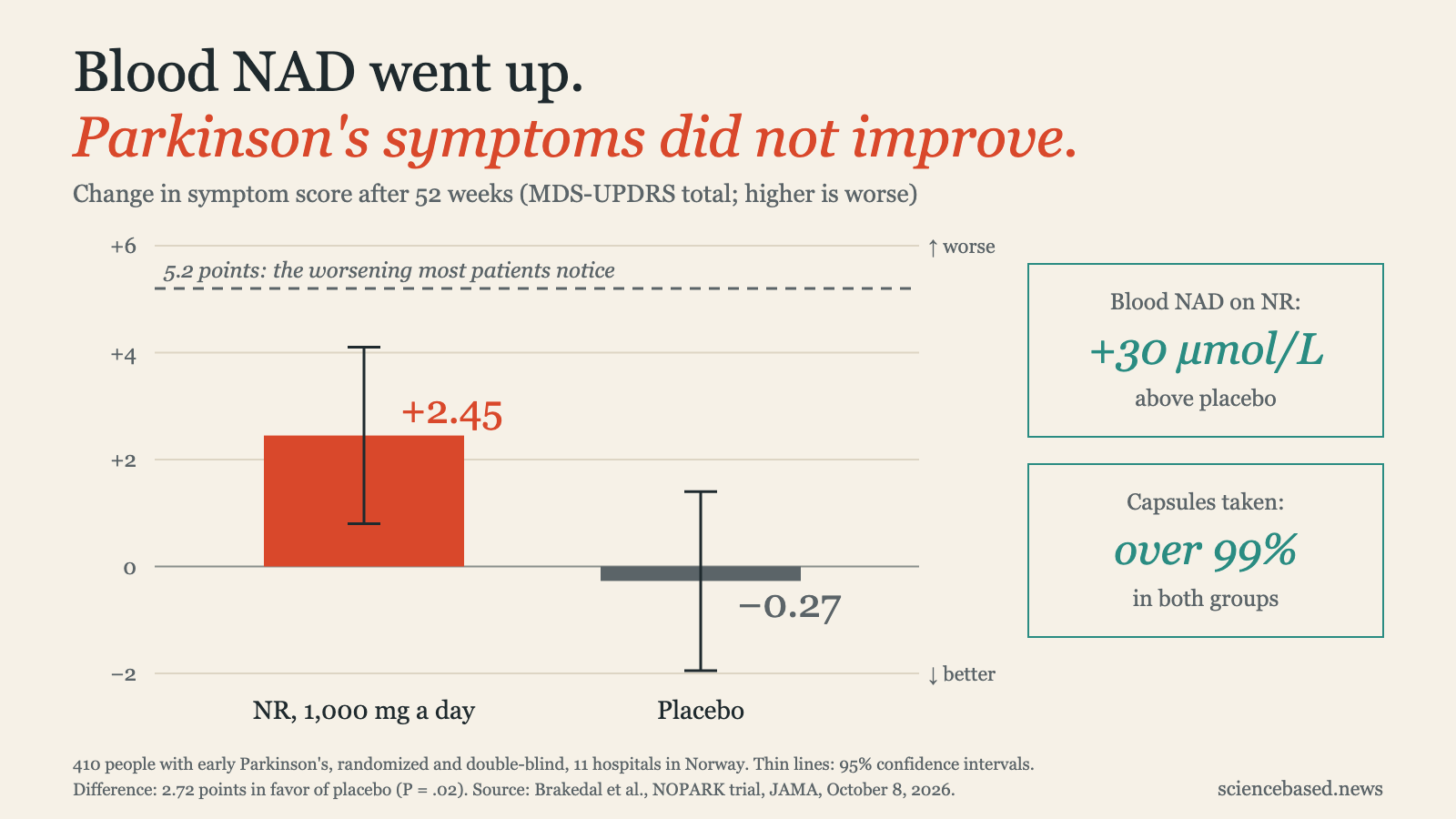
The main measure was a symptom score doctors use for Parkinson's, where higher is worse and people started near 26. After 52 weeks the NR group was 2.45 points worse. The placebo group had hardly moved (0.27 points better). The gap, 2.72 points, favored placebo and was unlikely to be chance [1].
How big is 2.7 points? Small. Patients usually notice a worsening at about 5 points, and the authors call the gap "modest." Nobody in the trial was badly harmed by NR. The fair reading is that it did not help, and may have nudged symptoms the wrong way.
The boring explanations don't hold. People did not skip their capsules: the typical person took more than 99% of them. And the capsules were not duds: blood NAD was higher on NR by 30 micromoles per liter, a clear rise [1].
NOPARK ran at 11 hospitals in Norway. It was randomized and double-blind: 206 people got 500 mg of NR twice a day, 204 got a placebo, and 393 were in the main analysis. Everyone kept taking their usual Parkinson's medicine [1].
A score for non-movement symptoms such as mood and sleep was 4.2 points worse on NR. Thinking tests were the same in both groups. Every way the team re-ran the numbers pointed the same direction [1].
Side effects were about even: 54.6% on NR and 53.7% on placebo reported one, and serious ones were less common on NR (8.3% against 14.1%). High blood pressure was reported more often on NR, 9.8% against 6.4% [1].
So NR went in every day for a year and reached the blood. That leaves one place to look.
The clue is in the brain scans
The claim was never about blood. It was that NR would raise NAD inside the brain, where the nerve cells are failing.
In NOPARK, 159 people had their brain NAD measured by scan. At one year it was no different from placebo. That is the opposite of the 30-day result. A scan that counts dopamine nerve endings showed no difference either [1].
That is most of the answer. NR changed what a blood test shows without changing the organ it was bought for.
One part is still open: why the NR group did slightly worse and not just the same. The authors don't know. One guess is that NR interferes with dopamine medicines. The scans argue against faster loss of nerve cells [1].
So back to Ruth's cart. A higher number in the blood did not mean a healthier brain. That is the lesson for her, and for anyone judging a supplement by a blood test.
Our grade
One failed trial in one disease does not settle every NAD claim. Here is each one on its own evidence.
| Claim | Evidence | Grade |
|---|---|---|
| NR raises NAD+ in your blood | Several randomized trials: up about 60% in blood cells in 24 older adults [6]; up 22% to 142% by dose in 140 adults [7]; higher in 353 people measured in NOPARK [1] | Solid |
| NR slows Parkinson's | NOPARK: 410 people, 1 year, symptoms 2.7 points worse than placebo, no benefit on brain scans [1] | Debunked |
| NAD boosters improve blood sugar control | NR, 40 men, 12 weeks: no change [8]. NMN, 25 women, 10 weeks: muscle responded better to insulin [9] | Weak |
| NR helps people with clogged leg arteries walk farther | One trial, 90 people, 6 months: 17.6 meters farther than placebo in six minutes [10] | Promising |
| NAD boosters make you live longer | Mice only, and they disagree: longer life in one lab [12], none in the US government's three-site test [13] | Unproven |
| Overall: NR protects the brain and slows Parkinson's | The one large, long trial found the opposite direction | Debunked |
The case for the other side starts with who was tested. Everyone in NOPARK had Parkinson's and took dopamine medicine. The result says nothing direct about healthy people, and the researchers say it does not rule out a benefit in other diseases [2].
The dose may also matter. NOPARK used 1,000 mg a day. A higher dose, or NMN, was not tested.
Other results are mixed, not empty. Walking distance improved in people with artery disease [10]. In 58 people with long COVID, 2,000 mg a day for 24 weeks raised NAD and did not beat placebo on thinking, fatigue, sleep or mood [11].
One more thing deserves credit. The trial's lead scientist holds patents on NR for Parkinson's, licensed to the company that sells it and supplied the capsules [1]. His team published a result against their own idea. That is how it should work.
A large placebo-controlled trial showing slower Parkinson's, or fewer diseases of aging in healthy adults, would change this grade.
What this means for you
Ruth should empty the cart. If you have Parkinson's, don't take NR or other NAD boosters for it outside a study. That is the trial team's own advice [2]. If you already take one, tell your neurologist; nothing in the trial suggests stopping is risky.
Put the effort where trials have paid off: hard aerobic exercise. In 130 patients, riding a stationary bike at home for 30 to 45 minutes three times a week held movement scores 4.2 points better than stretching over six months [15]. In 128 people not yet on medicine, treadmill sessions at about 80% of top heart rate held scores steady (0.3 points) while the no-exercise group worsened by 3.2 [14].
That gap is larger than anything NR was hoped to deliver, and it comes from a bike.
If you are healthy and take NR or NMN, this trial does not show harm to you. It does show that a raised NAD level is not proof of benefit. Ask what a product does for strength, walking or disease, in people, against placebo. NMN has one such trial with a real result: 250 mg a day made aging muscle 25% more responsive to insulin.
In NOPARK, what happened to Parkinson's symptoms after a year of NR?
The NR group worsened by 2.45 points while the placebo group barely changed.
Did NR raise NAD levels in the blood?
Blood NAD was clearly higher on NR, and people took over 99% of their capsules.
What kept movement scores steadier in two Parkinson's trials?
Stationary biking and high-intensity treadmill sessions both beat the comparison groups over 6 months.
Does this trial show NR harms healthy people?
Everyone in NOPARK had Parkinson's and took dopamine medicine, so it says nothing direct about healthy adults.
What's next
Expect the Bergen team to dig into why symptoms drifted the wrong way, and whether NR interacts with dopamine medicine. We'll update this page when they report.
For things that do hold up in people, see a few all-out bike sprints a week, which raised VO2 max about 8% in 93 trials, and five health levers, checked one by one. Another mitochondria supplement with early human data is urolithin A.
Was this helpful?
Sources
Show all sources (15)
- Brakedal B, Skeie GO, et al; Tzoulis C. Nicotinamide Riboside for Patients With Early-Stage Parkinson Disease: The NOPARK Randomized Clinical Trial. JAMA, published online October 8, 2026. 410 people, randomized, double-blind, placebo-controlled, 52 weeks, 11 sites in Norway. Public and foundation funding; ChromaDex (Niagen Bioscience) supplied NR and placebo; the senior author holds patents on NR licensed to the company. doi:10.1001/jama.2026.18828
- University of Bergen. Press release on the NOPARK trial, October 8, 2026. eurekalert.org/news-releases/1146813
- Huberman A, Sinclair D. The Biology of Slowing & Reversing Aging. Huberman Lab podcast, December 27, 2021. hubermanlab.com
- Brakedal B, et al. The NADPARK study: A randomized phase I trial of nicotinamide riboside supplementation in Parkinson's disease. Cell Metabolism, 2022. 30 people, randomized, double-blind, 30 days. doi:10.1016/j.cmet.2022.02.001
- Berven H, et al. NR-SAFE: a randomized, double-blind safety trial of high dose nicotinamide riboside in Parkinson's disease. Nature Communications, 2023. 20 people, randomized, 4 weeks. doi:10.1038/s41467-023-43514-6
- Martens CR, et al. Chronic nicotinamide riboside supplementation is well-tolerated and elevates NAD+ in healthy middle-aged and older adults. Nature Communications, 2018. 24 people analyzed, randomized crossover, 6 weeks each. NR supplied by ChromaDex. doi:10.1038/s41467-018-03421-7
- Conze D, Brenner C, Kruger CL. Safety and Metabolism of Long-term Administration of NIAGEN (Nicotinamide Riboside Chloride) in a Randomized, Double-Blind, Placebo-controlled Clinical Trial of Healthy Overweight Adults. Scientific Reports, 2019. 140 people, randomized, 8 weeks. Funded by ChromaDex. doi:10.1038/s41598-019-46120-z
- Dollerup OL, et al. A randomized placebo-controlled clinical trial of nicotinamide riboside in obese men: safety, insulin-sensitivity, and lipid-mobilizing effects. American Journal of Clinical Nutrition, 2018. 40 men, randomized, 12 weeks. doi:10.1093/ajcn/nqy132
- Yoshino M, et al. Nicotinamide mononucleotide increases muscle insulin sensitivity in prediabetic women. Science, 2021. 25 women, randomized, 10 weeks. doi:10.1126/science.abe9985
- McDermott MM, et al. Nicotinamide riboside for peripheral artery disease: the NICE randomized clinical trial. Nature Communications, 2024. 90 people, randomized, 6 months. doi:10.1038/s41467-024-49092-5
- Wu CY, et al. Effects of nicotinamide riboside on NAD+ levels, cognition, and symptom recovery in long-COVID: a randomized controlled trial. EClinicalMedicine, 2025. 58 people, randomized, 24 weeks. Part-funded by Niagen Bioscience. doi:10.1016/j.eclinm.2025.103633
- Zhang H, et al. NAD+ repletion improves mitochondrial and stem cell function and enhances life span in mice. Science, 2016. Mice. doi:10.1126/science.aaf2693
- Harrison DE, et al. 17-a-estradiol late in life extends lifespan in aging UM-HET3 male mice; nicotinamide riboside and three other drugs do not affect lifespan in either sex. Aging Cell, 2021. Mice, NIA Interventions Testing Program, three sites. doi:10.1111/acel.13328
- Schenkman M, et al. Effect of High-Intensity Treadmill Exercise on Motor Symptoms in Patients With De Novo Parkinson Disease: A Phase 2 Randomized Clinical Trial. JAMA Neurology, 2018. 128 people, randomized, 6 months. doi:10.1001/jamaneurol.2017.3517
- van der Kolk NM, et al. Effectiveness of home-based and remotely supervised aerobic exercise in Parkinson's disease: a double-blind, randomised controlled trial. Lancet Neurology, 2019. 130 people, randomized, 6 months. doi:10.1016/S1474-4422(19)30285-630285-6)
Discussion