

Tool · Daily targets
Your Daily Numbers
Every vitamin, mineral and macro, sized to you
Enter your age, size, activity and goal. You get calories, protein, carbs, fat and fiber, plus 27 vitamins and minerals, 9 essential amino acids, omega-3s and creatine, each with where the number comes from.
Free: three days that hit them
Our meal plan is three full days of real food that reach every vitamin and mineral target, for men and for women.
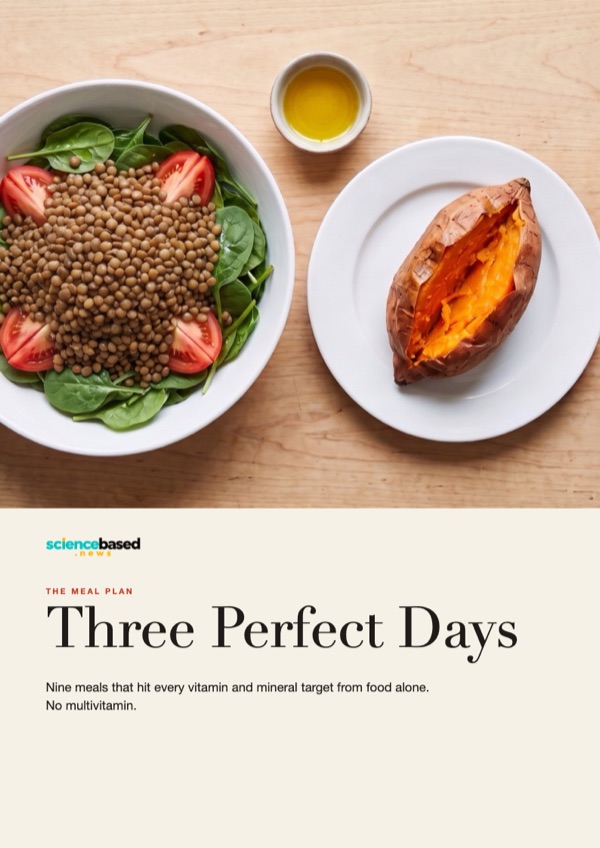 Three Perfect DaysPick the men's or women's plan and download the PDF.
How the numbers are set
Every piece is a published standard or study. The way they are combined is ours and has not been tested as a whole.
- Calories: the National Academies' 2023 equations, built from doubly labeled water, the most accurate way to measure how much energy people burn day to day [1]. Losing fat aims for 0.5% of body weight a week [2], with a floor of 1,500 kcal for men and 1,200 for women. Bulking adds 6.25%, the middle of a 5-7.5% surplus. Recomp and maintain eat at maintenance.
- Protein: 1.6 g per kg to maintain or bulk, where muscle gains level off in a meta-analysis of 49 trials [3]; 2.0 for recomp; 2.2 while losing fat, because in a deficit lean mass is kept from about 1.9 g/kg [4, 5]. Without lifting it is 0.8 g/kg (1.0 from age 65 [6]). Above a BMI of 30, protein uses the weight at a BMI of 25.
- Fat, carbs, fiber: fat is 25% of calories (the accepted range is 20-35%), saturated fat under 10%, carbs the rest, fiber 14 g per 1,000 kcal [7].
- Vitamins and minerals: the US Dietary Reference Intakes for your sex and age group (19-30, 31-50, 51-70, 71+) [7]. They do not grow with body size. "Max" is the safe upper limit. The bars compare your target with the Daily Value on US food labels, so you can add up the % DV on what you eat.
- Amino acids: the WHO minimums per kg [8]. Anyone eating the protein above clears them easily.
- Omega-3 and creatine: neither has an official target. EPA + DHA 0.5 g a day is about two servings of oily fish a week [9]. Creatine 3-5 g a day is the dose with the most evidence [10]; food gives about 1 g, so this means a supplement.
Adults 19 and over only, not pregnant or breastfeeding. It is a starting point, not medical advice. Equations miss real people by a few hundred calories either way, so the only real test is the scale: weigh yourself on the same days for three weeks and use "Check after three weeks" above.
- National Academies. Dietary Reference Intakes for Energy, 2023. doi:10.17226/26818
- Helms ER et al. Evidence-based recommendations for natural bodybuilding contest preparation. J Int Soc Sports Nutr 2014;11:20.
- Morton RW et al. Protein supplementation and resistance training: a meta-analysis. Br J Sports Med 2018;52:376-384.
- Longland TM et al. Higher protein during an energy deficit. Am J Clin Nutr 2016;103:738-746.
- Helms ER et al. Protein intake in resistance-trained, lean athletes during caloric restriction. Int J Sport Nutr Exerc Metab 2014;24:127-138.
- Bauer J et al. PROT-AGE recommendations for protein in older people. J Am Med Dir Assoc 2013;14:542-559.
- Institute of Medicine. Dietary Reference Intakes (vitamins, minerals, macronutrients), 1997-2011, and NASEM 2019 (sodium, potassium).
- WHO/FAO/UNU. Protein and amino acid requirements in human nutrition. WHO Technical Report Series 935, 2007.
- EFSA. Scientific opinion on dietary reference values for fats, 2010; American Heart Association fish advice.
- Kreider RB et al. ISSN position stand: creatine supplementation. J Int Soc Sports Nutr 2017;14:18.