

Replacing a narrowed heart valve early halved hospital stays
Evidence check, October 17, 2026

The claim: "If your aortic valve is badly narrowed, fix it before symptoms start. Don't wait."
Our grade: Solid. In four randomized trials of 1,427 people with a severely narrowed aortic valve and no symptoms, a new valve put in early cut unplanned heart hospital stays by more than half (14.6% vs 31.9%). Whether it also helps you live longer is not settled.
Walt is 77, plays nine holes twice a week and feels fine, but a heart ultrasound shows his aortic valve has narrowed to a slit. His doctor's plan is to check again in six months.
Should Walt fix a valve that isn't bothering him yet?
For decades the answer was no. Aortic stenosis, a stiff and narrowed valve between the heart and the body's main artery, affects more than 3% of adults 65 and older [2], and guidelines said to replace it only once it caused symptoms such as breathlessness, chest pain or fainting [2]. Since 2024, four randomized trials have tested that rule.
Where the claim came from
The old rule made sense. Replacing a valve meant open-heart surgery, and while people had no symptoms, their risk of sudden death was low, about 1 in 100 a year [9]. Why take a surgeon's risk for a valve that wasn't causing trouble?
But low is not zero, and it left a question open: what happens to people while they wait? Two things changed. TAVR (transcatheter aortic-valve replacement) puts a new valve in through a tube threaded up from an artery in the groin, with no open chest. And the trials came in. In May 2025 the FDA approved one TAVR valve for people with severe aortic stenosis and no symptoms [9]. Europe's 2025 guidelines now say early replacement should be considered when the procedure's risk is low [10]. In 2026 the New England Journal of Medicine put the question to two experts as a case: a 72-year-old woman with no symptoms [1].
What the studies found
The biggest trial: hospital stays cut in half
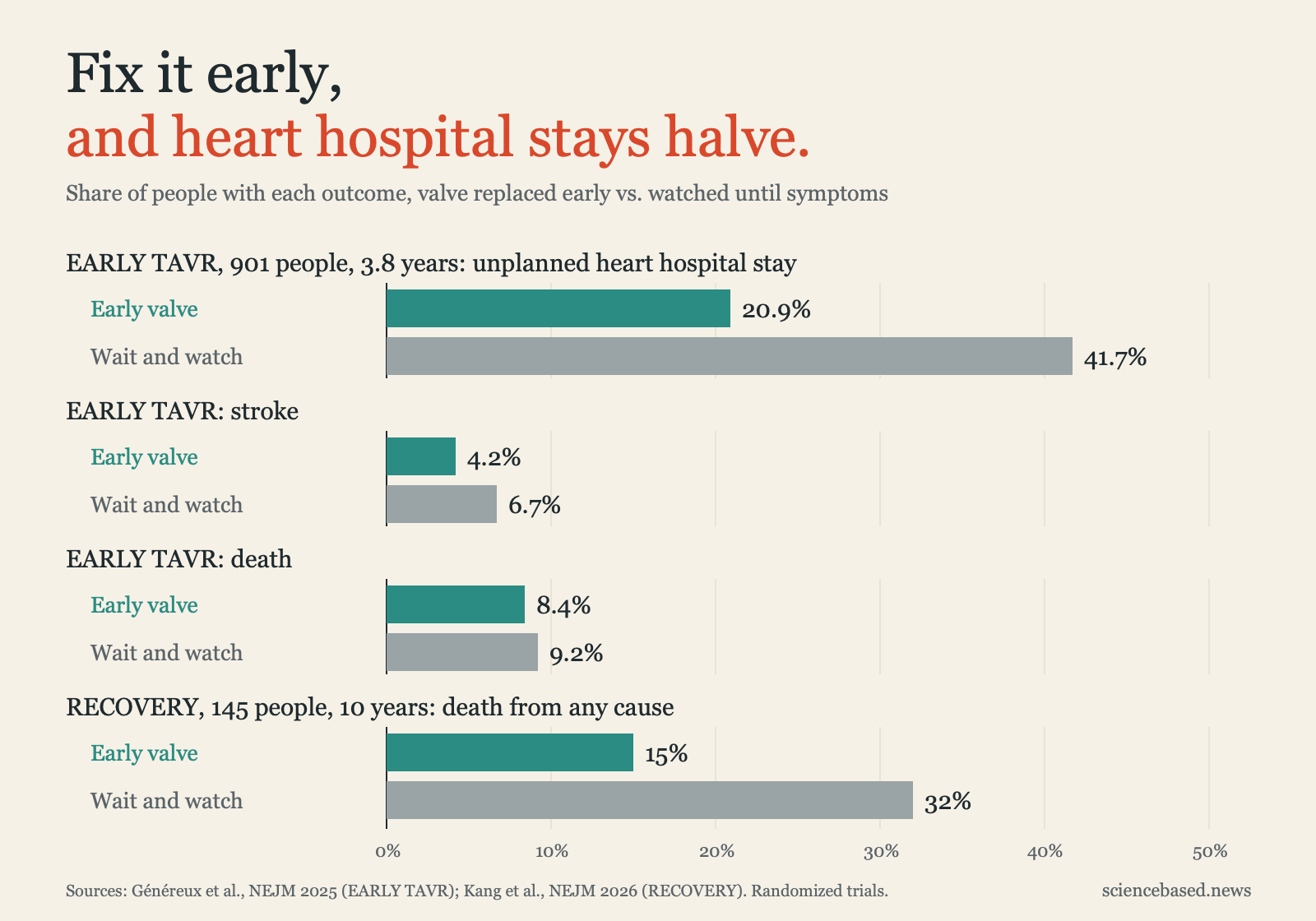
EARLY TAVR is the trial behind the FDA decision. It randomly assigned 901 people with severe aortic stenosis and no symptoms, average age 76, at 75 centers in the US and Canada [2]. Half got TAVR right away. Half were watched, with a new valve when symptoms came.
After a median of 3.8 years, 26.8% of the early group had died, had a stroke or had an unplanned hospital stay for a heart problem, against 45.3% of the watched group [2]. Most of that gap was hospital stays: 20.9% vs 41.7%. Strokes were 4.2% vs 6.7%. Deaths were about the same, 8.4% vs 9.2%.
Why would a valve that caused no symptoms send people to the hospital? The answer is in what happened to the watched group.
Waiting mostly meant waiting for an emergency
Here is the detail that matters for Walt. In EARLY TAVR, 87% of the watched group needed a new valve anyway within the 3.8 years, at a median of 11 months [2]. About 4 in 10 of them got it only after something went wrong, such as heart failure, fluid in the lungs or fainting [9].
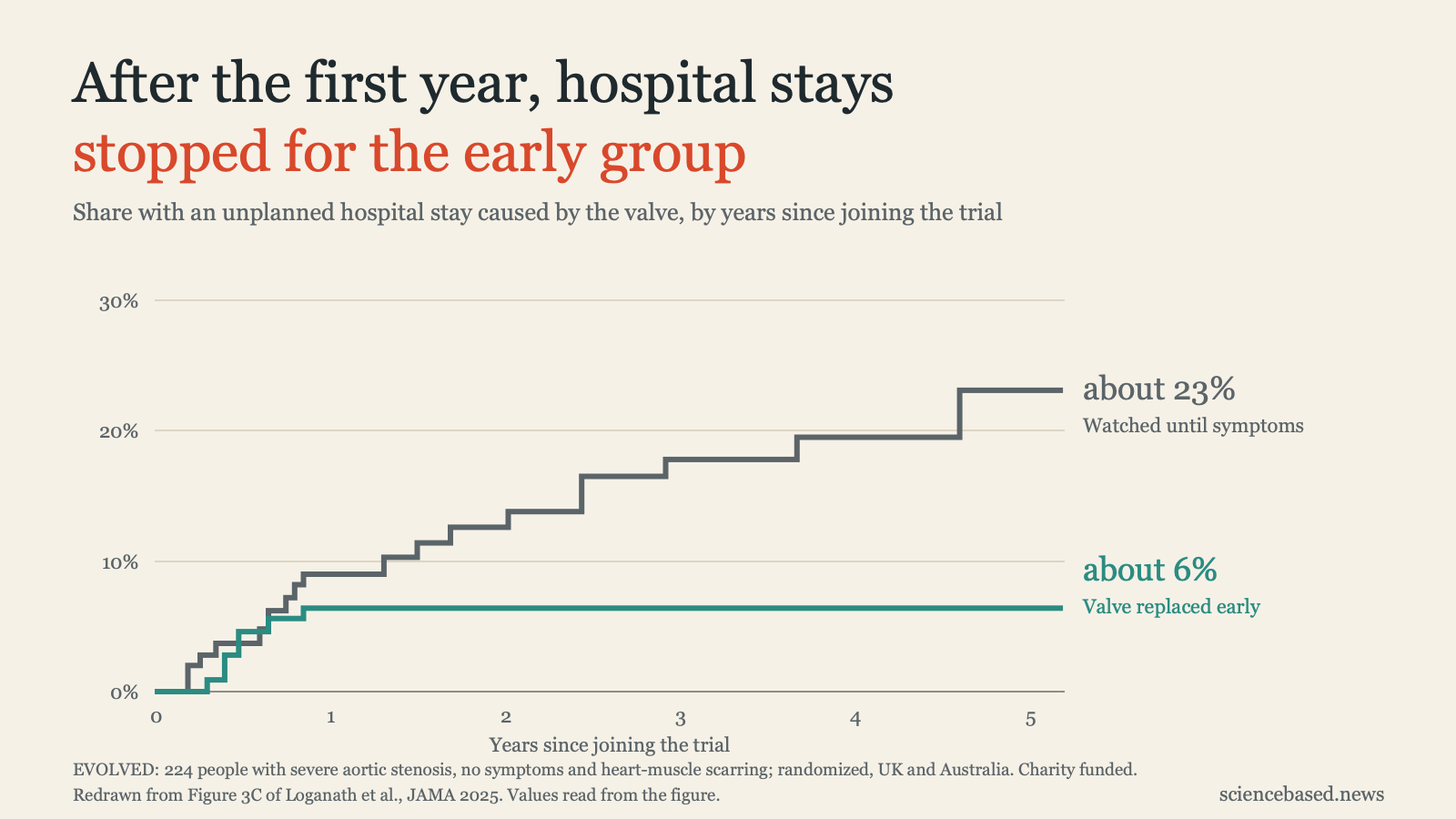
A smaller trial shows when those scares came. In EVOLVED, 224 people with severe aortic stenosis and no symptoms were followed for up to 5 years. In the early group, unplanned hospital stays caused by the valve stopped after the first year. In the watched group they kept coming, year after year [7].
So for most people the choice was not valve or no valve. It was a planned valve now or a valve later, often after a scare. That answers Walt's question about hospital stays. It leaves a bigger one: does fixing it early help him live longer?
The longest trial: half as many deaths at 10 years
RECOVERY, in Korea, is the trial that followed people longest. It randomly assigned 145 people with very severe aortic stenosis and no symptoms, average age 64, to early surgery or watchful waiting, and reported 10-year results in March 2026 [4].
After 10 years, 15% of the early-surgery group had died from any cause, against 32% of the watched group [4]. Deaths from the operation or from heart causes were 3% vs 24%.
EARLY TAVR (901 people, randomized, open-label, median 3.8 years, funded by Edwards Lifesciences, which makes the valve). Mean age 75.8, 69% men, 84% at low surgical risk. The combined outcome of death, stroke or unplanned heart hospital stay: 26.8% vs 45.3%, a hazard ratio of 0.50, meaning the early group had half the rate of these events over time [2]. Procedure problems were similar in the early group and in watched patients who later got a valve. Only people 65 and older whose arteries suited a groin approach took part, and only one valve was used [2, 3].
RECOVERY (145 people, randomized, open-label, 4 hospitals in Seoul, funded by a Korean research institute). The valves were very narrow: an opening of 0.75 cm² or less. Many people had a valve with two flaps instead of three, a birth difference common in younger patients. Operative or heart death: 2 of 73 vs 17 of 72. All deaths: 11 vs 23 [4].
AVATAR (157 people, randomized, 9 centers in 7 European countries, investigator-led, average age 67). Everyone first passed an exercise test, to make sure they truly had no symptoms. After a median of 63 months, death, heart attack, stroke or heart-failure hospital stay occurred in 23.1% vs 46.8%, deaths from any cause had a hazard ratio of 0.44, and heart-failure hospital stays a hazard ratio of 0.21 [5, 6].
EVOLVED (224 people with severe aortic stenosis and scarring of the heart muscle seen on MRI, randomized, UK and Australia, average age 73, median 42 months, charity funded). The main outcome, death or an unplanned hospital stay from the valve, was 18% vs 23%, too close to rule out chance. Deaths were 14% vs 13%. Hospital stays from the valve alone fell from 17% to 6% [7]. The trial enrolled fewer people than planned (224 of 356).
A 2025 analysis pooled the four trials: 1,427 people, average age 73, followed about 4 years [8]. Unplanned heart or heart-failure hospital stays: 14.6% vs 31.9%, a hazard ratio of 0.40, and the four trials agreed closely. Strokes: 4.5% vs 7.2%. Deaths from any cause: 9.7% vs 13.7%, a difference that could be chance, and the trials disagreed on it.
Put together, the four trials say the same thing about the hospital: fixing the valve early cut unplanned heart hospital stays by more than half [8]. That was true in a large TAVR trial and in smaller surgery trials, in North America, Europe and Korea.
What is not settled yet
On living longer, the trials split. The two smaller surgery trials, RECOVERY and AVATAR, found far fewer deaths with early surgery [4, 6]. The two larger ones, EARLY TAVR and EVOLVED, found none [2, 7]. Pooled, deaths were 9.7% vs 13.7%, not clearly different [8]. One reason may be that RECOVERY's patients were younger, with very narrow valves.
In every trial, patients and doctors knew who got a valve. A hospital stay is partly a doctor's call, and a doctor who knows a patient's valve is still narrow may admit them sooner [3]. The editorial on EARLY TAVR concluded that waiting for symptoms "remains a justifiable strategy" for people who are carefully watched [3].
Valves wear out. In PARTNER 3, a trial of 1,000 people with symptoms, average age 73, TAVR and surgical valves held up about equally over 7 years: valve failure 6.9% vs 7.5% [11]. Past 10 years, no one knows yet for TAVR. That matters more the younger you are, as does the chance of needing a pacemaker after TAVR [3].
So back to Walt. If his valve is severe, he is 77 and a valve team says his risk is low, the trials say a planned new valve now will very likely spare him a trip to the hospital later. Whether it adds years to his life is still being tested.
Our grade
| Claim | Evidence | Grade |
|---|---|---|
| An early new valve cuts unplanned heart hospital stays | 4 randomized trials, 1,427 people; 14.6% vs 31.9%, trials agree | Solid |
| An early new valve prevents strokes | Pooled 4.5% vs 7.2%; few strokes in each trial | Promising |
| An early new valve helps you live longer | 2 small trials yes (145 and 157 people), 2 larger trials no; pooled not clear | Promising |
| Overall: fix a badly narrowed valve before symptoms | Fewer emergencies is well shown; longer life is not yet | Solid |
The case for the other side is real. No trial hid who got a valve, and hospital stays are the outcome that drove the results. The largest trial was paid for by the valve's maker.
Careful watching, with an ultrasound every 6 to 12 months and fast action on symptoms, is still what US guidelines describe [2].
What would change the grade: three trials still running will report on deaths and heart-failure hospital stays (see below). If they show people live longer with an early valve, the "live longer" row moves up. If hospital stays don't fall when doctors are blinded to treatment, the main row moves down.
What this means for you
If an ultrasound shows severe aortic stenosis and you feel fine, ask your doctor to refer you to a heart valve team (a cardiologist and a heart surgeon who decide together). Ask them directly whether early replacement fits you. In the trials it helped people at low procedure risk, aged 64 to 76 on average [2, 4, 5, 7].
Ask which kind of valve. TAVR goes in through the groin; surgery means opening the chest. Europe's 2025 guidelines lean toward TAVR from age 70 and toward surgery below that, because of how long valves last [10].
If you and your doctor choose to wait, keep the checks. An ultrasound every 6 to 12 months [2], and a call to your doctor the same day for breathlessness on effort, chest pain, dizziness or fainting. In EARLY TAVR the median wait before a valve was needed was 11 months [2].
If your aortic stenosis is mild or moderate, these trials don't apply to you. They enrolled only severe cases.
In four trials, what did an early new valve clearly cut?
Unplanned heart hospital stays fell from 31.9% to 14.6%; deaths were not clearly different overall.
In EARLY TAVR, how many of the watched group needed a valve within about 4 years?
Most people who waited got a valve anyway, at a median of 11 months.
If you choose to wait, how often did guidelines say to get an ultrasound?
Guidelines recommend checks every 6 to 12 months, plus a call to your doctor at the first symptom.
Who were the trials for?
All four trials enrolled only severe aortic stenosis without symptoms.
What's next
Three randomized trials are still running: EASY-AS in the UK and other countries (2,844 people planned), DANAVR in Denmark (1,700 planned, results expected around 2029) and ESTIMATE. EASY-AS is the one to watch for deaths: its main outcome is heart death or heart-failure hospital stay [12, 13].
For other ways to protect your heart and live longer, see the five health levers with the strongest evidence and sprint intervals for VO2 max.
Was this helpful?
Sources
Show all sources (13)
- Kotanidis CP, Eltchaninoff H, Tseng EE, Thourani VH. Transcatheter or Surgical Aortic-Valve Replacement in Asymptomatic Severe Aortic Stenosis. New England Journal of Medicine, 2026;394:195-198. Clinical Decisions case with two expert essays. doi:10.1056/NEJMclde2416168
- Généreux P, Schwartz A, Oldemeyer JB, et al. Transcatheter Aortic-Valve Replacement for Asymptomatic Severe Aortic Stenosis (EARLY TAVR). New England Journal of Medicine, 2025;392:217-227. 901 people, randomized, open-label, median 3.8 years. Funded by Edwards Lifesciences. doi:10.1056/NEJMoa2405880
- Blankenberg S. Asymptomatic Severe Aortic-Valve Stenosis — To Wait or Not to Wait. New England Journal of Medicine, 2025. Editorial. doi:10.1056/NEJMe2415973
- Kang D-H, et al. Early Surgery or Conservative Care for Asymptomatic Aortic Stenosis at 10 Years (RECOVERY). New England Journal of Medicine, 2026;394:1167-1174. 145 people, randomized, open-label, 10 years. doi:10.1056/NEJMoa2511920
- Banovic M, Putnik S, Penicka M, et al. Aortic Valve Replacement Versus Conservative Treatment in Asymptomatic Severe Aortic Stenosis: The AVATAR Trial. Circulation, 2022;145:648-658. 157 people, randomized, investigator-initiated. doi:10.1161/CIRCULATIONAHA.121.057639
- Banovic M, Putnik S, Da Costa BR, et al. Aortic valve replacement vs. conservative treatment in asymptomatic severe aortic stenosis: long-term follow-up of the AVATAR trial. European Heart Journal, 2024;45:4526-4535. 157 people, median 63 months. doi:10.1093/eurheartj/ehae585
- Loganath K, Craig NJ, Everett RJ, et al. Early Intervention in Patients With Asymptomatic Severe Aortic Stenosis and Myocardial Fibrosis: The EVOLVED Randomized Clinical Trial. JAMA, 2025;333:213-221. 224 people, randomized, open-label, median 42 months. Charity funded. doi:10.1001/jama.2024.22730
- Généreux P, Banovic M, Kang D-H, et al. Aortic Valve Replacement vs Clinical Surveillance in Asymptomatic Severe Aortic Stenosis: A Systematic Review and Meta-Analysis. Journal of the American College of Cardiology, 2025;85:912-922. 4 randomized trials, 1,427 people, about 4 years. doi:10.1016/j.jacc.2024.11.006
- Lancellotti P, Coisne A, Cosyns B, et al. Early aortic valve intervention in asymptomatic severe aortic stenosis: a clinical dilemma in evolution. European Heart Journal Open, 2025;5:oeaf114. Viewpoint. doi:10.1093/ehjopen/oeaf114
- Praz F, Borger MA, Lanz J, et al. 2025 ESC/EACTS Guidelines for the management of valvular heart disease. European Heart Journal, 2025;46:4635-4736. doi:10.1093/eurheartj/ehaf194
- Leon MB, Mack MJ, Pibarot P, et al. Transcatheter or Surgical Aortic-Valve Replacement in Low-Risk Patients at 7 Years (PARTNER 3). New England Journal of Medicine, 2026;394:773-783. 1,000 people with symptoms, randomized, 7 years. Funded by Edwards Lifesciences. doi:10.1056/NEJMoa2509766
- Rationale and design of the Early valve replacement in severe ASYmptomatic Aortic Stenosis (EASY-AS) trial. American Heart Journal, 2024. 2,844 people planned, randomized. PubMed 38821453
- Danish National Randomized Study on Early Aortic Valve Replacement in Patients With Asymptomatic Severe Aortic Stenosis (DANAVR). ClinicalTrials.gov NCT03972644. 1,700 people planned. clinicaltrials.gov/study/NCT03972644
Discussion