

Rotator cuff exercises kept most people off the surgery list
Evidence check, October 18, 2026
The claim: "The right rotator cuff exercises can keep you off the operating table."
Our grade: Promising. In a Swedish trial of 97 people already booked for shoulder surgery, 12 weeks of loaded rotator cuff and shoulder-blade exercises cut the share who still wanted the operation from 63% to 20%, and the gap held for 10 years. It is one trial, and other trials found that simpler home exercises or advice did about as well as fancier programs.
Sam is 35. His right shoulder has ached for eight months, worst when he reaches up for a shelf or rolls onto it at night. Physical therapy last spring didn't fix it, and now a surgeon has put him on the list for an operation.
Should he do some exercises first?
In 2012, Swedish researchers asked that question of 102 people in Sam's position, all on a surgery waiting list in Linköping, and then followed them for 10 years [3, 6].
Where the claim came from
On October 14, 2026, Michael Greger posted a NutritionFacts.org video called "Preventing Rotator Cuff Shoulder Pain with Diet" [1]. It opens with a sweeping claim: "current therapies for the most common forms of shoulder pain—from the simplest and most conservative to the most invasive and expensive—show no consistent differences in clinical outcomes, even when tested against placebos or simply doing nothing." His answer is prevention through diet: lower cholesterol, and fewer advanced glycation end products (AGEs, compounds formed when food is browned at high heat).
A week earlier, in "Chiropractic Manipulation, Physical Therapy, and Exercise Therapy for Shoulder Pain Relief", he went after exercise directly [2]. The fact that the "dose" of physical therapy didn't seem to matter, he said, "makes one suspicious that special exercises play any role at all."
He is right about some of it, and he cites real trials. But he leaves out the trial that tested exercise against the operation itself, in the people closest to having it.
What the studies found
The Swedish trial enrolled people aged 30 to 65 with shoulder impingement pain (pain where the rotator cuff tendons pass under the top of the shoulder blade) for over 6 months [3]. All had tried physical therapy already and were waiting for a subacromial decompression, an operation that shaves bone to make room for the tendon.
Everyone got one steroid injection. Then half did a specific program: two rotator cuff exercises lowered slowly against a weight or band (the full can for the supraspinatus, external rotation for the infraspinatus), three shoulder-blade exercises and a stretch. They did 3 sets of 15, twice a day, with a physiotherapist raising the load every two weeks. The other half did gentle neck and shoulder movements with no weight. Patients didn't know which program was the real one, and neither did the shoulder specialist who later asked whether they still wanted the operation.
At 3 months, 69% of the exercise group said they were much better or recovered, against 24% of the control group [3]. Their shoulder score (the Constant-Murley score, 0 to 100) rose 24 points, against 9. And 20% still wanted surgery, against 63%.
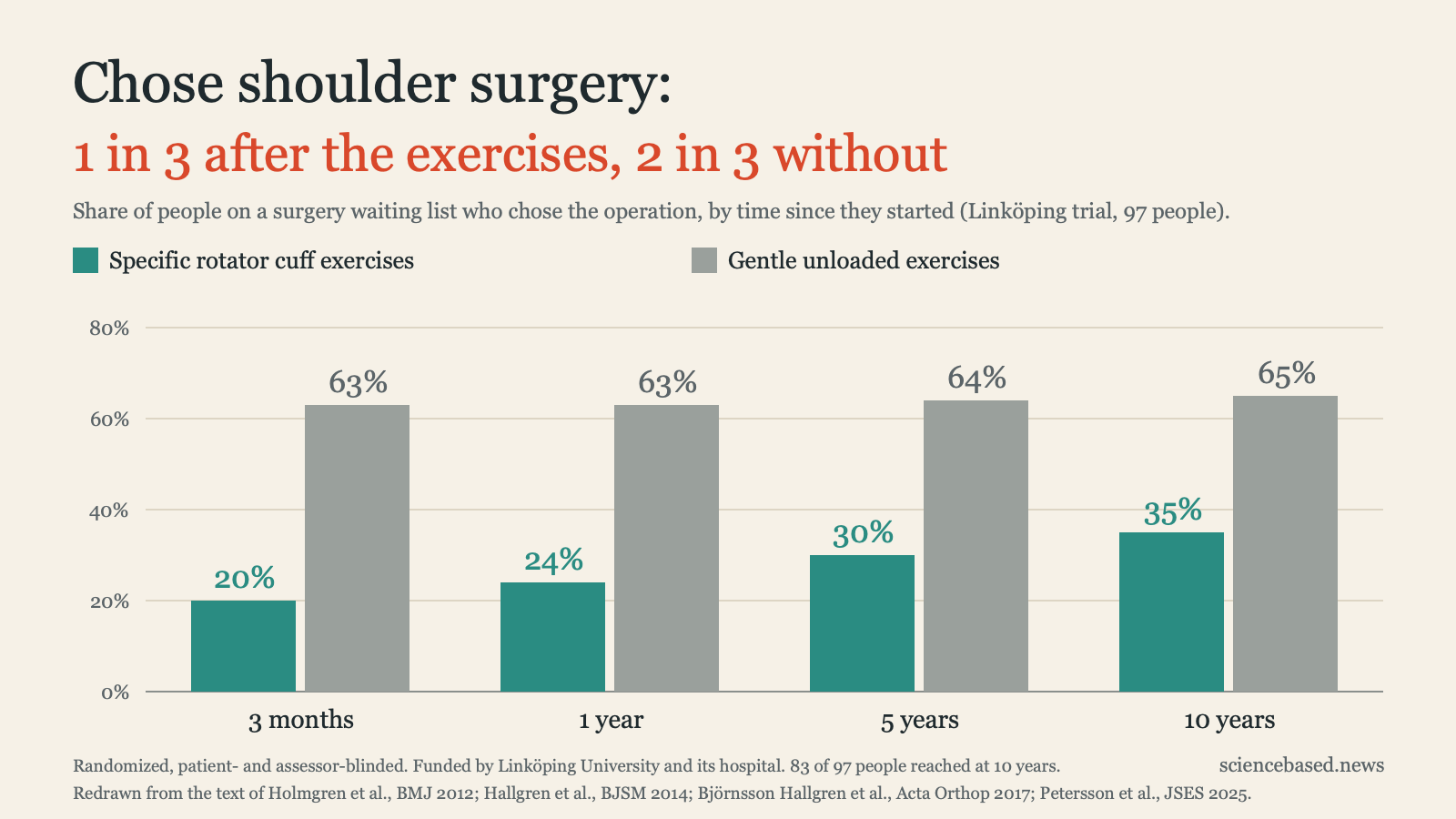
The gap held. At 1 year, 24% of the exercise group had chosen surgery, against 63% [4]. At 5 years, 30% against 64% [5]. At 10 years, 35% against 65% [6]. Most of those who skipped the operation still had good shoulders: a mean score of 88 out of 100 at 10 years.
The trial was small: 97 people analysed after 5 dropped out, at one clinic [3]. The assessing specialist and the patients were blinded, but the physiotherapist who ran both programs was not. The exercise group had more partial tendon tears at the start (15 against 6), which if anything should have worked against it. People with full-thickness tears and the lowest starting scores were the most likely to choose surgery anyway [4]. Those who did have the operation after failing the exercises also improved a lot, so the program worked as a way to find who really needed surgery [5, 6]. The trial was funded by Linköping University and its hospital, and the authors report no commercial ties [6].
The rotator cuff moves in the program are also the ones that work the muscle hardest. With wires recording muscle activity in 10 healthy people, side-lying external rotation used 62% of the infraspinatus's maximum effort and 67% of the teres minor's, the highest of seven exercises tested [13]. In 15 people, the full can worked the supraspinatus about as hard as the empty can (thumb down) but with less deltoid, which is why many therapists prefer it [14].
Did the people who skipped the operation miss out? Two larger trials say no. In the UK CSAW trial, 313 people were randomly assigned to decompression surgery, a placebo operation (a camera put in, nothing removed) or no treatment [7]. At 6 months, real surgery scored no better than placebo surgery on the Oxford Shoulder Score (32.7 against 34.2 out of 48). In Finland, 210 people were assigned to decompression, placebo surgery or supervised exercise, and after 10 years real surgery still did no better than either one on pain [8].
So back to Sam. In the one trial that tested his exact situation, 12 weeks of loaded exercise meant most people like him never had the operation, and 10 years later they weren't sorry.
But does it have to be this program, with a physiotherapist every two weeks? That is where Greger's evidence comes in.
Where Greger has a point
The trials Greger cites tested people earlier in the problem, and asked whether a full exercise program beats something simpler. Mostly, it didn't.
In the UK GRASP trial, 708 people with new rotator cuff pain got either up to six physiotherapy sessions of progressive exercise or one session of advice [10]. Over 12 months their pain and disability scores came out the same (a difference of 0.66 points on a 100-point scale). But the advice group was not left with nothing. They went home with a resistance band, a booklet and a simpler set of strengthening exercises to do five days a week. Both groups' scores fell from about 54 to about 20 to 24. GRASP shows that one visit plus home band work does as well as six visits, not that exercise does nothing.
In a Canadian trial of 123 people, adding strengthening or motor control exercises (retraining how the shoulder moves) to education did no better than education alone over 24 weeks [12]. A 2024 review of 22 trials (1,281 people) found motor control programs slightly better than general exercise, and too little evidence to say whether eccentric or shoulder-blade programs were [9].
In an Australian trial of 120 people with chronic rotator cuff pain, 10 weeks of manual therapy and home exercise did no better than fake ultrasound at 11 weeks [11]. Greger stopped there. At 22 weeks, the exercise group's pain and disability score was 7.1 points better than placebo, and at 11 weeks they were already stronger.
The diet claim
Greger's prevention advice rests on links, not trials. In a Taiwan cohort of 498,678 people followed for 11 years, high cholesterol came with 48% more rotator cuff disease after adjusting for age, sex and other factors [15]. Among people with high cholesterol, those on statins had 34% to 59% lower risk, depending on the drug. That is where his "half the risk" comes from, and it is fair to that study. A 2023 meta-analysis found the same 48% higher odds across 8 studies, with bias possible [17].
His "sixfold higher odds of retear" comes from one retrospective study of 85 people after surgical repair: 45.5% of those with high cholesterol tore again, against 11.3% without (odds ratio 6.5) [16]. Every one of the high-cholesterol patients was already taking a statin. The AGE claim rests on tendon cells and tissue in a lab dish [18].
None of this shows that changing your diet prevents shoulder pain; no trial has tested it. Lowering cholesterol is worth doing for your heart anyway.
Our grade
The exercise result is the strongest finding here. The real question is how far one trial of 97 people can carry it.
| Claim | Evidence | Grade |
|---|---|---|
| 12 weeks of loaded rotator cuff and shoulder-blade exercises keep many people on a surgery list from needing it [3, 4, 5, 6] | 1 randomized, blinded trial, 97 people, followed 10 years | Promising |
| Decompression surgery beats placebo surgery or exercise [7, 8] | 2 placebo-controlled trials, 313 and 210 people, up to 10 years | Debunked |
| A supervised, progressive program beats one visit plus home exercises or education [10, 12] | 2 randomized trials, 708 and 123 people | Debunked |
| Diet prevents rotator cuff disease [15, 16, 17, 18] | Observational links to cholesterol, a lab study of AGEs, no diet trial | Weak |
| Overall: the right rotator cuff exercises can keep you off the operating table | One strong trial with 10 years of follow-up; not yet repeated | Promising |
The case for the other side: the control group did gentle movements, not nothing, and not the simple band exercises that matched full programs in GRASP. The trial shows loaded exercise beat unloaded exercise, not that one special program beats all others.
Choosing surgery is the patient's decision, so expectations could shape it. The specialist who asked was blinded, but patients may have guessed which program was the real one.
No trial had a group that did nothing at all, so part of the improvement in every group is natural recovery.
What would change the grade: a second trial in people on a surgery waiting list, ideally comparing the program with simple home band exercises. A clear repeat would move it toward Solid.
What this means for you
- If you have had shoulder pain for months and a surgeon has offered decompression, ask about 12 weeks of loaded exercise first. In the trial, most people who did it never needed the operation [3, 6].
- The two rotator cuff moves in the program were the full can and external rotation, lowered slowly against a weight or band. Add shoulder-blade squeezes and a push-up plus, 3 sets of 15, twice a day for 8 weeks, then once a day to week 12 [3].
- Some pain is fine: up to 5 out of 10 during the exercise, as long as it settles before the next session [3].
- You may not need many physiotherapy visits. One session to learn the moves plus home band work did as well as six sessions [10].
- If it's still bad after 12 weeks, surgery is a reasonable next step; in the trial, those who had it after the exercises failed also did well [5, 6].
- A sudden injury, a fall, or an arm you can't lift is a different problem, often a large tear; see a doctor.
In the Swedish trial, how many people still wanted surgery after 12 weeks of the specific exercises?
20% of the exercise group still wanted surgery, against 63% of the group doing gentle movements.
Did the effect last?
The trial followed people for 10 years, and the gap held at every check.
How much pain is acceptable during the exercises in the trial program?
Pain up to 5 out of 10 was allowed, but it had to settle before the next session, or the load came down.
What did the GRASP trial find about physiotherapy visits?
Over 12 months, 708 people improved by the same amount whether they had one session of advice with home exercises or up to six sessions.
Ask about this study
Answers by AI from this article only. Not medical advice. Questions and answers are saved (never your IP address): what we keep.
What's next
The Swedish result needs a second trial. The most useful one would pit the program against simple home band exercises in people already on a surgery list. On the diet side, no trial has tested whether lowering cholesterol or AGEs protects shoulders; until then, statin and cholesterol studies are only links.
For other ways to build and keep muscle, see how much protein you need and creatine for strength. If a friend has told you a peptide fixed their shoulder, read our TB-500 check.
Was this helpful?
Sources
Show all sources (18)
- Michael Greger. Preventing Rotator Cuff Shoulder Pain with Diet. NutritionFacts.org video, published October 14, 2026. youtube.com, transcript and sources at nutritionfacts.org
- Michael Greger. Chiropractic Manipulation, Physical Therapy, and Exercise Therapy for Shoulder Pain Relief. NutritionFacts.org video, published October 5, 2026. nutritionfacts.org
- Holmgren T, Björnsson Hallgren H, Öberg B, Adolfsson L, Johansson K. Effect of specific exercise strategy on need for surgery in patients with subacromial impingement syndrome: randomised controlled study. BMJ, 2012. 102 people aged 30 to 65 on a surgery waiting list (97 analysed), randomized, patient- and assessor-blinded, 12 weeks. doi:10.1136/bmj.e787
- Hallgren HC, Holmgren T, Öberg B, Johansson K, Adolfsson LE. A specific exercise strategy reduced the need for surgery in subacromial pain patients. British Journal of Sports Medicine, 2014. 1-year follow-up of the same trial, 95 people. doi:10.1136/bjsports-2013-093233
- Björnsson Hallgren HC, Adolfsson LE, Johansson K, Öberg B, Peterson A, Holmgren TM. Specific exercises for subacromial pain: good results maintained for 5 years. Acta Orthopaedica, 2017. 5-year follow-up, 91 people. doi:10.1080/17453674.2017.1364069
- Petersson AH, Björnsson Hallgren HC, Adolfsson LE, Holmgren TM. No need for subacromial decompression in responders to specific exercise treatment: a 10-year follow-up of a randomized controlled trial. Journal of Shoulder and Elbow Surgery, 2025. 10-year follow-up, 83 people; funded by Linköping University and Linköping University Hospital, no commercial conflicts. doi:10.1016/j.jse.2024.10.027
- Beard DJ, Rees JL, Cook JA, Rombach I, Cooper C, Merritt N, et al. Arthroscopic subacromial decompression for subacromial shoulder pain (CSAW): a multicentre, pragmatic, parallel group, placebo-controlled, three-group, randomised surgical trial. The Lancet, 2018. 313 people, 32 UK hospitals, randomized, 6 months (primary) and 1 year. doi:10.1016/S0140-6736(17)32457-132457-1)
- Kanto K, Bäck M, Ibounig T, Björkenheim R, Malmivaara A, Czuba T, et al. Arthroscopic subacromial decompression versus placebo surgery for subacromial pain syndrome: 10 year follow-up of the FIMPACT randomised, placebo surgery controlled trial. BMJ, 2025. 210 people aged 35 to 65 (193 randomized to the three groups), 10 years. doi:10.1136/bmj-2025-086201
- Lafrance S, Charron M, Dubé MO, Desmeules F, Roy JS, Juul-Kristensen B, et al. The efficacy of exercise therapy for rotator cuff-related shoulder pain according to the FITT principle: a systematic review with meta-analyses. Journal of Orthopaedic & Sports Physical Therapy, 2024. 22 randomized trials, 1,281 people. doi:10.2519/jospt.2024.12453
- Hopewell S, Keene DJ, Marian IR, Dritsaki M, Heine P, Cureton L, et al. Progressive exercise compared with best practice advice, with or without corticosteroid injection, for the treatment of patients with rotator cuff disorders (GRASP). The Lancet, 2021. 708 people, 20 UK NHS trusts, randomized 2 × 2 factorial, 12 months; funded by the UK National Institute for Health Research. doi:10.1016/S0140-6736(21)00846-100846-1)
- Bennell K, Wee E, Coburn S, Green S, Harris A, Staples M, et al. Efficacy of standardised manual therapy and home exercise programme for chronic rotator cuff disease: randomised placebo controlled trial. BMJ, 2010. 120 people, randomized, placebo-controlled, 22 weeks. doi:10.1136/bmj.c2756
- Dubé MO, Desmeules F, Lewis JS, Roy JS. Does the addition of motor control or strengthening exercises to education result in better outcomes for rotator cuff-related shoulder pain? A multiarm randomised controlled trial. British Journal of Sports Medicine, 2023. 123 adults, randomized, 24 weeks. doi:10.1136/bjsports-2021-105027
- Reinold MM, Wilk KE, Fleisig GS, Zheng N, Barrentine SW, Chmielewski T, et al. Electromyographic analysis of the rotator cuff and deltoid musculature during common shoulder external rotation exercises. Journal of Orthopaedic & Sports Physical Therapy, 2004. 10 healthy people, muscle activity study. doi:10.2519/jospt.2004.34.7.385
- Boettcher CE, Ginn KA, Cathers I. Which is the optimal exercise to strengthen supraspinatus? Medicine & Science in Sports & Exercise, 2009. 15 healthy people, muscle activity study. doi:10.1249/MSS.0b013e3181a740a7
- Lin TT, Lin CH, Chang CL, Chi CH, Chang ST, Sheu WH. The effect of diabetes, hyperlipidemia, and statins on the development of rotator cuff disease: a nationwide, 11-year, longitudinal, population-based follow-up study. American Journal of Sports Medicine, 2015. 498,678 people, observational cohort, 11 years. doi:10.1177/0363546515588173
- Garcia GH, Liu JN, Wong A, Cordasco F, Dines DM, Dines JS, et al. Hyperlipidemia increases the risk of retear after arthroscopic rotator cuff repair. Journal of Shoulder and Elbow Surgery, 2017. 85 patients, retrospective review. doi:10.1016/j.jse.2017.05.009
- Giri A, O'Hanlon D, Jain NB. Risk factors for rotator cuff disease: a systematic review and meta-analysis of diabetes, hypertension, and hyperlipidemia. Annals of Physical and Rehabilitation Medicine, 2023. Meta-analysis of observational studies (8 on cholesterol). doi:10.1016/j.rehab.2022.101631
- Mifune Y, Inui A, Muto T, Nishimoto H, Kataoka T, Kurosawa T, et al. Influence of advanced glycation end products on rotator cuff. Journal of Shoulder and Elbow Surgery, 2019. Lab study of human tendon cells and tissue. doi:10.1016/j.jse.2019.01.022
Discussion