

One dose of creatine sharpened memory after a sleepless night
Evidence check, October 18, 2026. Updated October 30, 2026.

The claim: "Creatine protects your brain when you're short on sleep. Take more of it on the nights you can't sleep."
Our grade: Promising. In two randomized trials from one German lab, one large dose of creatine taken at the start of a night awake kept memory and thinking speed from sliding as far as they did on placebo, and brain scans showed why. The trials were small (15 and 29 people), and in well-rested young adults creatine made little difference.
Maya is 38 and an emergency room nurse. Tonight she starts a run of night shifts, 7 pm to 7 am, and by 4 am she will be checking drug doses on four hours of sleep from the day before. She already takes 5 grams of creatine for the gym.
Could more of it keep her head clear at 4 am?
Your brain uses creatine the way muscle does, as a fast backup for its energy supply. In 2024, a team at Forschungszentrum Jülich, a German research center, gave people a single big dose during a night without sleep and watched their brains in a scanner [3].
Where the claim came from
Rhonda Patrick takes 10 grams of creatine a day, twice the usual muscle dose, and 15 to 20 grams when she is short on sleep. She explained why on Peter Attia's podcast in 2025, and her FoundMyFitness clip of it is titled "Why Taking 5g of Creatine Is No Longer Enough" [1]. She called brain effects "the most interesting area of creatine research" to her right now.
She cited three things: the Jülich sleep trial, a small pilot in Alzheimer's disease, and a 2024 meta-analysis of 16 trials that found benefits for memory [1, 9]. Attia's question was the useful one: how big is the effect, and who gains from doubling the dose?
What a night awake does to the brain
Staying awake draws down the brain's quick energy reserve, phosphocreatine (creatine's energy-carrying form). A brain using energy faster than it can easily make it shows less phosphocreatine, more spare phosphate and a slight turn toward acid, and a scanner can see all three [3]. Memory slips with it.
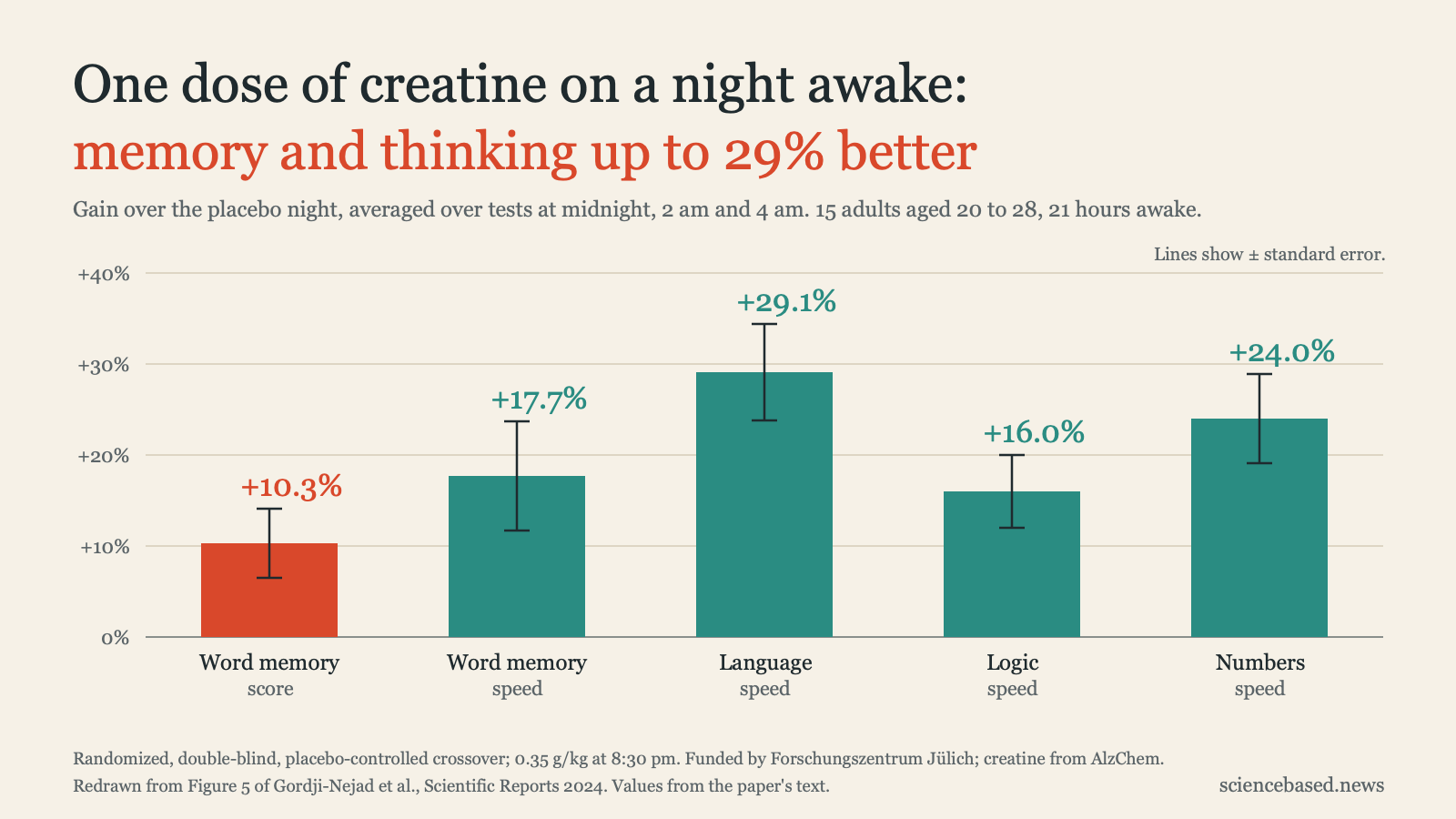
In the Jülich trial, 15 healthy adults aged 20 to 28 stayed awake for 21 hours on two separate nights, at least 5 days apart [3]. On one night they got creatine, 0.35 grams per kilogram of body weight (about 25 grams for a 70 kg person), at 8:30 pm. On the other they got a look-alike starch. Neither they nor the researchers knew which was which. They were tested at midnight, 2 am and 4 am.
On the placebo night, sleep loss did what you'd expect: scores on a word-pair memory test fell 7.8% from the evening, and the number of digits people could repeat back fell 18.7% [3].
The creatine night
On the creatine night, the brain's energy chemistry held. The scans showed creatine kept the balance of phosphocreatine to spare phosphate steady and stopped the drop in pH that came with staying up [3]. That surprised the field: until then, creatine was thought to reach the brain only after weeks of daily doses.
And the tests followed. Compared with the placebo night, people on creatine scored 10.3% higher on the word memory test and finished it 17.7% faster. They were 29.1% faster on a language task, 16.0% faster on logic problems and 24.0% faster on number problems. They also felt less tired [3].
Then the same team ran it again, larger. In 2026 they gave 29 adults aged 20 to 40 a lower dose, 0.2 grams per kilogram, on one sleepless night and placebo on another [4]. Creatine again eased the slide in logic, number tasks, language speed and a reaction-time test, by up to 12%. Women gained more than men. Nobody reported stomach trouble.
The memory results were weaker the second time. By 4 am, word memory scores had fallen 23.9% from the evening on placebo and 20.5% on creatine, close to the same. Repeating digits held up better: down 27.2% on placebo and 13.0% on creatine by 4 am [4]. The authors called the effect "modest" and wrote that the lower dose may be near the limit of what creatine can do.
Both trials were funded by Forschungszentrum Jülich, and both used creatine supplied by AlzChem, a German creatine maker [3, 4]. The 2026 trial was registered after it was done.
A third line of evidence points the same way. Older brains may run shorter on energy, and a 2023 meta-analysis found a large memory benefit in adults aged 66 to 76 (standardized difference 0.88, where 0.8 counts as large), against none in adults aged 11 to 31 (0.03) [2]. When the authors fixed a counting error that a letter to the journal pointed out, the overall effect was no longer clear, but the older-adult effect held [7, 8]. It rests on two small trials: 32 people aged 68 to 85 who took 20 g a day for a week and remembered better, and 25 women aged 60 to 80 on 5 g a day for 24 weeks, whose working memory did not change [2, 6].
In a pilot at the University of Kansas, 20 people with Alzheimer's disease aged 60 to 90 took 20 g a day for 8 weeks [10]. Brain creatine rose 11%, and scores went up on working memory, reading and a global thinking score. There was no placebo group, so practice and hope could explain part of that; the authors themselves urge caution. It was funded by the Alzheimer's Association and the US National Institutes of Health.
So back to Maya. The trials point to a dose at the start of her shift, not her usual 5 grams, and the best guess for what it buys her is a smaller slide at 4 am, not a rested brain.
The limits
The strongest results are in sleep-deprived young adults: two trials, 44 people, one lab. Nobody outside Jülich has repeated them, and nobody has tested night-shift workers over weeks of shifts.
In rested young adults, creatine barely moves memory. The largest trial so far gave 123 adults 5 g a day for 6 weeks and placebo for another 6, a preregistered replication of a famous 2003 study. Working memory improved by about 0.2 of a digit, roughly 2.5 points if it were an IQ test, and the result was not statistically clear (p = 0.067) [5]. Vegetarians, who eat almost no creatine, gained no more than meat eaters. Side effects were reported by 17% on creatine and 4% on placebo, 6% of them digestive [5].
In 2024 the European Food Safety Authority turned down a request from AlzChem to let creatine labels claim better thinking. Its panel found no cause-and-effect link in adults [6].
A 12-week trial at Texas A&M gave 64 adults aged 45 to 65 10 g a day [11]. Across its many memory and attention tests, creatine made no overall difference, only a few small, scattered gains. The creatine came from AlzChem, and the senior author chairs its scientific advisory board.
The 2024 meta-analysis Rhonda Patrick cited, of 16 trials, counted several tests from the same people as separate results, which makes effects look surer than they are [8, 9].
Our grade
So which parts of the claim hold?
| Question | Evidence | Grade |
|---|---|---|
| One big dose helps memory and thinking during a night without sleep [3, 4] | 2 randomized, placebo-controlled crossover trials, 15 and 29 people, one lab; brain scans showed the mechanism | Promising |
| Creatine helps memory in older adults [2, 6] | Meta-analysis effect held after correction, but rests on 2 small trials that disagree | Weak |
| Creatine helps memory in Alzheimer's disease [10] | 1 pilot, 20 people, no placebo group | Weak |
| 5 g a day noticeably sharpens a rested young brain [2, 5, 6] | 123-person preregistered trial: about 0.2 digit, not clear; meta-analysis 0.03; EFSA said no | Debunked |
| Overall: creatine protects your brain when you're short on sleep | Small randomized trials agree and the brain scans fit; not yet repeated outside one lab | Promising |
The case for the other side: 44 people in one lab is a small base, and lab tests at 4 am are not a hospital ward.
The second trial, at a lower dose, found smaller memory effects than the first. A real effect can look like that if the dose matters, and so can a first result that was partly luck.
Many of the researchers in this field use AlzChem's creatine or advise the company. That doesn't make the results wrong, but independent trials would count for more.
What would change the grade: a trial from another lab with 100 or more people, or one in shift workers over several weeks. A clear replication would move it toward Solid; a null result would move it down.
What this means for you
- If you face a night without sleep (a night shift, a red-eye flight, a newborn), the trials used one dose of 0.2 to 0.35 g per kg of body weight at 8:30 to 9 pm. At 80 kg that is 16 to 28 g [3, 4]. Rhonda Patrick splits big doses into 5 g servings to spare her stomach [1].
- Expect a smaller slide, not no slide. On creatine, people still got worse through the night, just less [3, 4].
- Sleep is still the fix. Creatine softened one night of lost sleep in the lab; nobody has tested it against weeks of short nights.
- For everyday brain benefits, the evidence in rested adults is thin. If you take creatine for muscle, 3 to 5 g a day is the dose with proof behind it; see our main creatine check.
- If you have kidney disease, ask your doctor first. In healthy kidneys, creatine raises a blood test number without harming them; see creatine and kidneys.
In the 2024 trial, when did people take creatine?
The 15 adults took 0.35 g per kg of body weight at about 8:30 pm and were tested at midnight, 2 am and 4 am.
How much did word memory improve on creatine compared with placebo after a night awake?
Word memory scored 10.3% higher on creatine than on the placebo night, and thinking speed was 16 to 29% faster.
What did the largest trial in well-rested young adults find?
In 123 adults on 5 g a day for 6 weeks, working memory improved by about 0.2 of a digit, and the result was not statistically clear.
What is the best fix for a sleepy brain?
On creatine, people still got worse through the night, just less. Nobody has tested it against weeks of short sleep.
What's next
The Jülich team suggests testing forms of creatine that the brain takes up more easily [4]. The test that matters most is one outside that lab, in people who really work nights.
This is part of our series on creatine. Start with creatine for muscle and strength, which we grade Solid, then creatine and kidneys, and see how it fits with how much protein you need.
Was this helpful?
Sources
Show all sources (11)
- FoundMyFitness. How Creatine Dose Shapes Muscle and Brain Benefits. Rhonda Patrick and Peter Attia, excerpted from The Peter Attia Drive, published November 10, 2025. foundmyfitness.com
- Prokopidis K, Giannos P, Triantafyllidis KK, Kechagias KS, Forbes SC, Candow DG. Effects of creatine supplementation on memory in healthy individuals: a systematic review and meta-analysis of randomized controlled trials. Nutrition Reviews, 2023. 8 randomized trials in the meta-analysis, 225 people; no external funding; one author advises AlzChem. doi:10.1093/nutrit/nuac064
- Gordji-Nejad A, Matusch A, Kleedörfer S, Jayeshkumar Patel H, Drzezga A, Elmenhorst D, et al. Single dose creatine improves cognitive performance and induces changes in cerebral high energy phosphates during sleep deprivation. Scientific Reports, 2024. 15 adults aged 20 to 28, randomized, double-blind, placebo-controlled crossover, 21 hours awake; funded by Forschungszentrum Jülich, creatine from AlzChem. doi:10.1038/s41598-024-54249-9
- Gordji-Nejad A, Matusch A, Hengstler L, Beer S, Kroll T, Klein S, et al. Single-dose creatine reduces sleep deprivation-induced deterioration in cognitive performance. Nutrients, 2026. 29 adults aged 20 to 40, randomized, double-blind, placebo-controlled crossover, 21 hours awake; creatine from AlzChem; registered after the trial. doi:10.3390/nu18081192
- Sandkühler JF, Kersting X, Faust A, Königs EK, Altman G, Ettinger U, et al. The effects of creatine supplementation on cognitive performance: a randomised controlled study. BMC Medicine, 2023. 123 adults, preregistered, randomized, double-blind, placebo-controlled crossover, 6 weeks per arm; funded by non-profit foundations, creatine from AlzChem. doi:10.1186/s12916-023-03146-5
- EFSA Panel on Nutrition, Novel Foods and Food Allergens (NDA). Creatine and improvement in cognitive function: evaluation of a health claim pursuant to Article 13(5) of Regulation (EC) No 1924/2006. EFSA Journal, 2024. Application by AlzChem; no cause-and-effect relationship established. doi:10.2903/j.efsa.2024.9100
- Eckert I, Pascher E. Letter to the editor on the meta-analysis of creatine and memory. Nutrition Reviews, 2023. Letter. doi:10.1093/nutrit/nuac108
- Citherlet T. Commentary: The effects of creatine supplementation on cognitive function in adults: a systematic review and meta-analysis. Frontiers in Nutrition, 2026. Commentary. doi:10.3389/fnut.2026.1716285
- Xu C, Bi S, Zhang W, Luo L. The effects of creatine supplementation on cognitive function in adults: a systematic review and meta-analysis. Frontiers in Nutrition, 2024. 16 randomized trials, 492 adults. doi:10.3389/fnut.2024.1424972
- Smith AN, Choi IY, Lee P, Sullivan DK, Burns JM, Swerdlow RH, et al. Creatine monohydrate pilot in Alzheimer's: feasibility, brain creatine, and cognition. Alzheimer's & Dementia: Translational Research & Clinical Interventions, 2025. 20 patients aged 60 to 90, single group, no placebo, 8 weeks; funded by the Alzheimer's Association and NIH. doi:10.1002/trc2.70101
- Chun J, Liu Y, Kibler GL, Lee H, Babakhani K, Rhoades N, et al. Effects of creatine supplementation with and without exercise and diet intervention on body composition, cognitive function, and markers of health in middle-aged and older adults. Journal of the International Society of Sports Nutrition, 2026. 64 of 73 adults aged 45 to 65 finished, randomized, double-blind, 12 weeks; creatine from AlzChem, senior author chairs its scientific advisory board. doi:10.1080/15502783.2026.2716273
Discussion