

Creatine didn't harm kidneys when filtering was measured directly
Evidence check, October 17, 2026. Updated October 18, 2026.

The claim: "Creatine is safe for healthy kidneys. The high creatinine on your blood test is a false alarm."
Our grade: Solid. In 26 randomized trials with 1,036 people, creatine raised blood creatinine, the number most kidney scores are built on, but the trials that measured kidney filtering directly found no harm, and protein in the urine did not change. That holds for people with healthy kidneys; nobody has tested people with kidney disease before dialysis.
Leo is 26. He lifts five days a week and has taken 5 grams of creatine every morning for two years. His yearly blood test came back with one line in red: creatinine, high. His doctor's note said kidney function "mildly reduced, recheck."
Is the creatine wrecking his kidneys?
Creatinine is a waste product that healthy kidneys clear from the blood. When it builds up, labs assume the kidneys are filtering less. But creatine, the supplement, turns into creatinine on its own in the body, without any help from the kidneys. A meta-analysis of 26 randomized trials, published in 2026, asked the obvious question: when you take that number out of the picture, does creatine still look bad for kidneys [1]?
Where the worry came from
It started with one man. In April 1998, two British kidney doctors wrote to The Lancet about a man who had a kidney disease called glomerulosclerosis for years. His kidney function got worse while he took creatine [2]. That same spring, three American college wrestlers died while cutting weight, and creatine was blamed in the news. The deaths were later put down to extreme weight loss, and two of the wrestlers had never taken it [3].
Twenty-eight years on, the worry lives mostly in doctors' offices. A high creatinine is a real warning sign in most people. The National Kidney Foundation lists creatine supplements, along with big meat meals, hard exercise and a lot of muscle, as things that raise creatinine and make kidney function look lower than it is [4].
The podcast hosts are on the other side. Peter Attia spent part of a 2023 episode on the difference between creatine and creatinine, and on cystatin C, a blood test that doesn't depend on either [5]. Rhonda Patrick calls the kidney fear a myth that "refuses to die" and suggests cystatin C to people on creatine [6].
Two ways to check a kidney
Doctors rarely measure kidney filtering directly. Instead they plug your creatinine, age and sex into a formula and get an estimate, the eGFR (estimated glomerular filtration rate, roughly how many milliliters of blood your kidneys clean each minute). The direct way is to inject a tracer the kidneys clear and nothing else makes, such as chromium-51 EDTA, then time how fast it leaves the blood. It is slower and costs more, but it is the reference test, and creatine can't fool it.
The 2026 meta-analysis, by urology and kidney researchers in São Paulo, Brazil, and Kansas, is the first to split the trials by which test they used [1]. If creatine really hurts kidneys, both tests should show it.
The "drop" shows up only on the creatinine test
Across the 26 trials, creatine raised blood creatinine by 0.14 mg/dL on average, about a tenth of a typical reading [1]. In trials where people took a steady daily dose for more than a week, with no loading phase, the rise was smaller, 0.09 mg/dL, and the review rated that finding high certainty.
Five trials worked out kidney filtering from creatinine. In them, creatine seemed to cut filtering by 10.75 mL/min. Five other trials measured filtering directly with the tracer. In those, filtering was 5.89 mL/min higher with creatine than with placebo, a result that could be chance but points the other way [1].
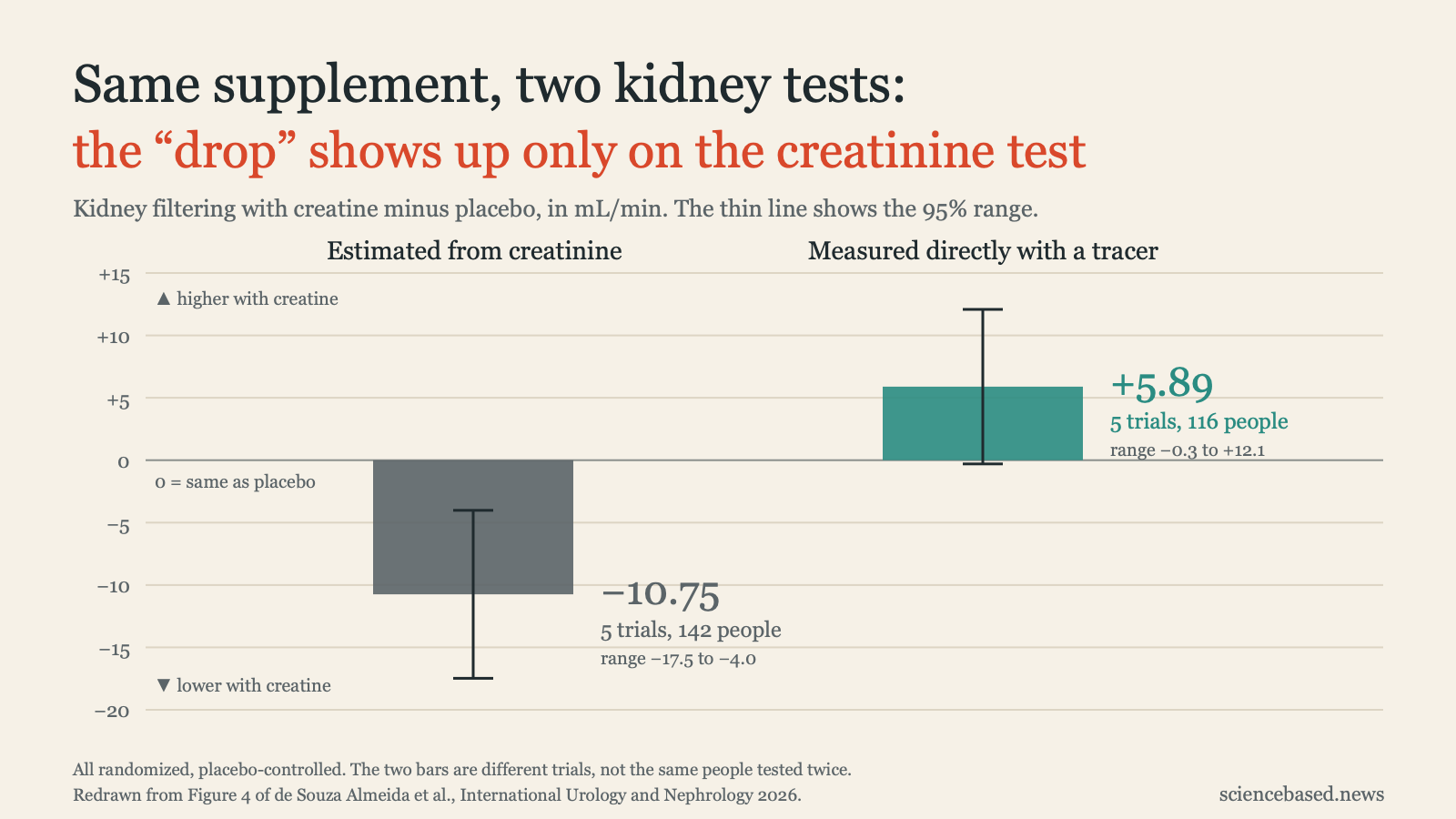
Other signs of kidney damage didn't move. Protein in the urine and albumin in the urine, early signs of leaky filters, were no different with creatine. Neither was blood urea, another waste product [1].
The direct-measure trials covered different kinds of people. In one, 26 young men who lifted and ate a high-protein diet, up to 3.1 g of protein per kilogram a day, took 20 g of creatine a day for 5 days, then 5 g a day, for 12 weeks. Measured filtering went from 101 to 109 mL/min with creatine and from 103 to 107 with placebo. Two of the 12 creatine takers had any drop, against 6 of the 14 on placebo [7]. The others were in postmenopausal women, adults with type 2 diabetes, and teenagers with lupus or dermatomyositis, a muscle disease [1].
Cystatin C, a kidney marker that comes from all the body's cells rather than muscle, was measured in two trials. In 18 young men on about 10 g a day for 3 months, it fell slightly in both groups, which suggests filtering held up [8]. In 60 people with Parkinson's disease on 4 g a day for 2 years, creatinine rose, as expected, but cystatin C and every other kidney marker stayed normal [9].
An earlier meta-analysis of 21 studies found the same pattern: creatinine up slightly, filtering unchanged in 5 trials with 143 people [10]. A third, of 20 trials, found creatinine up by 0.13 mg/dL but no clear change in urea (12 trials) or eGFR (8 trials) [11].
So back to Leo. His red flag is the number creatine is expected to raise. It doesn't, by itself, say his kidneys are filtering less, and there is a test that can tell the two apart.
The limits
The direct tests are the best evidence, and they are small. The five tracer trials had 116 people between them and ran about 12 weeks. One of them lost 20 of its 46 volunteers and was cut short from a planned 12 months [7].
Long-term data come mostly from the creatinine test. Only 4 of the 26 trials ran past 6 months, the longest 2 years [1]. Across 685 human trials of creatine, side effects were reported about as often as with placebo (13.7% of trials against 13.2%), but that review was paid for by Alzchem, a creatine maker [12].
The biggest gap is kidney disease. No trial has tested creatine in people with chronic kidney disease who are not yet on dialysis, the group with the most to lose [1]. Two small trials in people on dialysis found no harm [1]. In rats bred to grow kidney cysts, creatine made the cysts grow faster [13]. And the review counted 14 trials with "some concerns" about their methods and 1 at high risk of bias [1].
Our grade
So which parts of the claim hold?
| Question | Evidence | Grade |
|---|---|---|
| Creatine raises blood creatinine [1, 10] | 26 randomized trials, 1,036 people: +0.14 mg/dL | Solid |
| That rise doesn't mean kidney harm in healthy people [1, 7, 8, 9] | Directly measured filtering unchanged in 5 trials (116 people); urine protein, urea and cystatin C unchanged | Solid |
| Safe for years [1, 9] | 4 trials past 6 months, up to 2 years, mostly creatinine-based | Promising |
| Safe with kidney disease [1, 13] | No trials before dialysis; 2 small dialysis trials | Unproven |
| Overall: creatine is safe for healthy kidneys, and the high creatinine is a false alarm | Two independent ways of checking agree across randomized trials | Solid |
The case for the other side: the direct tests come from a handful of short, small trials, all from one research group in São Paulo. A rare person whose kidneys react badly would not show up in 116 people.
A creatinine rise can also be real kidney trouble that happens to land on a creatine user. The supplement doesn't protect against that.
What would change the grade: a trial in people with early kidney disease, or a year-long trial using a tracer or cystatin C. A sign of harm in either would cut the grade for that group.
What this means for you
- If you take creatine, say so before any blood test. Your creatinine will likely be higher, and a creatinine-based eGFR lower, than your kidneys deserve [1, 4].
- If your eGFR looks low, ask for cystatin C or the combined creatinine and cystatin C score, which the US kidney institute (NIDDK) says is more accurate than creatinine alone [14]. Some kidney doctors also have people pause creatine for a few days and retest [15].
- Stick to the doses the trials used: 3 to 5 g a day, with or without a 5 to 7 day load at 20 g. For why it's worth taking, see our main creatine check.
- If you have kidney disease, a single kidney or diabetes with kidney damage, talk to your kidney doctor first. The safety data don't cover you.
Why does creatine make kidney blood tests look worse?
Creatine turns into creatinine in the body on its own. A higher creatinine makes an eGFR look lower even if filtering is unchanged.
In trials that measured kidney filtering directly with a tracer, what did creatine do?
The 5 tracer trials found filtering 5.89 mL/min higher with creatine, a result that could be chance. The "drop" showed up only in trials that estimated filtering from creatinine.
Which blood test can tell creatine's effect apart from real kidney trouble?
Cystatin C doesn't come from creatine. It stayed normal or fell in the two creatine trials that measured it.
Who has not been studied?
No trial has tested creatine in chronic kidney disease before dialysis, the group with the most to lose. Ask your kidney doctor first.
What's next
The review's authors call for trials in early kidney disease. Until those exist, the evidence covers healthy kidneys.
This is part of our series on creatine. Start with creatine for muscle and strength, which we grade Solid, and see how it fits with how much protein you need and keeping muscle on GLP-1 drugs. Next, see what creatine does for memory after a sleepless night.
Was this helpful?
Sources
Show all sources (15)
- de Souza Almeida A, da Silva LOD, Takahasi BNA, Terada BD, et al. Impact of creatine supplementation on kidney health: a systematic review and meta-analysis. International Urology and Nephrology, 2026. 26 randomized controlled trials, 1,036 participants; funded by CAPES (Brazil), no competing interests. doi:10.1007/s11255-026-05287-x
- Pritchard NR, Kalra PA. Renal dysfunction accompanying oral creatine supplements. The Lancet, 1998. Case report, 1 man with existing kidney disease. doi:10.1016/S0140-6736(05)79319-379319-3)
- Greenhaff P. Renal dysfunction accompanying oral creatine supplements. The Lancet, 1998. Letter in reply to [2]. doi:10.1016/S0140-6736(05)77834-X77834-X)
- National Kidney Foundation. Creatinine. kidney.org
- Attia P. #262 – AMA #49: Heart rate recovery, strength training, rucking, kidney function, and brain health. The Peter Attia Drive, July 17, 2023. peterattiamd.com
- Patrick R (FoundMyFitness). Creatine is probably not harming our kidneys. Instagram. instagram.com
- Lugaresi R, Leme M, de Salles Painelli V, Murai IH, et al. Does long-term creatine supplementation impair kidney function in resistance-trained individuals consuming a high-protein diet? Journal of the International Society of Sports Nutrition, 2013. 26 men analyzed (46 randomized), double-blind, placebo-controlled, 12 weeks, filtering measured with 51Cr-EDTA. doi:10.1186/1550-2783-10-26
- Gualano B, Ugrinowitsch C, Novaes RB, Artioli GG, et al. Effects of creatine supplementation on renal function: a randomized, double-blind, placebo-controlled clinical trial. European Journal of Applied Physiology, 2008. 18 men, 3 months. doi:10.1007/s00421-007-0669-3
- Bender A, Samtleben W, Elstner M, Klopstock T. Long-term creatine supplementation is safe in aged patients with Parkinson disease. Nutrition Research, 2008. 60 patients, randomized, placebo-controlled, 2 years. doi:10.1016/j.nutres.2008.01.001
- Naeini EK, Eskandari M, Mortazavi M, Gholaminejad A, Karevan N. Effect of creatine supplementation on kidney function: a systematic review and meta-analysis. BMC Nephrology, 2025. 21 studies; 12 in the creatinine meta-analysis, 5 in the filtering-rate meta-analysis. doi:10.1186/s12882-025-04558-6
- Tsiaras A, Loufopoulos G, Theodoridis X, Liakopoulos V, Poulia KA, Chourdakis M. The effect of creatine supplementation on kidney function: a systematic review and meta-analysis of randomized controlled trials. Journal of Renal Nutrition, 2026. 20 trials, 786 participants. doi:10.1053/j.jrn.2026.04.010
- Kreider RB, Gonzalez DE, Hines K, Gil A, Bonilla DA. Safety of creatine supplementation: analysis of the prevalence of reported side effects in clinical trials and adverse event reports. Journal of the International Society of Sports Nutrition, 2025. 685 human trials; publication paid for by Alzchem, a creatine maker. doi:10.1080/15502783.2025.2488937
- Edmunds JW, Jayapalan S, DiMarco NM, Saboorian MH, Aukema HM. Creatine supplementation increases renal disease progression in Han:SPRD-cy rats. American Journal of Kidney Diseases, 2001. Rats with inherited cystic kidney disease, 6 weeks. doi:10.1053/ajkd.2001.20590
- National Institute of Diabetes and Digestive and Kidney Diseases. eGFR equations for adults. niddk.nih.gov
- Scripps Health. Does creatine damage your kidneys? What to know. September 2026. scripps.org
Discussion