

捐赠者的肠道细菌治好了81%的顽固肠道感染
证据核查,2026年10月12日。更新于2026年10月31日。
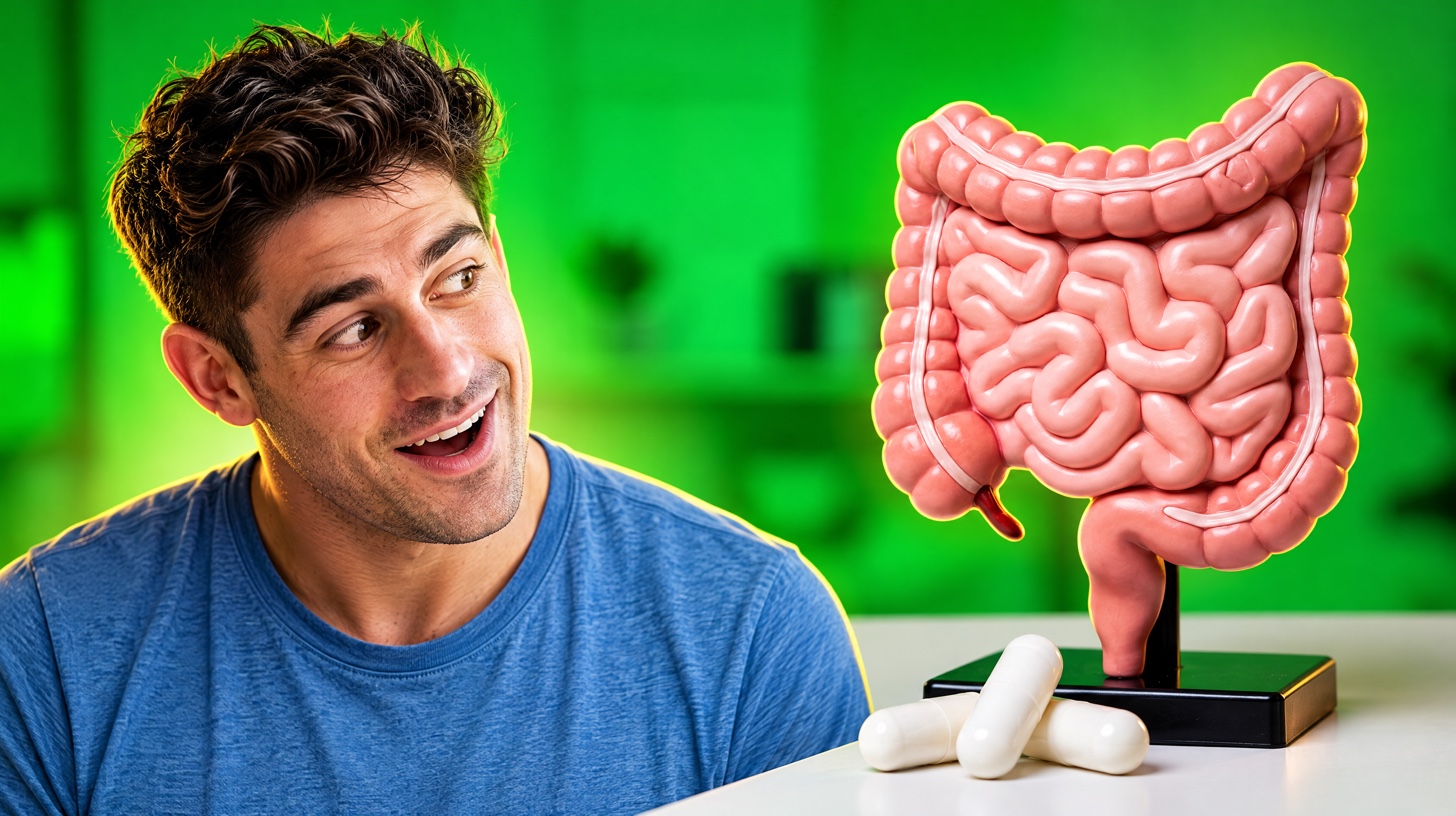
说法:“移植健康人的肠道细菌,能治好用抗生素后反复发作的肠道感染。”
我们的评级:扎实。 在一项随机试验中,捐赠者的肠道细菌治好了81%反复感染艰难梭菌的患者,而标准抗生素只治好31%。现在已有两种用肠道细菌制成的产品获得 FDA 批准。证据只针对这一种感染;其他肠道说法的排名在下文。
Leo 26岁,他刷到的内容说,肠道里的细菌掌管着他的情绪、睡眠、食欲和体重。他的购物车里有一套粪便检测试剂盒,旁边还有一瓶益生菌。
改变一个人的肠道细菌,真的治好过什么病吗?
治好过,而且有一次效果好到试验提前结束。2013年,荷兰医生把一名健康捐赠者的肠道细菌给了16名肠道感染反复发作的人,其中13人(81%)痊愈。标准抗生素只治好了13人中的4人(31%)[8]。
这个结果现在已经成为获批的药物。它也是我们手上最好的证据,说明你肠道里的细菌能决定你是病是好。
这个说法从哪来
艰难梭菌(C. difficile)是一种会引起严重腹泻的细菌。它常常在你为别的病吃了抗生素、肠道里的正常细菌被清掉之后趁虚而入。2017年,美国住院病人中估计有223,900例感染、12,800人死亡 [48]。
常规治疗是再用另一种抗生素。它能杀死艰难梭菌,却无法让正常细菌回来,所以停药后感染可能复发。在一项试验中,只用抗生素治疗的人有40%在8周内复发 [9]。
于是医生反过来做:用健康人的粪便,把缺失的细菌放回去。
更广的想法是,肠道细菌影响的远不止消化,这个想法主要是通过播客传到大多数人那里的。2022年2月,Andrew Huberman 对听众说,“为这些肠道微生物创造合适的生长环境,确实能改善情绪和幸福感”[6]。一周后,他和斯坦福大学微生物学家 Justin Sonnenburg 一起说,这些微生物“对我们的健康可能有巨大的好处,也就是我们的激素健康、大脑健康和免疫系统功能”[7]。他对局限也说得很公道:在讲情绪的同一句话里,他说这些研究“大多是在动物模型中做的,通常是小鼠”[6]。
捐赠者细菌治好了81%的患者:扎实
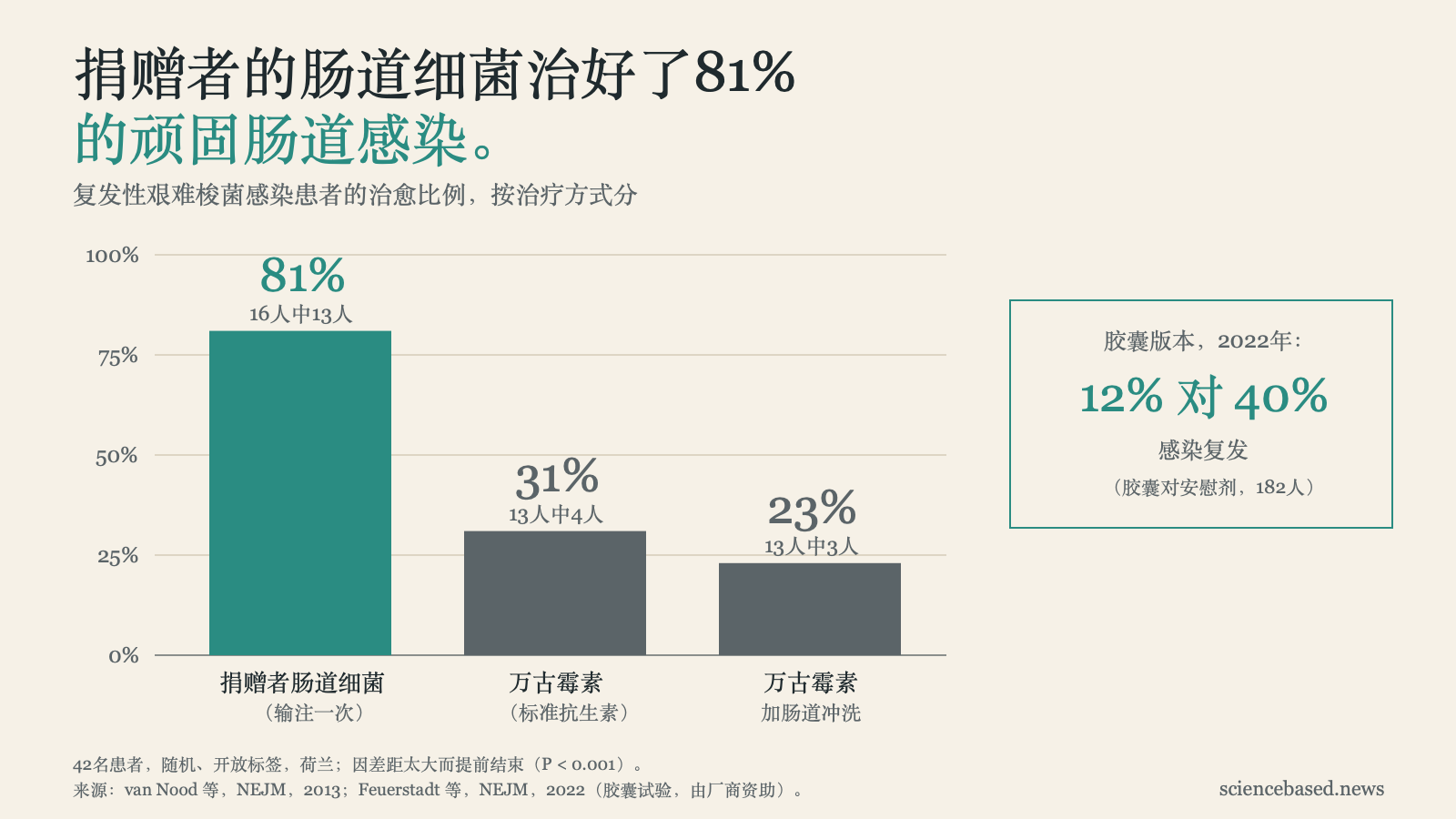
这项荷兰试验把42名艰难梭菌反复感染的人随机分成三组。一组接受健康捐赠者的粪便,通过管子送到小肠上段。另外两组用标准抗生素万古霉素(vancomycin),其中一组另加肠道冲洗 [8]。
输注一次后,16名患者中有13人(81%)痊愈。没治好的3人从另一名捐赠者那里再输注一次,其中2人痊愈。合计16人中有15人(94%)。
单用万古霉素治好了13人中的4人(31%),万古霉素加肠道冲洗治好了13人中的3人(23%)。试验在初步查看结果后就提前结束了 [8]。
副作用是输注当天轻微腹泻和腹部绞痛。之后,患者肠道细菌的多样性和捐赠者一样丰富 [8]。
它现在已是获批的药物:扎实
插管加新鲜捐赠者,很难提供给每个人,所以公司把这个想法做成了产品。
2022年11月,FDA 批准了第一种产品,是经直肠给药的单剂捐赠者细菌。在对它两项安慰剂对照试验的分析中,估计有70.6%的人8周内没有再感染,安慰剂组为57.5% [49]。
接着是胶囊。在一项182人的试验中,口服纯化的肠道细菌把感染复发率从40%降到了12% [9]。2023年4月,FDA 批准它成为第一种口服的肠道细菌产品 [10]。这项试验由厂商出资。
这告诉你一件重要的事。缺少一群细菌会让你病得很重,把它们放回去能让你好起来。
下一步:帮助抗癌药物起效:有希望
这是最让人期待的前沿。癌症免疫药物对一些患者有效,对另一些无效,而肠道细菌似乎是原因之一。
在三项没有对照组的小型研究中,45名晚期黑色素瘤患者在使用免疫药物的同时接受了捐赠者肠道细菌,其中22人有反应,包括一些原本对药物已不再有反应的人 [42, 43, 44]。2026年迎来了一次公平的检验。意大利研究人员把45名肾癌患者随机分组,在标准药物之外分别加上捐赠者细菌或安慰剂。用捐赠者细菌的一组,癌症被控制住的时间中位数是24.0个月,安慰剂组是9.0个月 [45]。试验的主要指标,即一年时癌症没有进展的患者比例,是70%对41%,以微弱差距没有达到排除偶然的门槛。
你自己能做的:发酵食品能降低炎症:有希望
改变肠道细菌,不一定需要捐赠者。食物在几周内就能重塑它们,而在目前最好的试验中,有一类食物格外突出。
斯坦福大学研究人员让36名健康成年人在10周内多吃发酵食品或多吃膳食纤维 [11]。发酵食品组从每天0.4份增加到6.3份。他们肠道细菌的多样性稳步上升,血液中93项炎症指标里有19项下降,其中包括一项叫 IL-6 的指标,它会随着长期炎症而升高。
纤维组把纤维摄入量翻了一倍,从每天21.5克增加到45.1克。他们的细菌多样性在10周内没有变化,不过他们的细菌产生了更多消化纤维的酶。
这并不代表纤维没用。在《柳叶刀》(Lancet)一篇汇总了185项长期研究的综述中,吃纤维最多的人死亡率低15%到30%,每天25克到29克时好处最大 [12]。这些研究都没有测量肠道细菌,所以我们不能说细菌就是原因。
反过来也一样:你的细菌决定你能从食物里得到什么。石榴和核桃本身不含尿石素A(urolithin A),这是一种以有益肌肉和心脏为卖点的化合物。肠道细菌用这些食物制造它,而大约每10人中就有1人完全不能制造 [46]。100名成年人喝了石榴汁后,第二天只有约40%的人血液中达到有意义的水平 [47]。更多内容见我们的尿石素A证据核查。
斯坦福的试验有局限。它规模小,没有照常饮食的对照组,而它原本要检验的结果,一项综合免疫评分,在两组中都没有变化。炎症指标下降是次要结果 [11]。纤维的数据主要来自观察人们本来就怎么吃的研究,另加58项、共4,635名成年人的试验,测量的是体重和胆固醇之类的指标 [12]。
抗生素会留下痕迹。12名健康男性服用了三种强效抗生素4天。他们的肠道细菌大多在1.5个月内恢复,但180天后,大多数人仍缺少9种常见菌种 [13]。在以色列一项健康志愿者的小型研究中,用完抗生素后吃益生菌,与什么都不吃相比,反而推迟了人体自身细菌的恢复;这项研究没有测量任何健康结果 [14]。需要时就用抗生素。这只是不需要时别用的一个理由。
家用粪便检测还不成熟。美国国家标准与技术研究院(NIST)的科学家把一份粪便样本混匀,寄给七家检测公司,每家三套试剂盒。报告列出的细菌种类从34种到906种不等,只有3种出现在每一份报告里。有一家公司对同一份样本,两次说健康,一次说不健康。七家中有三家说检出了艰难梭菌,四家说没有 [15]。一个来自18个国家、由69名专家组成的小组得出结论:“没有足够的证据在临床实践中广泛推荐常规使用微生物组检测”[16]。
局限:只有一种感染,而且只用经过筛查的捐赠者
证据只针对一种感染。两种获批产品都是给艰难梭菌已经复发过的成年人用的,用来在抗生素治疗后阻止下一次复发 [10, 49]。
第一项试验规模小,只有42人,而且每个人都知道自己接受的是哪种治疗 [8]。胶囊试验由厂商出资 [9]。第一种获批产品的优势较小,是70.6%对57.5% [49]。
捐赠者的粪便可能带来帮助,也可能带来伤害。2019年,两名免疫力弱的人在接受了用同一名捐赠者粪便制成的移植后,感染了耐药大肠杆菌,而那份粪便并没有做过这项检测。其中一人死亡 [50]。此后,FDA 要求对捐赠者粪便进行这类细菌的检测,获批产品也都来自经过筛查的捐赠者。即便如此,FDA 仍表示,用人类粪便制成的产品可能有传播感染的风险 [49]。
所以移植是医生做的事,绝不能自己在家尝试。
其他肠道说法的排名
治好一种感染,并不能证明 Leo 刷到的其他说法。下面是十个肠道说法,按人体证据的好坏排名,最好的在前。
| 说法 | 最好的人体证据 | 结果 | 评级 |
|---|---|---|---|
| 治好顽固的肠道感染(艰难梭菌) | 2项随机试验,2种获批产品 | 捐赠者细菌治愈81%,标准抗生素31% | A 扎实 |
| 降低炎症 | 1项36名成年人的试验,10周 | 发酵食品降低了93项炎症指标中的19项 | B 有希望 |
| 帮助癌症免疫药物起效 | 1项45人的随机试验,3项没有对照的小型研究 | 肾癌被控制住24.0个月,对照组9.0个月 | B 有希望 |
| 改善情绪 | 汇总72项益生菌试验,多数规模小 | 抑郁评分中等程度下降;试验质量低 | B 有希望 |
| 稳定血糖 | 2项小型移植试验,2项单一细菌的试验 | 6周时胰岛素反应改善,18周时消失 | C 薄弱 |
| 改善睡眠 | 汇总14项试验 | 人们自评睡眠略好;监测设备显示没有变化 | C 薄弱 |
| 提升精力 | 1项463名长新冠患者的试验 | 疲劳缓解的几率约为两倍;尚未重复 | C 薄弱 |
| 平衡激素 | 1项51人的研究,汇总46项皮质醇试验 | 只有关联,以及确定性低的轻微皮质醇下降 | C 薄弱 |
| 左右食欲 | 小鼠,以及一篇理论文章 | 没有人体试验检验过 | D 未经证实 |
| 移植能减重 | 3项随机试验,133人 | 没有一项出现体重下降 | F 已证伪 |
前三项上文已经讲过。其余的如下。
这些说法背后的动物研究是真实的,也很惊人。完全无菌饲养的小鼠,接受了一对双胞胎中肥胖那位的肠道细菌后,比接受瘦的那位细菌的小鼠长了更多脂肪 [32]。每个说法要问的是:同样的事会不会发生在人身上。
情绪:有希望
情绪方面的试验最多,结果偏向正面。2025年一篇综述汇总了72项益生菌及类似补充剂的随机试验。与安慰剂相比,抑郁评分有中等程度的下降,但作者警告说存在“高异质性和有限的方法学质量”,意思是这些试验彼此结果不一,而且很多质量不高 [17]。
单项试验的结果两边都有。在伦敦,49名正在服用抗抑郁药的人加用益生菌或安慰剂8周;在这项预试验中,益生菌组最后的抑郁评分较低,为8.83对11.09 [18]。一项75人的瑞典试验在所有指标上都没有发现效果 [19]。在2026年一项中国试验中,60名抑郁症患者在常规药物之外,服用捐赠者肠道细菌胶囊或安慰剂。2周时,移植组有30%出现反应,安慰剂组为6.7%。8周时,缓解的比例是43.3%对26.7%,这个差距可能出于偶然,所以试验没有达到主要目标。胶囊厂商资助了部分研究 [20]。这一切背后有一项1,054人的比利时研究,发现抑郁症患者体内有两类肠道细菌较少 [21]。这显示的是关联,不能说明谁先谁后。
睡眠:薄弱
一篇汇总14项试验的综述发现,服用益生菌的人在一份21分的问卷上,自评睡眠好了0.78分。设备测量的睡眠没有变化 [22]。
精力:薄弱
慢性疲劳综合征患者(106名患者对91名健康人)体内一种产生丁酸的细菌较少,丁酸是肠道内壁的燃料 [23]。但一项11名患者的移植试验“没有缓解症状”[24]。最好的消息来自香港:463名长新冠患者服用一种细菌加纤维的混合物或安慰剂6个月,服用混合物的人疲劳缓解的几率约高一倍 [25]。一种疾病、一项试验,还需要重复。那项著名的“马拉松跑者细菌”研究在15名跑者体内找到了一种微生物,但运动表现的测试是在32只小鼠身上做的,它们跑的时间长了13% [26]。
激素:薄弱
在51人中,肠道细菌种类较多的人,如果是男性或绝经后女性,雌激素水平较高。在较年轻的女性中,两者没有关系 [27]。一项汇总46项试验、3,516人的分析发现,益生菌让压力激素皮质醇略有下降,并把确定性评为低 [28]。至于睾酮,只有观察关联的研究。
食欲:未经证实
细菌左右你想吃什么,这个想法始于2014年一篇没有数据的理论文章 [29]。接受了不同肠道细菌组合的小鼠,确实会选择不同的食物 [30]。还没有人体试验在改变肠道细菌后测量过食欲。最接近的一项测试的是细菌用纤维制造的一种物质:60名超重成年人每天服用10克、持续24周,体重增加得较少 [31]。
靠移植减重:已证伪
三项随机试验把瘦捐赠者的肠道细菌给了肥胖者:22名成年人、24名成年人和87名青少年 [33, 34, 35]。没有人减重。一项汇总9项试验、303人的分析也发现体重没有差别 [36]。有一个较新的想法看起来更好。在2026年一项90名刚节食完的成年人的试验中,每天服用一种叫 Akkermansia 的经热处理细菌,让24周内的体重反弹降到1.2公斤(2.6磅),安慰剂组为3.2公斤(7.1磅)[37]。
血糖:薄弱
在两项针对男性的小型荷兰试验中,瘦捐赠者的细菌在6周后改善了身体对胰岛素的反应,而在规模较大、有38名男性的那项中,效果到18周就消失了 [38, 39]。在一项有32人完成的试验中,Akkermansia 让胰岛素反应改善了约29% [40],但在58名2型糖尿病患者中,整体上没有显示好处 [41]。
为什么还有更多有待发现
海底只有28.7%按现代标准测绘过 [1]。你的肠道也是这样一个地方。它里面约有38万亿个细菌,大致和你自身的细胞一样多,加起来约重0.2公斤(半磅)[2]。你自己的基因不到20,000个 [4]。一份根据1,267人肠道细菌建立的目录,找到了990万个基因 [3]。在目前记录的4,644种肠道菌种中,超过70%从未在实验室里培养过,它们的蛋白质有40%的功能至今没人说得出来 [5]。
所以这只是一张早期的地图,而第一段画清楚的海岸线,就是一种治愈方法。
回到 Leo。是的,改变肠道细菌治好过一种病,试验结果清楚到可以提前结束。对他来说,那几罐韩式泡菜和豆子是这个故事里他今天就能用上的部分,粪便检测可以先放一放。
我们的评级
| 说法 | 证据 | 评级 |
|---|---|---|
| 捐赠者肠道细菌治疗复发性艰难梭菌,比标准抗生素更有效 | 42人的随机试验:81%对31%,提前结束 | 扎实 |
| 肠道细菌产品能防止感染复发 | 随机安慰剂对照试验:182人中复发率12%对40%;另两项中保持健康的比例70.6%对57.5% | 扎实 |
| 捐赠者细菌帮助癌症免疫药物 | 1项45人的随机试验,以微弱差距未达主要目标;3项共45人的无对照研究 | 有希望 |
| 发酵食品能降低炎症 | 1项随机试验,36名成年人,10周;次要结果 | 有希望 |
| 总体:移植健康的肠道细菌,能治好反复发作的肠道感染 | 结果一致的随机试验,以及两种 FDA 批准的产品 | 扎实 |
情绪、睡眠、精力、激素、食欲、体重和血糖的评级,见上面的排名表。
另一面的理由:第一项试验只有42人,也没有设盲,而提前结束的试验,显示的效果往往比后来的试验大。
两项产品试验由厂商进行,其中一项显示的优势比另一项小得多。
而且一种疗效不能套用到别的疾病上。同样的移植在三项试验中都没有带来减重。
什么会改变这个评级:一项发现没有好处的大型独立试验会降低它。第二项达到主要目标的随机癌症试验,会把那一行提升为扎实。
这对你意味着什么
- 如果艰难梭菌在用抗生素后复发,请问医生有没有获批的肠道细菌疗法。不要在家自己做移植;捐赠者的粪便必须经过筛查 [50]。
- 每天吃发酵食品。试验用的是每天约6份酸奶、开菲尔、韩式泡菜、德式酸菜和康普茶,用4周逐步加量 [11]。挑选冷藏出售、含活菌的产品。如果你免疫力弱,请先问医生。
- 每天从豆类、燕麦、蔬菜、水果和坚果中摄取25到29克膳食纤维 [12]。我们的五个健康杠杆一文讲了纤维的证据。
- 只在需要时用抗生素,用了就按疗程用完。180天后仍有一些肠道菌种没有回来 [13]。
- 家用粪便检测先缓一缓。同一份样本得到的报告差别很大 [15]。
- 如果你有抑郁症,益生菌可以作为低风险的辅助加进治疗里,但不适合拿来取代治疗 [17, 19]。
- 要知道,你的肠道细菌会改变你从某些食物中得到什么。它们决定石榴能不能给你带来任何尿石素A。
在2013年的试验中,输注一次捐赠者肠道细菌后,复发性艰难梭菌患者有多少痊愈?
捐赠者细菌治好了16名患者中的13人,抗生素治好了13人中的4人,现在已有两种肠道细菌产品获批。
在斯坦福的试验中,哪种饮食在10周内提高了肠道细菌的多样性?
发酵食品组的多样性上升,19项炎症指标下降;纤维组的多样性没有变化。
七家公司检测了同一份粪便样本。结果如何?
只有3种出现在每一份报告里,而且有一家公司说同一份样本既健康又不健康。
肥胖者接受瘦捐赠者的肠道细菌后,结果如何?
三项共133人的随机试验都没有发现减重。到目前为止,治愈只在一种感染上得到证实。
接下来
捐赠者细菌搭配癌症免疫药物的大型试验正在进行,这些是值得关注的试验。等结果公布,我们会更新这一页。
本系列的下一篇:一项新研究,看你在用抗生素期间,糖对肠道细菌有什么影响;之后再分别谈发酵食品和家用粪便检测。
想看补充剂改变了血液指标、却没改变人的感受的例子,请看 NAD 补充剂。
这篇文章对你有帮助吗?
参考文献
查看全部参考文献(50)
- GEBCO. Release of the GEBCO_2026 Grid. April 2026. 28.7% of the ocean floor mapped to modern standards. gebco.net/news/release-gebco2026-grid
- Sender R, Fuchs S, Milo R. Revised Estimates for the Number of Human and Bacteria Cells in the Body. PLoS Biology, 2016. A calculation for a 70 kg reference man, not a trial. doi.org/10.1371/journal.pbio.1002533
- Li J, Jia H, Cai X, et al. An integrated catalog of reference genes in the human gut microbiome. Nature Biotechnology, 2014. 1,267 gut samples from three continents, 9,879,896 genes. doi.org/10.1038/nbt.2942
- Amaral P, Carbonell-Sala S, De La Vega FM, et al. The status of the human gene catalogue. Nature, 2023. Review. doi.org/10.1038/s41586-023-06490-x
- Almeida A, Nayfach S, Boland M, et al. A unified catalog of 204,938 reference genomes from the human gut microbiome. Nature Biotechnology, 2021. 4,644 gut species. doi.org/10.1038/s41587-020-0603-3
- Huberman A. How to Enhance Your Gut Microbiome for Brain & Overall Health. Huberman Lab, February 28, 2022. hubermanlab.com
- Huberman A, Sonnenburg J. Dr. Justin Sonnenburg: How to Build, Maintain & Repair Gut Health. Huberman Lab, March 7, 2022. hubermanlab.com
- van Nood E, Vrieze A, Nieuwdorp M, et al. Duodenal infusion of donor feces for recurrent Clostridium difficile. New England Journal of Medicine, 2013. 42 patients in three groups (16, 13, 13), randomized, open-label, 10 weeks, stopped early. Public funding. doi.org/10.1056/NEJMoa1205037
- Feuerstadt P, Louie TJ, Lashner B, et al. SER-109, an Oral Microbiome Therapy for Recurrent Clostridioides difficile Infection. New England Journal of Medicine, 2022. 182 people, randomized, double-blind, placebo-controlled, 8 weeks. Funded by Seres Therapeutics, the maker. doi.org/10.1056/NEJMoa2106516
- US Food and Drug Administration. FDA Approves First Orally Administered Fecal Microbiota Product for the Prevention of Recurrence of Clostridioides difficile Infection. April 26, 2023. fda.gov
- Wastyk HC, Fragiadakis GK, Perelman D, et al. Gut-microbiota-targeted diets modulate human immune status. Cell, 2021. 36 healthy adults, randomized to two diets, 10 weeks, no usual-diet group. doi.org/10.1016/j.cell.2021.06.019
- Reynolds A, Mann J, Cummings J, et al. Carbohydrate quality and human health: a series of systematic reviews and meta-analyses. Lancet, 2019. 185 prospective studies and 58 trials with 4,635 adults. doi.org/10.1016/S0140-6736(18)31809-931809-9)
- Palleja A, Mikkelsen KH, Forslund SK, et al. Recovery of gut microbiota of healthy adults following antibiotic exposure. Nature Microbiology, 2018. 12 healthy men, no control group, 180 days. doi.org/10.1038/s41564-018-0257-9
- Suez J, Zmora N, Zilberman-Schapira G, et al. Post-Antibiotic Gut Mucosal Microbiome Reconstitution Is Impaired by Probiotics and Improved by Autologous FMT. Cell, 2018. Mice and 46 healthy volunteers across its human studies; no health outcome. doi.org/10.1016/j.cell.2018.08.047
- Servetas SL, Gierz KS, Hoffmann D, et al. Evaluating the analytical performance of direct-to-consumer gut microbiome testing services. Communications Biology, 2026. One stool standard sent to 7 companies, 3 kits each. By NIST. doi.org/10.1038/s42003-025-09301-3
- Porcari S, Mullish BH, Asnicar F, et al. International consensus statement on microbiome testing in clinical practice. Lancet Gastroenterology & Hepatology, 2025. 69 experts from 18 countries. doi.org/10.1016/S2468-1253(24)00311-X00311-X)
- Zhang J, Zhu L, Meng Q, et al. The efficacy of probiotics, prebiotics, and synbiotics on anxiety, depression, and sleep: a systematic review and meta-analysis of randomized controlled trials. BMC Psychiatry, 2025. 72 randomized trials. doi.org/10.1186/s12888-025-07644-z
- Nikolova VL, Cleare AJ, Young AH, et al. Acceptability, Tolerability, and Estimates of Putative Treatment Effects of Probiotics as Adjunctive Treatment in Patients With Depression. JAMA Psychiatry, 2023. 49 people, randomized, double-blind, placebo-controlled pilot, 8 weeks. doi.org/10.1001/jamapsychiatry.2023.1817
- Söderberg Veibäck G, Lindahl J, Suneson K, et al. Add-on probiotics for inflammatory depression: a double-blind randomized placebo-controlled trial. Brain, Behavior, and Immunity, 2025. 75 people, 8 weeks. doi.org/10.1016/j.bbi.2025.06.002
- Li J, Wang Y, Li R, et al. Adjunctive fecal microbiota transplantation for major depressive disorder: A randomized, double-blind, placebo-controlled trial. Cell Host & Microbe, 2026. 60 people, 8 weeks. Part-funded by Shenzhen JCY Biotech, the capsule maker. doi.org/10.1016/j.chom.2026.05.017
- Valles-Colomer M, Falony G, Darzi Y, et al. The neuroactive potential of the human gut microbiota in quality of life and depression. Nature Microbiology, 2019. 1,054 people, observational. doi.org/10.1038/s41564-018-0337-x
- Irwin C, McCartney D, Desbrow B, et al. Effects of probiotics and paraprobiotics on subjective and objective sleep metrics: a systematic review and meta-analysis. European Journal of Clinical Nutrition, 2020. 14 studies. doi.org/10.1038/s41430-020-0656-x
- Guo C, Che X, Briese T, et al. Deficient butyrate-producing capacity in the gut microbiome is associated with bacterial network disturbances and fatigue symptoms in ME/CFS. Cell Host & Microbe, 2023. 106 patients and 91 healthy people, observational. doi.org/10.1016/j.chom.2023.01.004
- Salonen T, Jokinen E, Satokari R, et al. Randomized, double-blinded, placebo-controlled pilot study: efficacy of faecal microbiota transplantation on chronic fatigue syndrome. Journal of Translational Medicine, 2023. 11 patients. doi.org/10.1186/s12967-023-04227-y
- Lau RI, Su Q, Lau ISF, et al. A synbiotic preparation (SIM01) for post-acute COVID-19 syndrome in Hong Kong (RECOVERY): a randomised, double-blind, placebo-controlled trial. Lancet Infectious Diseases, 2024. 463 people, 6 months. Public and charity funding. doi.org/10.1016/S1473-3099(23)00685-000685-0)
- Scheiman J, Luber JM, Chavkin TA, et al. Meta-omics analysis of elite athletes identifies a performance-enhancing microbe that functions via lactate metabolism. Nature Medicine, 2019. 15 marathon runners, 10 controls, and 32 mice. Three authors hold equity in FitBiomics. doi.org/10.1038/s41591-019-0485-4
- Flores R, Shi J, Fuhrman B, et al. Fecal microbial determinants of fecal and systemic estrogens and estrogen metabolites: a cross-sectional study. Journal of Translational Medicine, 2012. 51 people, observational. doi.org/10.1186/1479-5876-10-253
- Jain M, Anand A, Sharma N, et al. Effect of Probiotics Supplementation on Cortisol Levels: A Systematic Review and Meta-Analysis. Nutrients, 2024. 46 randomized trials, 3,516 people. doi.org/10.3390/nu16203564
- Alcock J, Maley CC, Aktipis CA. Is eating behavior manipulated by the gastrointestinal microbiota? Evolutionary pressures and potential mechanisms. BioEssays, 2014. A hypothesis paper, no new data. doi.org/10.1002/bies.201400071
- Trevelline BK, Kohl KD. The gut microbiome influences host diet selection behavior. PNAS, 2022. Mice. doi.org/10.1073/pnas.2117537119
- Chambers ES, Viardot A, Psichas A, et al. Effects of targeted delivery of propionate to the human colon on appetite regulation, body weight maintenance and adiposity in overweight adults. Gut, 2015. 60 overweight adults, randomized, 24 weeks. doi.org/10.1136/gutjnl-2014-307913
- Ridaura VK, Faith JJ, Rey FE, et al. Gut microbiota from twins discordant for obesity modulate metabolism in mice. Science, 2013. Mice given human twins' gut bacteria. doi.org/10.1126/science.1241214
- Allegretti JR, Kassam Z, Mullish BH, et al. Effects of Fecal Microbiota Transplantation With Oral Capsules in Obese Patients. Clinical Gastroenterology and Hepatology, 2020. 22 adults, randomized, placebo-controlled. doi.org/10.1016/j.cgh.2019.07.006
- Yu EW, Gao L, Stastka P, et al. Fecal microbiota transplantation for the improvement of metabolism in obesity: The FMT-TRIM double-blind placebo-controlled pilot trial. PLoS Medicine, 2020. 24 adults. doi.org/10.1371/journal.pmed.1003051
- Leong KSW, Jayasinghe TN, Wilson BC, et al. Effects of Fecal Microbiome Transfer in Adolescents With Obesity: The Gut Bugs Randomized Controlled Trial. JAMA Network Open, 2020. 87 teenagers, randomized, double-blind. doi.org/10.1001/jamanetworkopen.2020.30415
- Qiu B, Liang J, Li C. Effects of fecal microbiota transplantation in metabolic syndrome: A meta-analysis of randomized controlled trials. PLoS One, 2023. 9 trials, 303 people. doi.org/10.1371/journal.pone.0288718
- Mount S, Canfora EE, Jocken JW, et al. Pasteurized Akkermansia muciniphila MucT for weight loss maintenance in people with overweight and obesity: a controlled randomized trial. Nature Medicine, 2026. 90 adults, 8-week diet then 24 weeks on the bacterium or placebo. doi.org/10.1038/s41591-026-04394-7
- Vrieze A, Van Nood E, Holleman F, et al. Transfer of intestinal microbiota from lean donors increases insulin sensitivity in individuals with metabolic syndrome. Gastroenterology, 2012. A small randomized trial in men, 6 weeks. doi.org/10.1053/j.gastro.2012.06.031
- Kootte RS, Levin E, Salojärvi J, et al. Improvement of Insulin Sensitivity after Lean Donor Feces in Metabolic Syndrome Is Driven by Baseline Intestinal Microbiota Composition. Cell Metabolism, 2017. 38 men, randomized, 18 weeks. doi.org/10.1016/j.cmet.2017.09.008
- Depommier C, Everard A, Druart C, et al. Supplementation with Akkermansia muciniphila in overweight and obese human volunteers: a proof-of-concept exploratory study. Nature Medicine, 2019. 32 people finished, randomized, placebo-controlled, 3 months. doi.org/10.1038/s41591-019-0495-2
- Zhang Y, Liu R, Chen Y, et al. Akkermansia muciniphila supplementation in patients with overweight/obese type 2 diabetes: Efficacy depends on its baseline levels in the gut. Cell Metabolism, 2025. 58 people, randomized, placebo-controlled. doi.org/10.1016/j.cmet.2024.12.010
- Baruch EN, Youngster I, Ben-Betzalel G, et al. Fecal microbiota transplant promotes response in immunotherapy-refractory melanoma patients. Science, 2021. 10 patients, no control group; 3 responded. doi.org/10.1126/science.abb5920
- Davar D, Dzutsev AK, McCulloch JA, et al. Fecal microbiota transplant overcomes resistance to anti-PD-1 therapy in melanoma patients. Science, 2021. 15 patients, no control group; 6 benefited. doi.org/10.1126/science.abf3363
- Routy B, Lenehan JG, Miller WH Jr, et al. Fecal microbiota transplantation plus anti-PD-1 immunotherapy in advanced melanoma: a phase I trial. Nature Medicine, 2023. 20 patients, no control group; 13 responded. doi.org/10.1038/s41591-023-02453-x
- Porcari S, Ciccarese C, Heidrich V, et al. Fecal microbiota transplantation plus pembrolizumab and axitinib in metastatic renal cell carcinoma: the randomized phase 2 TACITO trial. Nature Medicine, 2026. 45 patients, randomized, double-blind, placebo-controlled. doi.org/10.1038/s41591-025-04189-2
- Selma MV, Beltrán D, Luna MC, et al. Isolation of human intestinal bacteria capable of producing the bioactive metabolite isourolithin A from ellagic acid. Front Microbiol, 2017. Lab study. doi.org/10.3389/fmicb.2017.01521
- Singh A, D'Amico D, Andreux PA, et al. Direct supplementation with urolithin A overcomes limitations of dietary exposure and gut microbiome variability in healthy adults to achieve consistent levels across the population. Eur J Clin Nutr, 2022. 100 adults drinking pomegranate juice, plus a randomized dosing study. Funded by Amazentis, which sells urolithin A. doi.org/10.1038/s41430-021-00950-1
- Centers for Disease Control and Prevention. Antibiotic Resistance Threats in the United States, 2019: Clostridioides difficile. Estimated 223,900 cases in hospitalized patients and 12,800 deaths in the US in 2017. cdc.gov/antimicrobial-resistance/media/pdfs/clostridioides-difficile-508.pdf
- US Food and Drug Administration. FDA Approves First Fecal Microbiota Product. News release, November 30, 2022. Rebyota, a single rectal dose for adults; analysis of two randomized, placebo-controlled trials: 70.6% against 57.5% free of recurrence at 8 weeks. web.archive.org/fda.gov
- DeFilipp Z, Bloom PP, Torres Soto M, et al. Drug-resistant E. coli bacteremia transmitted by fecal microbiota transplant. New England Journal of Medicine, 2019. 2 patients who got stool from the same donor; one died. doi.org/10.1056/NEJMoa1910437