

Processed almonds vs whole: 47% more calories
Evidence check, October 21, 2026
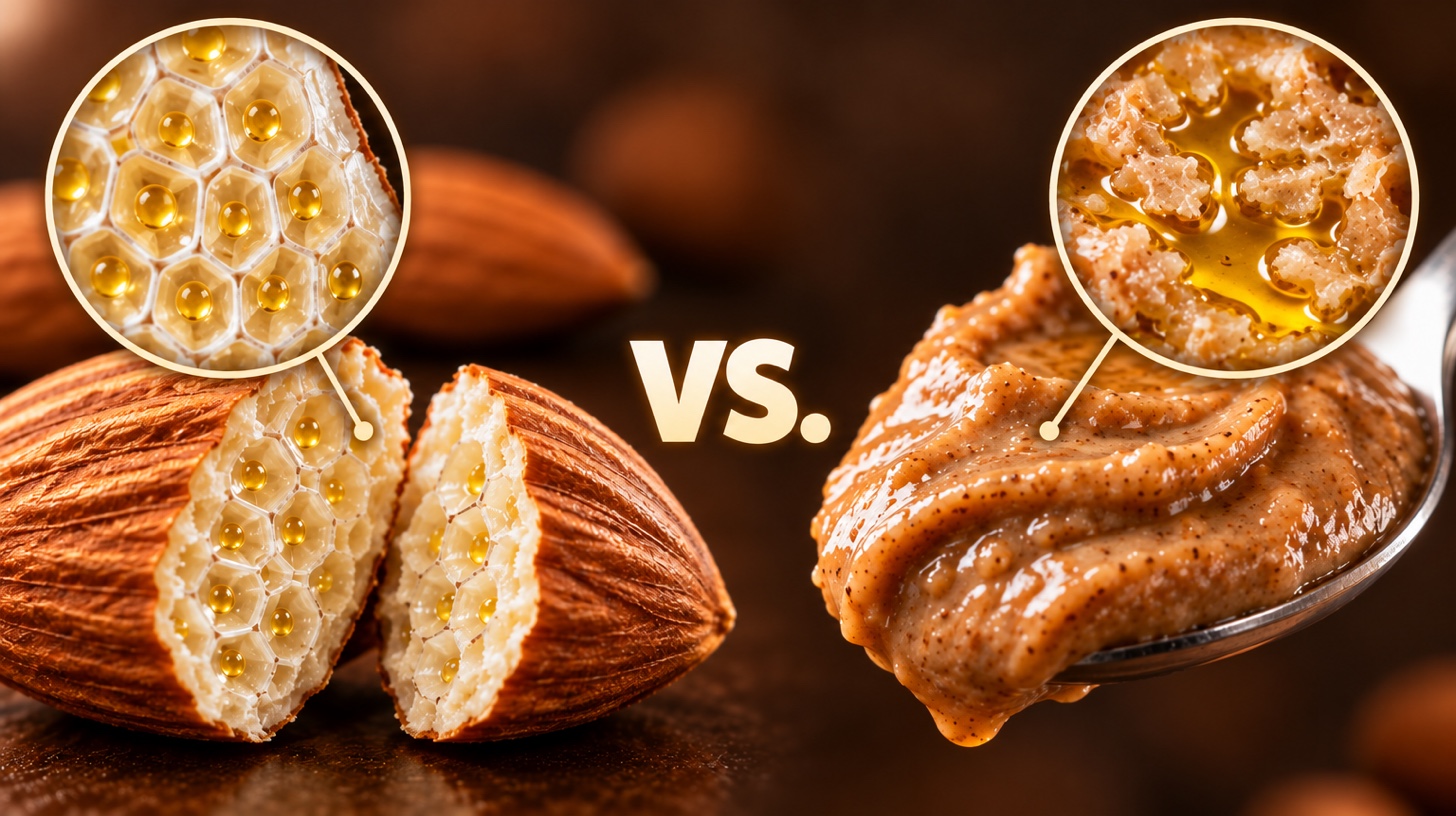
The claim: "Same almonds, different form: whole almonds give you about a third fewer calories than almond butter."
Our grade: Promising. In a USDA feeding trial in 18 adults, raw whole almonds gave the body 32% fewer calories than the same weight of almond butter. Two more trials found whole almonds give less than their label says. Only one trial has compared the forms head to head.
A handful of almonds and a spoon of almond butter weigh the same. The labels say they carry the same calories, about 170 an ounce [3].
Does your body get the same from both?
It doesn't. In a 2016 trial at the US Department of Agriculture, 42 grams of raw whole almonds a day gave the body 186 calories. The same 42 grams eaten as almond butter gave 274 [4].
Where the claim came from
On October 20, 2026, Rhonda Patrick posted on X about a new study: "Ultra-processed foods trigger a bigger insulin response than less-processed ones, even when they contain identical calories and nutrients" [1]. The study, from Virginia Tech, gave 32 young, healthy-weight adults two 300-calorie meals on different days, matched for protein, carbs, fat, fiber, water and salt, one built from ultra-processed foods [2]. Blood sugar rose about the same after both. Insulin, the hormone that moves sugar into cells, stayed higher after the ultra-processed meal from 40 to 120 minutes.
So if two foods have the same calories on paper, does the body get the same calories? The cleanest test is one food, the almond, eaten in different forms, with everything that leaves the body measured.
What the studies found
The same almond, four forms
Researchers at the USDA's Beltsville Human Nutrition Research Center fed 18 adults (average age 57) every meal for five 3-week periods [4]. Each period added 42 grams of almonds a day (1.5 ounces) in one form: raw and whole, roasted and whole, roasted and chopped, or roasted and ground into almond butter. One period had no almonds. After 9 days on each diet, the volunteers collected all their urine and stool for 9 days, and the lab burned dried samples to measure the calories still in them. Calories eaten minus the calories left in urine and stool is what the body kept.
The almonds all came from one batch. Only the form changed.
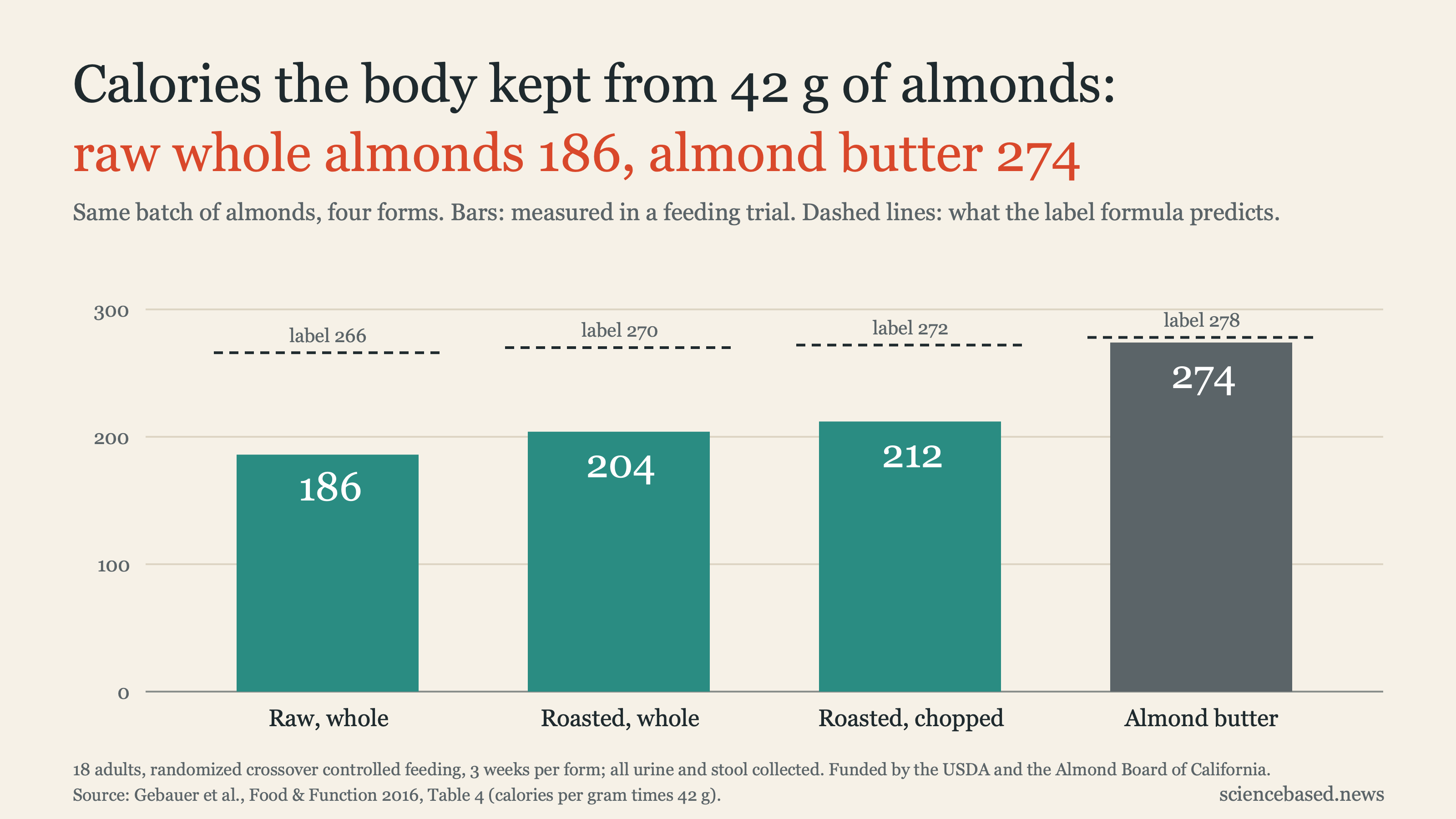
The body kept 4.42 calories per gram from raw whole almonds, 4.86 from roasted whole, 5.04 from chopped and 6.53 from almond butter [4]. Raw whole almonds gave 32% fewer calories than almond butter; put the other way, the butter gave 47% more (274 calories against 186). Roasted whole almonds, made from the same roasted nuts as the butter, gave 26% fewer.
Almond butter matched its label. The standard formula used for food labels (the Atwater factors, worked out in the late 1800s) predicted 6.62 calories per gram for it, and the body kept 6.53. For raw whole almonds the formula predicted 6.34, and the body kept 4.42, 30% less.
The earlier trial from the same USDA team fed 18 adults 0, 42 or 84 grams of whole almonds a day for 18 days each [3]. Whole almonds gave 129 calories per ounce (28 grams). The label value is 168 to 170. The same team found whole walnuts gave 146 calories per ounce against a predicted 185, 21% less, in 18 adults over 3 weeks [6]. Pistachios gave only 5% less than predicted, in 16 adults [7].
The 2016 trial also showed how much people differ. Across the four forms, single volunteers ranged from 2.84 to 7.66 calories per gram [4]. The authors point to chewing: nobody was told how to chew, and people break nuts down to very different sizes. The spread was smaller for almond butter, which arrives already ground.
Where the missing calories go
Almond fat sits inside tiny cells, each wrapped in a wall made of fiber. Your digestive enzymes can't get through an intact wall. A team in London had 15 adults chew raw and roasted almonds as they normally would and spit them out before swallowing [5]. Under the microscope, most cells in the chewed pieces were still whole, with their fat inside. A model based on piece size predicted that chewing freed only 8.5% of the fat from raw almonds and 11.3% from roasted ones [5]. Much of the locked-in fat leaves in the stool, and that is the gap the USDA trials measured.
Roasting makes almonds more brittle. In the 2016 trial, a raw almond needed 70 newtons of force to snap (about 7 kilograms of weight) and a roasted one 52 [4]. When crushed, raw almonds broke into 137 pieces on average and roasted ones into 339. More, smaller pieces means more broken cells and more fat set free. An almond cell is about 35 micrometers across [5]. In almond butter, half the particles are smaller than 11 micrometers [4], a third of one cell, so nearly every cell is open before the first bite. Almond flour is different: at about 250 micrometers a grain, it still holds intact cells [5].
So back to the spoon and the handful. The label is right for the spoon. For the handful, your body gets about a third less, because most of the fat never leaves its cells.
Does the same thing happen across a whole diet?
The same idea, in a whole diet
No one has measured calories in and out for a whole diet this way, but the NIH ran the closest test [8]. Twenty adults lived on a research ward for four weeks: two weeks on ultra-processed meals and two weeks on unprocessed meals, offered in matched amounts of calories, sugar, fat, fiber and salt. They could eat as much as they wanted. On the ultra-processed meals they ate 508 more calories a day, ate 17 calories a minute faster, and gained 0.9 kg. On the unprocessed meals they lost 0.9 kg.
Whether part of that gap is the almond effect, calories locked inside intact food, was not tested.
Our grade
| Claim | Evidence | Grade |
|---|---|---|
| Whole almonds give fewer calories than their label | 2 USDA feeding trials, 18 adults each, every calorie in and out measured [3, 4] | Solid |
| Whole almonds give about a third fewer calories than almond butter | 1 randomized crossover feeding trial, 18 adults, 3 weeks per form [4] | Promising |
| Intact cell walls are the reason | Chewing study in 15 adults with microscopy [5], plus particle sizes in [4] | Promising |
| Processed food changes what the body does with the same calories | 4-week ward trial in 20 adults [8]; one-meal trial in 32 young adults [2] | Promising |
| Overall: whole almonds give about a third fewer calories than almond butter | Large, measured gap in one well-run trial, backed by a clear mechanism | Promising |
The case for the other side:
The head-to-head result rests on one trial of 18 people, and no other group has repeated it. The Almond Board of California supplied the almonds and helped fund the 2016 trial; the authors declared no conflicts.
A calorie your body doesn't absorb isn't a calorie you never wanted. If whole almonds leave you less full than you expected, you may eat more later. None of these trials let people choose how much to eat, so none can show weight loss.
The gap depends on the nut: pistachios gave only 5% less than predicted [7].
What would change the grade: a second group repeating the whole-versus-butter comparison, or a trial where people eat freely and their weight is tracked.
What this means for you
Eat almonds whole: you get the same nut with a quarter to a third fewer calories than the butter. Raw whole almonds gave the fewest, 186 per 42 grams; roasted whole and chopped were close, 204 and 212 [4]. If you count calories, count whole almonds at about three-quarters of the label, and almond butter at the full label [3, 4].
Almond butter isn't a bad food. Its full label calories are useful if you are trying to gain weight or fuel long training.
Beyond almonds: our best guess
This goes past what has been measured. Our guess: food you can still recognize, like whole nuts, beans, intact grains and fruit you chew, gives you fewer calories than the same food ground or puréed. Three small findings point that way.
- Fewer calories get out. Whole almonds and walnuts both gave the body less than their labels, and beans, oats and whole fruit keep their cell walls too, though they have not been measured [3, 6].
- More calories go into digesting. In 17 adults, a sandwich of multigrain bread and cheddar took 137 calories to digest, and the same calories as white bread and processed cheese took 73 [9].
- You feel full on less. A whole apple filled 58 adults more than applesauce or juice with the same calories, and they ate less at lunch after it [10]; on the NIH ward, unprocessed meals led people to eat 508 fewer calories a day [8].
None of this proves whole food alone makes you lose weight, but it all points one way, and the switch is cheap: the nuts instead of the nut butter, the oats instead of the instant packet, the apple instead of the juice.
In the USDA trial, how many calories did the body keep from 42 grams of almond butter, compared with raw whole almonds?
The body kept 6.53 calories per gram from almond butter and 4.42 from raw whole almonds.
Why does the body get fewer calories from whole almonds?
Chewing freed only about 9% to 11% of the fat; the rest stayed inside intact cell walls.
Which label value is about right?
The body kept 6.53 calories per gram from almond butter against 6.62 predicted; whole almonds gave much less than predicted.
What has not been shown?
No trial has measured weight after a switch from almond butter to whole almonds.
What's next
The Virginia Tech study tested one meal on one morning [2]; whether the bigger insulin response lasts over weeks of eating is not yet known. We will update this check if another group repeats the whole-versus-butter comparison.
On this site: what a full day of whole foods looks like in the perfect food day, and why five whole foods beat a multivitamin on a fast food day.
Was this helpful?
Sources
Show all sources (10)
- Patrick R. "Ultra-processed foods trigger a bigger insulin response than less-processed ones, even when they contain identical calories and nutrients." Post on X, October 20, 2026. https://x.com/foundmyfitness/status/2112598313476219320
- Hutelin Z, Ahrens M, Baugh ME, Nartey E, Herald DL, Hanlon AL, DiFeliceantonio AG. Metabolic and neural responses to ultraprocessed foods: a randomized, controlled, crossover study. Nature Metabolism, 2026. 57 adults (32 in the metabolic arm, mean age 26), randomized crossover, one 300-calorie meal per condition. Funded by the NIH. https://doi.org/10.1038/s42255-026-01619-4
- Novotny JA, Gebauer SK, Baer DJ. Discrepancy between the Atwater factor predicted and empirically measured energy values of almonds in human diets. American Journal of Clinical Nutrition, 2012. 18 adults, randomized crossover controlled feeding, three 18-day periods. USDA. https://doi.org/10.3945/ajcn.112.035782
- Gebauer SK, Novotny JA, Bornhorst GM, Baer DJ. Food processing and structure impact the metabolizable energy of almonds. Food & Function, 2016. 18 adults, randomized crossover controlled feeding, five 3-week periods. Funded by the USDA and the Almond Board of California. https://doi.org/10.1039/c6fo01076h
- Grundy MM, Grassby T, Mandalari G, Waldron KW, Butterworth PJ, Berry SE, Ellis PR. Effect of mastication on lipid bioaccessibility of almonds in a randomized human study and its implications for digestion kinetics, metabolizable energy, and postprandial lipemia. American Journal of Clinical Nutrition, 2015. 15 adults, randomized crossover chewing study. Almonds supplied by the Almond Board of California. https://doi.org/10.3945/ajcn.114.088328
- Baer DJ, Gebauer SK, Novotny JA. Walnuts consumed by healthy adults provide less available energy than predicted by the Atwater factors. Journal of Nutrition, 2016. 18 adults, randomized crossover controlled feeding, two 3-week periods. https://doi.org/10.3945/jn.115.217372
- Baer DJ, Gebauer SK, Novotny JA. Measured energy value of pistachios in the human diet. British Journal of Nutrition, 2012. 16 adults, randomized crossover controlled feeding. https://doi.org/10.1017/S0007114511002649
- Hall KD, Ayuketah A, Brychta R, et al. Ultra-processed diets cause excess calorie intake and weight gain: an inpatient randomized controlled trial of ad libitum food intake. Cell Metabolism, 2019. 20 adults, randomized crossover, 2 weeks per diet on a research ward. NIH. https://doi.org/10.1016/j.cmet.2019.05.008
- Barr SB, Wright JC. Postprandial energy expenditure in whole-food and processed-food meals: implications for daily energy expenditure. Food & Nutrition Research, 2010. 17 adults, crossover, one meal per condition, energy use measured for 5 to 6 hours. https://doi.org/10.3402/fnr.v54i0.5144
- Flood-Obbagy JE, Rolls BJ. The effect of fruit in different forms on energy intake and satiety at a meal. Appetite, 2009. 58 adults, crossover, one 125-calorie apple preload per week for 5 weeks. https://doi.org/10.1016/j.appet.2008.12.001
Discussion