

Five foods fixed a fast food day better than a multivitamin
Evidence check, October 19, 2026. Updated October 21, 2026.
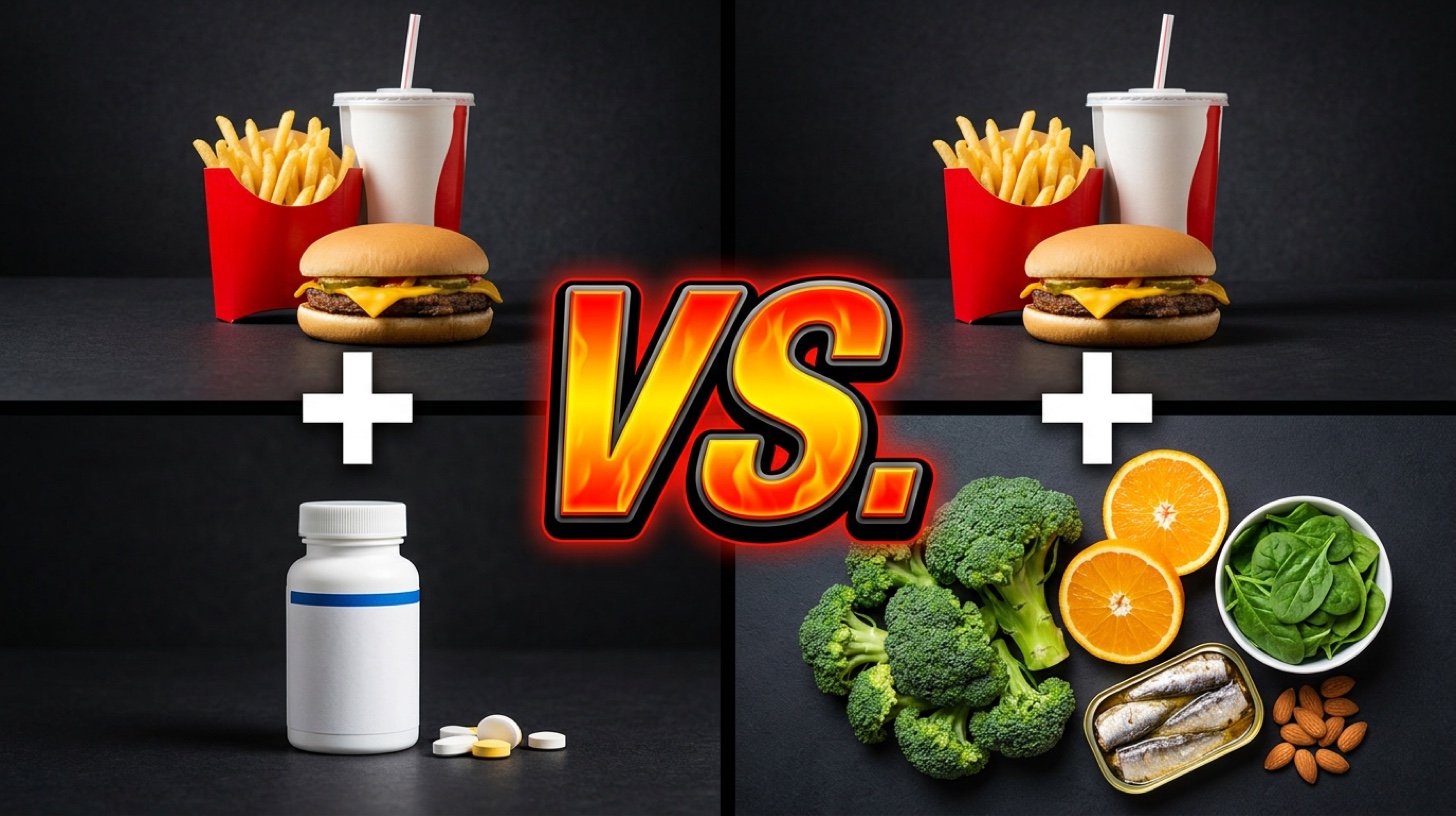
The claim: "A few whole foods rescue a fast food day better than a multivitamin."
Our grade: Promising. In our count, five whole foods lifted a fast food day to target on 9 of its 11 shortfalls; a multivitamin fixed 4. In a 25-day trial, fruit and vegetables did things to the blood that a pill with the same vitamins did not. No trial has tested either rescue on a fast food diet.
A Sausage McMuffin for breakfast, a plate of carbonara for lunch, a Quarter Pounder and fries for dinner, ice cream after. Tomorrow you'll eat better. Tonight, there is a multivitamin in the cupboard and broccoli in the fridge.
Which one do you reach for?
Start with what the day was missing. We counted it: 2,779 calories and plenty of protein, but only 13% of the vitamin C target and 21% of vitamin K [4, 5].
Where the claim came from
The case for the pill is often made in ads. On the Huberman Lab podcast in May 2022, Andrew Huberman read an ad for AG1, a paid sponsor, saying "it makes up for any deficiencies that I might have" [1]. His guest in that episode, Rhonda Patrick of FoundMyFitness, put the case for food: "So dark, leafy greens are how I like to get my magnesium... you get calcium in them. You get vitamin K1." [1]
Peter Attia wrote about the biggest recent study of multivitamin users. His verdict: it "does little to supplement earlier knowledge on multivitamins and health." [2]
So we ran the test on paper: one fast food day, then the same day rescued two ways.
What the fast food day was missing
We looked up every food in the US government's food database [4] and compared the totals with the US targets for an 80 kg man [5], as in our perfect food day. This is our own calculation, not a study of people.
| Meal | What we ate |
|---|---|
| Breakfast | McDonald's Sausage McMuffin with Egg and a hash brown |
| Lunch | Spaghetti carbonara: 110 g dry pasta, 40 g bacon, an egg and 2 yolks, 30 g parmesan |
| Dinner | McDonald's Quarter Pounder with Cheese and medium fries |
| Snack | 1 cup of vanilla ice cream |
The day was not short of everything. Fortified flour, meat, cheese and eggs covered the B vitamins, iron, zinc, calcium, selenium and every essential amino acid. Protein reached 111 g, 86% of the 1.6 g per kg that lifters aim for.
The gaps were the things plants and fish bring. Vitamin C was 12 mg, about what it takes to prevent scurvy. Fish oil (EPA and DHA) was 14% of the target, vitamin D 22%, fiber 41%, vitamin E 44%, vitamin A 49%, magnesium 54% and potassium 70%. So were the two essential fats from plants, omega-6 and the omega-3 called ALA.
The pill fixed the vitamins
First rescue: a popular two-a-day multivitamin, Life Extension Two-Per-Day, on top of the same food.
It lifted the four vitamins it carries in large amounts. Vitamin C went from 13% to 535% of the target, D from 22% to 356%, E from 44% to 490% and A from 49% to 216%.
It left the rest where it was. The label has no vitamin K, potassium, fiber or fish oil, and only enough magnesium to lift it from 54% to 78%. It also added to minerals the meat and cheese already covered. Zinc reached 39.3 mg against a US upper limit of 40 [6]. Vitamin B6 reached 76 mg, six times the European limit of 12 mg, set because of nerve damage [7].
Five foods fixed almost everything
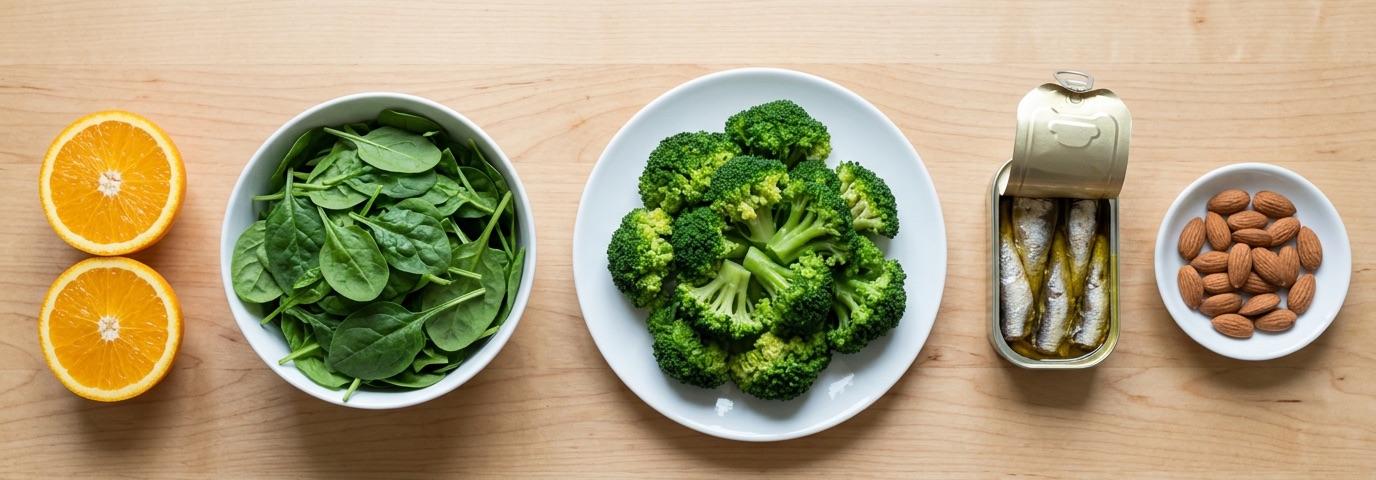
Second rescue: the same day with five whole foods, each picked for a gap. An orange at breakfast, 100 g of raw spinach at lunch, and at dinner 200 g of broccoli and a 92 g can of sardines in oil. Then 20 g of almonds as a snack.
| Fast food day | Plus multivitamin | Plus five foods | |
|---|---|---|---|
| Calories | 2,779 | 2,779 | 3,249 |
| Vitamin C | 13% | 535% | 277% |
| Vitamin K | 21% | 21% | 660% |
| Vitamin D | 22% | 356% | 52% |
| Vitamin E | 44% | 490% | 125% |
| Vitamin A | 49% | 216% | 124% |
| Fiber | 41% | 41% | 79% |
| Magnesium | 54% | 78% | 108% |
| Potassium | 70% | 70% | 126% |
| Fish oil (EPA+DHA) | 14% | 14% | 194% |
| Zinc (mg; US limit 40) | 14.3 | 39.3 | 17.7 |
The five foods brought 9 of the 11 shortfalls to target. Vitamin D (52%) and fiber (79%) stayed short. They also added what no label lists: beta-carotene rose from 86 to 7,677 mcg and lutein, a pigment found in the eye, from 613 to 15,165 mcg. Our rough estimate of polyphenols, the plant compounds in tea, fruit and vegetables, went from 50-100 mg to about 350-450 mg.
The price was about 470 calories, 17% more food. The sardines were 190 of them, and they did the fish oil and vitamin D work. Without them the rescue costs about 280 calories, and fish oil and vitamin D fall back to 14% and 22%.
On paper, the foods win. But a target met on paper is not a body that works better. Has anyone tested fruit and vegetables against a pill with the same vitamins, in people?
The trial that put produce against a pill
Once, in Denmark. Forty-three healthy non-smokers ate a fully controlled diet for 24 or 25 days, every meal supplied [3]. Sixteen got 600 g of fruit and vegetables a day. Twelve got a pill matched to the vitamins and minerals in that produce: vitamin C, beta-carotene, vitamin K, folate, potassium and magnesium. Fifteen got a placebo.
On the vitamins themselves, the pill did as well. Blood vitamin C and folate ended the same in the two groups, and beta-carotene ended higher on the pill.
One thing moved only with food, and one moved more. Glutathione peroxidase, an enzyme that protects cells from oxidation, rose from 126 to 133 units in the fruit and vegetable group and did not move on the pill (120 to 119) or the placebo (116 to 116). Blood fats became harder to oxidize in both groups, but more so with produce. The authors concluded that "additional factors, apart from the known vitamins and minerals" in the produce were at work [3].
That is the closest anyone has come to pill versus broccoli. It answers part of the question: a pill can copy the vitamins, but not everything in the food.
Does the difference reach anything you would feel? The best test of that is blood pressure.
The food result that reached blood pressure
In the DASH trial, 459 US adults were fed one of three diets for 8 weeks [8]. The fruits-and-vegetables diet had 8 to 10 servings a day, against a US average of 4.3, and the same salt as the control diet. Blood pressure fell by 2.8/1.1 mm Hg against control, and by 3.1/2.1 when measured around the clock with a worn monitor. The drop came within two weeks and held. Constipation fell from 10.1% to 5.4%.
The DASH authors chose food for a reason. Trials of these same nutrients, "often as dietary supplements", had shown results that were "typically small and inconsistent" [8].
So back to the cupboard and the fridge. The broccoli, with the orange, the spinach, the sardines and the almonds, covers more of what was missing, and brings things the pill does not.
What large studies of pills and food show
Multivitamin trials are large and mostly flat. In COSMOS, 21,442 US adults with an average age of 72 took Centrum Silver or a placebo for a median of 3.6 years [9]. Cancer (hazard ratio 0.97, 95% CI 0.86 to 1.09), heart disease and stroke (0.98) and death (0.93, 0.81 to 1.08) did not clearly change. The pills were donated by Pfizer and Haleon, with funding from Mars Edge and the NIH. A memory test in 3,562 of them improved a little: recall of a word list rose from 7.10 to 7.81 words on the pill against 7.21 to 7.65 on placebo [10].
In the Physicians' Health Study II, 14,641 male US doctors took a multivitamin or placebo for 11.2 years. Cancer was 8% lower (hazard ratio 0.92, 0.86 to 0.998) [11]. Heart disease did not change (1.01) [12].
A review for the US Preventive Services Task Force pooled 9 trials with 51,550 people: odds of death 0.94 (0.87 to 1.01), and of cancer 0.93 (0.87 to 0.99) [13]. The Task Force found too little evidence to recommend for or against multivitamins [14]. In a study of 390,124 US adults followed for up to 27 years, daily multivitamin users had a 4% higher risk of death in the first 12 years (hazard ratio 1.04, 1.02 to 1.07) [15]. That is the study Attia was writing about [2].
One study asked the food-or-pill question directly. Among 30,899 US adults followed for a median of 6.1 years, 3,613 died [16]. Getting enough vitamin K or magnesium from food went with a lower risk of death, about 20%. Getting the same amount from supplements did not.
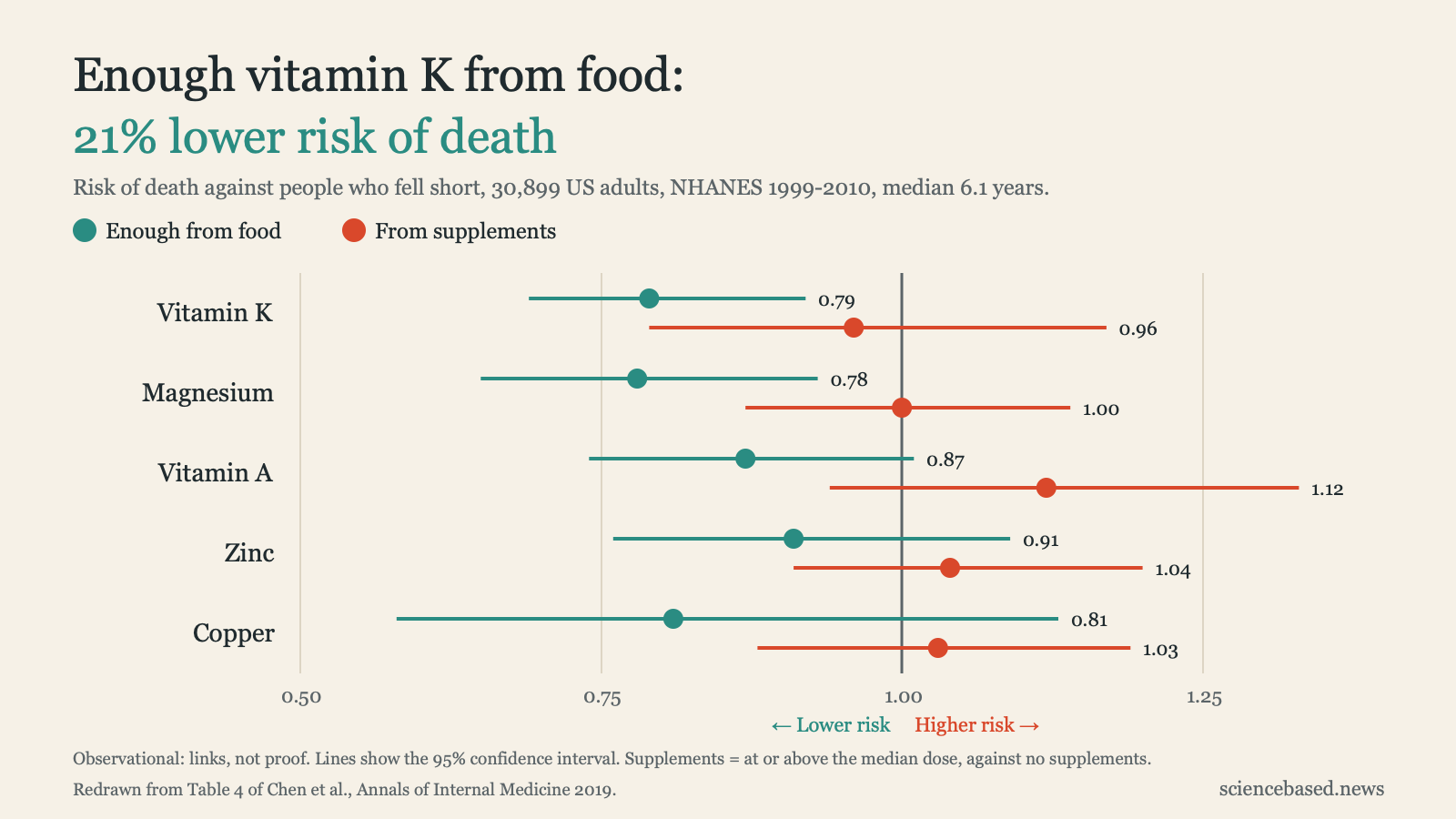
This is an observational study. People who eat a lot of vegetables also tend to exercise more and smoke less, and no adjustment catches all of that. It points the same way as the trial; it does not prove it.
The limits
Our count is a calculation for one man on one day, from a database. USDA has no values for vitamins A, D and K, folate or choline in the McDonald's items, so some totals are low; with the eggs filled in, vitamin D was about 30% and vitamin A about 75%.
Neither rescue touched what the day had too much of. Sodium was 4,594 mg, twice the 2,300 mg limit, and the carbonara (1,863 mg) was saltier than the McDonald's breakfast (1,251). Saturated fat was 16% of calories, against US advice of under 10%. The five foods raised sodium to 5,038 mg and brought saturated fat down only to 15%.
The Danish trial had 43 people for under a month and measured blood markers, not illness. Its blood fat results are shown only in a figure, without exact numbers. DASH tested a whole diet, not five foods added to a fast food day. Nobody has tested either rescue on people who eat fast food.
Our grade
The real question is not whether a multivitamin is useless. It is which rescue fills more of what a bad day lacks.
| Question | Evidence | Grade |
|---|---|---|
| Five whole foods fill more of a fast food day's gaps than a multivitamin [4, 5] | Our calculation: 9 of 11 shortfalls to target with food, 4 with the pill | Promising |
| Produce does things a vitamin-matched pill does not [3] | One randomized trial, 43 people, 25 days: an enzyme and blood fat oxidation | Promising |
| Adding fruit and vegetables lowers blood pressure [8] | Randomized trial, 459 adults, 8 weeks: 2.8/1.1 mm Hg | Promising |
| A multivitamin prevents heart disease or early death [9, 12, 13] | Large trials: no clear effect | Debunked |
| Nutrients from food are linked to longer life and from pills are not [16] | One observational study, 30,899 adults | Weak |
| Overall: a few whole foods rescue a fast food day better than a multivitamin | Better coverage on paper and one small trial; no test on fast food eaters | Promising |
The case for the other side: the pill is easier. It costs a few cents, has no calories, and fixed vitamin D, which the foods did not. On a day without sardines, it is the only one of the two that brings vitamin D near target.
The pill also has some trial support of its own. Cancer was 8% lower over 11 years in male doctors [11], and memory scores rose slightly in older adults [10].
What would change the grade: a trial that feeds people a fast food diet for weeks, adds either a multivitamin or a few whole foods, and measures blood levels, blood pressure and markers like the enzyme above.
What this means for you
- On a fast food day, add plants and fish, not a pill. An orange, spinach, broccoli, sardines and almonds fixed 9 of 11 gaps in our count [4].
- No sardines? The plant foods alone cost about 280 calories. Eat oily fish another day that week for fish oil and vitamin D.
- If you take a multivitamin, know what it covers: vitamins C, D, E and A here, not vitamin K, potassium, fiber or fish oil.
- Watch zinc and B6 if you take one on a meat and cheese day: they reached 39 mg and 76 mg in ours [6, 7].
- Neither rescue fixes salt. Two fast food meals and a carbonara gave twice the daily sodium limit.
- For a day that needs no rescue, see our perfect food day.
Which gap did the multivitamin leave untouched in our fast food day?
The label has no vitamin K. It stayed at 21%; spinach and broccoli took it to 660%.
What did the five added foods cost in calories?
470 calories, with 190 of them from the sardines. Without the sardines, about 280.
In the Danish trial, what rose with fruit and vegetables but not with the matched pill?
Glutathione peroxidase rose from 126 to 133 units only with produce. Vitamin C ended the same, and beta-carotene higher on the pill.
What did neither rescue fix?
Sodium stayed at twice the daily limit. Adding food cannot take salt away.
Ask about this study
Answers by AI from this article only. Not medical advice. Questions and answers are saved (never your IP address): what we keep.
What's next
The study that would settle this has not been done: fast food eaters, randomized to a pill or a few foods, for weeks.
For the other side of the plate, see one day of ordinary food that met every nutrient target, how much protein you need, the five habits with the most evidence for a longer life, why the almonds are best eaten whole, and the food with heart data its pill lacks: natto.
Was this helpful?
Sources
Show all sources (16)
- Huberman Lab. Dr. Rhonda Patrick: Micronutrients for Health & Longevity. Podcast episode, May 2, 2022; includes an ad read for AG1, a paid sponsor. hubermanlab.com
- Attia P. Article on multivitamin use and mortality. peterattiamd.com, August 10, 2024. peterattiamd.com
- Dragsted LO, Pedersen A, Hermetter A, et al. The 6-a-day study: effects of fruit and vegetables on markers of oxidative stress and antioxidative defense in healthy nonsmokers. American Journal of Clinical Nutrition, 2004. 43 adults, randomized, fully controlled diet for 24-25 days; pills donated by Pharma Vinci. doi:10.1093/ajcn/79.6.1060
- US Department of Agriculture. FoodData Central. Food values used for our calculation of one fast food day for an 80 kg man. fdc.nal.usda.gov
- Food and Nutrition Board, National Academies. Dietary Reference Intakes: Tolerable Upper Intake Levels, Elements. In: Dietary Reference Intakes for Sodium and Potassium, 2019. ncbi.nlm.nih.gov
- NIH Office of Dietary Supplements. Zinc: Fact Sheet for Health Professionals. Read October 18, 2026. ods.od.nih.gov
- EFSA Panel on Nutrition, Novel Foods and Food Allergens. Scientific opinion on the tolerable upper intake level for vitamin B6. EFSA Journal, 2023. Review of the evidence. doi:10.2903/j.efsa.2023.8006
- Appel LJ, Moore TJ, Obarzanek E, et al. A clinical trial of the effects of dietary patterns on blood pressure. New England Journal of Medicine, 1997. 459 adults, randomized, 8 weeks of controlled feeding; funded by the NHLBI. doi:10.1056/NEJM199704173361601
- Sesso HD, Rist PM, Aragaki AK, et al. Multivitamins in the prevention of cancer and cardiovascular disease: the COcoa Supplement and Multivitamin Outcomes Study (COSMOS) randomized clinical trial. American Journal of Clinical Nutrition, 2022. 21,442 adults, randomized, median 3.6 years; funded by Mars Edge and the NIH, pills from Pfizer and Haleon. doi:10.1093/ajcn/nqac056
- Yeung LK, et al. Multivitamin supplementation improves memory in older adults: a randomized clinical trial. American Journal of Clinical Nutrition, 2023. 3,562 adults, randomized, 3 years. doi:10.1016/j.ajcnut.2023.05.011
- Gaziano JM, Sesso HD, Christen WG, et al. Multivitamins in the prevention of cancer in men: the Physicians' Health Study II randomized controlled trial. JAMA, 2012. 14,641 male physicians, randomized, median 11.2 years; funded by the NIH, with grants and pills from BASF, Pfizer and DSM. doi:10.1001/jama.2012.14641
- Sesso HD, Christen WG, Bubes V, et al. Multivitamins in the prevention of cardiovascular disease in men: the Physicians' Health Study II randomized controlled trial. JAMA, 2012. 14,641 male physicians, randomized. Abstract read. doi:10.1001/jama.2012.14805
- O'Connor EA, Evans CV, Ivlev I, et al. Vitamin and mineral supplements for the primary prevention of cardiovascular disease and cancer: updated evidence report and systematic review for the US Preventive Services Task Force. JAMA, 2022. 84 studies; multivitamin results from 9 trials, 51,550 people. doi:10.1001/jama.2021.15650
- US Preventive Services Task Force. Vitamin, mineral, and multivitamin supplementation to prevent cardiovascular disease and cancer: US Preventive Services Task Force recommendation statement. JAMA, 2022. Recommendation based on a review of the evidence. doi:10.1001/jama.2022.8970
- Loftfield E, et al. Multivitamin use and mortality risk in 3 prospective US cohorts. JAMA Network Open, 2024. 390,124 adults, observational, up to 27 years. doi:10.1001/jamanetworkopen.2024.18729
- Chen F, Du M, Blumberg JB, et al. Association among dietary supplement use, nutrient intake, and mortality among U.S. adults: a cohort study. Annals of Internal Medicine, 2019. 30,899 adults, NHANES 1999-2010, observational, median 6.1 years; funded by the NIH. doi:10.7326/M18-2478
Discussion