

Spermidine Foods: The Diet Linked to a Longer Life
Evidence check, October 30, 2026
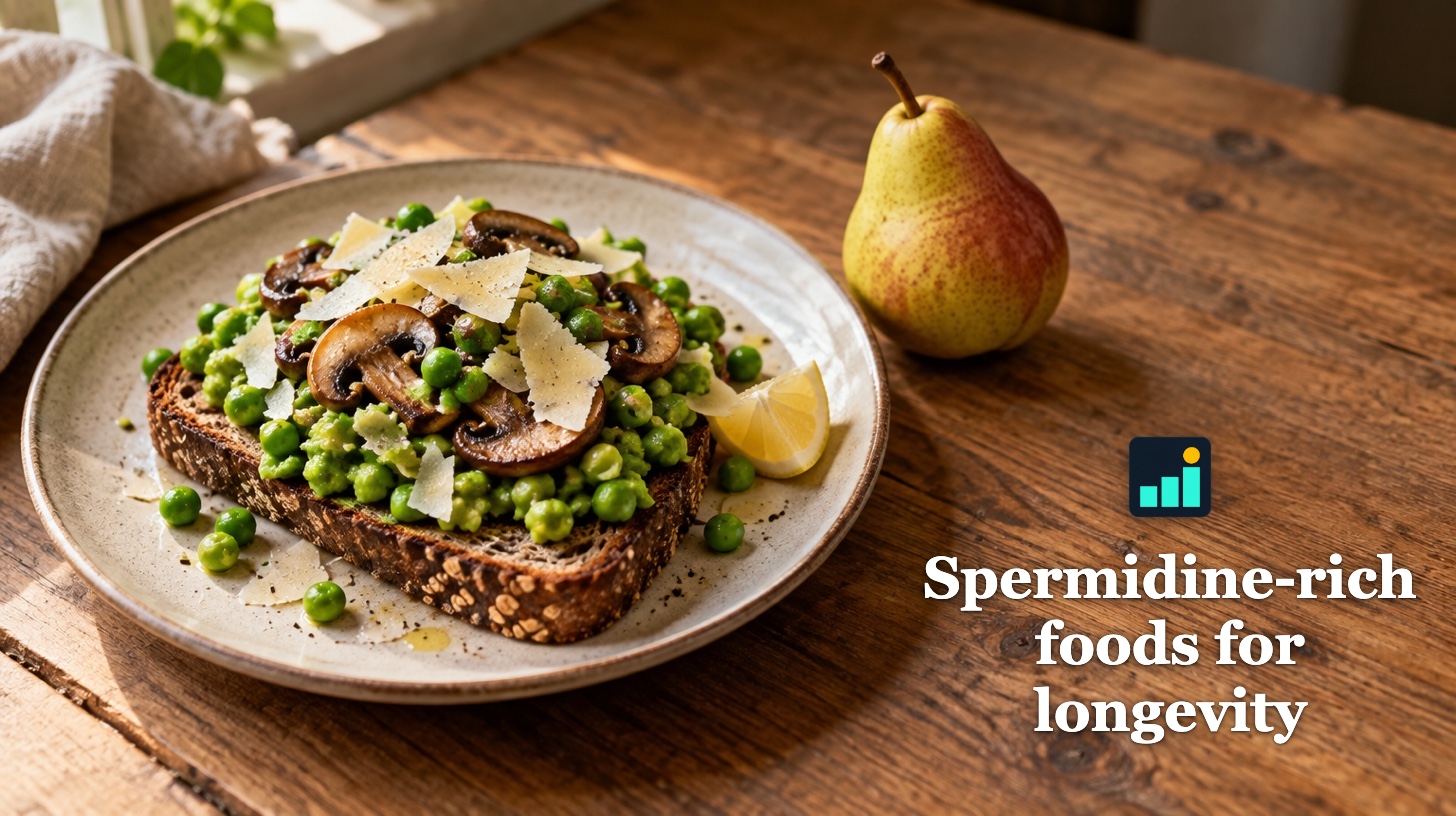
The claim: "Spermidine is a longevity molecule, and you can get enough from food: people who eat the most of it live longer, and the pills add little."
Our grade: Weak. In two European studies, people who ate the most spermidine died less often over 13 to 20 years, and two larger studies point the same way, one leveling off at a moderate intake. Spermidine lengthens life in mice. But no trial has tested it on human lifespan, and the people who ate the most also lived healthier lives. Caveat: the food link is promising; the pills have little to show yet.
Spermidine got its odd name because it was first found in semen. Today it is sold in capsules as a longevity supplement. But the best human evidence for it doesn't come from a capsule. It comes from what 829 people in a small Italian town ate for 20 years.
So should you buy the pill, or change your plate?
The plate. In that town, Bruneck, the third of people who ate the most spermidine died about as often as people 5.7 years younger who ate the least [2]. The line between the two groups was close: under 9 mg of spermidine a day against over 11.6 mg. One plate of peas and mushrooms holds more than the top third's line.
The stranger part is the pill. The year-long capsule trial gave less than 1 mg a day, and in two trials doses of 15 and 40 mg barely moved spermidine in the blood [8, 10, 11]. Why would food work where a capsule doesn't, and is it the spermidine at all, or the good diet that comes with it?
| Food | Serving | Spermidine |
|---|---|---|
| Green peas | 140 g (1 cup) | 9.1 mg |
| Pear | 125 g (1 small) | 6.6 mg |
| Mushrooms | 50 g (a handful) | 4.4 mg |
| Aged cheddar, 1 year | 20 g (a thin slice) | 4.0 mg |
| Broccoli | 100 g | 3.6 mg |
| Whole-grain bread | 40 g (1 slice) | about 1 mg |
| Apple | 150 g | 0.4 mg |
Spermidine per serving, from a review of more than 250 measured foods [7]. Values for one food vary a lot from sample to sample; peas ranged thirtyfold.
Where the claim came from
On September 7, 2026, the longevity YouTuber Siim Land posted "This Longevity Supplement for Autophagy: Food vs Pill" [1]. Autophagy is a cell's recycling system: worn-out proteins and parts are broken down and reused. It slows with age, and spermidine switches it back on in cells and animals.
Land walked through the mouse studies, the Bruneck study and the pill trials, and drew a plain line: "I'm not taking spermidine supplements because the evidence mostly points to food." His advice: "If you want spermidine, you don't necessarily need the supplement," and aim for at least 11.6 mg a day, the top third's line in Bruneck [1]. He also said the one recent pill trial with a striking result, in older people's vaccine responses, has him "rethinking spermidine a little bit."
So is the food claim as strong as he says, and is the pill as weak?
What the studies found
The village study
The Bruneck Study has followed a random sample of the town's adults since 1990 [2]. In 1995, 829 of them, aged 45 to 84, sat down with a dietitian and went through a list of 118 foods, and did it again in 2000, 2005 and 2010. From those answers and a table of measured foods, the researchers worked out how much spermidine each person ate. Then they counted deaths until 2015: 341 in all, with every death traced.
It is observational: nobody was told what to eat. The researchers looked at 146 nutrients, and spermidine had the strongest link of any with living longer [2].
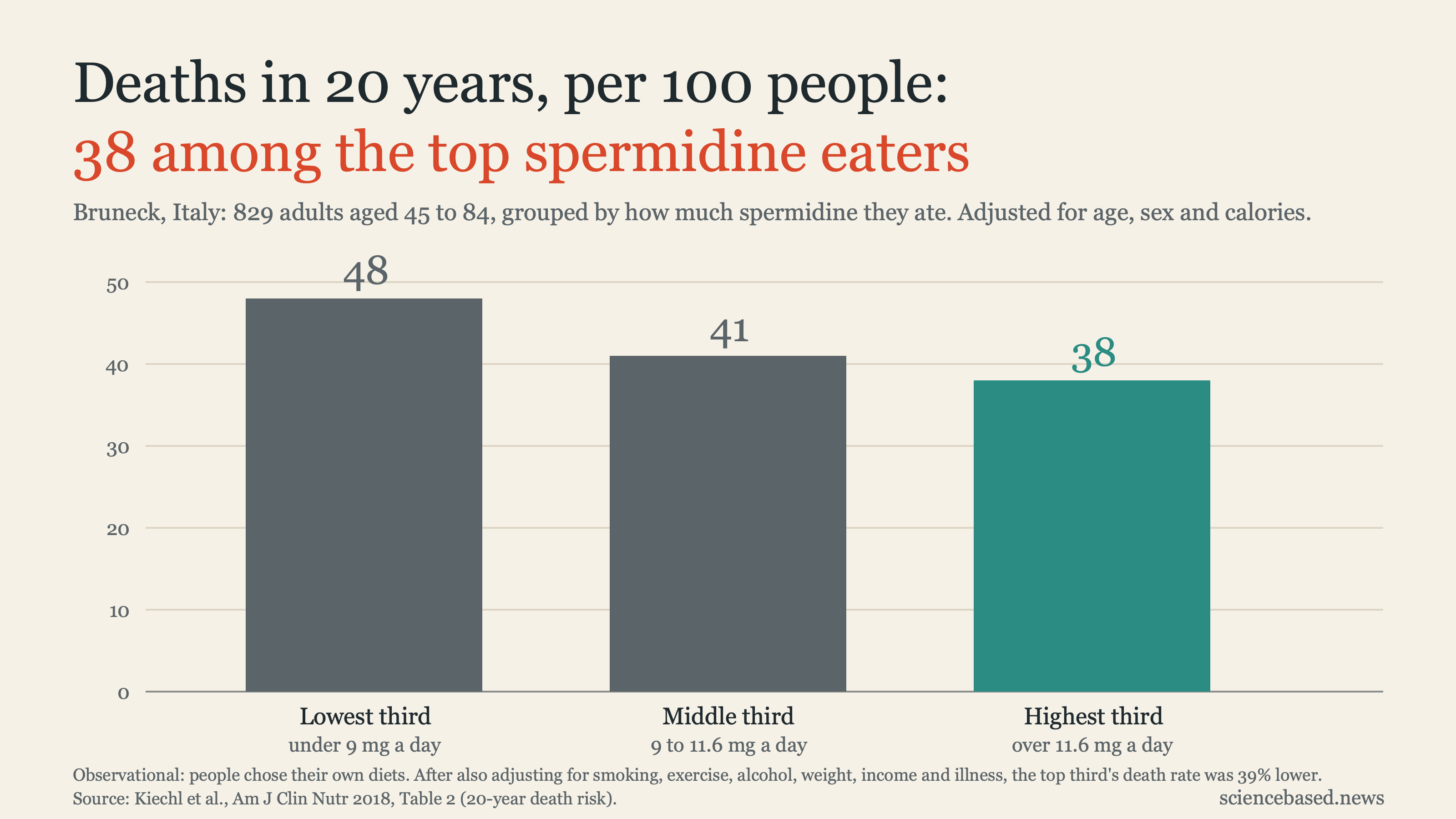
After adjusting for age, sex and calories, 48 of every 100 people in the bottom third would be expected to die within 20 years, against 38 in the top third [2]. The link was a straight line: more spermidine, fewer deaths, all the way up.
The top third were not the same people as the bottom third, though. They were younger (65 against 69), more often women, smoked less, exercised more and ate twice as much fruit and vegetables [2]. So the researchers adjusted for smoking, exercise, alcohol, weight, income and education, diabetes, high blood pressure and aspirin use. The top third's death rate was still 39% lower than the bottom third's [2]. Leaving out the first 5 years, when people already ill might have eaten differently, gave the same answer.
Was it spermidine, or the whole grains and fruit that carry it? The researchers checked. Spermidine's link held no matter which food it came from, and the benefit of whole grains and of fruit and vegetables faded once spermidine was taken into account, not the other way round [2]. Its main sources in Bruneck were everyday ones: whole grains (13%), apples and pears (13%), salad (10%), sprouts (7%) and potatoes (6%).
Three more studies point the same way
The same team checked a second Austrian group, the SAPHIR study: 1,770 adults followed for a median 12.8 years [2]. More spermidine went with fewer deaths again, by about a quarter for each step up in intake, though with only 48 deaths the result is less certain.
In the United States, a study of 23,894 adults in the national nutrition survey found the quarter who ate the most spermidine had 30% fewer deaths than the quarter who ate the least [3]. The link held for spermidine from vegetables, grains, legumes, nuts and cheese, after adjusting for overall diet quality.
The UK Biobank, 184,732 adults followed for 11.5 years, measured all three polyamines together, spermidine and its two cousins [4]. Everyone above the bottom fifth did better, but the lowest risk was in the second fifth, 17 to 22 mg of polyamines a day, with no extra gain above that. That fits "enough" better than "more is better."
Why mice matter here
Cohort studies can't prove spermidine did anything. Animals can test it. In 2016, mice given spermidine in their drinking water lived longer: started late in life, it lengthened their median lifespan by about 10%, and their aging hearts stayed more flexible [5]. In yeast, worms and flies it also lengthens life, and it needs autophagy to do it.
A 2024 study added a link to fasting [6]. Spermidine in the blood rose in more than 100 people during a fast of about 9 days, and in animals, blocking spermidine canceled the longer life that fasting gives. Spermidine looks like one of the ways fasting works, which is a reason to think it matters in people too.
The pills that didn't deliver
If spermidine helps, a capsule should be the easy way. The trials so far say otherwise.
The biggest, SmartAge, gave 100 older adults with memory worries a spermidine-rich wheat-germ extract or a placebo for a year [8]. The extract held 0.9 mg a day, about a tenth of what people already eat. Memory did not improve: the difference was −0.03 on the main test, which is no difference. An earlier 3-month pilot in 30 people had found a medium-sized gain [9].
Higher doses don't obviously reach the blood. In 12 healthy adults, 15 mg a day for 5 days raised blood spermine, its cousin, but not spermidine itself [10]. In 37 older men, 40 mg a day for 28 days barely changed blood polyamines; that trial was paid for by the supplement's maker [11].
The most interesting pill result is the newest. In 2026, 40 adults over 65 who had had three COVID vaccine doses took 6 mg of spermidine from wheat-germ extract, or a placebo, for 13 weeks [12]. Across the whole group, antibodies did not rise significantly. The gain came from the 8 people on spermidine whose vaccines had not taken: their antibodies jumped and stayed up for 37 weeks. But the placebo group had only 2 such people, so there was little to compare against, and the study needs repeating.
That is the answer to the pill puzzle, as far as anyone has one. The capsules tested so far gave either far less than a normal diet or doses that barely showed up in the blood. No published trial has yet given a pill matching what the Bruneck top third ate, for years. The food has 20 years of death counts behind it; the capsules, so far, have short trials on blood levels and memory.
Our grade
| Claim | Evidence | Grade |
|---|---|---|
| People who eat more spermidine die less often | 4 cohort studies, about 211,000 adults, up to 20 years [2, 3, 4]; consistent, one levels off | Promising |
| Spermidine itself lengthens life | Mice, yeast, worms and flies [5, 6]; no human trial on lifespan | Weak |
| Spermidine pills help older people | 1 year-long trial in 100 adults, no memory benefit [8]; blood levels barely move [10, 11]; 1 small vaccine pilot [12] | Unproven |
| Overall: spermidine is a longevity molecule you can get from food | Consistent food cohorts and animal lifespan; no human trial of the outcome | Weak |
Why only Weak, if four cohorts agree? Because nobody can yet say whether it is the spermidine or the diet around it. The strongest case against the grade is the people. Bruneck's top third were already healthier in almost every way that matters, and spermidine-rich foods are the foods of a good diet. Adjustment helps, but never removes everything. When the researchers matched people on their whole diet with a statistical method, the top-third gap shrank to 24% and could have been chance, though each step up in intake still counted [2].
The numbers are estimates. Nobody measured spermidine on anyone's plate; it came from food questionnaires and tables in which the same food can vary many times over from sample to sample.
Bruneck's people were all white Europeans, and the researchers warned their result "cannot readily be extrapolated to high-dose spermidine supplementation or extreme diets" [2]. Three of the authors own shares in a company that sells a spermidine supplement; the study itself was paid for with Austrian public grants.
What would change the grade: a randomized trial that raises spermidine in food or pills and measures heart health or aging markers over years. One such trial, in 187 older people with heart disease, finished in June 2026 [13].
What this means for you
Eat spermidine; don't buy it yet. The Bruneck line, 11.6 mg a day, is within reach of an ordinary diet with whole grains, fruit and vegetables [2].
How much, and how soon
Per day: aim for over 11.6 mg, the top third in Bruneck [2]. Adults in the Austrian replication study averaged about 11 mg [2], so most people are looking for a few extra milligrams, not a new diet.
Per week: about 80 mg. Three of the plates below, plus a pear on most other days, get you there before you count anything else you eat.
How soon? Not in weeks, and nothing you will feel. The Bruneck gap built up over 20 years, in people whose diets stayed fairly steady [2]. Think of it as a habit for decades, not a cure for a month.
More is not shown to be better. The UK Biobank found the lowest risk at a moderate intake [4], so there is no reason to eat 500 g of peas a day.
One plate that clears the line
Peas, mushrooms and aged cheddar on toast
Serves 1 · 15 minutes · about 18 mg spermidine
Ingredients
- 140 g frozen green peas (1 cup)
- 50 g mushrooms, sliced (a handful)
- 20 g one-year aged cheddar, shaved
- 1 slice whole-grain bread, 40 g
- 1 teaspoon olive oil, a squeeze of lemon, salt and pepper
Method
- Toast the bread.
- Warm the oil in a pan and fry the mushrooms over high heat for 4 minutes, until browned.
- Add the peas with a spoon of water and cook 3 minutes, until hot. Crush half of them with a fork.
- Season with lemon, salt and pepper. Pile onto the toast and shave the cheddar over the top.
The spermidine amounts come from measured foods [7]; the cooking amounts are ours. Spermidine holds up well in cooking, but frozen peas from different crops vary a lot.
Other easy sources:
- A pear a day: about 6.6 mg in a small one [7].
- Whole grains instead of white: the top source in Bruneck [2].
- Mushrooms in eggs, soups or stir-fries: about 4.4 mg in a handful [7].
- A slice of aged cheese rather than young: a year-old cheddar held about twice the spermidine of a fresh one [7].
If you take a spermidine supplement, nothing in the trials suggests harm at the doses studied [8, 12]. It just hasn't shown a benefit you can count on.
The best news here is how ordinary the answer is. In Bruneck, the people who lived longest were not taking anything special; they ate a little more whole grain, fruit and salad [2]. A plate of peas and mushrooms, a pear for dessert, and you are eating like the top third.
In the Bruneck study, how much spermidine a day did the top third eat?
The top third ate more than 11.6 mg a day; the bottom third under about 9 mg.
Out of 100 people over 20 years, how many deaths did the study expect in the top and bottom thirds?
After adjusting for age, sex and calories, 48 of 100 in the bottom third against 38 in the top third.
What did the year-long SmartAge trial of a spermidine pill find?
100 older adults took 0.9 mg a day for a year; memory did not improve.
Why can't the Bruneck study prove spermidine itself helped?
It was observational; adjustment helps but never removes every difference between the groups.
What's next
PolyCAD, a randomized trial of spermidine in 187 older people with coronary heart disease, finished in June 2026, and its results are not out yet [13]. If it shows a real effect, the pill side of this check moves up; if not, the case rests even more on food.
On this site: why five foods beat a multivitamin, what a perfect food day looks like, and what happens in your body on a 7-day water fast, where spermidine rises.
Was this helpful?
Sources
Show all sources (13)
- Land S. "This Longevity Supplement for Autophagy: Food vs Pill." YouTube, September 7, 2026. https://www.youtube.com/watch?v=rti_3KlkKNY
- Kiechl S, Pechlaner R, Willeit P, et al. Higher spermidine intake is linked to lower mortality: a prospective population-based study. American Journal of Clinical Nutrition, 2018. 829 adults aged 45 to 84, observational, 20 years (Bruneck); replication in 1,770 adults, 12.8 years (SAPHIR). Funded by Austrian public grants; three authors hold shares in The Longevity Labs, which sells a spermidine supplement. https://doi.org/10.1093/ajcn/nqy102
- Wu H, Wang J, Jiang H, et al. The association of dietary spermidine with all-cause mortality and CVD mortality: the U.S. National Health and Nutrition Examination Survey, 2003 to 2014. Frontiers in Public Health, 2022. 23,894 adults, observational. https://doi.org/10.3389/fpubh.2022.949170
- Han S, Qian M, Zhang N, et al. The association of dietary polyamines with mortality and the risk of cardiovascular disease: a prospective study in UK Biobank. Nutrients, 2024. 184,732 adults, observational, 11.5 years. https://doi.org/10.3390/nu16244335
- Eisenberg T, Abdellatif M, Schroeder S, et al. Cardioprotection and lifespan extension by the natural polyamine spermidine. Nature Medicine, 2016. Mice. https://doi.org/10.1038/nm.4222
- Hofer SJ, Daskalaki I, Bergmann M, et al. Spermidine is essential for fasting-mediated autophagy and longevity. Nature Cell Biology, 2024. Yeast, worms, flies, mice and human volunteers. https://doi.org/10.1038/s41556-024-01468-x
- Atiya Ali M, Poortvliet E, Strömberg R, Yngve A. Polyamines in foods: development of a food database. Food & Nutrition Research, 2011. Review of measured values in more than 250 foods. https://doi.org/10.3402/fnr.v55i0.5572
- Schwarz C, Benson GS, Horn N, et al. Effects of spermidine supplementation on cognition and biomarkers in older adults with subjective cognitive decline: a randomized clinical trial. JAMA Network Open, 2022. 100 adults aged 60 to 90, randomized, placebo-controlled, 12 months. Supplement and placebo from The Longevity Labs. https://doi.org/10.1001/jamanetworkopen.2022.13875
- Wirth M, Benson G, Schwarz C, et al. The effect of spermidine on memory performance in older adults at risk for dementia: a randomized controlled trial. Cortex, 2018. 30 adults, randomized, placebo-controlled, 3 months. Graded from the abstract. https://doi.org/10.1016/j.cortex.2018.09.014
- Senekowitsch S, Wietkamp E, Grimm M, et al. High-dose spermidine supplementation does not increase spermidine levels in blood plasma and saliva of healthy adults. Nutrients, 2023. 12 adults, randomized crossover, 5 days each. https://doi.org/10.3390/nu15081852
- Keohane P, Everett JR, Pereira R, et al. Supplementation of spermidine at 40 mg/day has minimal effects on circulating polyamines: an exploratory double-blind randomized controlled trial in older men. Nutrition Research, 2024. 37 men, randomized, 28 days. Funded by Chrysea Labs, the maker. https://doi.org/10.1016/j.nutres.2024.09.012
- Alsaleh G, et al. Spermidine mitigates immune cell senescence and boosts vaccine responses in healthy older adults: a pilot study. Aging Cell, 2026. 40 adults over 65, randomized, placebo-controlled, 13 weeks. Extract and part of the funding from The Longevity Labs; two authors consult for it. https://doi.org/10.1111/acel.70545
- Polyamine treatment in elderly patients with coronary artery disease: a randomized controlled trial (PolyCAD). ClinicalTrials.gov NCT06186102. 187 people, completed June 2026, no results posted yet. https://clinicaltrials.gov/study/NCT06186102
Discussion