

At the molecular level, your fast starts on day 3
Evidence check, October 26, 2026. Updated October 30, 2026.
The claim: "After three days without food, your body flips a massive switch: hundreds of your blood proteins change."
Our grade: Promising. In 12 healthy people on a 7-day water fast, changed blood proteins went from 6 on day 1 to 390 on day 7, and the jump came after day 3. Caveat: It is one small study with no comparison group, and most proteins went back to normal within 3 days of eating.
Day 3 is when most people end a fast. The hunger peaks, the head aches, and a plate of eggs starts to look like the reasonable choice.
So what changes if you keep going?
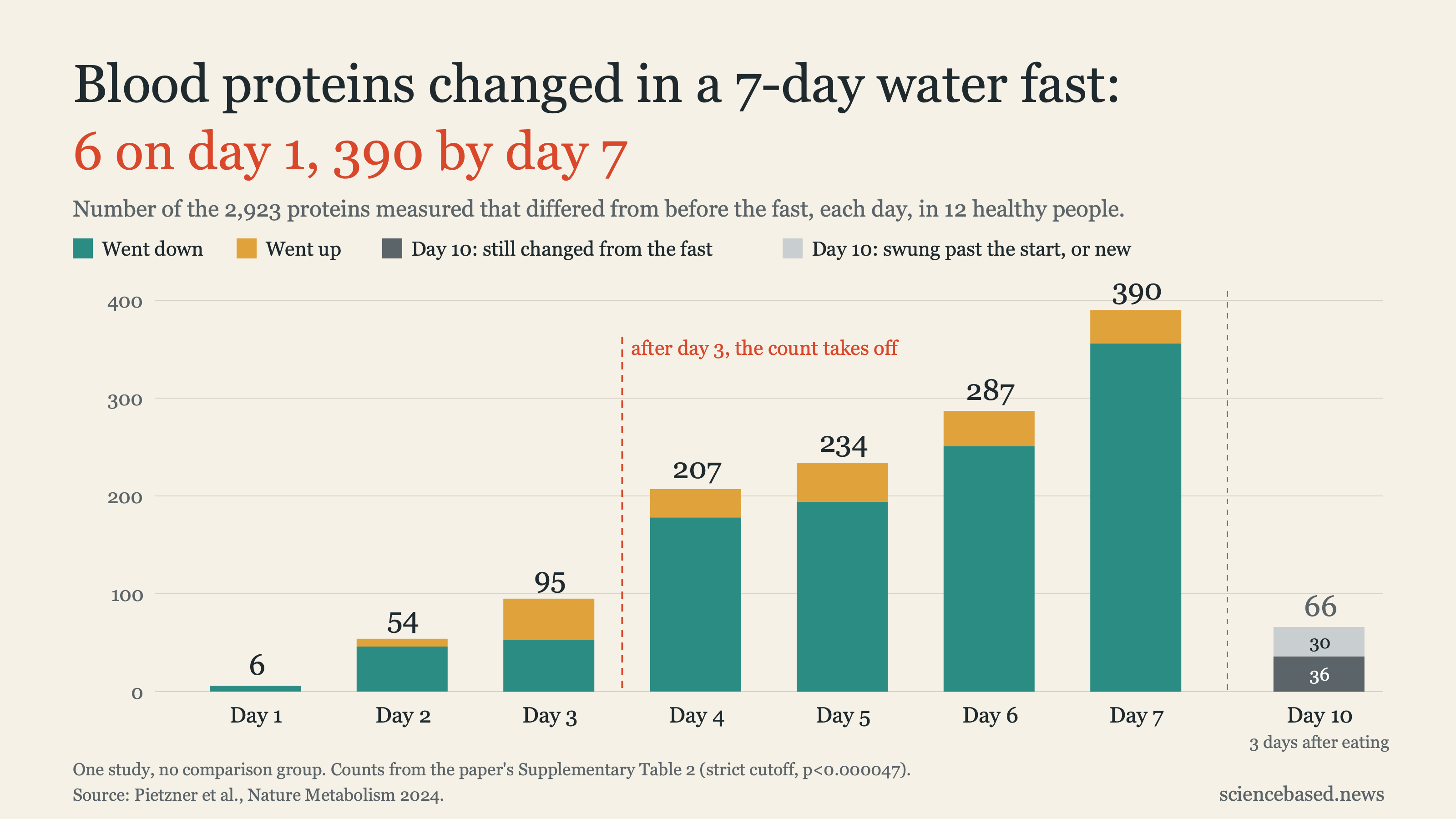
A 2024 study in Nature Metabolism measured it [1]. Researchers in Norway, Germany and the UK took blood from 12 healthy people every morning of a 7-day water-only fast and measured 2,923 proteins in it. After one day, 6 had changed. After two days, 54. After three days, 95. Then the count took off: 207 on day 4, and 390 on day 7.
That raises two questions. Why does the body wait until day 3? And does the change stay once you eat again?
Where the claim came from
On August 3, 2026, Nick Norwitz, a doctor with a PhD in metabolism, posted a video called "How to Hack a 7 Day Fast in 24 Hours" [2]. It has 180,000 views. He calls the study "a massive second wave of protein changes" and says "most people who practice fasting stop right before the most impactful biological changes begin."
His hack is about ketones, the fuel your liver makes from fat when food runs out. In the study they rose slowly all week. Norwitz ate a very low-carb diet, then fasted 24 hours and drank two ketone shots of 10 grams each. His blood ketones reached 4.4 millimoles per liter, higher than the study's people reached in 7 days. He gives a 15% discount code for the drink.
He is careful about what that shows: "I'm not going to sell you snake oil and say that this approach will mimic all the benefits of a 7-day fast." We agree, and we check the fast itself, not the hack.
What the study found
The switch is real, and it waits for day 3. On day 1, 6 proteins were different from before the fast. On day 2, 54. On day 3, 95. Then it jumped, to 207 on day 4, and climbed every day to 390 on day 7 by the study's strictest test. The authors write that a body-wide response was "evident only after three days of complete calorie restriction."
The change reached almost every organ. The proteins that moved come from the brain, the heart, the liver, muscle, fat, the immune system and the blood's clotting system. Most went down. The fat hormone leptin, which tells your brain how much fat you carry, fell hardest by day 4. Follistatin, a protein that lets muscle grow, rose by more than 5 standard deviations by day 3, a jump far outside its usual range and one of the biggest moves in the study.
The switch is about fasting, not about weight. 452 proteins rose or fell with the number of days people had fasted. Only 49 moved with how much weight they had lost, and blood ketones were only weakly linked to weight loss.
So what is the body waiting for? The study's fuel numbers give the best clue. Blood sugar fell and fat in the blood rose, and both leveled off after 2 to 3 days [1]. The body finishes switching from sugar to fat first, and the protein change follows. Day 3 is the turn. Of its 95 changed proteins, almost half were going up, and follistatin peaked. After that the number going up held steady, and almost all the new changes were proteins going down. The study shows the order, not that one causes the other.
The body kept its fat loss and got its lean tissue back. People lost 5.7 kg in 7 days: 3.6 kg lean tissue and 1.6 kg fat by the scanner. Three days after eating again, the lean loss had almost disappeared (0.7 kg), while the fat loss held (1.9 kg). Most of the early "lean" loss was water and stored sugar.
The main study, Pietzner et al. 2024 [1], had 12 healthy non-smoking volunteers, 5 women and 7 men, average weight 77.5 kg and body mass index 25.4. They drank only water for 7 days, then ate normally for 3. Blood was drawn 2 days before, every morning of the fast and on day 10, 117 samples in all. The proteins were measured with a method called Olink, which gives relative levels, not exact amounts. There was no comparison group, and the study was not randomized. Nobody had a serious side effect. It was funded by the Norwegian School of Sport Sciences and German public research money; the authors report no conflicts.
The team also used genetics to ask what the changes might do. People born with naturally higher or lower levels of 212 of these proteins have different rates of about 500 diseases. Of the links, 52% pointed toward lower risk with the change fasting made, and 48% toward higher risk. The authors call this "exploratory." It suggests where to look, not what a fast does.
A second protein study, run at a water-fasting clinic in California, found much the same pattern [3]. Twenty people fasted 9.8 days on average; 86 of 1,317 proteins changed, and 49 of them moved the same way as in the Pietzner study.
The muscle question was tested directly in 16 healthy men on a 10-day fast with daily walks [4]. They lost 5.9 kg. A model of the loss counted about 1.5 kg as working tissue, and lean tissue was still 3.2% lower 3 months later. Grip strength did not change, and leg strength was 33% higher at 3 months, which the authors put down to the walking.
The best trial for results you can feel is Maifeld et al. 2021 [5]. In Berlin, 71 people with metabolic syndrome (belly fat with high blood pressure, sugar or blood fats) were randomly assigned to a 5-day fast on 300 to 350 calories a day followed by a DASH diet, which is high in vegetables, fruit and low-fat dairy, or the DASH diet alone. At 3 months, 24-hour blood pressure was still lower in the fasting group, and not significantly changed on the diet alone. Doctors cut blood-pressure pills for 15 of 35 in the fasting group (43%) and 6 of 36 on the diet alone (17%).
So the people who stop on day 3 do stop just before the body-wide change gets going. The study shows the change. It does not yet show what the change does for health.
What switched off, and is that good for you?
Most of the late change was proteins going down. Of the 390 proteins changed on day 7, 356 had fallen, and 309 of those had not yet moved on day 3 [1]. The authors sorted them by what they do.
The biggest group is scaffolding. Between your cells sits a mesh of proteins, the extracellular matrix, that holds tissues together, including the elastic walls of blood vessels. Many of its proteins fell from about day 2 on. The authors think the body takes this scaffold apart or stops renewing it, to save protein while none is coming in, and that this may explain part of the lean tissue lost. The protein most tied to the fast was one of these: tenascin-R, a scaffold protein found only in the brain. Brain scaffold proteins were lower when ketones were higher. The authors guess this might one day help explain why ketogenic diets calm epilepsy; nobody has tested that.
After day 3 a second group fell: proteins of the complement system, part of the immune defense, and of blood clotting. So did transthyretin, which carries thyroid hormone, and several immune signals and their receptors. Hormones from the liver (fetuin-B) and from fat (chemerin) went down too, as did two proteins tied to bone (SFRP4 and osteoglycin).
Is that good for you? Nobody knows, and this study cannot say. A lower level in the blood can mean the body makes less, uses more or leaks less from tissue, and the study cannot tell which. Read together, the changes look like a body saving energy and protein: leptin down, the thyroid signal down, the scaffold recycled. That is how a body gets through a long stretch without food. It is not evidence of a repair or cleanup program. The genetics check came out almost even, 52% of disease links pointing toward lower risk and 48% toward higher. And not everything fell: earlier in the fast, immune proteins rose for a while and a clotting factor went up.
Does it last? Mostly not, as far as anyone has looked. Of the 390 proteins changed on day 7, 36 were still changed the same way 3 days after people ate again: about 1 in 11. Most of those 36 had fallen late in the fast and were still on their way back, like transthyretin, which carries thyroid hormone in the blood. Six were still raised, among them the leptin receptor and FABP4, a protein from fat cells. Another 10 swung past where they started. PCSK9, the liver protein that some cholesterol drugs block, fell sharply during the fast and then rose above its starting level. And 20 that were not changed at the end of the fast changed only after eating, among them two proteins made by the pancreas; the authors call this a possible response to food coming back. That is why the gray bar in the chart shows 66, not 36. In the California study, 12 of 86 proteins were still changed about 5 days after the fast [3]. No study has checked later, so nobody knows whether any of it lasts weeks or months. In his video Norwitz calls the change a "software update" that "remained installed after food was reintroduced." For about 1 in 11 proteins it stayed for 3 days; for the rest it did not. The authors say benefits "might only be achieved through sustained manipulation."
What the fast has not shown
It raised inflammation for a while. In the California clinic study of 20 people, CRP, a blood marker of inflammation, more than doubled, from 1.7 to 3.9 mg/L [3]. In the same people, a marker of sticky platelets rose 21% and was 36% up after refeeding, liver enzymes rose about 65%, and 6 of the 20 switched to juice or broth on medical advice. In 1,422 people on a very-low-calorie fast at a German clinic, CRP rose in two of three [3]. In a hospital study at Brigham and Women's in Boston, CRP peaked around day 3 of a 10-day fast [6]. Pietzner's team also saw a short rise in immune proteins on days 2 to 3 and a clotting factor go up [1].
Autophagy has not been measured in people. Autophagy is the cell's recycling of its own worn parts, and it is the benefit people most often fast for. The only human sign so far is one lab blot from 4 people after a 72-hour fast, a snapshot that cannot show whether the recycling actually sped up [7]. A trial in Sydney is set up to measure it properly [8].
Your biological age did not get younger. In a 2026 study of 32 people on a 12-day fast of about 200 to 250 calories a day, not one of the DNA marks the tests read changed significantly, and three of the aging clocks read older, not younger [9]. It is a preprint, not yet checked by other scientists, and most of its authors work for the clinic or a test company. Our biological age test guide explains what those clocks can and can't tell you.
Nobody has tested the ketone hack. No study has measured blood proteins after a 24-hour fast plus ketone drinks. In the 7-day fast, ketones explained part of the protein change, but they rose alongside many other things, such as low insulin and low blood sugar, which a ketone drink does not copy.
The number of participants in the 7-day fast of the main study, Pietzner et al. [1], is small. Twelve young, healthy, mostly white Europeans, with no comparison group. It cannot tell a fasting effect from the effect of time or of being sampled daily.
Our grade
| Claim | Evidence | Grade |
|---|---|---|
| The body-wide protein change comes after day 3 | 1 study, 12 people, daily blood for 7 days, no control [1] | Promising |
| The change lasts after you eat again | About 1 in 11 still changed the same way 3 days after eating (36 of the 390 changed on day 7) [1]; 12 of 86 in a second study [3]; no one has looked later | Unproven |
| A long fast lowers inflammation | CRP doubled in 2 studies [3, 6] | Debunked |
| A long fast turns on autophagy in people | 1 snapshot blot in 4 people [7] | Unproven |
| A 5-day fast with a diet lowers blood pressure | 1 randomized trial, 71 people, 3 months [5] | Promising |
| Ketone drinks after 24 hours copy a 7-day fast | No study | Unproven |
| Overall: a water fast flips a protein switch after day 3 | Clear, large and partly repeated in a second study, but small and uncontrolled | Promising |
The case for a higher grade: the size of the change is hard to wave away. 390 proteins differed on day 7 alone, some by more than 2 standard deviations, and a second team using a different method found the same direction for 49 of the same proteins.
The case for a lower one: there is no comparison group, and what the proteins do for health is a guess from genetics, which pointed both ways.
What would change the grade: a randomized trial that measures proteins and health outcomes after people eat again for weeks, not days.
What this means for you
If you want what the study saw, it takes 3 full days of water only, and every study here was supervised. Clinics that run long fasts check blood, blood pressure and medicines daily. If you take pills for blood sugar or blood pressure, the doses may need to change during a fast, as they did for 43% in the Berlin trial; do not do it alone [5].
Expect the scale to drop fast and bounce back partly. In the study, 5.7 kg came off in 7 days, and about 3 kg was still off 3 days after eating again [1]. The part that stayed off was mostly fat.
Plan the week after as carefully as the fast. The protein change faded within 3 days of eating. The one trial with a lasting benefit put the fast in front of a diet people kept, and their blood pressure was still lower 3 months later [5].
Keep moving. The men who walked every day of a 10-day fast kept their grip strength and had stronger legs 3 months later [4].
If you try Norwitz's ketone approach, treat it as an experiment on your ketone number, not as a shortcut to the 7-day result. He says so himself.
The hopeful part is real. In one week without food, the body rebuilt the mix of proteins in its blood from the brain to the muscles, and it kept the fat loss. Day 3 is not where the fast fails; it is where the biggest change starts.
When did most blood proteins start to change in the 7-day fast?
Only 6 proteins changed on day 1 and 54 on day 2; the body-wide change came after day 3.
How many changed proteins were still different 3 days after people ate again?
Most went back to where they started; the authors say benefits may need longer change.
What happened to CRP, a marker of inflammation, in long water fasts?
In the California clinic study it went from 1.7 to 3.9 mg/L, and a Boston study saw it peak around day 3.
Which fast has a randomized trial with a lasting benefit?
In 71 people with metabolic syndrome, blood pressure was still lower at 3 months, and 43% cut their pills.
What's next
This study raises more questions than it answers. What are those protein changes doing to us? How long do they last beyond the first few days? Will they help us live longer? Will they make us stronger? We don't have the answers yet. Even so, I'm hopeful that fasting is good for you, because some results do last for months. In the Berlin trial, a 5-day fast left blood pressure lower 3 months later [5]. In another Berlin trial, 32 people with type 2 diabetes were randomly assigned to a 7-day fast on 300 calories a day or to usual care. Insulin and long-term blood sugar did not change significantly, but four months later the fasting group had lost more weight (3.5 kg against 2.0 kg) and had lower blood pressure [10]. A week without food can leave something good behind for months.
The autophagy answer is coming. The PROFASTA trial in Sydney, a randomized crossover study, measures autophagy directly in people after a long fast, with and without hard exercise first [8]. It is the first trial built to show whether fasting turns on the cell's recycling in humans. We will update this article when it reports.
For what fasting does to blood sugar, see our article on glucose monitors. For another way to lower blood sugar, see berberine.
The next step for the protein switch is a study that follows people for weeks after the fast and has a comparison group. Until then, the Berlin trial is the best guide to a fast that leaves something behind. In one week without food, your body remade hundreds of the proteins in its blood. That is a remarkable thing to be able to do, and science is only starting to learn what it means for you.
Was this helpful?
Sources
Show all sources (10)
- Pietzner M, Uluvar B, Kolnes KJ, et al. Systemic proteome adaptions to 7-day complete caloric restriction in humans. Nature Metabolism, 2024. 12 healthy adults, single-arm, 7-day water-only fast and 3 days of refeeding, no control group. Funded by the Norwegian School of Sport Sciences, DZHK and BMBF; no conflicts reported. Numbers checked against the authors' manuscript (PMC7617311). https://doi.org/10.1038/s42255-024-01008-9
- Norwitz N. How to Hack a 7 Day Fast in 24 Hours. YouTube, August 3, 2026. Contains a paid promotion for a ketone drink. https://www.youtube.com/watch?v=RJIdFfKgi2g
- Commissati S, Cagigas ML, Masedunskas A, et al. Prolonged fasting promotes systemic inflammation and platelet activation in humans: a medically supervised, water-only fasting and refeeding study. Molecular Metabolism, 2025. 20 adults, single-arm, water-only fast of 9.8 days on average at TrueNorth Health Center, plus CRP data from 1,422 people at a Buchinger clinic. The clinic's founder is an author. https://doi.org/10.1016/j.molmet.2025.102152
- Laurens C, Grundler F, Damiot A, et al. Is muscle and protein loss relevant in long-term fasting in healthy men? A prospective trial on physiological adaptations. Journal of Cachexia, Sarcopenia and Muscle, 2021. 16 healthy men, single-arm, 10-day fast with walking, 3-month follow-up. Funded by CNRS and Amplius GmbH, a fasting company; one author is its managing director. https://doi.org/10.1002/jcsm.12766
- Maifeld A, Bartolomaeus H, Löber U, et al. Fasting alters the gut microbiome reducing blood pressure and body weight in metabolic syndrome patients. Nature Communications, 2021. 71 adults with metabolic syndrome, randomized, 5-day fast plus DASH diet against DASH diet alone, 3 months. https://doi.org/10.1038/s41467-021-22097-0
- Fazeli PK, Zhang Y, O'Keefe J, et al. Prolonged fasting drives a program of metabolic inflammation in human adipose tissue. Molecular Metabolism, 2020. Healthy adults, single-arm, 10-day inpatient fast at Brigham and Women's Hospital. https://doi.org/10.1016/j.molmet.2020.101082
- Qian J, Fang Y, Yuan N, et al. Innate immune remodeling by short-term intensive fasting. Aging Cell, 2021. Healthy adults, 72-hour fast; autophagy shown in 4 people without a flux measure. https://doi.org/10.1111/acel.13507
- Masedunskas A, de Ciutiis I, Hein LK, et al. Investigating the impact of glycogen-depleting exercise combined with prolonged fasting on autophagy and cellular health in humans: a randomised controlled crossover trial. Nutrients, 2024. Trial protocol, ACTRN12623000087651; no results yet. https://doi.org/10.3390/nu16244297
- Luo, Knufinke, et al., Horvath S, Mesnage R, von Meyenn F. Effects of long-term fasting: longitudinal epigenetic responses in humans. bioRxiv preprint, 2026, not peer reviewed. 32 adults, single-arm, 12-day fast of about 200 to 250 calories a day, 1-month follow-up. Most authors work for the Buchinger Wilhelmi clinic or GenKnowme. https://doi.org/10.64898/2026.06.12.731903
- Li C, Sadraie B, Steckhan N, et al. Effects of a one-week fasting therapy in patients with type-2 diabetes mellitus and metabolic syndrome: a randomized controlled explorative study. Experimental and Clinical Endocrinology & Diabetes, 2017. 46 adults with type 2 diabetes randomized, 32 analyzed, 7-day fast of 300 calories a day against usual care, 4 months. https://doi.org/10.1055/s-0043-101700
Discussion