

Berberine lowers blood sugar in type 2 diabetes trials
Evidence check, October 16, 2026. Updated October 17, 2026.
The claim: "Berberine lowers blood sugar in people with type 2 diabetes."
Our grade: Promising. In double-blind trials of people with type 2 diabetes, berberine lowered HbA1c by about 0.4 points more than placebo in 12 weeks, and a berberine drug did as well in a US trial. Most trials were short and done in China, and in people without diabetes it did little.
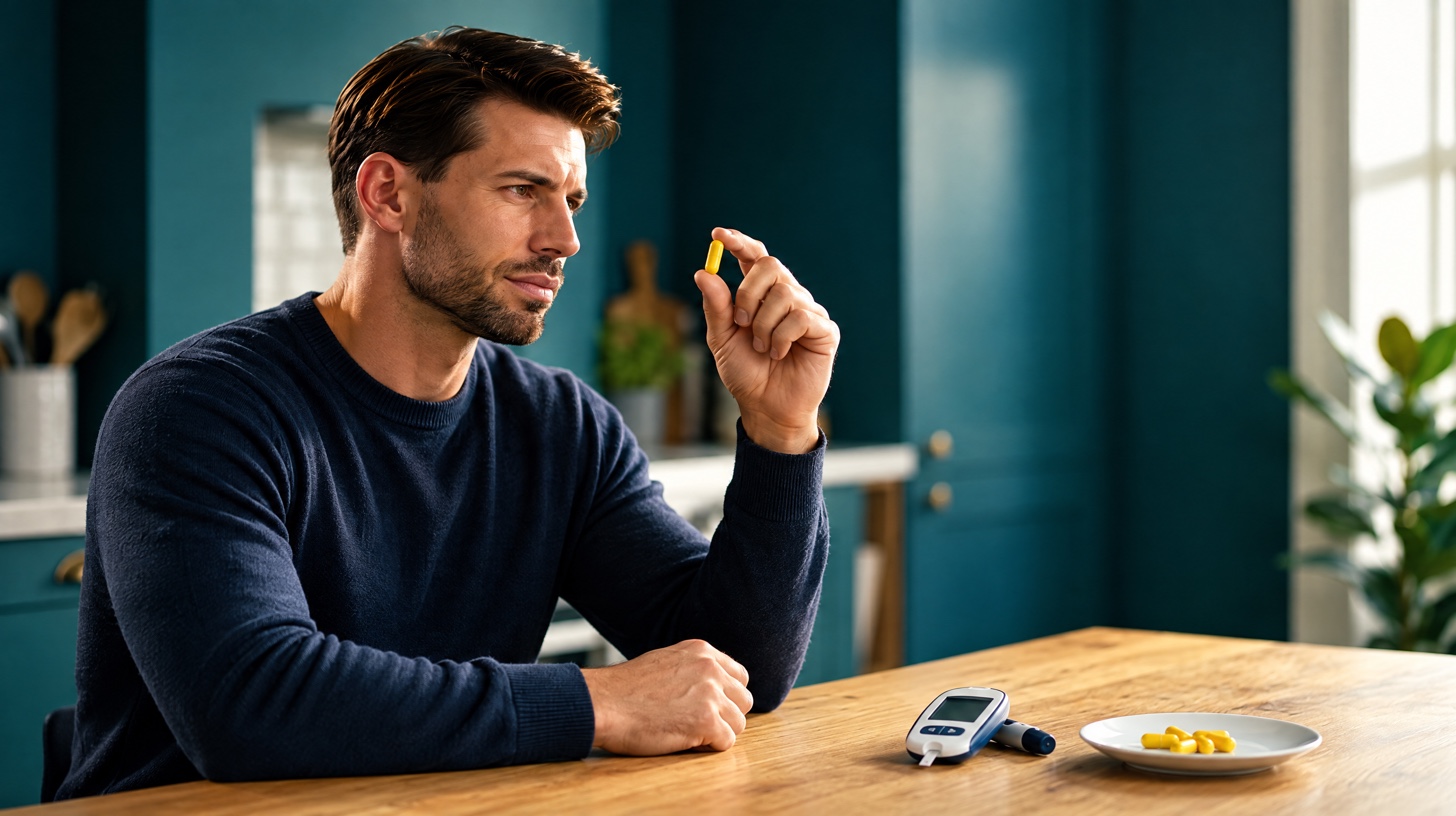
Sam is 35, and his last blood test put his HbA1c at 7.1%. That is type 2 diabetes. His feed calls berberine "nature's Ozempic."
Can a yellow capsule bring his number down?
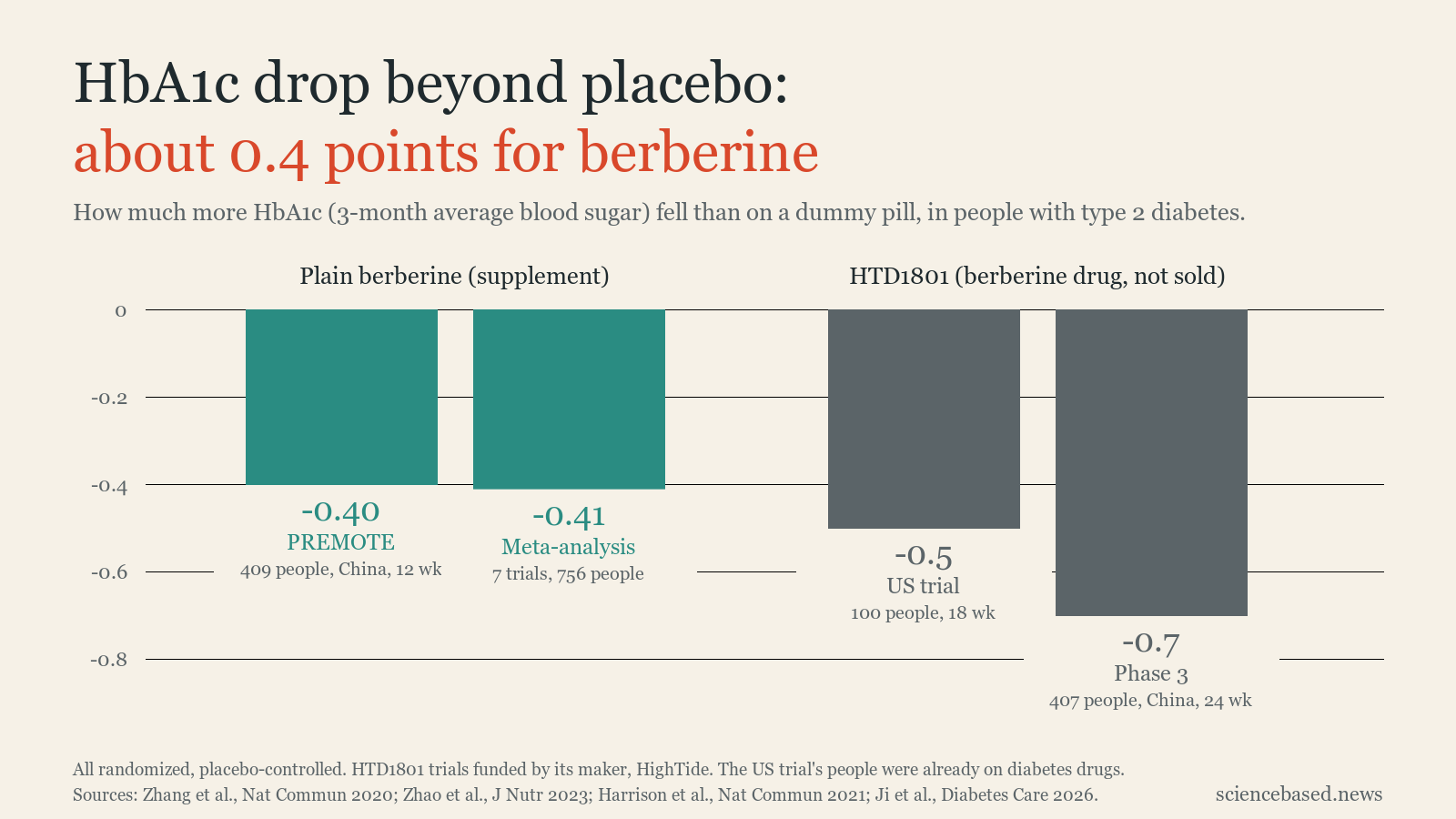
In the biggest placebo trial, yes, by a real but modest amount. In 2020, 409 adults in China with newly found type 2 diabetes took berberine or a dummy pill for 12 weeks. HbA1c, a three-month average of blood sugar, fell 0.40 points more on berberine [1].
That leaves two questions the feed skips. Does it work outside China, where nearly all the big trials were done? And does it do anything for weight, the reason it went viral?
Where the claim came from
Berberine is a bitter yellow compound from plants such as goldenseal and Chinese goldthread. It has been used for diarrhea for centuries. Doctors in China noticed that diabetic patients taking it for diarrhea had lower blood sugar, and started testing it [2].
The comparison to metformin, the first drug most people with type 2 diabetes get, goes back to a 2008 pilot trial in Shanghai [3]. In 2023 it took off on TikTok under the name "nature's Ozempic," as a weight-loss pill [4].
Those are two different claims. One is about blood sugar in people whose blood sugar is high. The other is about weight in everyone. The trials treat them very differently.
The best trials: blood sugar
PREMOTE is the strongest test of plain berberine. It ran at 20 hospitals in China and was randomized and double-blind, so neither the patients nor the doctors knew who got what. The 409 people were aged 20 to 69 and had not yet started any diabetes drug. They took 0.6 g of berberine twice a day before meals, probiotics, both, or placebo, for 12 weeks [1].
HbA1c fell 0.99 points on berberine and 0.59 on placebo. The gap, 0.40 points, was not chance. People ended at an average of 6.71% on berberine and 7.23% on placebo; under 7% is the usual goal [1]. Adding probiotics did not help.
An older Chinese trial of 116 people with type 2 diabetes and high cholesterol found the same direction. On 1 g of berberine a day for 3 months, HbA1c went from 7.5% to 6.6%, a clear gap from placebo, and LDL cholesterol fell from 3.23 to 2.55 mmol/L [2]. We read only the abstract of that one.
The 2008 pilot is where "as good as metformin" comes from. Of 36 people with new diabetes, 31 finished 13 weeks on 0.5 g of berberine or 0.5 g of metformin three times a day. HbA1c fell from 9.47% to 7.48% on berberine and from 9.15% to 7.72% on metformin [3]. That looks like a tie. But it was small and nobody was blinded, and the authors called it a pilot.
A 2023 meta-analysis, which pools trials, found 20 placebo-controlled trials with 1,761 people. In the 7 that measured HbA1c (756 people), berberine lowered it by 4.48 mmol/mol, about 0.4 points. The effect on fasting glucose was larger in people with diabetes and in Asian people [5].
So across trials, berberine lowers HbA1c by about 0.4 points in 12 weeks. That is modest, and it is real.
The Western trials
Most berberine trials were done in China. That matters, since the meta-analysis found larger effects in Asian people [5]. So we looked hard for trials in the US and Europe.
The best one is from the US. In 2021, 12 American liver clinics tested HTD1801, a drug that joins berberine to a bile acid (ursodeoxycholic acid). The 100 people had type 2 diabetes and fatty liver, their average age was 56, and 94 of them were already on diabetes drugs. They took 500 or 1,000 mg twice a day, or placebo, for 18 weeks [6].
Did it work in Americans? Yes. On the high dose, HbA1c fell 0.6 points while it rose 0.1 on placebo, a gap of 0.5 on top of their usual drugs. Liver fat fell 4.8 points against 2.0, and weight fell 3.5 kg against 1.1 kg [6].
A later trial of the same drug in 113 Chinese people on diet alone found a 0.7-point gap on the high dose, and 56% reached an HbA1c under 7%, against 15% on placebo [7]. Then came a phase 3 trial, the last stage before approval: 407 Chinese adults, 24 weeks, double-blind. HbA1c fell 1.3 points on HTD1801 and 0.6 on placebo, the same 0.7-point gap, and the drop held through a year of open-label use [15]. The drug's maker, HighTide, paid for all three. HTD1801 is not a supplement you can buy, but it is the best sign that the berberine effect holds in Americans.
What about the plain supplement in the West? Only small trials, and they point the same way. In Mexico, 24 people with metabolic syndrome took 500 mg three times a day for 3 months; 36% no longer met the definition of metabolic syndrome, and insulin worked better [8]. In Italy, 49 overweight adults with high fasting glucose lowered their glucose and their belly fat compared with placebo in 60 days [9]. In Greece, a capsule of berberine with mulberry leaf and chromium raised insulin sensitivity 28% in 93 adults with obesity, but it had no berberine-only group [10]. In Poland, 70 people with fatty liver improved a liver enzyme and cholesterol but not glucose [11].
Weight: where the hype ends
Now the "Ozempic" part, the second open question. A 2025 meta-analysis of 23 trials found berberine cut weight by 0.88 kg on average [12]. Ozempic-type drugs cut weight by 15% or so.
The cleanest test is BRAVO, from 11 hospitals in China and published in 2026. It enrolled 337 adults with obesity and fatty liver but no diabetes, and gave them 0.5 g of berberine twice a day or placebo for 6 months, with diet advice for both. Belly fat, liver fat and weight did not change more on berberine. Weight fell 1.8 kg on berberine and 1.9 kg on placebo [13]. Blood sugar did not change either. Only LDL cholesterol fell a little more, by 7.7 mg/dL, and that was not a main outcome.
That is the punchline. Berberine works on blood sugar when blood sugar is high. When it is normal, there is little for it to fix. So back to Sam: with an HbA1c of 7.1%, he is the kind of person the trials helped, and losing weight would still do more.
The limits
Every large trial of plain berberine was in China. The best Western trial tested a drug version, not what is on store shelves. Most trials lasted 12 to 18 weeks, and none measured heart attacks, kidney disease or deaths, the things that matter most in diabetes.
Supplements also vary. The 2025 weight meta-analysis noted that trials rarely report the purity or real dose of what they gave [12].
Side effects are common. In the 2008 pilot, 34.5% had stomach trouble: gas, constipation or diarrhea, and 24% cut their dose [3]. In the US drug trial, 26% on the high dose had diarrhea, against none on placebo, and 9 people stopped because of side effects, against 1 [6]. Liver and kidney tests stayed normal in the trials.
Berberine also slows three liver enzymes that clear many drugs. In a study of healthy men, 300 mg three times a day for 2 weeks raised blood levels of a test sedative, midazolam, by 40% [14].
Our grade
| Question | Evidence | Grade |
|---|---|---|
| HbA1c in type 2 diabetes, plain berberine: PREMOTE, Zhang 2008, meta-analysis [1, 2, 5] | Double-blind trials of 409 and 116 people; about 0.4 points beyond placebo in 12 weeks. All large trials in China | Promising |
| HbA1c with the drug version: HTD1801 in the US and China [6, 7, 15] | 100 people, double-blind, 18 weeks; 0.5 points beyond placebo, on top of other drugs; 0.7 in a phase 3 trial of 407 in China. A drug, not the supplement; maker-funded | Promising |
| As good as metformin: Yin 2008 [3] | 31 people, open-label, 13 weeks | Weak |
| Weight loss: meta-analysis and BRAVO [12, 13] | 0.88 kg on average; no gap from placebo in 337 people over 6 months | Debunked |
| Overall: berberine lowers blood sugar in type 2 diabetes | Several double-blind trials agree, but short, mostly in one country, and no outcome trials | Promising |
So why not Solid? The case for the other side: several randomized, double-blind trials, a meta-analysis and a US trial of a related drug all agree. By our scale, that is close to Solid.
What holds it back is where and how long. Almost all of the plain-berberine evidence comes from China, the effect may be larger in Asian people, and no placebo-controlled trial has run past 6 months.
What would change the grade: a placebo trial of a store-bought berberine in Western adults with type 2 diabetes, lasting a year, would move it to Solid.
What this means for you
- If your HbA1c is in the diabetes or high prediabetes range, berberine can lower it by about 0.4 points in 3 months. Take it with meals, split over the day, at the doses the trials used: 0.6 g twice a day [1] or 0.5 g three times a day [3].
- Retest after 3 months. If the number has not moved, it is not working for you.
- Do not use it in place of a drug your doctor prescribed. Metformin has decades of safety data; berberine has months.
- Start low if your stomach is sensitive. In the pilot, 24% cut to 0.3 g three times a day because of stomach upset, and the authors found that dose well tolerated [3].
- If you take any prescription drug, ask your doctor or pharmacist first, because berberine slows the enzymes that clear many of them [14].
- For weight loss, skip it. The proven tools are diet, exercise and, if you qualify, GLP-1 drugs.
In the biggest placebo trial, how much more did berberine lower HbA1c than placebo in 12 weeks?
In PREMOTE, 409 people with new type 2 diabetes, HbA1c fell 0.99 points on berberine and 0.59 on placebo, a gap of 0.40.
In BRAVO, 337 adults with obesity but no diabetes, how much weight did people lose on berberine compared with placebo?
Weight, belly fat and liver fat did not change more on berberine than on placebo over 6 months.
Why should you ask a doctor before taking berberine with other drugs?
In healthy men, berberine raised blood levels of a test drug by 40% by slowing the liver enzymes that break it down.
Where were the largest trials of plain berberine done?
Every large trial of the plain supplement was done in China. The best US trial tested HTD1801, a berberine drug.
What's next
HTD1801, the berberine drug from the US trial, has finished phase 3 testing in China [15]. We will update this article if it is approved or tested in the West.
For the bigger picture on blood sugar, see what a glucose spike after oatmeal really means. In a 283-person trial, simply wearing a glucose sensor cut HbA1c 0.9 points in type 2 diabetes, more than twice berberine's effect. If you want the real weight-loss drugs, read about keeping muscle on GLP-1 drugs and the new GLP-1 pill.
Was this helpful?
Sources
Show all sources (15)
- Zhang Y, Gu Y, Ren H, et al. Gut microbiome-related effects of berberine and probiotics on type 2 diabetes (the PREMOTE study). Nature Communications, 2020. 409 drug-naive adults with new type 2 diabetes at 20 centers in China, randomized, double-blind, placebo-controlled, 12 weeks; government funded, berberine donated by Northeast Pharmaceutical. doi:10.1038/s41467-020-18414-8
- Zhang Y, Li X, Zou D, et al. Treatment of type 2 diabetes and dyslipidemia with the natural plant alkaloid berberine. Journal of Clinical Endocrinology and Metabolism, 2008. 116 people in China, randomized, placebo-controlled, 3 months. Graded from the abstract. doi:10.1210/jc.2007-2404
- Yin J, Xing H, Ye J. Efficacy of berberine in patients with type 2 diabetes mellitus. Metabolism, 2008. 36 people randomized to berberine or metformin, open-label, 13 weeks (31 finished), plus 48 people in an add-on study without a control group; Shanghai, with NIH funding. doi:10.1016/j.metabol.2008.01.013
- LaMotte S. Forget TikTok claims: 'Nature's Ozempic' is no such thing, experts say. CNN, July 4, 2023. https://www.cnn.com/2023/07/04/health/berberine-nature-ozempic-wellness/
- Zhao JV, Huang X, Zhang J, et al. Overall and sex-specific effect of berberine on glycemic and insulin-related traits: a systematic review and meta-analysis of randomized controlled trials. Journal of Nutrition, 2023. 20 placebo-controlled trials, 1,761 people. Graded from the abstract. doi:10.1016/j.tjnut.2023.08.016
- Harrison SA, Gunn N, Neff GW, et al. A phase 2, proof of concept, randomised controlled trial of berberine ursodeoxycholate in patients with presumed non-alcoholic steatohepatitis and type 2 diabetes. Nature Communications, 2021. 100 adults at 12 US liver centers, randomized, double-blind, placebo-controlled, 18 weeks; funded by HighTide Therapeutics, the drug's maker. doi:10.1038/s41467-021-25701-5
- Ji L, Ma J, Ma Y, et al. Berberine ursodeoxycholate for the treatment of type 2 diabetes. JAMA Network Open, 2025. 113 adults at 14 sites in China, randomized, double-blind, placebo-controlled, 12 weeks; funded by HighTide. doi:10.1001/jamanetworkopen.2024.62185
- Pérez-Rubio KG, González-Ortiz M, Martínez-Abundis E, et al. Effect of berberine administration on metabolic syndrome, insulin sensitivity, and insulin secretion. Metabolic Syndrome and Related Disorders, 2013. 24 people in Mexico, randomized, double-blind, placebo-controlled, 3 months. Graded from the abstract. doi:10.1089/met.2012.0183
- Rondanelli M, Gasparri C, Petrangolini G, et al. Berberine phospholipid exerts a positive effect on the glycemic profile of overweight subjects with impaired fasting blood glucose (IFG): a randomized double-blind placebo-controlled clinical trial. European Review for Medical and Pharmacological Sciences, 2023. 49 people in Italy, randomized, double-blind, placebo-controlled, 60 days. Graded from the abstract. doi:10.26355/eurrev_202307_33142
- Xenos K, Chalkias K, Chryssou G, et al. Effects of berberine, white mulberry leaf extract and chromium picolinate on body composition and insulin resistance in adults with obesity: a randomized controlled trial. Nutrients, 2026. 93 adults in Greece, randomized, placebo-controlled, 12 weeks; combination product, no berberine-only group. doi:10.3390/nu18172801
- Koperska A, Moszak M, Seraszek-Jaros A, et al. Does berberine impact anthropometric, hepatic, and metabolic parameters in patients with metabolic dysfunction-associated fatty liver disease? Randomized, double-blind placebo-controlled trial. Journal of Physiology and Pharmacology, 2024. 70 people in Poland, 12 weeks. Graded from the abstract. doi:10.26402/jpp.2024.3.06
- Elahi Vahed I, Shahir-Roudi E, Nojumi S, et al. The effect of berberine on obesity indices: a systematic review and meta-analysis. International Journal of Obesity, 2026. 23 randomized trials. Graded from the abstract. doi:10.1038/s41366-025-01943-x
- Lei L, Wang B, Zhao L, et al. Berberine and adiposity in diabetes-free individuals with obesity and MASLD. JAMA Network Open, 2026. 337 adults at 11 hospitals in China, randomized, double-blind, placebo-controlled, 6 months. doi:10.1001/jamanetworkopen.2025.54152
- Guo Y, Chen Y, Tan ZR, et al. Repeated administration of berberine inhibits cytochromes P450 in humans. European Journal of Clinical Pharmacology, 2012. Healthy men, randomized crossover, 2 weeks. Graded from the abstract. doi:10.1007/s00228-011-1108-2
- Ji L, Ma J, Cheng Z, et al. A randomized placebo-controlled trial of HTD1801 monotherapy in participants with type 2 diabetes (SYMPHONY-1). Diabetes Care, 2026. 407 adults in China, randomized 2:1, double-blind, placebo-controlled, 24 weeks plus a 28-week open-label extension; funded by HighTide. Graded from the abstract. doi:10.2337/dc26-0739
Discussion