

Morning coffee drinkers: 29% fewer deaths at 2-3 cups
Evidence check, October 23, 2026

The claim: "Coffee isn't bad for you: people who drink 2 to 3 cups in the morning live longer."
Our grade: Promising. Two randomized trials found coffee did not harm heart rhythm, and in one a daily cup cut relapses of atrial fibrillation by 39%. The longer life is a link seen in large studies that watched people, strongest for 2 to 3 cups before noon; no trial has shown coffee itself adds years.
You pour your second cup at 8 a.m. and hear an old warning: coffee is bad for your heart. For decades, doctors told people with a racing or uneven heartbeat to quit it.
So is that second cup doing you harm?
In 2025, a study of 40,725 American adults followed for about 10 years found the opposite: people who drank 2 to 3 cups, mostly before noon, died 29% less often than people who drank none [2]. People who spread their coffee across the day, and drank a little more of it, showed no clear drop.
Same drink, different hours. Why would the clock matter? First, though, the old warning about the heart has been put to a real test.
Where the claim came from
On June 16, 2025, Rhonda Patrick posted a FoundMyFitness episode called "How To Use Coffee To Live Longer (Full Guide & Research)" [1]. Citing that study, she said "morning coffee drinkers experience a 12% lower risk of death from all causes and an impressive 31% lower risk of cardiovascular-related death." Her advice: "two to three cups of coffee daily, ideally filtered, and primarily in the morning hours" [1].
Andrew Huberman's caffeine episode, from December 5, 2022, also puts coffee early. He tells listeners to "delay your caffeine intake to 90 to 120 minutes after waking up on most days" and sees "a huge advantage to restricting your caffeine intake to the early part of your day" [1]. His reason is sleep, not a longer life.
The YouTube channel Physionic covered the same study on March 21, 2025, in "Coffee prevents Death, but only if you Time it Right" [1]. Its takeaway: "coffee consumption should be finished before noon because later consumption does not associate with benefit." It also said the results were checked in a second database. That second group only checked when people drink coffee, not who died [2].
What the studies found
A daily cup kept the heart in rhythm
The old warning was about atrial fibrillation, or AF: the upper chambers of the heart quiver instead of beating, which raises the risk of stroke. In 2025, a trial at 5 hospitals in the US, Canada and Australia put it to the test [3].
The trial took 200 coffee drinkers with persistent AF, mean age 69, right after doctors had shocked their hearts back into rhythm (cardioversion). Half were told to drink at least 1 cup of caffeinated coffee a day; half to give up coffee and caffeine. Over 6 months, AF or a related rhythm called flutter came back in 47% of the coffee group and 64% of the no-coffee group: a 39% lower risk with coffee [3]. AF hospital stays were 10 against 15. That is the reverse of what the old advice predicted.
What coffee does to a normal day
An earlier trial asked what coffee does from hour to hour in healthy people. In San Francisco, 100 adults (mean age 39) wore a heart monitor, a Fitbit and a glucose sensor for 2 weeks, while text messages told them on which days to drink coffee and on which to avoid caffeine [4].
| Same 100 people, per day | Coffee day | No caffeine | Change |
|---|---|---|---|
| StepsFitbit | 10,646 | 9,665 | +1,000 steps |
| SleepFitbit | 397 min | 432 min | −36 min |
| Skipped beatsearly beats from the lower heart | 154 | 102 | +51% |
| Early beats from the upper heartthe kind tied to AF | 58 | 53 | no clear difference |
| Blood sugarmg/dL | 95 | 96 | no difference |
On coffee days people walked about 1,000 more steps and slept 36 minutes less [4]. Early beats from the upper heart, the kind that can lead to AF, did not rise. Skipped beats from the lower chambers did, by about half, and only on days with more than 1 cup. These extra beats are common and usually harmless in a healthy heart, but they are a sign of too much for some people.
The atrial fibrillation trial (DECAF) ran from November 2021 to December 2024 and was not blinded: everyone knew what they drank [3]. People in the coffee group drank a median of 7 cups a week, the same as before the trial; the no-coffee group went from 7 to 0. Only 69% of the no-coffee group drank no coffee at all, which, if anything, would shrink the difference. AF alone, leaving out flutter, was 38% lower. Side effects were similar in both groups and no one died. The trial counted only AF that doctors detected, and it took people with persistent AF, not the kind that comes and goes. A quarter of the people screened refused to give up coffee, so people who know coffee sets off their AF were probably less likely to join.
The San Francisco trial (CRAVE, 2023) was not blinded either [4]. Its main measure, the early beats from the upper heart, was 9% higher on coffee days, a difference that could be chance. People whose genes break down caffeine slowly lost more sleep. The steps result is the one the authors linked to health: in other studies, about 1,000 more steps a day goes with 6% to 15% lower death rates. The trial was paid for by the University of California, San Francisco and the US National Institutes of Health; Dexcom gave the glucose sensors.
The 2025 timing study used the US national health survey, NHANES, from 1999 to 2018 [2]. Each person recalled everything they drank in the past 24 hours, with the time. About 36% drank coffee mainly between 4 a.m. and noon (the morning group), 16% across the day, and 48% none. Over a median 9.8 years there were 4,295 deaths. The results were adjusted for age, sex, race, income, education, smoking, exercise, diet quality, calories, diabetes, high blood pressure, high cholesterol and, in the final model, sleep. Cancer deaths showed no link in either group. One cup in the study was 8 ounces (237 ml). It was funded by the US National Institutes of Health.
In the 2017 BMJ review of 201 meta-analyses of observational studies, death from any cause was still 10% lower at 7 cups a day, and heart deaths were 19% lower at 3 cups [5]. In 171,616 UK adults, unsweetened coffee went with 16% to 29% lower death rates across 1.5 to 4.5 cups a day, and coffee with a little sugar showed similar numbers [6].
Coffee did not cause the rhythm problems people feared, and it got people moving. Now the clock.
Same cups, different hours
In the 2025 study of 40,725 adults, after adjusting for smoking, diet, exercise, sleep and illnesses such as diabetes, people who drank coffee mainly in the morning died 16% less often than non-drinkers, and 31% less often of heart disease [2]. People who drank the same coffee spread across the day showed no clear drop.
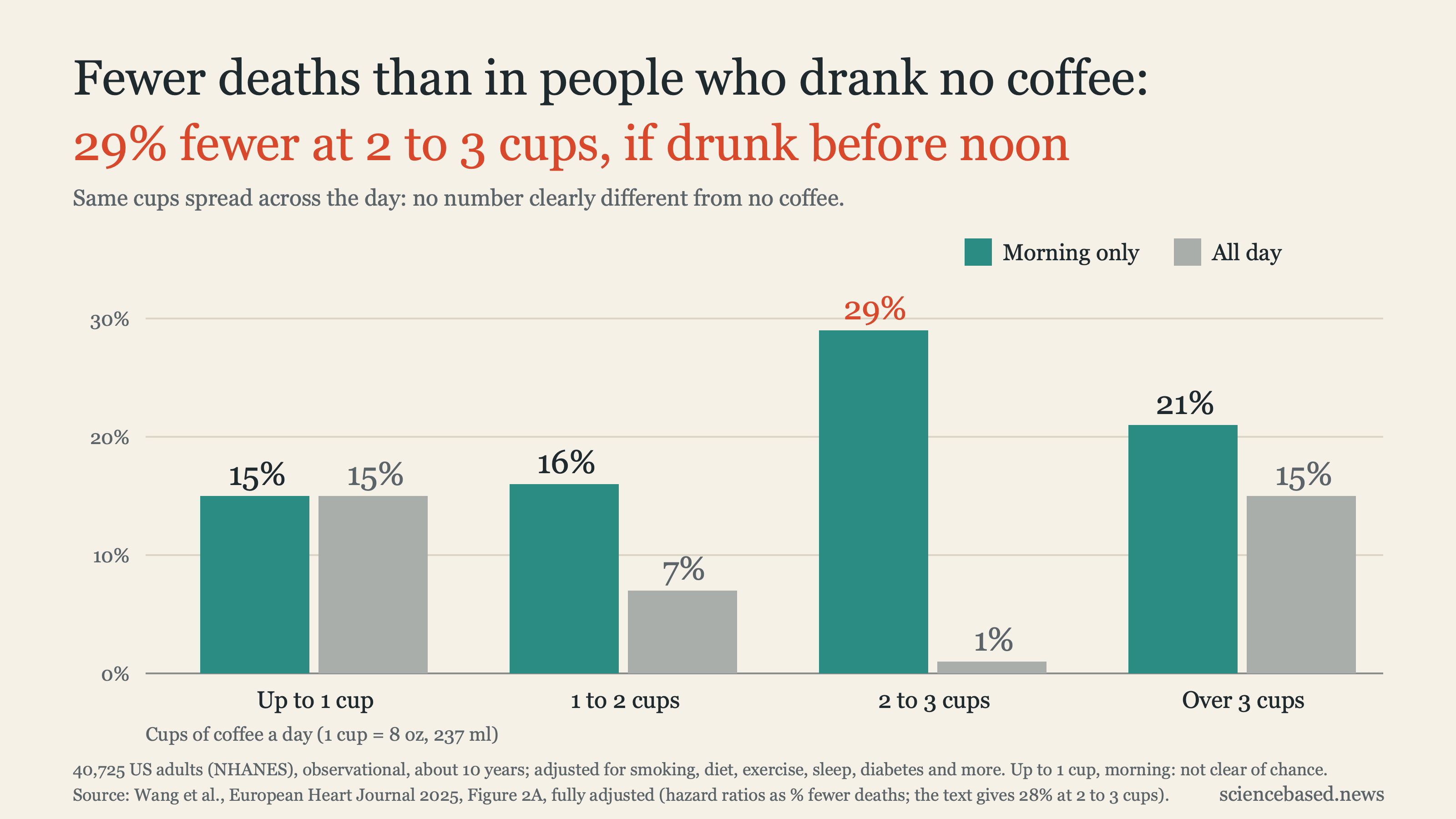
The best result was at 2 to 3 cups in the morning: 29% fewer deaths [2]. Above 3 cups the drop was 21%, still lower than none. For people who drank across the day, none of the numbers was clearly different from non-drinkers.
The link between coffee and a longer life is not new; the clock is. Across 201 meta-analyses, death from any cause was lowest at about 3 cups a day, 17% below non-drinkers [5], and decaf drinkers showed the same 17%. That points beyond caffeine to the rest of the bean, which carries hundreds of plant compounds such as chlorogenic acids.
So why would the hour matter? The authors offer two guesses they did not test [2]. Coffee late in the day may upset the body clock: in a small 2002 trial of six volunteers, caffeinated coffee, against decaf, cut how much melatonin, the sleep hormone, the body made through the following night [11]. And coffee's anti-inflammatory compounds may do most in the morning: in 124 heart patients, CRP, a blood marker of inflammation, ran highest in the morning and lowest at midday [12]. There is a plainer third answer too, and it is the main case against the finding: people who drink coffee only in the morning may simply live more regular lives (see the grade below).
So back to the second cup at 8 a.m. The best evidence we have says it is not hurting your heart's rhythm, and it sits right where the longest-lived coffee drinkers drank.
Our grade
| Claim | Evidence | Grade |
|---|---|---|
| Coffee doesn't harm heart rhythm | 2 randomized trials: 200 AF patients, 6 months, 39% fewer relapses [3]; 100 healthy adults, 2 weeks, no rise in upper-heart early beats [4] | Promising |
| 2 to 3 cups a day go with a longer life | Many observational studies: 40,725 US adults [2], 171,616 UK adults [6], 201 meta-analyses [5]; a genetic study found no link to caffeine itself [7] | Weak |
| Morning coffee beats coffee all day | 1 observational study, 40,725 adults [2] | Weak |
| Overall: coffee isn't bad for you, and 2 to 3 morning cups go with a longer life | Randomized trials on safety; consistent but observational links to longer life | Promising |
The trials are the strongest part, and they are small. The case for the other side:
People who drink coffee in the morning may differ in ways no survey caught. The study did not ask about night shifts or wake times, and the morning drinkers drank less coffee overall (a median of 355 g a day against 483 g for all-day drinkers) [2]. Morning coffee may mark a regular life rather than cause a longer one.
The timing result comes from one study, in one country, from one day's recall of what people drank.
Genes that make people drink more caffeine did not go with a longer life in 112,509 Danes [7]. If caffeine were the cause, those genes should show the link too. The test has limits: the genes added only about 1 cup a day (2.2 against 3.1 cups), and the authors say a test like this cannot see a benefit that peaks at middle amounts. Still, it fits with decaf showing the same benefit: if something in coffee helps, it may not be the caffeine.
Some harms are real. In pregnancy, more coffee went with low birth weight (31% more often) and pregnancy loss [5]. Women who drank the most had 14% more fractures, though men had fewer. In trials, boiled and French press coffee raised LDL cholesterol, while filtered coffee barely changed it [5]. And skipped beats rose above 1 cup a day [4].
What would change the grade: a long randomized trial of coffee against none that counts deaths, or a second large study that tests timing. If the timing finding repeats in another country, the morning row goes up.
What this means for you
If you like coffee, you don't need to quit it for your heart. The randomized evidence says a daily cup is safe for heart rhythm, even in people with AF [3].
How much, and how soon?
Per day: 2 to 3 cups of 240 ml (8 oz), about 95 mg of caffeine each, so about 190 to 290 mg [2, 8]. That is under the 400 mg a day the US FDA calls generally safe for adults [9].
Per week: 14 to 21 cups. The AF trial's coffee group drank about 7 a week, 1 a day [3].
When: before noon, where the 2025 study saw the drop [2]. Huberman's advice to wait 90 to 120 minutes after waking still fits inside that window; no study here tested the wait.
How soon? Steps went up the same day [4]. AF relapses were lower within 6 months [3]. The longer life is a 10-year link [2]: a habit for decades, not a fix for a month.
How you make it matters. Use a paper filter, a drip machine or instant: in trials, filtered coffee barely changed LDL cholesterol, while boiled and French press coffee raised it [5]. Instant has less caffeine, about 62 mg a cup [8].
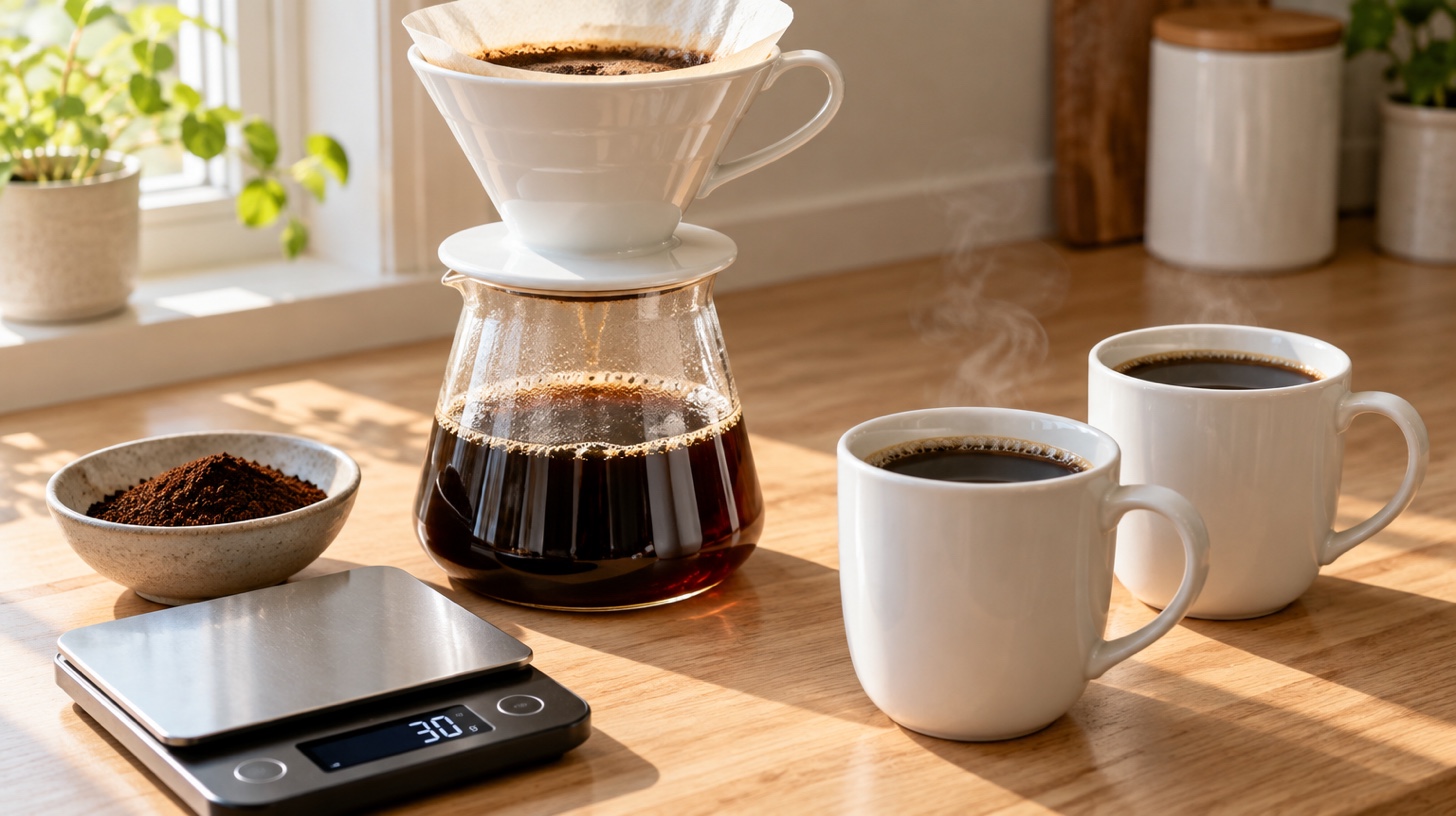
The morning pour-over
Makes 2 cups (480 ml) · 5 minutes · about 190 mg caffeine
Ingredients
- 30 g medium-ground coffee (about 5 level tablespoons), such as fresh beans from Onyx Coffee Lab
- 500 ml water just off the boil, plus a little to rinse the filter
- 1 paper filter and a pour-over cone or drip machine
- Milk if you like it; little or no sugar
Method
- Put the filter in the cone over a carafe and rinse it with hot water. Pour that water away.
- Add the coffee and level it.
- Pour about 60 ml of water over it to wet all the grounds, and wait 30 seconds.
- Pour the rest slowly in circles over 2 to 3 minutes.
- Drink one cup with breakfast and the second by mid-morning.
The 2 to 3 cups before noon come from the 2025 study [2]; the 30 g and 500 ml are cooking amounts, about 1 g of coffee for every 16 ml of water. Want a third cup, or one in the afternoon? Make it decaf: about 1 mg of caffeine [8], and the same longer-life link at 3 cups [5].
If you are pregnant, stay under 200 mg of caffeine a day, about 2 cups [10]. If coffee makes your heart skip or keeps you awake, cut back, or make the last caffeinated cup 8 to 10 hours before bed, as Patrick suggests [1]; on coffee days people slept 36 minutes less [4].
The best news here is that the old warning has turned around. A cup a day helped heart patients stay in rhythm [3], and 2 to 3 cups before noon sat where the longest-lived coffee drinkers were [2]. Pour the second cup and enjoy it.
In the 2025 study of 40,725 US adults, how much less often did people who drank 2 to 3 cups in the morning die than non-drinkers?
Figure 2 of the study shows 29% fewer deaths at 2 to 3 morning cups; all-day drinkers showed no clear drop.
In a trial of 200 people with atrial fibrillation, what happened to those told to drink at least 1 cup of coffee a day?
The DECAF trial found a 39% lower risk of relapse with coffee.
Which kind of coffee raised LDL cholesterol in trials?
A paper filter holds back the oils that raise LDL; filtered and instant coffee barely changed it.
How should you get a third cup in the afternoon?
Decaf has about 1 mg of caffeine and showed the same longer-life link at 3 cups.
What's next
The next answer to look for is a second large study of coffee timing, in another country, that asks about wake times and shift work. If morning drinkers live longer there too, the timing finding gets much stronger. We will update this check when it comes.
On this site: why sleep matters for clearing waste from the brain in the glymphatic sleep check, the five foods that beat a multivitamin, and the perfect food day, three days of meals that meet every nutrient target.
Was this helpful?
Sources
Show all sources (12)
- Creators on coffee. Patrick R. "How To Use Coffee To Live Longer (Full Guide & Research)." FoundMyFitness, YouTube, June 16, 2025. https://www.youtube.com/watch?v=vgrV9rjqQyA · Physionic. "Coffee prevents Death, but only if you Time it Right." YouTube, March 21, 2025. https://www.youtube.com/watch?v=jyygn-7MWBQ · Huberman A. "Using Caffeine to Optimize Mental & Physical Performance." Huberman Lab, December 5, 2022. https://www.youtube.com/watch?v=iw97uvIge7c
- Wang X, Ma H, Sun Q, et al. Coffee drinking timing and mortality in US adults. European Heart Journal, 2025. 40,725 adults, observational (NHANES 1999-2018), median 9.8 years. Funded by the US National Institutes of Health. https://doi.org/10.1093/eurheartj/ehae871
- Wong CX, Cheung CC, Montenegro G, et al. Caffeinated coffee consumption or abstinence to reduce atrial fibrillation: the DECAF randomized clinical trial. JAMA, 2026. 200 adults with persistent atrial fibrillation, randomized, open-label, 6 months. Investigator-initiated. https://doi.org/10.1001/jama.2025.21056
- Marcus GM, Rosenthal DG, Nah G, et al. Acute effects of coffee consumption on health among ambulatory adults. New England Journal of Medicine, 2023. 100 adults, randomized case-crossover, 14 days. Funded by UCSF and the US National Institutes of Health; glucose sensors donated by Dexcom. https://doi.org/10.1056/NEJMoa2204737
- Poole R, Kennedy OJ, Roderick P, et al. Coffee consumption and health: umbrella review of meta-analyses of multiple health outcomes. BMJ, 2017. 201 meta-analyses of observational studies and 17 of randomized trials. https://doi.org/10.1136/bmj.j5024
- Liu D, Li ZH, Shen D, et al. Association of sugar-sweetened, artificially sweetened, and unsweetened coffee consumption with all-cause and cause-specific mortality. Annals of Internal Medicine, 2022. 171,616 UK adults, observational, median 7 years. Graded from the abstract. https://doi.org/10.7326/M21-2977
- Nordestgaard AT, Nordestgaard BG. Coffee intake, cardiovascular disease and all-cause mortality: observational and Mendelian randomization analyses in 95 000-223 000 individuals. International Journal of Epidemiology, 2016. 95,366 Danes observational (median 6 years) and 112,509 Danes genetic (Mendelian randomization), up to 223,414 with international data for heart disease; hospital and Danish Heart Foundation funding. https://doi.org/10.1093/ije/dyw325
- Mayo Clinic. Caffeine content for coffee, tea, soda and more. Brewed coffee, 8 oz (237 ml): 96 mg; instant: 62 mg; brewed decaf: 1 mg. https://www.mayoclinic.org/healthy-lifestyle/nutrition-and-healthy-eating/in-depth/caffeine/art-20049372
- US Food and Drug Administration. Spilling the beans: how much caffeine is too much? 2024. https://www.fda.gov/consumers/consumer-updates/spilling-beans-how-much-caffeine-too-much
- American College of Obstetricians and Gynecologists. Moderate caffeine consumption during pregnancy. Committee Opinion 462, reaffirmed 2026. https://www.acog.org/clinical/clinical-guidance/committee-opinion/articles/2010/08/moderate-caffeine-consumption-during-pregnancy
- Shilo L, Sabbah H, Hadari R, et al. The effects of coffee consumption on sleep and melatonin secretion. Sleep Medicine, 2002. 6 volunteers, randomized double-blind crossover, regular against decaf coffee, one day each. Graded from the abstract. https://doi.org/10.1016/S1389-9457(02)00015-1
- Koc M, Karaarslan O, Abali G, Batur MK. Variation in high-sensitivity C-reactive protein levels over 24 hours in patients with stable coronary artery disease. Texas Heart Institute Journal, 2010. 124 patients, observational, CRP measured four times in 24 hours. Graded from the abstract. https://pubmed.ncbi.nlm.nih.gov/20200626/
Discussion