

COVID and flu wake sleeping cancer cells in mice. And in people?
Evidence check, October 28, 2026
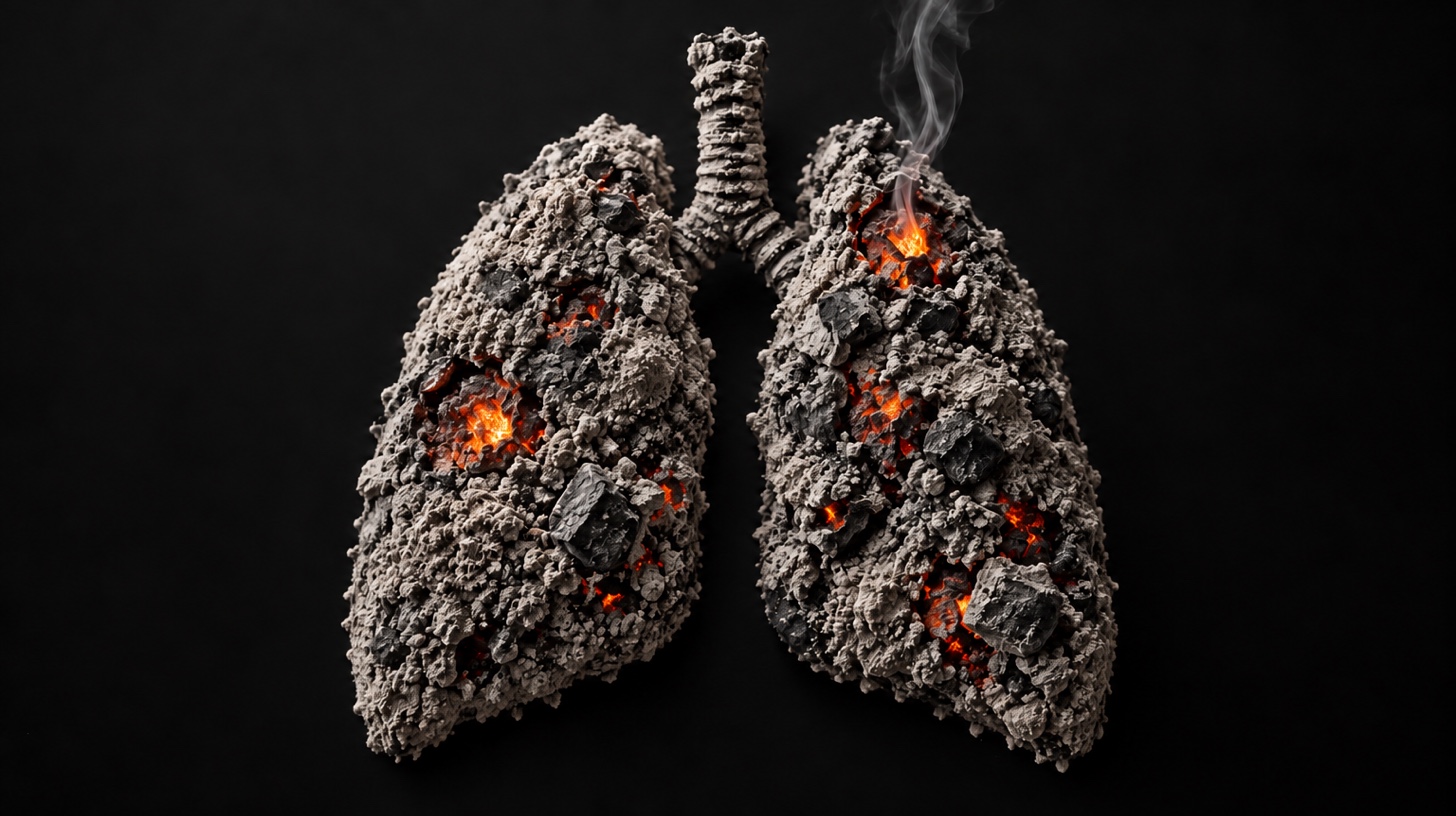
The claim: "COVID can wake up sleeping cancer cells in people who have had cancer."
Our grade: Weak. In mice, flu and COVID woke dormant breast cancer cells in the lungs, through a signal called IL-6. In people there are only observational records for COVID, muddied by who got tested, and none on survivors for flu. The vaccine is not the problem: national records from Korea and the US show no rise in cancer after the rollout.
You're scrolling at night and two headlines about COVID and cancer sit one above the other. One says the virus can "wake up" cancer cells that treatment left behind. The other says the shot causes cancer.
Which one holds up: the infection, or the shot meant to prevent it?
Here is the result behind the first headline. In a 2025 study in Nature, mice with a few sleeping breast cancer cells in their lungs caught a mild flu, and two weeks later those cells had grown from about 4 to about 10,000 [1]. COVID did the same. The trigger was IL-6, a signal the body makes in any strong infection, so there is nothing special about COVID here; a bad flu should not surprise anyone either.
What about people? For COVID, two sets of records hint at it but cannot show the virus caused it. For flu, we found no study that followed survivors to see whether their cancer came back.
Where the claim came from
"COVID causes cancer" has two versions online. One says the virus wakes up cancer that was already there. The other, often called "turbo cancer", says the vaccine starts new, fast-growing cancers. They rest on different studies, so we check them apart, and then put them together.
The first comes from the Nature study [1]. Its senior author, James DeGregori of the University of Colorado, put it this way in the press release: "Dormant cancer cells are like the embers left in an abandoned campfire, and respiratory viruses are like a strong wind that reignites the flames" [2]. On January 22, 2026, he explained the work on the Cracking Cancer podcast [3]. He was careful there: "we don't know if that same risk is going to occur the second or third or fourth time someone gets infected," and "being effectively vaccinated is in all likelihood your best defense" [3].
The vaccine version got its boost in September 2025. A short letter in Biomarker Research compared about 3 million vaccinated and unvaccinated adults in Seoul and reported higher rates of six cancers in the year after a shot [4]. It was soon "being touted as evidence" that the shots cause cancer, as MedPage Today put it [5]. In October 2025 the journal added a notice that concerns had been raised about the paper [4].
We searched the podcast and YouTube feeds we follow, from Huberman Lab to Peter Attia and FoundMyFitness, and found no episode on either version. So the words checked here are the researchers' own.
What the mice showed
The star is the Nature study, by Shi Chia, Bryan Johnson and colleagues in the labs of DeGregori, Julio Aguirre-Ghiso and Mercedes Rincón [1]. It goes after a puzzle doctors have known for decades: breast cancer can come back 10 or 20 years after treatment.
The reason is that a few cancer cells often leave the breast early and settle in other organs, such as the lungs. There they sit still, sometimes for years. Doctors call them dormant cells. What wakes them up has been a mystery.
The team used mice bred to grow breast cancer that sends a few such sleeping cells to the lungs. They gave the mice a mild dose of flu. The mice got sick and recovered by day 12. The cancer cells in their lungs did not go back to sleep.
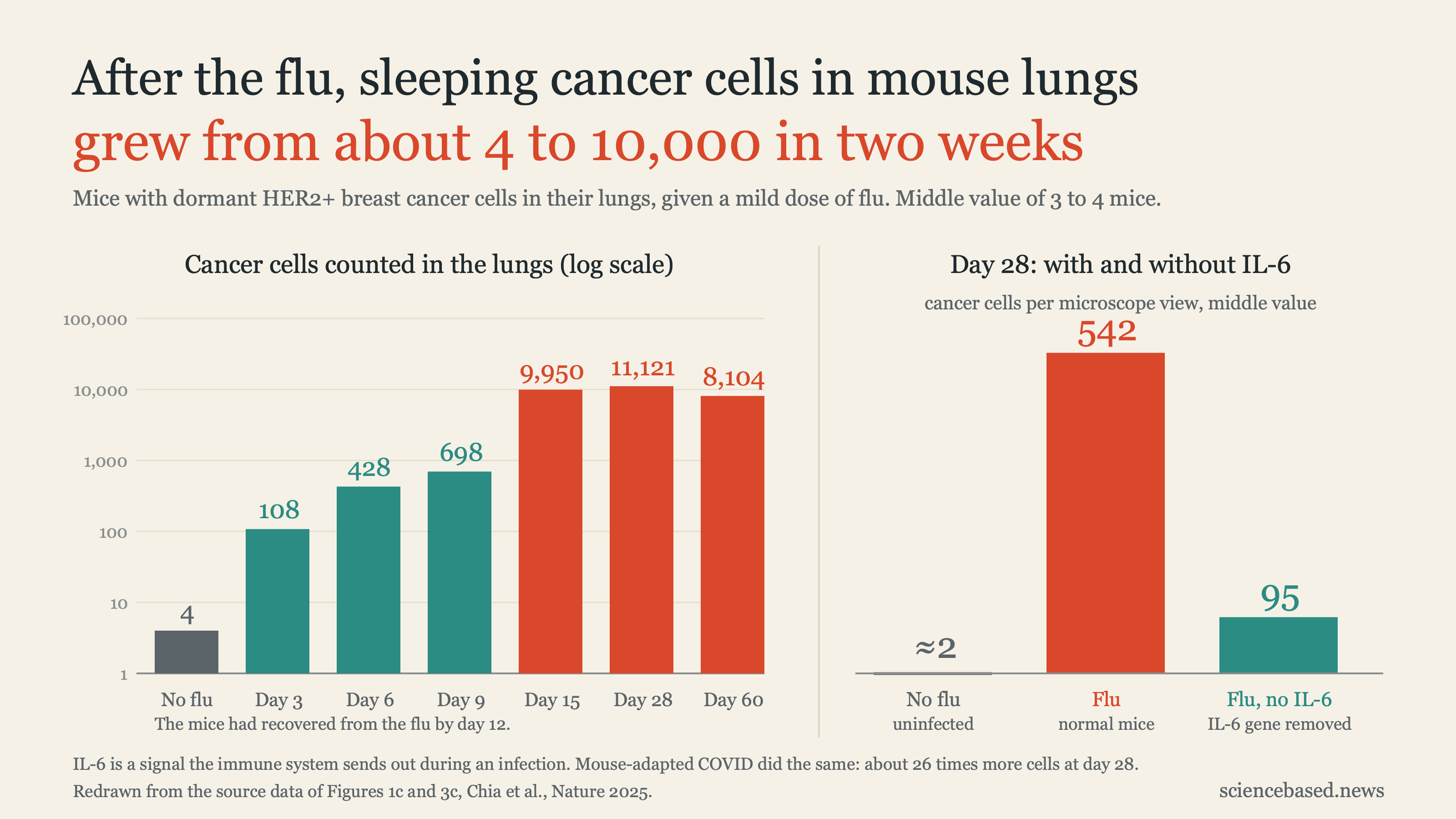
Within 3 days the count of cancer cells in the lungs had gone from about 4 to about 108. By day 15 it was about 10,000, and it was still that high 2 months later [1]. In the breast, the team saw no rise in dividing cells [1]. The cells that grew were the ones already sleeping in the lungs.
So the flu was gone, and the cancer kept growing. What was still telling it to grow?
The team's answer was IL-6, a signal immune cells send out during an infection. In mice bred without the gene for it, the flu woke far fewer cells: at day 28 the middle count was 95 cells per microscope view, against 542 in normal mice, about 80% fewer [1]. That is most of the answer, and it is the hopeful part, because drugs that block IL-6 already exist for other uses. It is not the whole answer: even without IL-6, the count stayed above that of mice that never had flu.
The mice were MMTV-Her2 mice, which carry a human-like HER2 breast cancer gene. They still had their early breast lesions during the experiment. Groups were small, 3 to 4 mice per time point. The flu strain was a lab strain (PR8) at a dose too low to kill. The count of cancer cells rose 100- to 1,000-fold between day 3 and day 15, and was still raised at 9 months [1].
The team repeated it with a mouse-adapted strain of the COVID virus (MA10). At day 28, the middle count was about 67 cancer cells per microscope view in infected mice against about 2.6 in uninfected ones, roughly 26 times more (6 and 7 mice) [1]. With COVID, the IL-6 test was done only at day 9, and the drop was smaller: about 13 cells per view without IL-6 against about 21 with it, roughly 37% fewer [1].
The IL-6 result showed early with flu. At day 9, about 66% to 80% of the cancer cells in normal mice were dividing, against 2% to 14% in mice without IL-6 [1]. Without IL-6, the mice still had their sleeping cells and still grew breast tumors at the usual age; the gene mattered for the wake-up. Another kind of immune cell, CD4 T cells, then kept the woken cells from being cleared.
Money came from the US Department of Veterans Affairs, the National Institutes of Health and university funds. Aguirre-Ghiso co-founded HiberCell, a company working on dormant cancer cells, and holds shares and a patent; DeGregori and Rincón advise another company, Mitotherapeutix [1].
So in mice the answer is yes, with two different viruses. The question for you is whether the same thing happens in people.
What the human studies found
So does it happen in people? For COVID, maybe: the same paper checked two sets of records, and both point the same way [1]. For flu, there is no answer yet: both sets of records looked at COVID only, and we found no study that followed survivors after a flu. Neither can show cause, and the paper's abstract, which says infection "substantially increases the risk", goes further than its own numbers.
In the UK Biobank, a large health study, the team matched 487 cancer survivors who tested positive for COVID with 4,350 who tested negative, all before vaccines were offered, by December 2020. Those who tested positive had 1.85 times the odds of dying of cancer by the end of 2022 (128 cancer deaths in all) [1]. The odds were highest early: counted only to December 2020, they were 8.2 times as high.
In US cancer clinic records (Flatiron Health), 36,845 women with breast cancer were followed to August 2023. Those who had COVID were 44% more likely to be diagnosed with cancer that had spread to the lungs [1]. When the team also took other illnesses and the type of breast cancer into account, in 24,235 women, it was 41%, and no longer clearly different from no effect. Only 673 person-years of follow-up came after a positive test, which is thin.
Both numbers fit the mouse story. The trouble is a third number from the same UK data.
What is not known
The human studies are observational. They compare people who caught COVID with people who didn't, and in 2020 those groups differed in ways records miss.
Here is the third number. Survivors who tested positive had 2.56 times the odds of dying of anything other than COVID [1]. That count includes the cancer deaths, and it rose more than they did. In 2020, the people being tested were often sicker or frailer to begin with, and frail people die more of everything. A virus that wakes cancer should raise cancer deaths more than other deaths. Over the full follow-up it didn't, so much of the cancer link may be frailty. The best point for the mouse story is the early window to December 2020: there cancer deaths did rise more than other deaths, 8.2 against about 3.5 times the odds [1].
The groups were also small for a question this size. In survivors diagnosed 10 or more years before the pandemic, the group the "embers" idea is about, the odds (1.80 times) were not clearly different from chance [1]. The paper could not split the UK data by cancer type, and neither data set was split by vaccination.
So nobody has yet checked whether a vaccinated survivor who catches a mild case faces any extra risk. The mice got one strain of flu or COVID and had one kind of breast cancer.
The way to settle it is larger records studies, with vaccination data, that follow survivors after an infection and compare them with survivors who had a different illness of the same severity.
That leaves the second fear. If the infection is the risk in mice, could the shot be one too?
The vaccine and "turbo cancer"
Every study that linked the shot to cancer shares three features. The extra cancers pile up in the first months after a shot, they track who sees a doctor, and they shrink as the study design gets stronger. Here is each one in turn.
Start with the Seoul letter [4]. From 8.4 million health records, it matched 2,380,028 vaccinated adults with 595,007 unvaccinated ones, average age 44, and counted cancer billing codes for one year. The vaccinated had 27% more cancer codes. In plain numbers, that was about 43 cases per 10,000 people in a year against 33, so about 9 extra per 10,000 [4]. More than half of that gap opened in the first 3 months: the ratio was 1.96 in months 0 to 3, and 1.14 after.
A cancer the shot had started would not be found that fast; most solid cancers take years to decades to grow [6, 7]. A cancer that was already there and got found at a doctor's visit would. All six cancers in the letter are ones Koreans are often screened for, through national programs or private checkups, and people who get vaccinated also tend to see doctors more [5, 7]. The two groups were not even set up the same way: the unvaccinated were all counted from January 1, 2022, and people with a recent cancer were removed only from the vaccinated group [4]. A 2026 commentary also counted 30 comparisons with no correction for chance findings [7]. Comparing people with and without a booster, which takes out some of the difference in who goes to doctors, gave the same overall cancer rate: 1.01 times [4].
Then, on October 22, 2026, a Korean team tested the claim on most of the country [6]. They tracked monthly cancer rates from 2011 to 2025 in 36,024,394 people born between 1955 and 2004 with no earlier cancer, about 70% of Koreans. By August 2021, more than half had a first dose, and 89.3% got at least one. If the shots raised cancer the way the Seoul letter suggested, rates should have jumped after the rollout.
They didn't. None of 13 cancer types, and none of the six named in the Seoul letter, rose or sped up [6]. In 848 of 850 cancer-months, the rate stayed inside the range the trend before the vaccines predicted, and the two exceptions are fewer than chance alone would give. The observed changes in the six cancers ran from 0.7% to 5.5% below the trend.
This is where the two studies can be held side by side. If 89% of people got a shot, and a shot raised thyroid cancer by 35% as the Seoul letter reported, thyroid cancer across the country should have risen by about 31%. The national data rule out anything above 16%, and saw a 4% dip [4, 6].
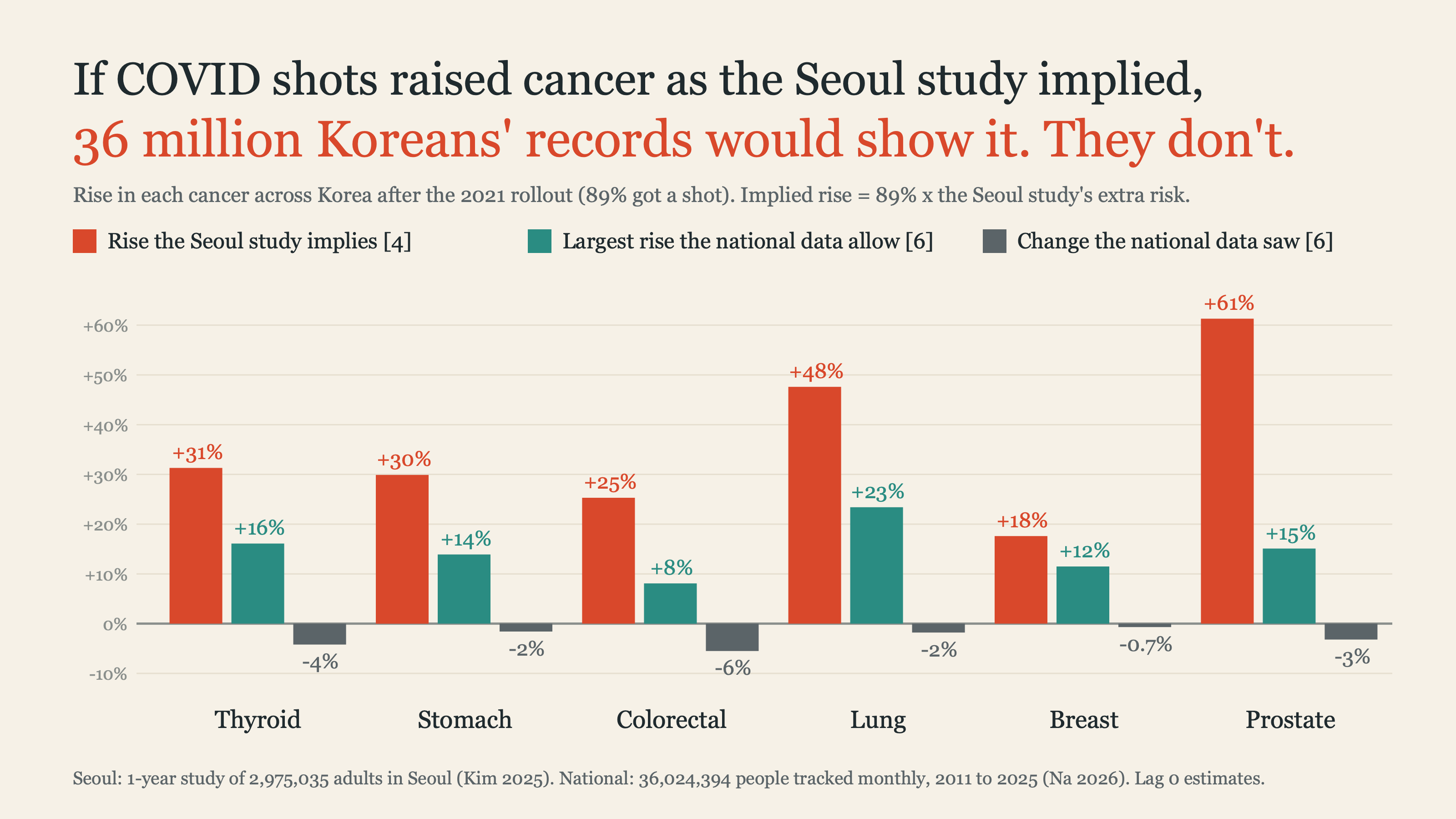
So does a shot raise the risk for a few months, or for good? A short-window effect would show as a jump right after the rollout; a lasting one as a slow climb over the 50 months after it. Neither showed: the monthly trend changes ran from 0.995 to 1.005, none clearly different from chance [6]. Moving the start of the "after" period anywhere from 0 to 18 months later gave a significant result in 2.0% of tries, fewer than the 4.1% at fake start dates before the pandemic, which is chance alone. Allowing for a delay of up to 9 months loosens the limits, to as much as 43% for some cancers, so the data can't rule out a small, slow effect [6]. One rise did appear: cancers of the female genital organs, 17% above trend with a 9-month delay, which the authors tie to care catching up after the pandemic.
The same pattern turned up in Italy. In 296,015 people in the province of Pescara, those with at least one dose were 23% more likely to be admitted to hospital with a cancer code over 30 months [10]. When the authors counted only cancers found a year or more after the shot, that fell to 13% and was no longer clear of chance; in people with 3 or more doses it turned into 10% fewer [10]. Breast and bladder cancer kept a link in the whole vaccinated group, but not in people with 3 or more doses. More doses did not mean more cancer. The link showed only in people never recorded as infected. And the vaccinated were 58% less likely to die of any cause, which the authors put down to healthier people choosing to get vaccinated. They call their findings "inevitably preliminary" [10].
The United States shows no rise either. In cancer registries covering about half the country, 2021 cancer rates matched what the pre-pandemic trend predicted: 458.3 new cases per 100,000 against 459.1 expected [19]. The one exception, breast cancer found after it had spread, was 9% above expected, which the authors tie to screening paused in 2020. The national figures for 2022 and 2023, 435.5 and 437.8 per 100,000, sit at or just under the modeled trend, though that line is fitted with those years included [20].
So a shot from 2021 shows no sign of raising your cancer risk now. The limit is time: the national data reach about 4 years after the rollout, and some cancers take longer than that to grow [6]. But the "turbo" version, a fast rise right after the shots, should have shown up in a country this large and this vaccinated.
The first fear doesn't show in big records either. In 499,396 US veterans, those who had COVID in 2020 were 25% less likely to be diagnosed with a new cancer over 3 years [8]. The authors lean toward a biological reason. The groups differed, though: people who tested negative smoked almost twice as often (23.1% against 12.3%). Whatever the reason, it gives no sign that the virus starts new cancers.
And mRNA COVID shots may help some people with cancer. At MD Anderson, 180 patients with advanced lung cancer who got one within 100 days before or after starting immunotherapy, a treatment that frees the immune system to attack tumors, lived a median 37.3 months, against 20.6 months in 704 who got no shot [9]. After adjusting for other differences, their risk of death was about half (0.51). Flu and pneumonia shots showed no such benefit. That is records from one hospital, not a trial, and several authors hold patents on this kind of RNA; a large trial is being planned [9].
Questions people ask about the vaccine and cancer
If you just saw a post saying the shots cause cancer, these are the questions it leaves. Here is what the studies say about each.
Does the COVID vaccine cause cancer?
No study has shown that it does. The largest test, 36 million people in Korea with 89% vaccinated, found no rise in any of 13 cancer types in the 4 years after the rollout [6]. US registries saw no rise in 2021 to 2023 [19, 20]. The studies that found links counted for one or two years, and their extra cases bunched in the first months, when vaccinated people were also seeing doctors more [4, 7, 10].
What is "turbo cancer"?
It is an internet term for cancers said to appear or grow unusually fast after a shot. It isn't a medical diagnosis. The evidence behind it is mostly single-patient reports. A 2026 review gathered 69 publications, 50 of them case reports and 5 case series, describing 333 patients in all [11]. Its authors call this "an early phase of potential safety-signal detection", not proof [11]. One of them, Wafik El-Deiry, is co-editor-in-chief of the journal, and both sat on a 2025 US vaccine advisory work group on COVID shots, which the paper doesn't disclose. The review also gets the Nature study's mechanism wrong; it was IL-6 [1, 11]. A case report can show that two things happened to one person; it can't show that one caused the other. A real fast rise would have shown up in the national numbers, and it didn't [6].
Can the mRNA change my DNA?
There is no evidence it does in people. A 2022 Swedish study put the Pfizer vaccine on liver cancer cells in a dish and found a DNA copy of part of it inside the cells within 6 hours [12]. It did not show how the copy was made, did not show it joining the cells' own genes, and was not done in a person.
What about the SV40 DNA found in vaccine vials?
The Pfizer vaccine is made from a loop of DNA, in Pfizer's words, that includes a short stretch of code borrowed from a monkey virus called SV40 [14]. The virus itself is not in the vaccine. Tiny DNA fragments are left over after manufacturing; the European Medicines Agency says the amounts are within safety limits [14]. The FDA called it "quite implausible" that such fragments could reach the nucleus and be built into your DNA [13].
How long does the vaccine stay in your body?
Days to weeks. Spike protein in the blood was mostly gone about a week after each dose [15]. In 7 women whose lymph nodes near the shot were sampled after mammogram findings, vaccine mRNA was easy to find 16 to 37 days after a shot and faint at day 60, the last day checked [15]. That is where the immune system learns from it. The national cancer data cover the 4 years after that.
Why are more young people getting cancer? Is it the shots?
The rise started long before the shots. Worldwide, the number of new cancers in people under 50 rose by 79% between 1990 and 2019 [16]. That is a count of cases, and part of it comes from there being more people; the data end in 2019. The authors name diets high in red meat and salt, alcohol and tobacco as the main risk factors, with too little exercise and extra weight adding to them [16]. A trend that began 30 years before the vaccines can't be blamed on them.
Is one brand worse: Pfizer, Moderna or AstraZeneca?
No brand has been shown to raise cancer. In the Seoul letter, the AstraZeneca group had 47% more cancer codes and the mRNA group (Pfizer, Moderna) 20% more [4]. The AstraZeneca group was likely older, since Korea gave that shot mainly to older adults, and older people get more cancer. So the brands were not compared on equal groups. The national study could not split by brand, but with 89% vaccinated, a rise of that size in any large group would have pushed up the totals, and none moved [6].
Do boosters raise the risk?
The Seoul letter compared people with and without a booster. Overall cancer was the same: 1.01 times [4]. Of 29 cancer types, two came out higher (stomach and pancreas), and one, leukemia, came out lower [4]. With that many comparisons, a few will cross the line by chance, which is the problem the 2026 commentary raised [7].
Can the shot wake sleeping cancer cells, like the virus did in mice?
That hasn't been tested. The mouse study used real infections, not shots [1]. In the Korean national data, breast cancer, the cancer the mice had, showed no rise after the rollout [6].
I have or had cancer. Should I get the shot?
Cancer doctors say yes. The US National Cancer Institute says people with cancer are at high risk of severe COVID, and that there is no evidence the vaccines cause cancer, bring it back or make it grow faster [17]. Memorial Sloan Kettering, a major US cancer hospital, advises a shot every 6 months during treatment [18]. Ask your cancer team about timing: the NCI advises waiting at least 3 months after a stem cell transplant or CAR T-cell therapy, and up to 2 weeks after surgery [17].
Our grade
Two claims, two different answers. What would move each one?
| Claim | Evidence | Grade |
|---|---|---|
| In mice: flu and COVID wake sleeping breast cancer cells in the lungs | 1 study, groups of 3 to 7 mice; about 4 to 10,000 cells after flu, 26 times more after COVID; about 80% fewer without IL-6 after flu [1] | Promising |
| In people: COVID raises the risk that past cancer comes back or kills | 2 observational analyses; UK 1.85 times the odds of cancer death, but 2.56 for other deaths; US 41% more lung spread, not clear of chance after full adjustment [1] | Weak |
| The COVID vaccine causes new cancers ("turbo cancer") | A 1-year letter with early-bunched cases and a journal notice [4]; 36 million Koreans showed no rise in 13 cancer types [6]; US rates on trend [19, 20] | Debunked |
| Overall: COVID can wake sleeping cancer in people who have had cancer | Strong in mice; in people, observational and confounded by who got tested [1] | Weak |
The case for the other side: the mouse result is big and clean. It shows a cause, a timeline and a trigger, and was done with two different viruses [1].
The human data agree with the mice on timing. In the UK the odds were highest in the first months after infection, when the mice showed the fastest growth [1].
Two very different data sources, a UK health study and US cancer clinics, pointed the same way [1].
What would change the grade: a large study of survivors, with vaccine data, that compares those who caught COVID with those who had another illness of the same severity. A clear rise in cancer deaths, without the same rise in other deaths, would move it to Promising. For the vaccine claim, a rise that grows with more doses and holds years after the shot would be the sign to look for; so far every study that looked found the reverse.
What this means for you
If you have had cancer, the most useful step is the simplest. Get the yearly flu shot and the current COVID shot, and talk with your care team about any worries [2]. In the mice it was the infection that woke the cells, and the study's authors suggest survivors take precautions such as vaccination [2]. Whether the shot prevents the wake-up has not been measured; it does lower the odds of a hard infection.
You don't need proof in people to act on this. When a step is safe and cheap, a good reason to suspect is enough, and shots, hand washing in flu season and keeping away from sick people when you can are all steps you would want anyway. Proof matters for steps with risks of their own, such as an IL-6-blocking drug, which weakens the immune system.
If you do get flu symptoms, call your doctor early. Flu antivirals work best when started within 1 to 2 days of the first symptoms, and the CDC says people with cancer or a history of cancer can be at higher risk of flu complications [21, 22]. Then keep your scheduled follow-up visits. In the UK data the extra odds were greatest in the months right after a positive test [1]. Tell your doctor about a cough or shortness of breath that lasts after the infection is gone.
Don't skip a vaccine because of "turbo cancer". In 36 million Koreans, 89% vaccinated, no cancer type rose, neither right after the shots nor over the 4 years since [6]. If you are about to start immunotherapy, ask your oncologist about the timing of a COVID shot; in one hospital's records it went with longer survival [9].
So back to the two headlines: the one worth acting on is the infection, and the shot is part of the answer. You can't make sleeping cells vanish, but you can lower the odds of a hard infection that stirs them. If cancer screening is on your mind too, our check on the Galleri blood test covers what a test can find early. The finding that the wake-up runs mostly through one signal, IL-6, is the hopeful part: it gives researchers a clear target, and drugs that hit it are already on pharmacy shelves for other uses.
In the mouse study, what happened to sleeping breast cancer cells in the lungs after a mild flu?
The count rose within 3 days, reached about 10,000 by day 15, and stayed high after the mice had recovered.
Which signal was mostly behind the wake-up?
Mice without the IL-6 gene had far fewer woken cells: 95 per view against 542 at day 28.
Why is the human evidence that COVID wakes cancer only Weak?
UK survivors who tested positive had 1.85 times the odds of cancer death, but 2.56 times the odds of death from any cause other than COVID.
Did cancer rates rise in South Korea after 89% of people got a COVID shot?
The national study ruled out rises larger than about 8% to 23%, depending on the cancer, and the six cancers came in slightly below trend.
What is the most useful step for a cancer survivor?
The infection is what woke the cells in mice; vaccines lower the odds of a hard infection, and no IL-6 drug has been tested for this.
What's next
The next big answer will come from survivors with vaccine records. The authors say IL-6 blockers, already approved for severe COVID, now need testing in animals and then in people as a way to stop the wake-up [1, 2]. A large trial of mRNA shots given with immunotherapy is being designed, which would test the MD Anderson result properly [9].
We will update this check when a study follows vaccinated survivors after an infection. For screening, see our Galleri check.
Was this helpful?
Sources
Show all sources (22)
- Chia SB, Johnson BJ, Hu J, et al., Aguirre-Ghiso JA, Rincon M, DeGregori J. Respiratory viral infections awaken metastatic breast cancer cells in lungs. Nature, 2025;645:496-506. Mice (groups of 3 to 7, flu and mouse-adapted SARS-CoV-2), plus 2 observational human analyses: UK Biobank, 4,837 cancer survivors; Flatiron Health, 36,845 women with breast cancer. Funded by the US Department of Veterans Affairs, NIH and others; one author co-founded HiberCell. https://doi.org/10.1038/s41586-025-09332-0
- University of Colorado Anschutz. Respiratory viruses can wake up breast cancer cells in lungs. Press release, July 30, 2025. https://news.cuanschutz.edu/news-stories/respiratory-viruses-can-wake-up-breast-cancer-cells-in-lungs
- The Cracking Cancer Podcast. Do Respiratory Viruses Awaken Cancer with Dr. James DeGregori. Episode 40, January 22, 2026. https://www.iheart.com/podcast/1323-the-cracking-cancer-podca-267124331/episode/do-respiratory-viruses-awaken-cancer-with-318710596/
- Kim HJ, Kim MH, Choi MG, Chun EM. 1-year risks of cancers associated with COVID-19 vaccination: a large population-based cohort study in South Korea. Biomarker Research, 2025;13:114. Correspondence; 2,975,035 matched adults in Seoul drawn from 8,407,849 records, observational, 1 year. Notice of concerns added October 2025. https://doi.org/10.1186/s40364-025-00831-w
- Fiore K. COVID vaccines and cancer risk: experts dissect flawed study. MedPage Today, October 1, 2025. https://www.medpagetoday.com/infectiousdisease/covid19vaccine/117731
- Na Y, Radnaabaatar M, Jung J. Impact of SARS-CoV-2 vaccination on cancer trends: a nationwide interrupted time series study. Biomarker Research, 2026;14:147. 36,024,394 people, national records, monthly from 2011 to 2025. Funded by Korea University and the National Research Foundation of Korea. https://doi.org/10.1186/s40364-026-01027-6
- Locquet M, Beaudart C, Douxfils J, Roberfroid D, Van Damme P, Dogné JM. Commentary: 1-year risks of cancers associated with COVID-19 vaccination. Frontiers in Public Health, 2026;14:1772406. https://doi.org/10.3389/fpubh.2026.1772406
- Bradley J, Tang F, Resendes NM, Tosi DM, et al. Lower cancer incidence three years after COVID-19 infection in a large veteran population. PLOS One, 2025. 499,396 US veterans, observational, 3 years. https://doi.org/10.1371/journal.pone.0318131
- Grippin AJ, et al. SARS-CoV-2 mRNA vaccines sensitize tumours to immune checkpoint blockade. Nature, 2025. 884 patients with advanced lung cancer and 210 with melanoma, observational records at one hospital, plus mouse studies. Funded by the US National Cancer Institute and others; several authors hold RNA patents licensed to iOncologi. https://doi.org/10.1038/s41586-025-09655-y
- Acuti Martellucci C, et al. COVID-19 vaccination, all-cause mortality, and hospitalization for cancer: 30-month cohort study in an Italian province. EXCLI Journal, 2025;24:690-707. 296,015 residents, observational, 30 months. https://doi.org/10.17179/excli2025-8400
- Kuperwasser C, El-Deiry WS. COVID vaccination and post-infection cancer signals: evaluating patterns and potential biological mechanisms. Oncotarget, 2026;17:1-29. Review of 69 publications (50 case reports, 5 case series, 8 cohort studies, 3 reviews, 3 lab studies), 333 patients. https://doi.org/10.18632/oncotarget.28824
- Aldén M, Olofsson Falla F, et al. Intracellular reverse transcription of Pfizer BioNTech COVID-19 mRNA vaccine BNT162b2 in vitro in human liver cell line. Current Issues in Molecular Biology, 2022;44(3):1115-1126. Lab study in a liver cancer cell line, no people. https://doi.org/10.3390/cimb44030073
- US Food and Drug Administration. Response to Florida Surgeon General concerns on mRNA COVID-19 vaccines. Letter, December 14, 2023. https://www.fda.gov/media/174875/download
- Associated Press. No evidence that DNA sequence used in Pfizer shot leads to cancer and other health issues. Fact check, November 20, 2023. https://apnews.com/article/fact-check-covid-vaccine-pfizer-SV40-DNA-853343189368
- Röltgen K, et al. Immune imprinting, breadth of variant recognition, and germinal center response in human SARS-CoV-2 infection and vaccination. Cell, 2022;185(6):1025-1040. Lymph node biopsies from 7 vaccinated women and blood from vaccinated people. https://doi.org/10.1016/j.cell.2022.01.018
- Zhao J, et al. Global trends in incidence, death, burden and risk factors of early-onset cancer from 1990 to 2019. BMJ Oncology, 2023;2:e000049. Global Burden of Disease data, ages 14 to 49. https://doi.org/10.1136/bmjonc-2023-000049
- National Cancer Institute. COVID-19 vaccines and people with cancer. Updated October 10, 2023. https://www.cancer.gov/about-cancer/coronavirus/covid-19-vaccines-people-with-cancer
- Memorial Sloan Kettering Cancer Center. 2026-2027 COVID-19 vaccine for people with cancer and others with weakened immune systems. Page dated October 1, 2026. https://www.mskcc.org/coronavirus/for-people-with-cancer
- Howlader N, Chen H-S, Noone A-M, Miller D, Byrne J, Negoita S, Cronin KA, Mariotto AB. Impact of COVID-19 on 2021 cancer incidence rates and potential rebound from 2020 decline. Journal of the National Cancer Institute, 2025;117(3):507-510. SEER-22 cancer registries, about 48% of the US population. Funded by the National Cancer Institute. https://doi.org/10.1093/jnci/djae180
- National Cancer Institute, SEER Program. Cancer Stat Facts: Cancer of Any Site. New cases per 100,000, SEER 12 registries, observed and modeled trend, 2015 to 2023. https://seer.cancer.gov/statfacts/html/all.html
- Centers for Disease Control and Prevention. Flu and Cancer. Page dated September 26, 2024. https://www.cdc.gov/flu/highrisk/flu-cancer.html
- Centers for Disease Control and Prevention. Treating Flu with Antiviral Drugs. Page dated June 26, 2026. https://www.cdc.gov/flu/treatment/antiviral-drugs.html
Discussion