

Magnesium Glycinate Does Help You Sleep, a Little
Evidence check, November 3, 2026. Updated November 3, 2026.
The claim: Magnesium glycinate before bed eases poor sleep.
Our grade: Promising. In the largest trial, 155 adults who slept poorly took magnesium glycinate or a dummy capsule for 4 weeks, and 250 mg of magnesium a night eased their insomnia scores more than the dummy did. Caveat: the gain was 1.6 points on a 28-point scale, in one trial, and a 2026 review of 12 trials rated all the sleep evidence low or very low certainty.
TikTok creators call magnesium a "magic pill" for anxiety and sleepless nights, Business Insider reported in 2023 [16]. One video, viewed more than 16 million times, came from Melissa Gray in Florida, who said she had long struggled to find help for her anxiety and trouble sleeping until she started taking magnesium glycinate [16].
Here is what the largest trial found. In Germany, 155 adults who slept poorly took magnesium glycinate or a dummy capsule every night for 4 weeks [1]. Insomnia scores fell 3.9 points on magnesium and 2.3 on the dummy capsule, so magnesium won by 1.6 points on a 28-point score. That is no magic pill, but it is a real nudge. These are the studies behind that answer:
| Study | Type | People | Result |
|---|---|---|---|
| Schuster 2025 [1] | Randomized human trial | 155 adults 18 to 65 who slept poorly, 4 weeks, 250 mg as glycinate | Insomnia score 1.6 points better than placebo; sleep quality, fatigue and mood no clear difference |
| Lopresti 2026 [2] | Review of trials | 12 randomized trials, 75 to 729 mg a day | Mixed results; certainty low or very low for all sleep outcomes |
| Mah 2021 [7] | Pooled review of trials | 3 randomized trials, 151 older adults | Asleep 17 minutes faster; total sleep no clear change; low to very low quality |
| Abbasi 2012 [8] | Randomized human trial | 46 adults 60 to 75 with insomnia and low intake, 8 weeks, 500 mg as oxide | Insomnia score and share of time in bed asleep better; total sleep no change |
| Nielsen 2010 [9] | Randomized human trial | 100 adults 51 to 85, 7 weeks, 320 mg as citrate | Sleep score improved the same on magnesium and placebo |
| Hausenblas 2024 [10] | Randomized human trial | 80 adults 35 to 55, 21 days, 1 g of threonate | Insomnia score no different; ring-based deep sleep score better |
| Lopresti 2026 [11] | Randomized human trial | 100 adults 18 to 45, 6 weeks, 145 mg as threonate | Sleep-related impairment better; 2 other sleep measures and ring-measured sleep no different |
| Zhang 2022 [12] | Observational | 3,964 US adults | Highest magnesium intake: 36% lower odds of sleeping under 7 hours |
A nudge is worth having, because sleep does real work: brain scans show fluid pulsing through the brain during deep sleep. So what is the magnesium adding, and who gets the most from it?
Where the claim came from
Magnesium became a sleep staple through the big health podcasts.
On August 8, 2022, Andrew Huberman laid out a sleep stack on Huberman Lab: magnesium threonate, apigenin and theanine, 30 to 60 minutes before bed. "For many people, however, taking 145 milligrams of magnesium threonate can be very beneficial," Huberman said. "That's the dosage that most people will benefit from" [3]. The Huberman Lab newsletter also lists "200mg Magnesium Bisglycinate" as an option, and warns that about 5% of people get an upset stomach [4].
Rhonda Patrick was more careful on FoundMyFitness on March 19, 2024: "I'm not going to say that magnesium supplementation will not improve sleep, but I will say there is not strong evidence that magnesium supplementation will improve sleep" [5]. Peter Attia added a useful twist on The Drive on December 11, 2023: "The more deficient you are in magnesium, the more you will be helped by supplementing magnesium" [6].
Patrick's caution still holds for magnesium in general. The trial that gives the glycinate claim its best support came out the next year.
Does magnesium help you sleep?
A little, in the best trial we have. People on magnesium rated their sleep problems as milder than people on a dummy capsule did, and the gap was small.
Julius Schuster, a researcher at Leibniz University Hannover, ran the project with his colleagues. Capsules went by post to people's homes across Germany, and neither the volunteers nor the researchers knew who got what [1]. They enrolled healthy adults aged 18 to 65 who had been sleeping poorly; 8 in 10 were women. Each night, 30 to 60 minutes before bed, they took two capsules: either magnesium bisglycinate, which is another name for magnesium glycinate, or cellulose. The magnesium capsules gave 250 mg of magnesium a night.
The score was the Insomnia Severity Index, a questionnaire from 0 to 28 where higher is worse. People started at about 15.5, the low end of moderate insomnia.
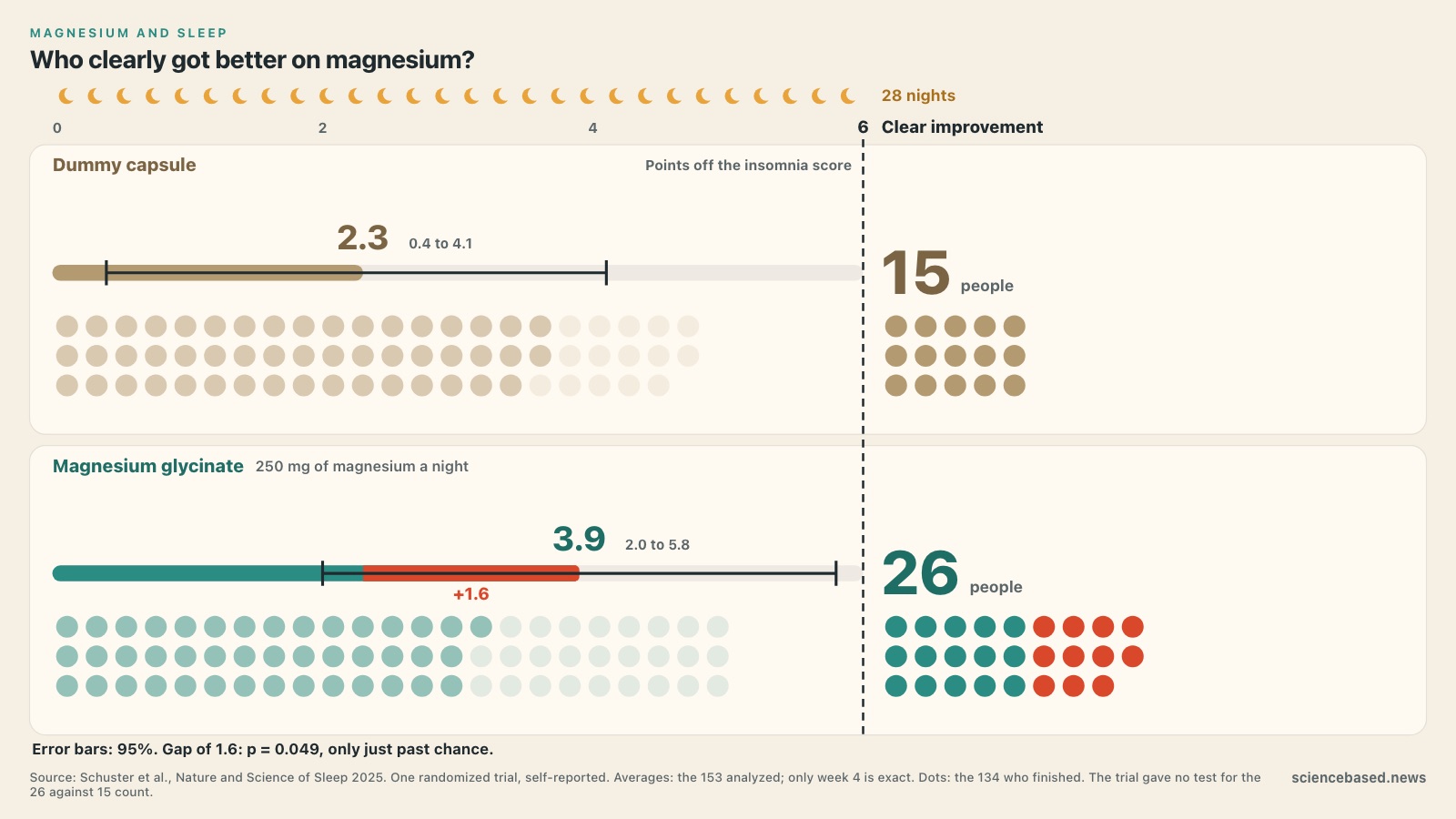
After 4 weeks, the magnesium group's score had dropped 3.9 points and the dummy group's 2.3. The 1.6-point gap only just cleared the usual bar for chance. A drop of 6 points is the trial's mark of a clear improvement. In all, 26 people on magnesium reached it, against 15 on the dummy capsule.
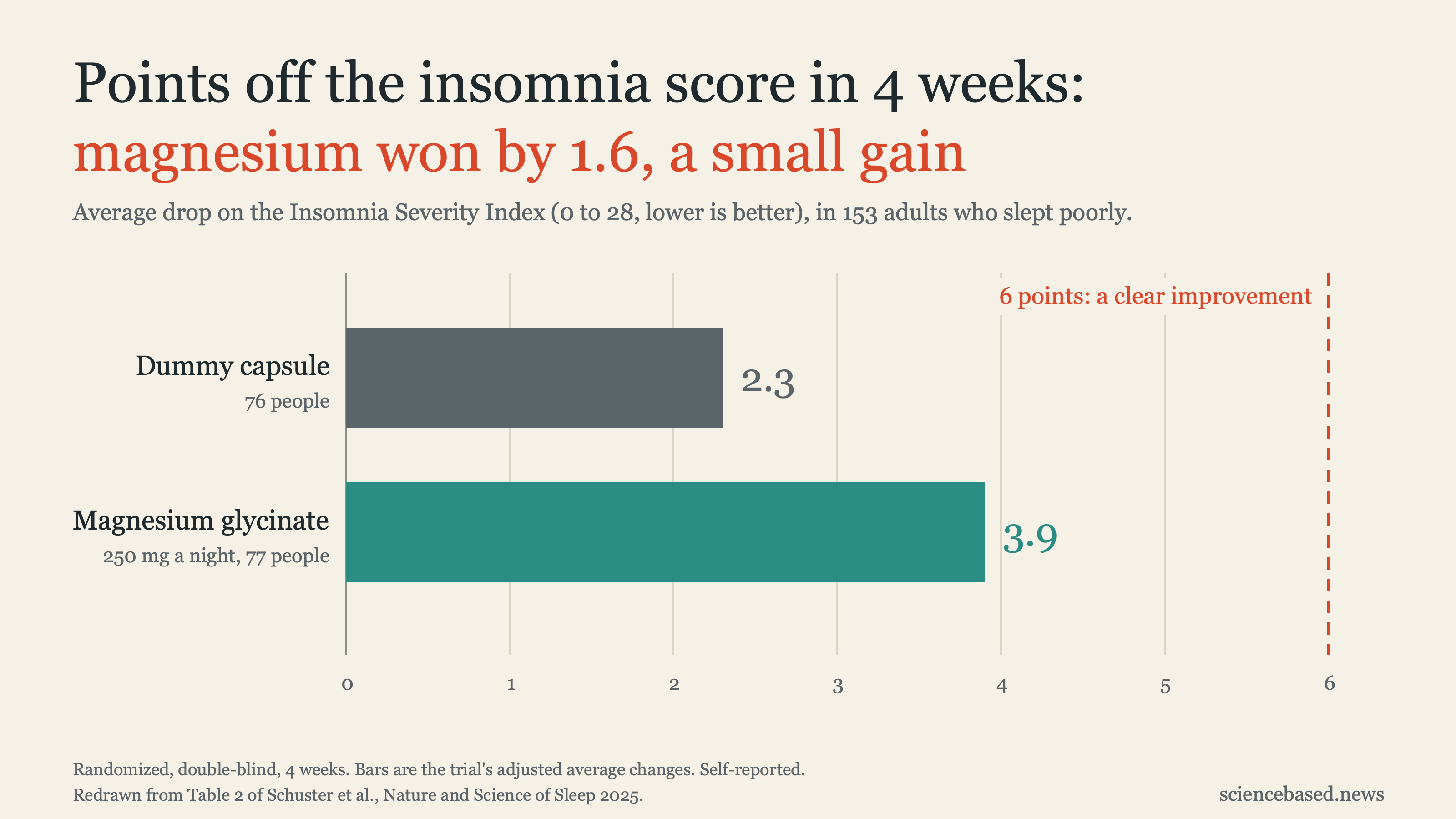
So more than half of the drop, 2.3 of the 3.9 points, came with the dummy capsule too. That is what magnesium adds: a nudge on top of what belief, attention and time already do. For a poor sleeper, that means a slightly better score, not a new night.
Does that nudge hold up in other people? Older adults show a similar hint. A review pooled 3 trials in 151 older adults and found they fell asleep 17 minutes faster on magnesium, a result that rests on just 55 people in 2 of those trials [7]. Total sleep time did not clearly change. In one of those trials, 46 people aged 60 to 75 in Tehran, all with insomnia and low magnesium intake, took 500 mg a day as magnesium oxide for 8 weeks [8]. Their insomnia scores improved, and the share of time in bed spent asleep rose from 63% to 73%. Total sleep did not change.
Which magnesium is best for sleep?
Glycinate has the best single result, but no trial has ever compared forms head to head [2]. Any "best form" list you see is an inference across different studies in different people.
Threonate is the form Huberman made famous, and it has two trials, both funded by companies that sell the ingredient. In 80 adults, 21 days of it did nothing for the insomnia score, though deep sleep scores from an Oura ring rose [10]. Those scores use the ring maker's own formula. In 100 adults on 145 mg of magnesium as threonate for 6 weeks, daytime sleep-related impairment fell 6.35 points against 3.38 on placebo, while two other sleep measures and ring-measured sleep didn't budge [11].
Citrate absorbs better than oxide [13], yet in a trial of 100 adults aged 51 to 85 it showed no edge over placebo: both groups improved the same [9]. And the older-adult result above came from oxide, which absorbs poorly. So absorption alone doesn't pick the winner.
How much magnesium should you take for sleep, and how soon does it work?
Copy the German trial: 250 mg of magnesium, 30 to 60 minutes before bed [1]. Trials have used 75 to 729 mg a day, with no clear sign that more works better [2].
Read the label with care. A Supplement Facts panel lists the magnesium itself, not the whole compound [13], so the number to look for is the magnesium line. Each capsule in the trial held 893 mg of magnesium bisglycinate, and only 125 mg of that was magnesium.
The US upper limit for magnesium from supplements is 350 mg a day for adults, and food doesn't count toward it [13]. The 500 mg in the Tehran trial went over that.
Expect to know within a month. Both groups in the German trial had improved by week 2, and the trial ended at week 4 [1]. It can't say whether the gain lasts past that.
What the magnesium trials can't tell you
The German trial's 1.6-point gain was about a quarter of the 6 points that count as a clear improvement. The average person on magnesium finished at 11.0, still above the line for no insomnia, and the authors wrote that supplements alone are "unlikely to eliminate insomnia in many individuals" [1]. The team had planned for an effect more than twice as large as they found.
Only that one score separated clearly. Sleep quality on a single question rose 1.0 against 0.3 points, short of the bar, and daytime sleepiness, fatigue, stress and mood matched the dummy capsule. Everything was self-reported, and fewer than 1 in 10 people filled in their sleep diaries completely.
Glycinate also carries glycine. The nightly dose came with 1.5 g of it, and some studies link 3 g of glycine to better sleep, so the trial can't say which half did the work [1].
The wider evidence is thinner still. A 2026 review of 12 randomized trials found mixed results, rated certainty low or very low for every sleep outcome, and concluded: "Current evidence does not support oral magnesium as a routine treatment for insomnia" [2]. Wrist monitors showed no clear benefit, and what people reported tended to look better than what devices recorded.
Who gets the most? The best clue is Attia's point about low intake. In the German trial, people who ate less magnesium gained more, an exploratory finding from one question [1]. About 48% of Americans eat less than they need [13], and among 3,964 US adults, those who ate the most had 36% lower odds of sleeping under 7 hours than those who ate the least [12]. That study shows a link, not a cause. A trial that picks low-intake people on purpose could show a far bigger effect.
Our grade
The grade turns on one question: is a single trial that only just cleared the bar enough to call this Promising?
| Claim | Evidence | Grade |
|---|---|---|
| Magnesium glycinate eases a poor-sleep score | 1 randomized trial, 153 people, 4 weeks, small effect | Promising |
| Any magnesium helps sleep | 12 randomized trials, mixed, low or very low certainty | Weak |
| One form is best for sleep | No head-to-head trial | Unproven |
| Threonate is the form for sleep | 2 company-funded trials, mixed | Weak |
| Overall: magnesium glycinate before bed eases poor sleep | Largest trial is positive; small, short, not yet repeated | Promising |
A stricter reader would call this Weak. One trial just cleared the bar, and its other sleep measures did not.
A kinder reader would say the direction keeps pointing the same way, with oxide in older adults and glycinate in working-age adults, and that side effects were rare. In the German trial 93% reported none [1].
A second trial of glycinate with the same result, using sleep measured by a device, would move this toward Solid. A larger trial that finds nothing would move it to Weak.
What this means for you
If you want to try it, buy magnesium glycinate with about 250 mg of magnesium per dose and take it 30 to 60 minutes before bed for 4 weeks. Compare how you sleep at the end, and stop if nothing has changed. Don't expect a sleeping pill. Expect a nudge, at best.
Food is the low-risk first step, since low intake may be where the gain is largest: 28 g of pumpkin seeds has 156 mg of magnesium, 28 g of chia seeds 111 mg, and 28 g of almonds 80 mg [13].
Check three things first. Risk rises with poor kidney function, so ask your doctor if you have kidney disease [13]. Take oral bone drugs (bisphosphonates) 2 hours apart from magnesium, and take tetracycline or quinolone antibiotics 2 hours before it or 4 to 6 hours after [13]. Stomach trouble is the most likely side effect [2].
For sleep trouble that lasts, the best-proven help isn't a pill. Cognitive behavioral therapy for insomnia, a short course of sleep training, cut the time to fall asleep by 19 minutes and time awake at night by 26 minutes across 20 trials and 1,162 people with chronic insomnia, with no reported harm [14].
Four weeks of a capsule is a fair and cheap test, and a daily handful of pumpkin seeds is worth keeping either way. If you sleep a little better, you have found your nudge, and each extra hour of deep sleep has real work to do in your brain.
In the largest trial, how much did magnesium glycinate beat the dummy capsule by?
Scores fell 3.9 points on magnesium and 2.3 on the dummy capsule, so the gap was 1.6.
Which form of magnesium has been proven best for sleep?
The 2026 review found no trial that directly compared forms, so "best" lists are inferences.
On a label, which number tells you how much magnesium you get?
In the trial, 893 mg of bisglycinate held only 125 mg of magnesium.
Who seemed to gain the most from magnesium in the star trial?
It was an exploratory finding, but it fits the idea that low intake is where a supplement helps most.
What's next
The trial that would settle this one puts forms head to head, in people who eat little magnesium, with sleep measured by a device as well as a questionnaire. We found none running yet.
The next glycinate data point is close. A placebo-controlled trial in Spain will test 215 mg of magnesium from bisglycinate and malate in 55 adults for 8 weeks, with the same insomnia score, and lists an estimated finish of December 2026 [15]. It tests a maker's product, and it hasn't started recruiting, so that date may slip.
More on the site: what deep sleep does for your brain, how to cover magnesium and the rest with a day of food, and whether a pill can replace broccoli. We'll update this article when a second glycinate trial reports, and until then a small handful of seeds and a fair 4-week test are an easy place to start.
Was this helpful?
Sources
Show all sources (16)
- Schuster J, Cycelskij I, Lopresti A, Hahn A. Magnesium Bisglycinate Supplementation in Healthy Adults Reporting Poor Sleep: A Randomized, Placebo-Controlled Trial. Nature and Science of Sleep, 2025. 155 randomized, 153 analyzed, double-blind, placebo-controlled, 4 weeks. Funded by Leibniz University Hannover's Institute of Food and One Health; capsules made by Biogena. https://doi.org/10.2147/NSS.S524348
- Lopresti AL, Smith SJ, Drummond PD. Magnesium Supplementation for Sleep in Adults: A Systematic Review of Randomized Controlled Trials. Journal of Dietary Supplements, 2026. 12 randomized trials in the main synthesis. https://doi.org/10.1080/19390211.2026.2719670
- Huberman Lab. Sleep Toolkit: Tools for Optimizing Sleep & Sleep-Wake Timing. August 8, 2022. https://www.hubermanlab.com/episode/sleep-toolkit-tools-for-optimizing-sleep-and-sleep-wake-timing
- Huberman Lab Neural Network newsletter. Toolkit for Sleep. https://www.hubermanlab.com/newsletter/toolkit-for-sleep
- FoundMyFitness #87. The Science of Magnesium and Its Role in Aging and Disease. March 19, 2024. https://www.foundmyfitness.com/episodes/magnesium
- The Drive #282, AMA #54. December 11, 2023. https://peterattiamd.com/ama54
- Mah J, Pitre T. Oral magnesium supplementation for insomnia in older adults: a Systematic Review & Meta-Analysis. BMC Complementary Medicine and Therapies, 2021. 3 randomized trials, 151 older adults. https://doi.org/10.1186/s12906-021-03297-z
- Abbasi B, et al. The effect of magnesium supplementation on primary insomnia in elderly: A double-blind placebo-controlled clinical trial. Journal of Research in Medical Sciences, 2012. 46 adults aged 60 to 75, randomized, double-blind, 8 weeks. https://pmc.ncbi.nlm.nih.gov/articles/PMC3703169/
- Nielsen FH, Johnson LK, Zeng H. Magnesium supplementation improves indicators of low magnesium status and inflammatory stress in adults older than 51 years with poor quality sleep. Magnesium Research, 2010. 100 adults aged 51 to 85, randomized, placebo-controlled, 7 weeks. https://doi.org/10.1684/mrh.2010.0220
- Hausenblas HA, et al. Magnesium-L-threonate improves sleep quality and daytime functioning in adults with self-reported sleep problems: A randomized controlled trial. Sleep Medicine: X, 2024. 80 adults, randomized, placebo-controlled, 21 days. Funded by AIDP Inc. https://doi.org/10.1016/j.sleepx.2024.100121
- Lopresti AL, Smith SJ. The effects of magnesium L-threonate (Magtein) on cognitive performance and sleep quality in adults: a randomised, double-blind, placebo-controlled trial. Frontiers in Nutrition, 2026. 100 adults, 6 weeks. Funded by Threotech Inc. https://doi.org/10.3389/fnut.2025.1729164
- Zhang Y, et al. Association of magnesium intake with sleep duration and sleep quality: findings from the CARDIA study. Sleep, 2022. 3,964 adults, observational. https://doi.org/10.1093/sleep/zsab276
- NIH Office of Dietary Supplements. Magnesium: Fact Sheet for Health Professionals. https://ods.od.nih.gov/factsheets/Magnesium-HealthProfessional/
- Trauer JM, et al. Cognitive Behavioral Therapy for Chronic Insomnia: A Systematic Review and Meta-analysis. Annals of Internal Medicine, 2015. 20 studies, 1,162 participants. https://doi.org/10.7326/M14-2841
- ClinicalTrials.gov. NCT07894562. Magnesium bisglycinate and malate for sleep, 55 adults, placebo-controlled, 8 weeks. https://clinicaltrials.gov/study/NCT07894562
- Akhtar A. TikTok creators think magnesium is a 'magic pill' for anxiety and sleepless nights, experts weigh in. Business Insider, March 22, 2023. https://www.businessinsider.com/little-data-magnesium-glycinate-for-anxiety-tiktok-trend-psychologists-say-2023-3
Discussion